Alibaba’s Qwen team appears to have skipped the press release again. On May 18, developers spotted Qwen 3.7 options appearing inside Qwen Chat without any official model cards or open-weight downloads, immediately triggering a firestorm of speculation, early testing, and the usual demands for 122B parameter files across Reddit and local AI forums. The incident highlights Alibaba’s aggressive cadence in the open-source LLM race and the growing tension between cloud-hosted previews and the developer community’s hunger for downloadable, quantizable weights they can run on everything from RTX 3090s to Apple Silicon Macs.
The Drop Nobody Announced
On May 18, community users reported seeing Qwen3.7-Max-Preview and Qwen3.7-Plus-Preview quietly surface in Qwen Chat’s model selector. No blog post. No release notes. No Hugging Face repo. Just… options. In the world of frontier AI, this is roughly equivalent to a band dropping an album at 3 AM with zero promo and watching the forums melt.
This isn’t the first time Qwen has moved fast and asked questions later. The team has built a reputation for turning around model generations at a cadence that makes Western labs look sluggish. Previous releases like Qwen 3.6-27B shattered local LLM expectations by proving dense models could punch at MoE weight classes, while the Qwen3.5-397B-A17B MoE architecture delivered top-tier performance with only 17 billion active parameters per token. So when a new version number appears, even as a chat-only ghost, people pay attention.
But let’s be precise: a preview in a hosted chat UI is not an open-weight release. Alibaba’s public model listings still point to Qwen 3.5 and 3.6 families as the latest documented drops. The distinction matters because the Qwen ecosystem’s real muscle comes from what developers can download, quantize, and serve on their own iron.
“Just Give Us the Weights, Alibaba”
The immediate community reaction wasn’t applause. It was a shopping list.
Developers on local-AI forums made their priorities clear within hours of the sighting. The prevailing sentiment oscillates between two desires: a compact powerhouse that runs on mid-tier GPUs, and an absolute unit that consumes all available VRAM. Many are hoping for a successor to the Qwen 3.5 small model series, something in the 9B range that breaks the parameter race, or a full-fat Qwen3 Coder Next sub-60GB coding model update trained natively on coding corpora. Others are clamoring for the 122B MoE variant with sliding window attention, a configuration they believe would turn DGX Spark, Ryzen 395+, and Apple 128GB devices into legitimate local inference workstations.
The hype isn’t blind faith. Qwen 3.6 35B has already earned its stripes as a capable coding model, with users reporting 13-hour autonomous coding sessions without falling into catastrophic loops, provided you run the full BF16 weights and avoid aggressive quantization that seems to scramble reasoning paths. That track record makes the 3.7 preview feel less like vaporware and more like a pending upgrade for an already-solid toolchain.
Still, the cloud-first drop raises eyebrows. Some forum observers speculate that Alibaba may be pivoting toward monetizing cloud services rather than feeding the open-weight pipeline, a fear that surfaces every time a preview hits the chat UI before the model card does. The counterargument is that Qwen’s entire brand is built on ecosystem momentum, its dominant share of OpenRouter traffic didn’t happen because developers love API wrappers. Qwen’s overall market adoption and OpenRouter traffic proves that open weights are the engine of its popularity. Alienating that base would be self-sabotage.
Benchmarks, Bandwidth, and the Brutal Math of Local Inference
While enthusiasts trade wishlists, the technical reality of running these models remains unforgiving. Community benchmarks around previous releases show exactly how tight the margins are. One test with Qwen3.6 27B using llama.cpp’s multi-token prediction jumped throughput from 38 tok/s to 65 tok/s on consumer hardware, a meaningful gain, but one that still sits nowhere near the latency you’d get from a cloud API.
Performance Note: Running Qwen 3.5 122B in INT4 without MTP on a DGX Spark yields roughly 5 tok/s. With MTP and DFLASH, you might claw your way to 8-12 tok/s.
For the rumored 122B variants, the math gets ugly fast. Running Qwen 3.5 122B in INT4 without MTP on a DGX Spark yields roughly 5 tok/s. With MTP and DFLASH, you might claw your way to 8-12 tok/s. Concurrency can double or triple total throughput, but individual prompt latency remains glacial. That hasn’t stopped the community from wanting it anyway. The philosophy is simple: if the weights exist, the optimization wizards will find a way. Distilled Qwen3 models already proved that 0.6B parameter models can humiliate frontier LLMs on narrow tasks, so there’s precedent for squeezing blood from stones.
There’s also a growing appetite for unconventional precision formats. Requests for native NVFP4 training have circulated heavily, reflecting developer frustration with the quantization lottery. The argument is straightforward: if Nemotron 3 Super can be trained as a 4-bit quantization-aware model, why not Qwen? The community wants a native low-precision origin story so that downstream GGUF conversions don’t introduce the subtle errors that turn a reasoning model into a parrot.
Export Controls and the Efficiency Imperative
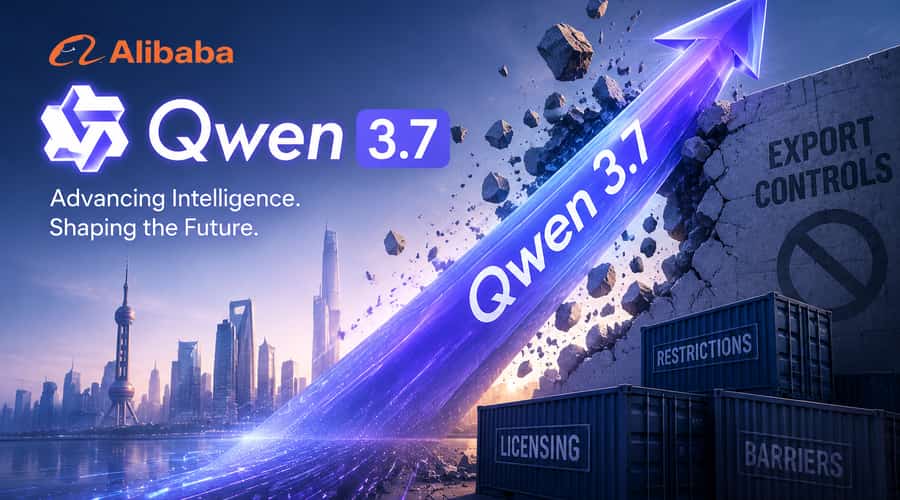
Behind the memes and model-size demands sits a harder geopolitical reality. U.S. export controls have kneecapped Chinese labs’ access to the latest Nvidia accelerators, which means Alibaba’s Qwen team is being forced to do more with less, less top-tier silicon, less overseas cloud capacity, and less margin for training inefficiency.
This constraint doesn’t make Qwen 3.7 surprising, it makes it strategically necessary. Frequent releases keep developer attention locked on the Alibaba ecosystem, feed AI features into the company’s commerce platforms, and support Alibaba Cloud’s market position against ByteDance’s Doubao and DeepSeek. Every new generation is a proof of life that Chinese frontier AI isn’t chokepointed into irrelevance.
For practitioners, the practical upshot is that Qwen models are being optimized under pressure that American labs don’t feel. The result is often leaner, more efficient architectures that run better on constrained hardware, which happens to be exactly what the local LLM community needs. The Qwen 3.5 edge AI and quantization revolution demonstrated how 4B models could eat GPT-4’s lunch on edge devices, Qwen 3.7 will likely continue that efficiency-first tradition.
What to Actually Watch For
Until Alibaba uploads official weights to ModelScope or Hugging Face, Qwen 3.7 remains a hosted-model signal, not a confirmed open-weight release. The real checkpoints are easy to list:
- Official model cards with context limits, architecture details, and training data disclosures.
- License terms, because nothing kills deployment momentum like ambiguous commercial licensing.
- Smaller variants (2B, 4B, 9B, 27B) appearing alongside the cloud behemoths.
- Reproducible third-party benchmarks on coding, reasoning, and long-context tasks.
If those arrive, Qwen 3.7 could solidify what Qwen3.5-397B-A17B as an open-source challenger already hinted at: a non-American model family capable of competing head-to-head with closed Western frontier labs.
If they don’t, if 3.7 stays locked behind Qwen Chat’s API, then the leak becomes a warning shot. It suggests Alibaba is tempted by the same gravity that pulled OpenAI toward pure cloud lock-in, and that the golden age of Qwen open weights might be transitioning into something more gated.
For now, the community waits, benchmarks, and speculates. Because in 2026, a model isn’t real until you can download it, quantize it to EXL2, and make your GPU fans scream at 3 AM.