Your 8GB GPU Can Now Run a 125B Model, and That Breaks Everything
There’s a moment in every local AI enthusiast’s life when they look at their wallet, then at the 24GB VRAM requirement for a decent model, and decide maybe cloud APIs aren’t so bad after all. That moment just got a lot less inevitable.
Strata, a C++ inference engine that’s been on GitHub for barely a week, is running Qwen3.8-Flash-Next, a 125B parameter Mixture-of-Experts model, on consumer hardware that most people assumed was permanently obsolete. The kicker? It’s not just “technically runs.” It’s genuinely fast.
The Hardware That Shouldn’t Be Able To Do This
One user ran Flash-Next Q4 with 8-bit KV cache at 262K context on a rig that looks like it was pulled from a data center’s recycling bin: four P100 GPUs on PCIe 3.0 x8 slots (64GB total VRAM), paired with 128GB of DDR4 at 2133MHz. That’s a 2016-era GPU configuration held together by a Xeon E5-2683 v4.
The result? On average, Strata ran the 125B model twice as fast as a 27B model and five times faster than Flash-Next running through a customized llama.cpp that needed surgical modifications just to load the model at all.
Let that sink in for a moment. A 125B parameter model, running on hardware that predates the RTX 20 series, outperforming a 27B model on the same box. This isn’t a marginal improvement. This is a paradigm shift in what “local inference” even means.
Why Strata Breaks the VRAM Ceiling
The dirty secret of MoE models is that they don’t actually need all their parameters for every token. Qwen3.8-Flash-Next activates only a fraction of its 125B parameters per token, that’s the entire point of sparse MoE design. The model’s 125B parameters exist, but a given inference step only touches a handful of the experts.
Strata exploits this ruthlessly. It keeps frequently used experts resident in GPU VRAM while streaming the rest from system RAM on demand. The engine’s CUDA kernels are rewritten specifically for the Qwen3.8-Flash-Next architecture, this isn’t a general-purpose inference engine, and that’s precisely why it’s so effective.
The results speak for themselves:
| Hardware | Quantization | Prefill (tok/s) | Decode (tok/s) | Context |
|---|---|---|---|---|
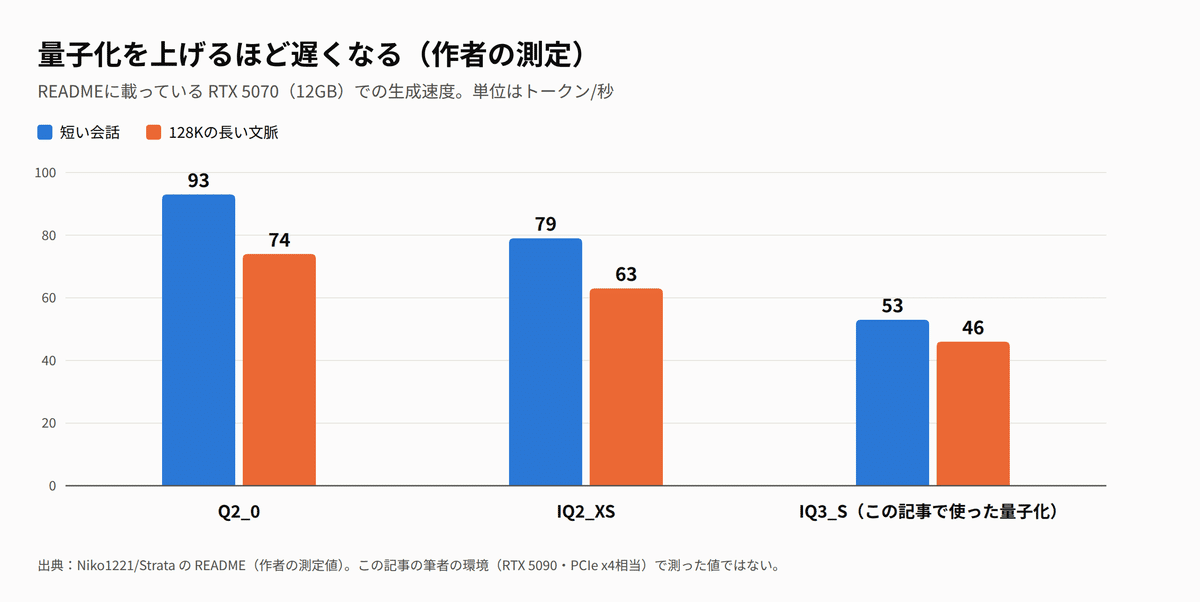
| RTX 5070 12GB | Q2_0 | 2,030 | ~65 | 32K |
| RTX 5070 12GB | IQ3_S | ~1,208 | 54 | 32K |
| 4x P100 64GB | Q4 | , | ~2x a 27B model | 262K |
| RX 7900 XTX (HIP) | Coder IQ1_M | ~1,200 | 50, 68 | 8, 32K |
| RTX 5090 32GB | IQ3_S | , | ~114 | 128K |
One user on a single V100 32GB with 64GB DDR4 reported 1,400 tokens per second prefill and 60 tok/s decode with Strata, versus 300 tok/s and 20 tok/s respectively on llama.cpp. A 3070 Ti user with 128GB DDR4 reported 500 tokens prefill and 60 tokens/s decode on a 6900 XT, on an AMD card, via an experimental HIP port.
There are even reports of running Flash-Next Coder on a 12GB 4070 with 32GB DDR4 at 35 tokens per second at the IQ1_M quantization level. That’s a 125B model running on a mid-range consumer GPU with “just add more RAM” as the solution to VRAM limitations.

The Specialization Trade-Off Nobody’s Talking About
Here’s the uncomfortable truth that makes this interesting: Strata is fast because it refuses to be general.
The engine’s CUDA kernels are hand-optimized for the Qwen3.8-Flash-Next architecture. It doesn’t do tensor parallelism. It doesn’t support arbitrary models. It doesn’t even try to be llama.cpp’s replacement for running a diverse model zoo. The README states clearly: this is a dedicated engine for one model family, and that’s the whole ballgame.
This is a radical departure from how the local LLM ecosystem has evolved. Projects like llama.cpp and vLLM succeeded precisely because they abstracted across model architectures. They’re the “write once, run anywhere” of inference engines. Strata is the opposite: a NASCAR-style hot rod built for exactly one track and one engine type.
And it works stunningly well. The speedups come from several sources: hand-tuned math routines, optimal GPU feature utilization, smarter expert placement in the MoE’s routing layer, and aggressive buffer management tricks. On older hardware with lower PCIe bandwidth, the gains are even more dramatic, the 4x P100 setup shows a 5x improvement precisely because Strata minimizes the amount of data that needs to cross the slow PCIe link.
There’s a lesson here that echoes through system-level performance optimization: your biggest wins come from architecture-aware engineering, not micro-tuning loops.
The 26 Versions in 7 Days Problem

Strata’s velocity is both its greatest strength and its scariest liability. The project went from v0.1.0 to v0.1.26 in a single week, with over 230 commits in seven days. That’s not a typo. The first commit was September 24th. By October 1st, the engine was at version 0.1.26.
The initial releases focused on fixing what the creator calls “permanent generation stalls”, the kind of bugs that make a benchmark look like a loading screen. Then came the performance work: long prompts got approximately 2x faster in v0.1.13, with the RTX 5070’s 32K prompt speed jumping from 572 to 1,290 tokens per second. By v0.1.22, that same metric hit 1,646 tokens per second. By v0.1.25, it was at 2,030.
This isn’t iterative optimization. This is a rewrite of the prompt path, moving sparse attention selection to Tensor Cores (a 3.3, 3.9x speedup in the selection step alone), batching per-token kernels for validation windows, and implementing KV streaming to squeeze 262K context into 12GB of VRAM.
The project also went MIT-licensed at v0.1.16, ensuring this isn’t a “look at what I built, don’t touch it” project. And it’s already accumulating a community: a V100-specific fork exists with even more aggressive optimization work.
What This Means for Local AI Agents
The intersection of Strata’s capabilities with the growing ecosystem of autonomous local AI agents using large models is where this gets genuinely interesting. Running a 125B model locally means your agentic capabilities of open MoE models aren’t gated by cloud API costs or rate limits.
One user tested Strata’s Coder variant against their own llmbench (a SWE-bench-like tool) and measured a 96.7% resolution rate on 60 coding tasks after adjusting the reasoning token limit. That’s with a single consumer GPU. Sixteen harder L7 questions came in at 68.8%, a number that was 56.2% with the naive settings, suggesting the bottleneck was the benchmark’s thinking limit, not the model’s capability.
The engine also exposes OpenAI and Anthropic-compatible APIs, meaning tools like Open WebUI, Cline, Continue, and even Claude Code can connect to it with a simple base URL swap. The Claude Code integration is particularly ruthless: you just set ANTHROPIC_BASE_URL to your local Strata instance and suddenly your coding agent runs on your hardware instead of Anthropic’s servers.
The Long Tail of Implications
There are three non-obvious consequences of this work that deserve attention:
1. Dedicated engines are the new frontier
The “general-purpose inference engine” era isn’t ending, but it’s no longer the only game in town. When you have a dominant model architecture (Qwen3.8-Flash-Next is becoming the Llama 2 of the MoE era), it makes sense to build purpose-built engines that extract every last drop of performance. This will likely spawn a new generation of model-specific inference optimizers.
2. Older hardware has a new lease on life
The P100 test case is the tell. NVIDIA’s datacenter cards from the Pascal era are now cheap on the used market, and Strata’s work shows that with the right software, they can run modern MoE models at usable speeds. This significantly lowers the barrier to entry for local AI infrastructure experimentation.
3. Memory hierarchy optimization is the next battleground
Strata’s real innovation isn’t the CUDA kernels, it’s the intelligent management of the VRAM/RAM/disk hierarchy. As models grow faster than VRAM does, every inference engine will need to solve this problem. Strata is the proof that “total memory” matters more than “VRAM” for MoE models, and that has massive implications for efficient simulation environments for AI agents using MoE models and beyond.
The Reality Check
Strata isn’t a miracle worker. There are caveats, and they’re worth stating clearly:
- VRAM still matters. On a 12GB card, you’re running heavy quantizations (Q2_0, IQ3_S) with significant quality loss. On an 8GB card, you’re in “speculative decoding” territory, hoping the draft model is good enough.
- RAM is the new bottleneck. Strata’s expert-mmap approach requires substantial system memory, 64GB is comfortable, 32GB works for Coder but with caches constantly being evicted. The v0.1.26 Low-RAM mode reduces Coder’s commit memory from ~36GB to ~13GB, but you’re still looking at 32GB as a realistic floor for the full model.
- The quality debate is real. When asked about hallucination and performance versus vLLM or llama.cpp, community members note that Strata tends to match those engines bit-for-bit on identical quantizations because there are no lossy optimizations. But the quantizations themselves carry quality costs, one user describes IQ1_M as “feeling like talking to a minion.” That’s a load-bearing quote.
- Model lock-in. You’re running Qwen3.8-Flash-Next. That’s it. Porting Strata to a different architecture (like GLM-5.3-Flash) would require a multi-week kernel rewrite effort because attention mechanisms, MoE configurations, and tokenizers differ. The specialization that makes Strata fast is the same specialization that makes it rigid.
- PCIe bandwidth still matters. The user with the x4-connected RTX 5090 saw 114 tokens per second, a properly-connected card would likely do significantly better. Strata can’t fix physics.
The Takeaway
Strata represents the first real crack in the VRAM ceiling for MoE models. Its approach to hybrid memory offloading, keeping hot experts on the GPU while streaming cold ones from RAM, works because sparse MoE architectures make it viable. The project has demonstrated that with purpose-built kernels, a 125B model can run on hardware that wasn’t expected to handle it, and at speeds that were thought impossible.
This is a significant development for anyone interested in open-source MoE model developments or the energy efficiency challenges in large AI models. If the trend continues, the “check your VRAM first” mentality of local AI is about to be replaced with “check your total memory” thinking.
Strata may not be the llama.cpp replacement that everyone’s waiting for, and its dedicated architecture means it can’t be. But it’s a proof-of-concept that’s rewriting the hardware requirements for frontier-scale inference. For everyone who’s ever looked at their aging GPU and wondered if it was time to give up on local AI: hold that thought. The software just caught up with your hardware.
Watch this project. In a month, v0.1.26 will look like a prototype, and the implications will be even harder to ignore.