Tencent just dropped a 295-billion-parameter Mixture-of-Experts model called Hy3 under the Apache 2.0 license. The model itself is impressive, 21B active parameters punching above its weight class against models 2-5x its size. But the real story here isn’t the benchmark scores. It’s the license.
After initially shipping Hy3 Preview in April under a restrictive “community license” that explicitly banned use in South Korea, the UK, and the EU, Tencent flipped the script. The official Hy3 release comes under Apache 2.0, one of the most permissive open-source licenses in existence. That’s not just a nice gesture. It’s a signal that could reshape how the biggest AI players think about openness.
The License That Wasn’t
When Tencent dropped Hy3 Preview in late April, the community response was muted for a reason that had nothing to do with model quality. The license was a mess. It wasn’t just restrictive, it was geographically discriminatory. Developers in South Korea, the UK, and the EU were explicitly barred from using it. That’s not open-source. That’s a teaser with a bouncer.
The backlash was predictable. The open-source AI community has zero tolerance for “open-ish” licensing that picks winners and losers by geography. You can’t call something open-source while telling half the developed world they can’t touch it. That’s not openness. That’s a marketing stunt.
So when Tencent flipped the switch to Apache 2.0 for the official Hy3 release, the community took notice. This isn’t just a licensing change, it’s a strategic pivot that could signal where the entire industry is heading.
What Actually Changed
The numbers tell the story. Hy3 Preview launched under a “community license” that was anything but community-oriented. It explicitly blocked developers in South Korea, the UK, and the European Union. The official Hy3 release? Pure Apache 2.0. No geographic restrictions. No commercial use limitations. No fine print gotchas.
This isn’t an isolated incident either. Tencent’s recent translation models (Hy-MT2) also shipped under Apache 2.0, suggesting a broader organizational shift rather than a one-off PR move. The company’s broader open-source AI ecosystem strategy appears to be converging on a genuinely permissive approach.
The Architecture That Makes It Possible
Before we get too deep into the licensing drama, let’s talk about what Hy3 actually is. Because the numbers matter here.
| Property | Value |
|---|---|
| Architecture | Mixture-of-Experts (MoE) |
| Total Parameters | 295B |
| Activated Parameters | 21B |
| MTP Layer Parameters | 3.8B |
| Number of Layers (excluding MTP layer) | 80 |
| Attention Heads | 64 (GQA, 8 KV heads, head dim 128) |
| Hidden Size | 4096 |
| Context Length | 256K |
| Number of Experts | 192 experts, top-8 activated |
The key insight here is the activation ratio. With 192 experts and only 8 active per token, Hy3 activates just 7% of its total parameters for any given forward pass. That’s the MoE magic, you get the representational capacity of a 295B model while only paying the compute cost of a 21B one.
This isn’t just academic. For developers running local inference, this means Hy3 can run on hardware that would choke on a dense 295B model. The community is already buzzing about running it on DGX Spark setups, with estimates suggesting a 2x Spark cluster could handle a 4-bit quant comfortably with decent context lengths.
The Benchmark Story That Actually Matters
Let’s cut through the marketing. Every model release claims to beat everything else. What makes Hy3’s benchmark claims worth examining is the specificity of the comparisons and the methodology behind them.
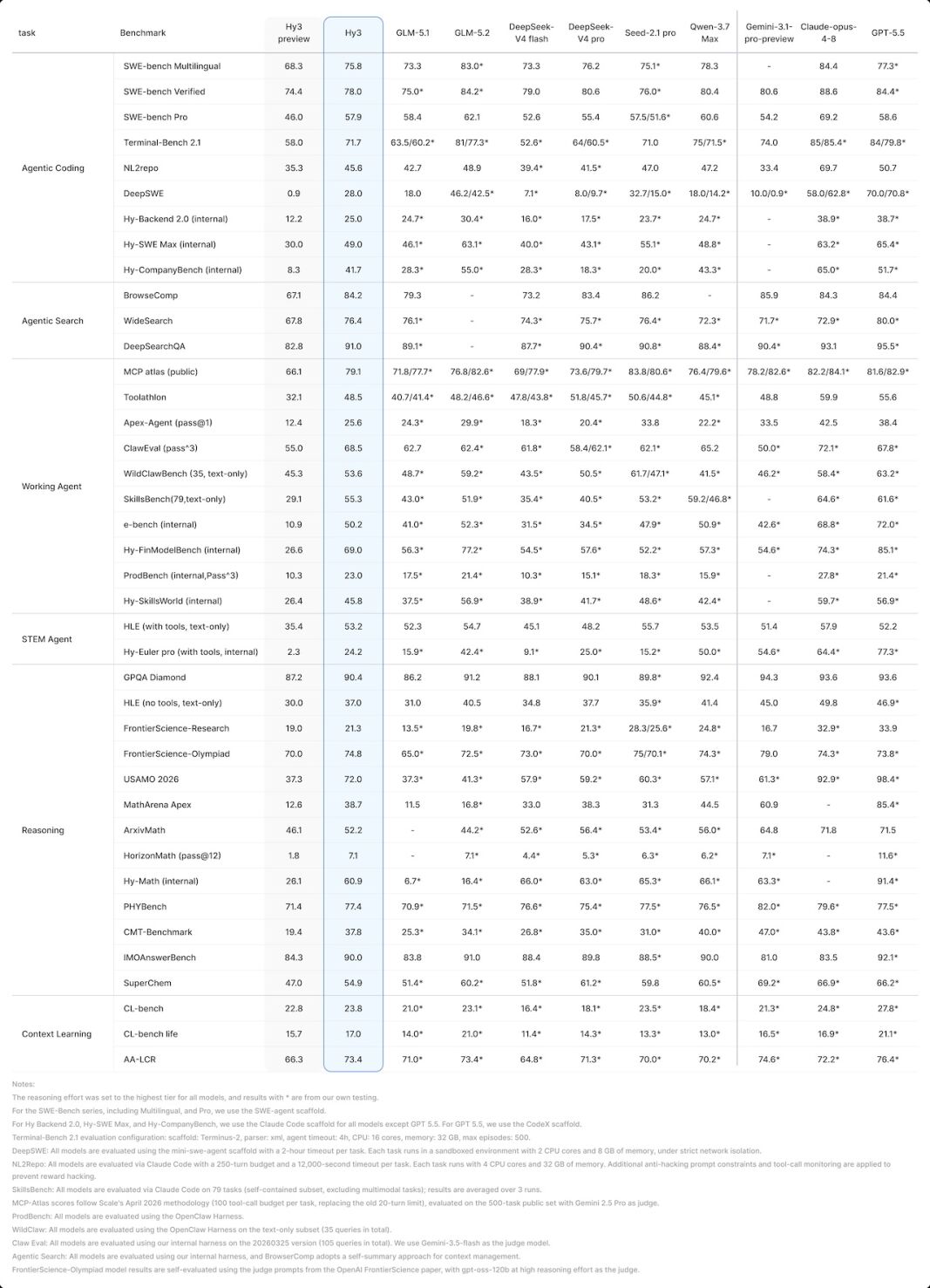
Hy3 is being compared against models with 2-5x its parameter count. GLM-5.1 has 744B total parameters with 40B active. DeepSeek V4 Pro and Qwen 3.7 Max are in similar weight classes. Hy3’s 21B active parameters are punching significantly above their weight.
The benchmark results tell a nuanced story. On GPQA Diamond, Hy3 scores 90.4, ranking #2 in the sub-500B parameter category. On SWE-Bench Verified, it hits 78% resolution rate. On Apex Agents, it scores 25.6, ranking #3 overall. These aren’t just incremental improvements. They’re competitive with models that cost 2-5x more to run.
But here’s where it gets interesting. Tencent didn’t just publish benchmark numbers. They ran a blind evaluation with 270 domain experts using real work tasks. Hy3 scored 2.67/4, outperforming GLM-5.1 at 2.51/4. The advantage was most pronounced in frontend development, data & storage, and CI/CD tasks. That’s not a synthetic benchmark, that’s actual humans judging actual work output.
The Licensing Pivot That Changes the Game
The shift from a restrictive community license to Apache 2.0 is the most significant aspect of this release, and it deserves more attention than it’s getting.
The original Hy3 Preview license wasn’t just restrictive, it was geographically discriminatory. Blocking developers in South Korea, the UK, and the EU wasn’t a technical necessity. It was a political choice. And it backfired. The open-source community doesn’t forget these things.
Apache 2.0 changes everything. It’s one of the most permissive licenses in software. You can use Hy3 in commercial products without paying royalties. You can modify it, redistribute it, and build derivative works. You can integrate it into proprietary systems without worrying about copyleft obligations. For startups and enterprises alike, this removes a massive adoption barrier.
This isn’t an isolated move either. Tencent’s recent translation models (Hy-MT2) also shipped under Apache 2.0. The company’s broader open-source AI ecosystem strategy appears to be converging on genuine openness rather than the “open-ish” approach that has plagued the industry.
What the Benchmarks Actually Say
Let’s look at the numbers that matter. Tencent published comprehensive benchmark results, and they’re worth examining critically.
On GPQA Diamond, Hy3 scores 90.4, ranking #2 in the sub-500B parameter category. On SWE-Bench Verified, it achieves 78% resolution. On Apex Agents, it scores 25.6, ranking #3 overall. On HLE (Hard Language Evaluation), it scores 53.2, ranking #3. On SkillsBench V1.1, it scores 55.3, ranking #2. On WildClawBench, it scores 53.6, ranking #1.
These aren’t cherry-picked results. They’re consistent across multiple evaluation frameworks. The model doesn’t just excel in one area, it performs competitively across reasoning, coding, agent tasks, and long-context understanding.
But the most interesting data point comes from the blind evaluation. Tencent ran a study with 270 domain experts who evaluated Hy3 against GLM-5.1 using real work tasks. Hy3 scored 2.67/4 versus GLM-5.1’s 2.51/4. The advantage was most pronounced in frontend development, data & storage, and CI/CD tasks. This isn’t a benchmark designed by the model’s creators, it’s actual professionals judging actual output.
The Efficiency Argument Gets Real
The debate on parameter count vs. architectural efficiency has been raging for months, and Hy3 provides fresh ammunition for the efficiency camp. With 21B active parameters out of 295B total, Hy3 achieves a 14:1 sparsity ratio. That means you get the representational capacity of a massive model while paying the compute cost of a much smaller one.
The practical implications are significant. For developers running local inference, Hy3 can run on hardware that would choke on a dense 295B model. The community estimates that a 2x DGX Spark setup could handle a 4-bit quant with comfortable context lengths. That’s not just impressive, it’s democratizing.
Tencent’s efficiency-focused model development isn’t limited to Hy3 either. The Youtu-LLM-2B model packs just 1.96 billion parameters yet handles 128K token contexts and executes complex agent tasks better than competitors four times its size. There’s a clear pattern emerging: Tencent is betting that architectural efficiency will win over raw scale.
The Real-World Improvements That Matter
Tencent’s model card for Hy3 includes some of the most honest self-assessment I’ve seen from a major AI lab. They didn’t just publish benchmark scores and call it a day. They identified specific failure modes and documented how they fixed them.
Hallucination rates dropped from 12.5% to 5.4%. That’s not a marginal improvement, it’s a 57% reduction. The team implemented fine-grained data cleaning and training constraints guided by the principle of “answer when grounded, state when evidence is missing, do not conflate sources or fabricate data.” That’s refreshingly specific.
Commonsense error rates fell from 25.4% to 12.7%. These aren’t the kinds of improvements you get from scaling alone. They come from targeted data curation and training interventions.
Multi-turn issue rates dropped from 17.4% to 7.9%. For anyone building conversational agents, this is the kind of improvement that makes or breaks a product. Models that lose track of context after a few turns are useless for real applications.
The model also shows remarkable stability across different agent scaffolding frameworks. On SWE-Bench Verified, accuracy variance across scaffoldings like CodeBuddy, Cline, and KiloCode remains within 4%. That’s production-grade reliability.
What This Means for the Open-Source AI Landscape
The Apache 2.0 licensing shift is the story here, and it’s worth examining why it matters beyond the feel-good narrative of “openness.”
First, it puts pressure on other major players. When a company the size of Tencent releases a competitive model under a fully permissive license, it raises the bar for what “open-source” means in AI. Models released under restrictive “research-only” or “non-commercial” licenses suddenly look less appealing. The community notices.
Second, it signals a strategic shift in how Chinese AI companies approach global markets. The original Hy3 Preview license that blocked the UK, EU, and South Korea was clearly designed to limit regulatory exposure. Apache 2.0 abandons that approach entirely. Tencent is betting that the benefits of global adoption outweigh the risks of regulatory complications.
Third, it creates pressure on other major players. When a 295B MoE model with competitive benchmarks is available under Apache 2.0, it raises the question: why aren’t you doing the same? This is particularly pointed for companies like Meta (which uses a custom license for Llama) and Mistral (which has experimented with restrictive licenses).
The Real-World Deployment Story
Hy3 isn’t just a research artifact. It’s already deployed across Tencent’s product ecosystem. WorkBuddy (Tencent’s enterprise productivity agent) has seen a sixfold increase in users who actively select Hy3 Preview since launch. Yuanbao has introduced an Agent function powered by Hy3 that can generate PowerPoint, Word, Excel, PDF, and HTML files from natural language descriptions.
The model is also powering WeChat Official Accounts’ AI customer service, where it can better understand user intent and provide more accurate responses to vague or incomplete questions by taking earlier context into account. In gaming, Path of Exile: Advent on WeGame has connected its AI assistant to Hy3, reducing hallucinations and improving the player experience.
This isn’t a research project. It’s a production system that’s already handling real workloads.
The Pricing That Makes You Think
Tencent Cloud’s pricing for Hy3 is worth examining: 1 yuan per million input tokens, 4 yuan per million output tokens, and 0.25 yuan per million cache-hit input tokens. At current exchange rates, that’s roughly $0.14, $0.55, and $0.03 respectively.
The cache-hit pricing is particularly interesting. For agent workflows that repeatedly access the same context, a coding assistant working on the same codebase, an office agent processing the same documents, the effective cost drops dramatically. This makes Hy3 viable for high-volume, long-context applications that would be prohibitively expensive with other providers.
The Apache 2.0 Ripple Effect
The most important question coming out of this release is whether other major AI players will follow Tencent’s lead. The open-weight model competition and licensing trends have been trending toward more restrictive terms, not less. DeepSeek’s V4 models, while impressive, don’t use Apache 2.0. Meta’s Llama family uses a custom license that restricts commercial use for companies with over 700 million monthly active users.
Apache 2.0 is the gold standard for open-source licensing. It’s the license that built Linux, Kubernetes, and TensorFlow. By adopting it for Hy3, Tencent is signaling that they want this model to be infrastructure, not just a product.
The smaller open-source models challenging larger ones trend has been building for months, and Hy3 is the strongest evidence yet that the “bigger is better” paradigm is cracking. When a 21B active parameter model can compete with models 2-5x its size, the argument for building trillion-parameter monsters starts to look shaky.
Tencent’s Hy3 release under Apache 2.0 is a watershed moment for open-source AI licensing. It’s not just about one model, it’s about what it signals for the industry.
The shift from a restrictive, geographically discriminatory license to the most permissive option available suggests that the market is punishing “open-ish” approaches. Developers have choices. They can vote with their downloads, their integrations, and their commercial decisions. When a model as capable as Hy3 is available under Apache 2.0, the models with restrictive licenses need to justify why developers should accept those limitations.
For practitioners, the takeaway is straightforward: Hy3 is a serious contender for production workloads, particularly in agent scenarios, coding, and long-context applications. The Apache 2.0 license removes the legal friction that has held back adoption of other models. The pricing is competitive. The performance is validated by both benchmarks and real-world product deployments.
The question now is whether other major players will follow Tencent’s lead. If they do, we could be looking at a genuine shift toward openness in AI. If they don’t, Tencent just gained a significant competitive advantage in developer mindshare.
Either way, the open-source AI landscape just got a lot more interesting. And for once, the license is the most exciting part of the story.