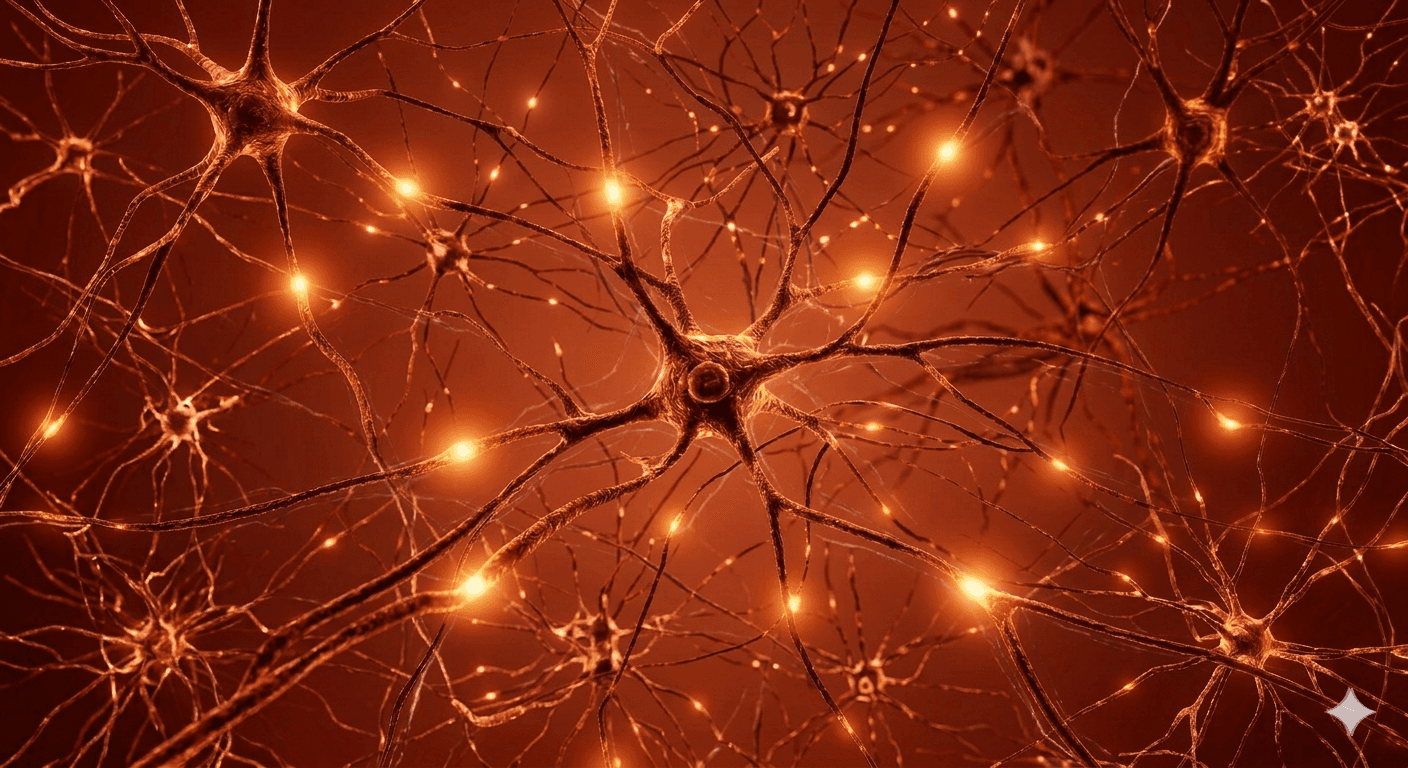
The human brain handles perception, memory, language, motor control, emotional regulation, and creative thought on roughly 12–20 watts. That’s about the same draw as a bedside lamp, or charging a smartphone.
Switzerland’s Blue Brain Project estimated that simulating the brain’s full processing in real time would require approximately 2.7 billion watts. That’s the combined output of three nuclear power stations. Enough electricity to supply a large city.
A peer-reviewed estimate in Frontiers in Neuroscience puts the brain’s total energy efficiency advantage over silicon at roughly 2.7 × 10¹³, accounting for both per-operation efficiency and the fact that current hardware takes about 30,000 times longer than real time to simulate biological neural activity.
This isn’t a niche academic comparison. It’s the central engineering challenge of the next decade in computing. And the gap is getting more attention, not less, as AI data center energy projections keep getting revised upward.
The Von Neumann Bottleneck Is Eating Your Electricity Bill
The brain’s efficiency isn’t a single clever feature—it’s the product of several interlocking architectural properties, each fundamentally different from how conventional computers work.
Memory and processing occupy the same physical space. In a conventional computer, data moves constantly between storage, RAM, and the processor, burning energy at every step. This is the von Neumann bottleneck. Synapses in the brain both store information and participate in computation. There’s no equivalent shuttle back and forth.
Sparse activation. Most neurons are quiet at any given moment. Power draw scales with what the brain is actually doing, not its theoretical maximum capacity. AI hardware, by contrast, keeps vast numbers of transistors switching continuously, regardless of whether those operations are immediately needed. (Mixture-of-experts architectures are a partial move toward fixing this, but the hardware itself still wastes energy at idle.)
Event-driven signalling. Neurons fire electrochemical spikes called action potentials, using energy only at the moment of transmission. Digital transistors switch on and off billions of times a second, consuming power on every transition regardless of whether it’s useful.
And let’s not forget the timescale advantage: biological evolution has had roughly 500 million years to refine neural architecture. Silicon computing has had about seventy.
| System | Continuous power draw | Energy per cognitive task |
|---|---|---|
| Human brain | 12–20 W | ~20 J/second (all tasks, continuously) |
| Laptop processor | ~150 W | n/a |
| Large language model (single response) | Variable (data centre) | >6,000 J per query |
| Frontier supercomputer | 21,000,000 W | n/a |
| Hypothetical real-time brain simulation (Blue Brain estimate) | ~2,700,000,000 W | Estimated requirement to match brain |
The GPUs Aren’t Even Idling Efficiently
A common counterargument: modern GPUs clock down and go to sleep when there’s no load, just like CPUs. It’s dynamic. Fair point at the surface level.
But the reality is messier. A recent paper on GPU energy behavior in AI workloads observed something counterintuitive: a GPU can continue drawing substantial power even when a live job shows little compute, memory, or communication activity. In state-of-the-art serving traces, such intervals can account for up to 65% of total energy use.
The researchers call this state “execution-idle”, intervals where the GPU remains allocated and a program remains loaded, yet visible activity is near zero. The hardware is technically available but doing nothing useful, while still pulling power.
The real killer isn’t idle vs. active framing, though. It’s what happens during actual inference: shuttling gigabytes of weights back and forth from HBM memory to compute cores for every single token. That memory wall is doing more damage to the efficiency gap than anyone’s idle power management fixes.
What Researchers Are Actually Building
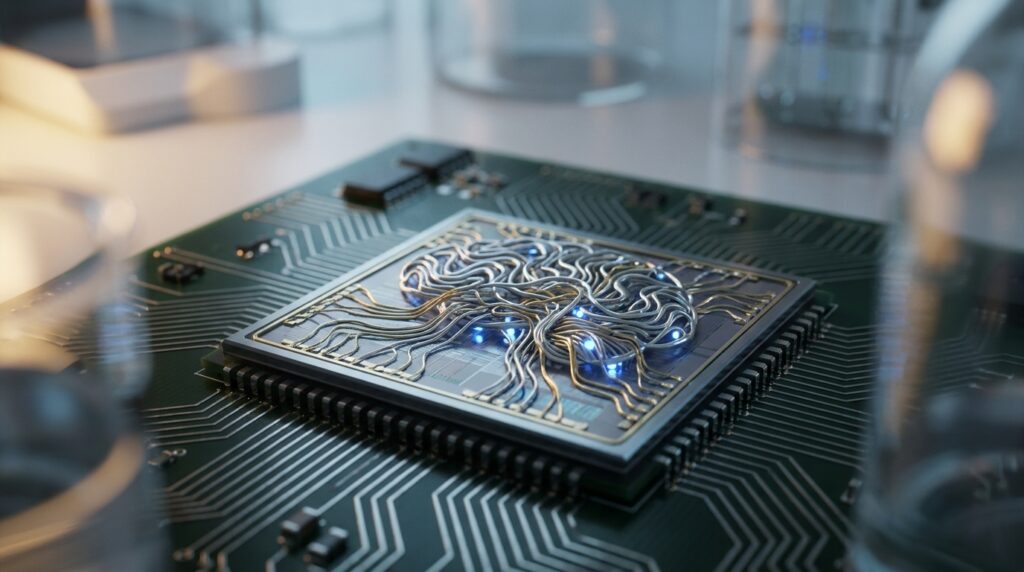
The dominant research response to AI’s energy problem is neuromorphic computing: hardware that physically mimics aspects of the brain’s architecture, rather than running brain-like software on fundamentally brain-unlike hardware.
Spin-Memristors (TDK / CEA, 2024–2025)
TDK has demonstrated a working spin-memristor, a device that uses quantum magnetic properties to function simultaneously as memory and processor, much like a biological synapse. The target is chips that cut power consumption to less than 1/100th of current AI processing requirements. That’s a reduction conventional semiconductor miniaturization simply cannot reach.
Phase-Change Neuromorphic Chips (University at Buffalo, 2025)
Physicist Sambandamurthy Ganapathy leads an NSF-funded team working with phase-change materials to build artificial neurons and synapses that reproduce the rhythmic electrical oscillations visible in brain imaging. As he puts it: “There’s nothing in the world that’s as efficient as our brain. It’s evolved to maximise the storage and processing of information and minimise energy usage.”
Super-Turing AI and Hebbian Learning (Texas A&M, 2025)
This approach integrates learning and memory at the algorithmic level, targeting the training-inference split that accounts for much of conventional AI’s computational cost. The framework uses Hebbian learning (“cells that fire together, wire together”) combined with spike-timing-dependent plasticity.
Standard AI training uses backpropagation, a global error signal with no real biological equivalent that becomes increasingly expensive as models grow. The team calls this “Super-Turing AI” : learning and memory integrated into the same hardware operation, removing the need to shuttle data between components during training.
In a practical test, a drone navigated a complex environment without any prior training, adapting in real time. It was faster and less energy-intensive than a conventional AI approach. Lead researcher Dr. Peng Li: “Modern AI like ChatGPT is awesome, but it’s too expensive. We’re going to make sustainable AI.”
Oregon State’s Programmable Phototransistor (June 2026)
Researchers at Oregon State University have developed a light-sensitive device that integrates sensing, memory, and signal processing in a single phototransistor. By applying a small electrical gate voltage, the device can programmatically control how memories strengthen or decay, mimicking the neurochemical processes in the human brain.
This is particularly relevant for vision systems in robotics, drones, and autonomous vehicles, where not every visual signal needs to be preserved forever. Some information should matter briefly, some should persist longer, and some should disappear almost immediately.

| Approach | Institution / Company | Brain feature being replicated | Reported efficiency target |
|---|---|---|---|
| Spin-memristor chips | TDK / CEA | Collocated memory and processing (synaptic) | Target: <1/100 of current AI power draw |
| Phase-change neuromorphic chips | University at Buffalo | Event-driven spiking, synchronised oscillations | Significant reduction, hardware in development |
| Super-Turing AI (Hebbian) | Texas A&M University | Integrated learning and memory, on-the-fly adaptation | Demonstrated improvement over backpropagation in drone navigation test |
| Gate-tunable phototransistor | Oregon State University | Programmable memory decay, in-sensor processing | Device-level demonstration, scaling in progress |
The University of Pisa’s Ultra-Thin 2D Material Breakthrough
A study published in Nature Electronics involving the University of Pisa, Shanghai University, the University of Messina, and EPFL has developed new electronic memories based on ultra-thin two-dimensional materials (molybdenum disulphide and niobium disulphide) that store information and perform computing operations in the same location on the chip.
Professor Giuseppe Iannaccone of the University of Pisa explains: “The human brain can process enormous amounts of information while consuming only a fraction of the energy required by artificial intelligence systems. In computers, data must be continuously transferred between memory and the processor, resulting in significant energy consumption.”
Critically, this new technology is compatible with existing silicon chip manufacturing processes, a major advantage over more exotic research approaches that require entirely new fabrication infrastructure.
The Rebound Effect Will Eat Your Efficiency Gains
Here’s where the narrative gets uncomfortable.
GPU efficiency has improved at roughly 1.28x per year since 2010. Algorithmic improvements over the past decade have cut the compute needed to reach a given level of model performance by an estimated factor of 20,000. Neuromorphic hardware is edging out of the lab. The energy profile of AI in 2035 could look very different from today’s.
But efficiency projections tend to underplay the rebound effect: when something gets cheaper, people use more of it. If neuromorphic chips cut cost per query by 100x but usage grows 200x, total consumption still rises. The IEA has already revised its AI energy projections upward twice.
Data centers and AI consumed around 460 terawatt-hours globally in 2022. The IEA projects that could more than double by 2026, approaching 1,000 TWh, roughly comparable to Japan’s total annual energy use. AI queries already consume considerably more electricity than conventional web searches, and when multiplied across billions of daily interactions, it adds up fast.
Where the Brain vs. AI Comparison Breaks Down
As fascinating as the efficiency numbers are, the comparison has fundamental limitations.
Continuous learning vs. discrete training. Current AI systems are trained in a discrete, resource-heavy phase, once done, parameters are largely fixed. The brain has no equivalent separation. Synaptic connections adjust throughout life, consolidating during rest and sleep.
Embodiment. The brain didn’t evolve to process language. It evolved to keep a body alive, navigating space, managing energy, sensing threats. Language and abstract reasoning are relatively recent additions on top of a system whose primary job is survival. AI systems have no hunger, no pain, no social stakes, no experience of time passing.
General vs. narrow capability. The brain is extraordinarily efficient at doing everything. AI is most efficient when doing one thing well. As a peer-reviewed analysis in Frontiers in Neuroscience argues: “Even the tasks performed in the construction of a footpath, involving spatial planning and the use of several tools to manipulate a variety of materials, require greater computational performance than any advanced AI system can match.”
Getting to broad general intelligence isn’t a matter of running today’s systems at greater scale. The energy required for a hypothetical artificial general intelligence capable of matching collective human civilization would likely exceed the total power output available to industrialized nations under current semiconductor architectures.
The Deeper Implications
Neuromorphic research is producing real results. Spin-memristors work in the lab. A drone navigated an obstacle course without prior training. TDK’s target of cutting AI power to <1/100th of current levels, if achieved at scale, shifts the energy comparison considerably.
But the convergence between biological and artificial architectures raises a more interesting question than “what’s more efficient.” Many of the architectural solutions engineers have landed on while developing AI weren’t borrowed from neuroscience, they emerged from solving engineering problems independently. Yet they share structural similarities with features of the biological brain.
| Human brain structure/function | Approximate AI equivalent (2025) |
|---|---|
| Anterior Cingulate Cortex (conflict detection) | Critic node that flags contradictions before output |
| Prefrontal Cortex (goal maintenance) | Chain-of-thought reasoning and system prompts |
| Dopamine reward signal | Reinforcement learning reward model |
| Neuroplasticity | Fine-tuning and LoRA weight adaptation |
| Sparse, parallel neural activation | Mixture-of-Experts (MoE) sparse activation |
| Hippocampal memory consolidation | Retrieval-augmented generation (RAG) |
None of these parallels should be pushed too hard. The biological mechanisms are far more complex. But the directional similarity keeps showing up, which suggests the brain’s architecture may be a useful long-term reference point for AI design, even where the specific biology can’t be replicated.
The Practical Takeaway
For anyone building, deploying, or investing in AI systems, the 15W gap isn’t an abstract curiosity. It’s a concrete constraint that will reshape the economics of AI over the next decade.
- If you’re deploying AI at scale: Factor energy costs into your architecture decisions now. The IEA projections suggest you’ll be paying significantly more per query by 2028.
- If you’re building AI hardware: Neuromorphic approaches are moving from lab curiosity to commercial viability faster than most industry observers realize. The model efficiency and parameter reduction techniques being developed alongside hardware improvements will compound these gains.
- If you’re an AI researcher: The biological vs. artificial comparison isn’t just a philosophical exercise. Understanding why the brain achieves its efficiency—sparse activation, collocated memory and processing, event-driven signalling—can directly inform better architectures.
The brain’s efficiency advantage isn’t a gap that neuromorphic hardware will close in one generation. But the direction of travel is clear. Getting from today’s data centers to something closer to brain size still looks decades away, but not centuries away.
And if the rebound effect holds, we’re going to need every watt of that efficiency just to keep up with demand.
Related reading: For more on how these technologies are being deployed in practice, check out our analysis of brain-computer interfaces as a direct application bridging biological and artificial cognition. And if you’re concerned about the human side of this equation, our piece on cognitive surrender to AI automation explores what happens when we trust AI systems that still consume three nuclear power plants’ worth of energy to match a bedside lamp.