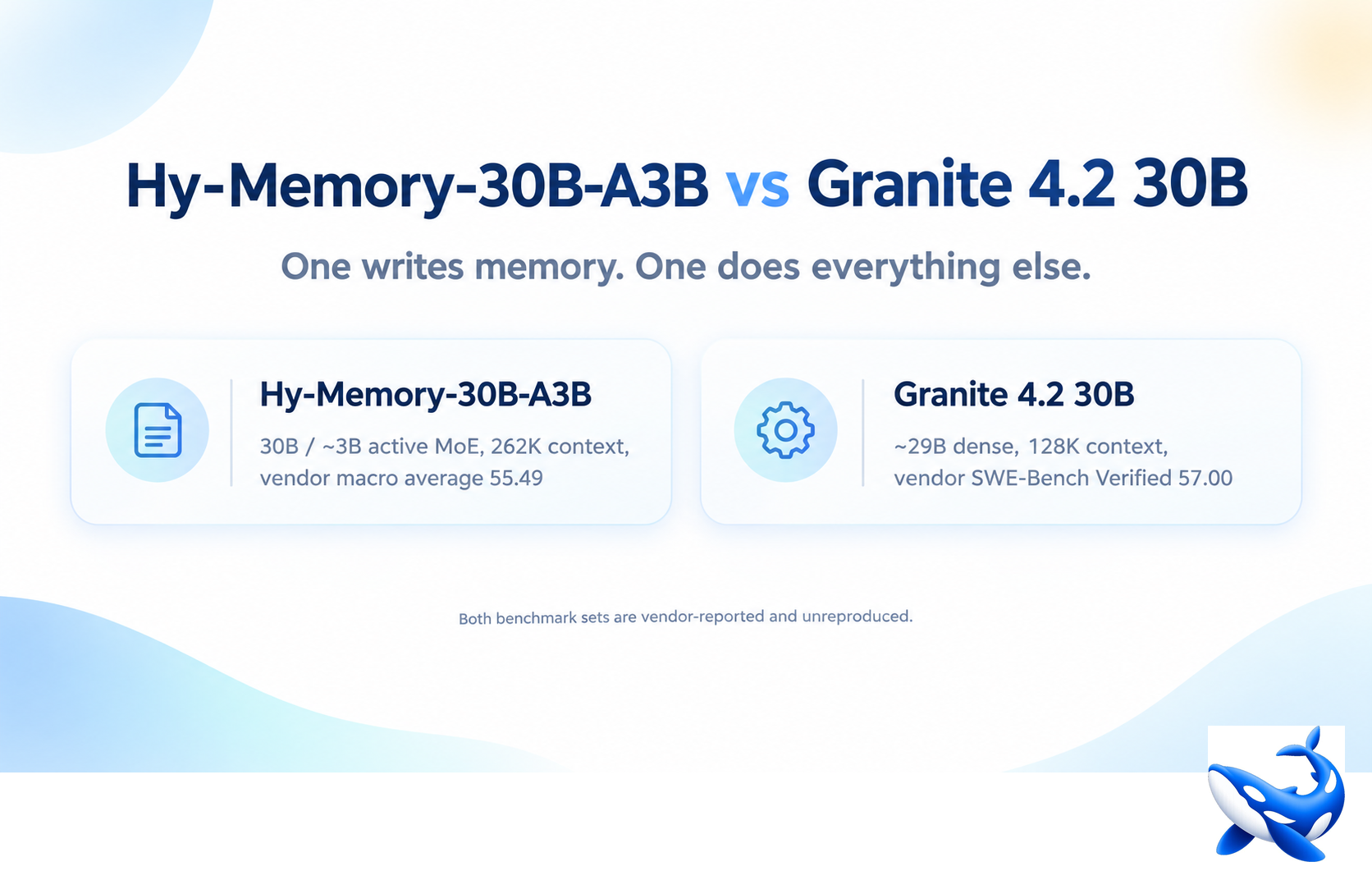
Tencent’s Hunyuan team shipped a 30-billion-parameter model that claims to beat Claude Opus 5 at memory tasks. It activates only 3 billion parameters per token. It’s licensed Apache 2.0. And it hit Hugging Face on October 15 with zero downloads, nine likes, and no launch post, just a paper, a repo, and a benchmark table that looks too good to be true.
The model doesn’t write essays. It doesn’t reason through math problems. It writes memory, deciding what a long-running agent should keep, how to phrase it, and when new evidence should overwrite old facts. That’s the unglamorous but brutally expensive part of every agent framework, from Mem0 to MemOS to whatever custom thing you’ve duct-taped together.
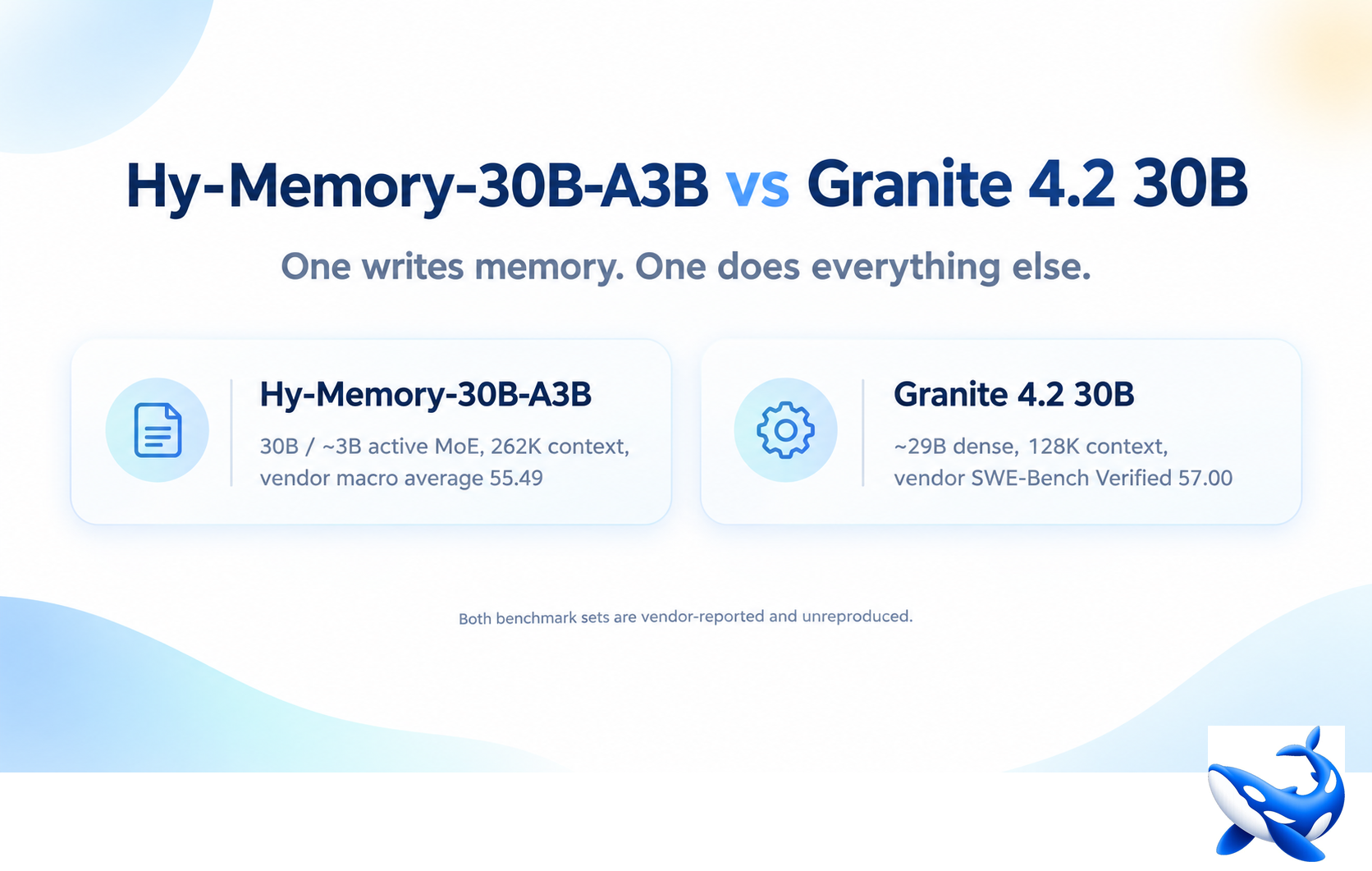
The claim: a 55.49 macro average across four harnesses, against 54.62 for Opus 5. On a fixed 20% benchmark subsample. With no third-party reproduction, because nobody’s run it yet.
Let’s dig into what’s actually here.

What the hell is a memory writer?
An agent framework sits between a conversation and a persistent store. Every turn, something has to read the exchange, decide which fragments matter, phrase them so they’re retrievable later, and reconcile them against what’s already stored. Today, that job goes to a frontier chat model with a framework-specific prompt bolted on.
That’s expensive. A general-purpose model firing on every single turn, in every agent conversation, at frontier API prices, just to decide “user likes concise answers” is worth remembering.
Hy-Memory-30B-A3B is trained to do exactly that job, across Mem0, MemOS, and Tencent’s own Hy-Memory, covering chat, working, and coding scenarios. Then it’s tested on a fourth framework, EverMemOS, held out from training entirely.
That held-out harness is the entire thesis. Cross-framework transfer is what makes a specialized model viable, if you need a different writer for every framework, you’re back to square one.
The model card gives you the shape of the thing:
- Architecture: 48 layers, one dense feed-forward block, 47 sparse MoE blocks
- Experts: 128 per block, top-8 routing plus one shared expert
- Context: 262,144 positions with a RoPE base of 11,158,840
- Footprint: 51 safetensors shards, roughly 60.1 GB in BF16
- Serving: vLLM 0.31.0, OpenAI-compatible endpoint
No GGUF. No FP8. No quantization at all. One BF16 checkpoint, nothing else.
The training recipe: distillation, then unattributed RL with training wheels
The two-stage training process is where things get interesting, and where the “beats Opus 5” claim gets its legs.
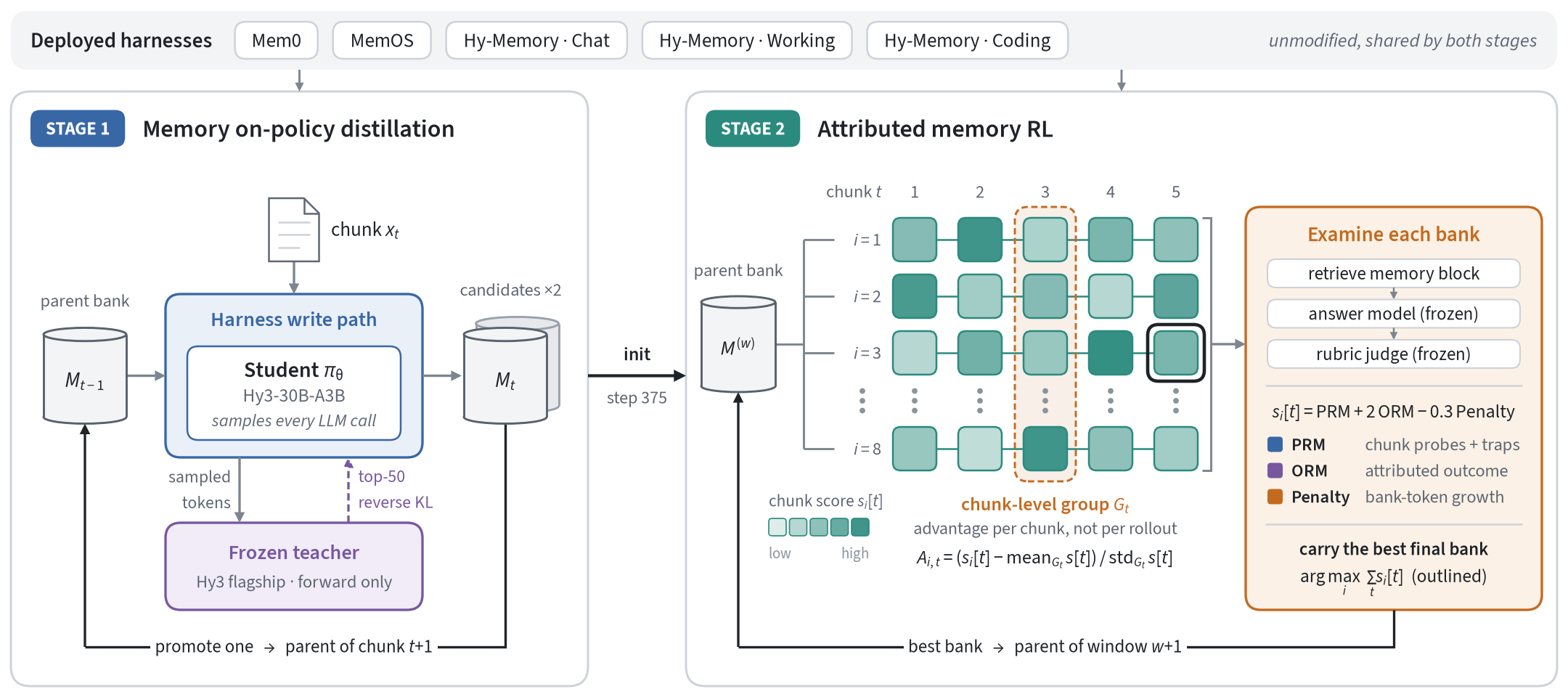
Stage one: Memory On-Policy Distillation (OPD). A teacher supplies dense supervision on memory states that the student itself produced. On-policy, meaning the student gets corrected on its own mistakes rather than being forced to imitate a teacher’s trajectory. It’s the difference between learning to drive by watching a pro versus practicing with an instructor yelling corrections.
Stage two: Attributed Memory Reinforcement Learning. This is the novel part. The framework builds memory banks from rollouts, scores them chunk by chunk, and carries the selected bank forward across windows instead of resetting between them.
That carry-forward matters because it matches deployment reality. In production, a memory bank is never empty. Every write lands on top of everything written before. If your training assumes each session starts fresh, your model will make garbage decisions the moment context accumulates.
Credit is attributed at chunk level, with an explicit penalty for over-storage. A writer that keeps everything is useless, the reward function has to price that in.
The quickstart default tells you everything about intended use: reasoning_effort: "no_think" and temperature: 0.0. A memory writer doesn’t need to deliberate. It needs to be deterministic and cheap, because it fires on every turn.
The benchmark table, read properly
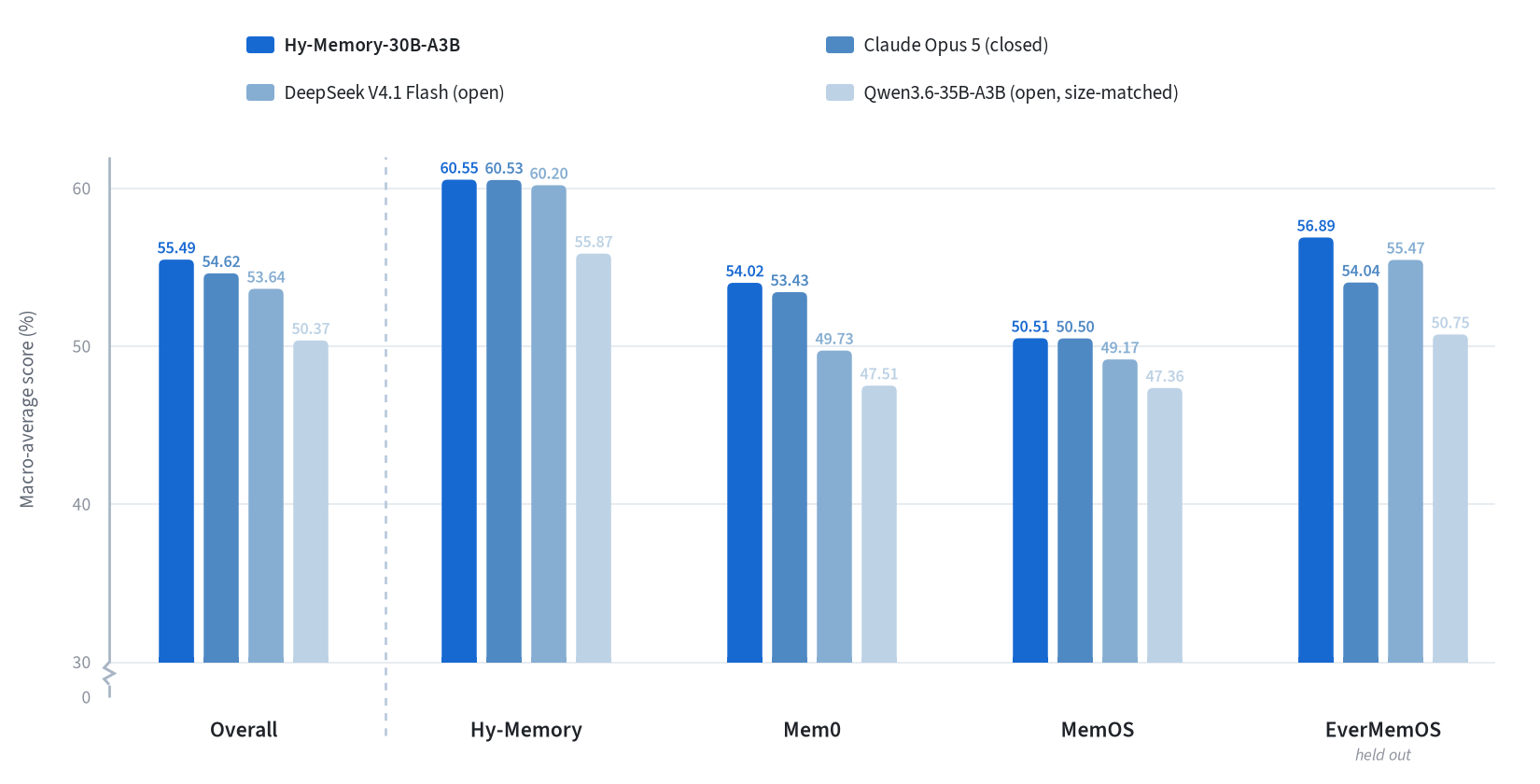
Here’s the headline and what’s actually behind it:
| Memory writer | Mem0 | Hy-Mem. | MemOS | EverMem. | Avg. |
|---|---|---|---|---|---|
| Hy-Memory-30B-A3B | 54.02 | 60.55 | 50.51 | 56.89 | 55.49 |
| Claude Opus 5 | 53.43 | 60.53 | 50.50 | 54.04 | 54.62 |
| DeepSeek V4.1 Flash | 49.73 | 60.20 | 49.17 | 55.47 | 53.64 |
| Hy3 | 45.99 | 58.06 | 50.19 | 52.30 | 51.63 |
| Qwen3.6-35B-A3B | 47.51 | 55.87 | 47.36 | 50.75 | 50.37 |
| Hy3-A3B Base | 40.20 | 50.39 | 49.05 | 50.98 | 47.66 |
| Qwen3-30B-A3B | 39.81 | 45.67 | 45.44 | 46.57 | 44.37 |
A 3B-active specialist beating a frontier model by 0.87 points on a memory task is plausible. The task is narrow, the specialist was trained for it, and that’s the same argument that makes small code-completion models competitive on single-file edits.
Here’s the full benchmark for the most important row, the held-out EverMemOS:
| Writer | LoCoMo | LME | PM-v2 | Travel | Shop. | CMB | Avg. |
|---|---|---|---|---|---|---|---|
| Hy-Memory-30B-A3B | 73.28 | 76.00 | 53.28 | 56.56 | 19.05 | 63.19 | 56.89 |
| Claude Opus 5 | 73.28 | 80.41 | 51.19 | 45.91 | 23.89 | 49.53 | 54.04 |
| DeepSeek V4.1 Flash | 72.52 | 82.83 | 49.74 | 59.47 | 18.89 | 49.38 | 55.47 |
The details are as revealing as the averages. Hy-Memory wins on code memory (CMB, which is repo QA) by a landslide: 63.19 vs 49.53 for Opus 5. It also crushes Travel SPS: 56.56 vs 45.91. But it loses Shopping PS: 19.05 vs 23.89.
That’s not noise. The pattern suggests the model excels at structured, fact-extraction-heavy tasks (code, travel plans) but underperforms on subjective preference tracking. That’s a write-path model trained to extract explicit facts, not to infer preferences from context, and the benchmark reflects it.
The elephant in the room: the 20% subsample problem
Every benchmark in the main matrix runs on a fixed 20% subsample. Tencent is upfront about this. The abstract says it explicitly.
Here’s the thing about subsamples: they’re fine if the subsampling is random and the task distribution is homogeneous. They’re dangerous if there are clusters of difficulty, a particular conversation type, a specific repository structure, that happen to be over- or under-represented in the sample.
And each harness score averages six metrics equally. That gives busywork metrics like Shopping PS equal weight with substantive ones like code memory. The model wins the overall average partly by dominating CMB and Travel while having mediocre Shopping scores.
The evaluation design itself is sound, changes only the memory writer, holds harness, prompts, retrieval, answer model, and judge fixed. That’s exactly how you isolate a writer’s contribution.
But there’s a second, more practical problem: reproducibility.
Check the file listing. 51 safetensors shards. 60.1 GB. One precision.
Why zero downloads is actually informative
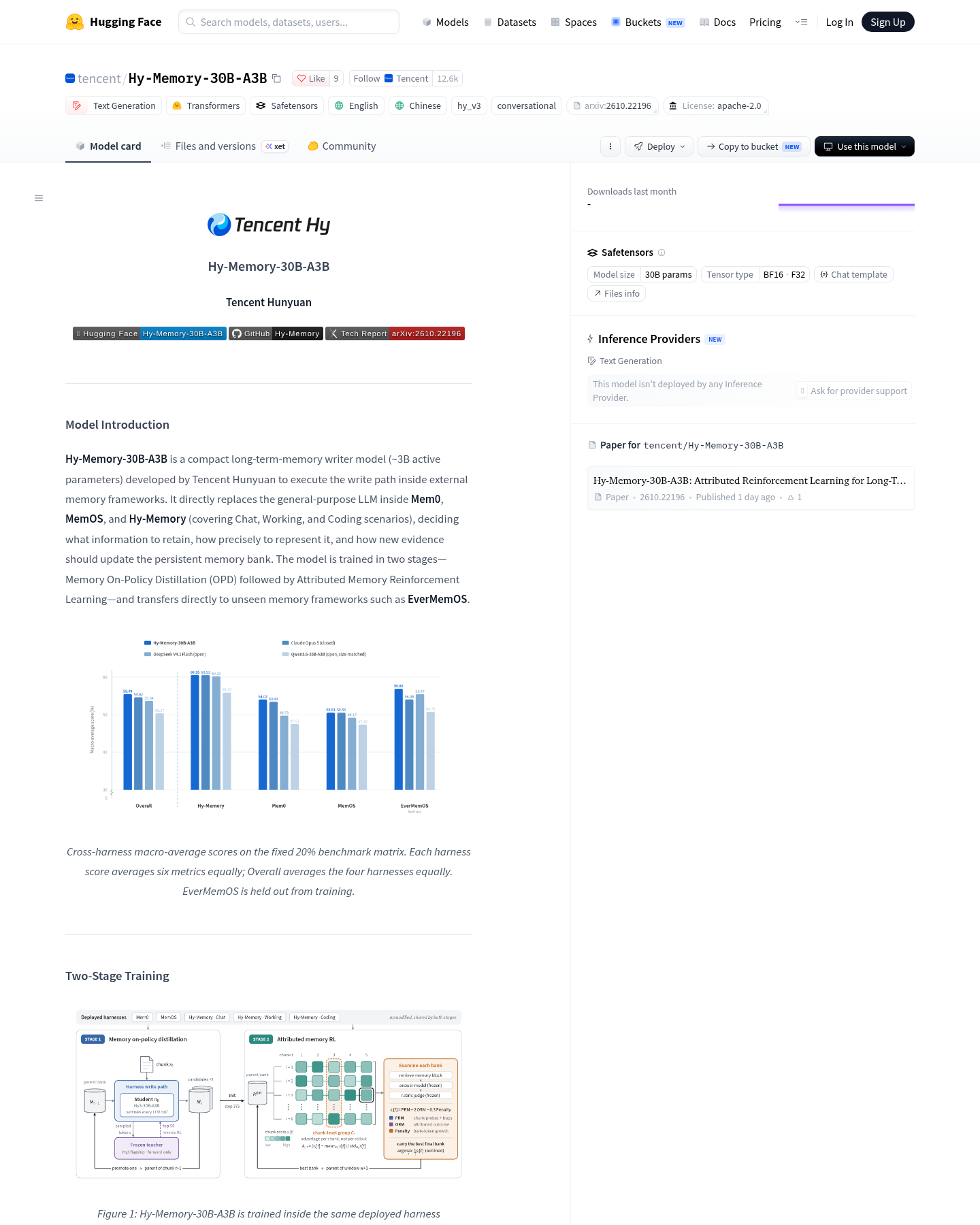
Tencent doesn’t have a launch post for this thing. There’s no press release, no hosted endpoint, no pricing page. The model card sits with nine likes and a big fat zero in the “Downloads last month” column.
The OrcaRouter breakdown nails the comparison: NVIDIA’s Nemotron 3.5 Lightning 30B-A3B Base, released two months earlier, sits in the tens of thousands of downloads. It ships BF16, NVFP4, and FP8 builds, plus community GGUFs.
NVIDIA published a recipe you can re-run. Tencent published a table you can’t easily check.
That gap isn’t a quality judgment. It’s a measurement of how hard each team made it to try the thing. A model that requires 60 GB of VRAM and has no quantized alternative is one you evaluate after clearing your datacenter budget, not after a quick lunch break.
Standard attention is the hidden cost nobody’s talking about
The Reddit reaction to this model picked up on something the official docs downplay: Hy-Memory uses standard attention. At 262K context, that’s a lot of key-value cache.
Here’s the math: at 131K context, standard attention with 4 KV heads (which this model uses) still burns roughly 12 GB of memory for context storage alone. Compare to Qwen3.6-35B-A3B, which uses Mamba-2 hybrid blocks and needs only about 1.2 GB for equivalent context.
That’s the difference between “runs on one H100” and “needs a second GPU just for context.”
On the other hand, the model’s proponents point out a genuine advantage: it understands memory writing. General models used for memory compaction slowly break when they don’t understand the framework’s protocol. A specialist trained across three frameworks with held-out validation on a fourth is a different beast entirely.
Several developers noted they’d want to benchmark this against models like Qwen3.6-35B for observational memory tasks before switching. That’s the right instinct, the paper’s numbers are the hypothesis, not the conclusion.
The 30B-A3B naming collision, and why it matters
Here’s a trap: “30B-A3B” appears on two very different models right now. Tencent’s Hy-Memory-30B-A3B and NVIDIA’s Nemotron 3.5 Lightning 30B-A3B Base share the same parameter arithmetic, 30 billion total, 3 billion active, and almost nothing else.
NVIDIA’s model is a Mamba-2 hybrid with Multi-Token Prediction heads, pre-trained on 20+ trillion tokens, released as raw material for post-training. It has no instruction-following behavior, no chat template worth the name, and no intention of answering your questions.
Tencent’s is a finished product, post-trained twice, designed to return structured JSON records describing what an agent should remember.
Both are self-hosting propositions. Neither has a hosted endpoint in any inference catalog.
The name collision will keep putting these in the same sentence. The sooner you separate “30B-A3B” from “the same kind of model”, the more useful your comparisons become.
What this means for agent architecture
Strip away the benchmark drama and here’s the real signal: specialized memory writers are becoming a viable component in agent stacks.
The architecture makes the split explicit. A memory harness invokes a writer on every turn, short outputs, deterministic, must never invent facts. That’s the write path, and it’s distributed across every conversation you run. Then an answer model reads the bank back and responds, the read path, where a frontier model’s depth is worth its cost.
Two models, two very different call profiles. And this is where the MoE efficiency trend intersects with agent infrastructure: if the write path can run on a 3B-active model, the per-turn cost of memory drops by an order of magnitude.
Tencent’s own history here is telling. The Youtu-LLM-2B demonstrated the company’s appetite for compact models that outperform much larger competitors. The WeDLM 8B showed a willingness to challenge architectural orthodoxy. This memory writer continues a pattern: find a narrow, high-frequency task, build a specialist that beats generalists at it, and open-source the result.
The broader shift from parameter count to architectural efficiency has been building for a while now. Distilled and specialized small models have been quietly humiliating frontier LLMs on narrow tasks. This is another data point in that trend, but it’s also a uniquely well-designed experiment, because the held-out EverMemOS harness actually tests whether specialization generalizes across frameworks, not just within one.
The honest assessment
Here’s what we know:
- A 3B-active specialist beating a frontier model on its narrow task is not a new phenomenon. Code completion models have pulled this off for years.
- The held-out EverMemOS result, 56.89 vs 54.04 for Opus 5, is the one that matters most, and the one nobody has reproduced.
- The 0.87-point macro average gap rests on a 0.01-point MemOS difference and a 20% subsample. It’s a real result, but it’s not a rout.
- The 60 GB BF16-only release, with no quantized alternative, puts verification behind a hardware paywall.
The correct posture: treat the table as a hypothesis. Read the repo. Run the quickstart on whatever hardware you have. If you’re building a memory system, the routing pattern is the thing to steal, a cheap specialist on the write path, a frontier model on the read path, one interface in front of both, whether or not this specific model lives up to its numbers.
Three things would move this from paper to product: a quantized build (FP8 or GGUF would let a workstation user actually test the claims), an independent harness run, and a hosted endpoint. Until then, it’s a fascinating architecture with an unverified scoreboard. And if Tencent’s past releases are any indication, the company has a habit of shipping efficient models that punch above their weight, there’s a decent chance the numbers hold up under scrutiny.
But “decent chance” isn’t a benchmark. And neither is a table nobody’s checked.