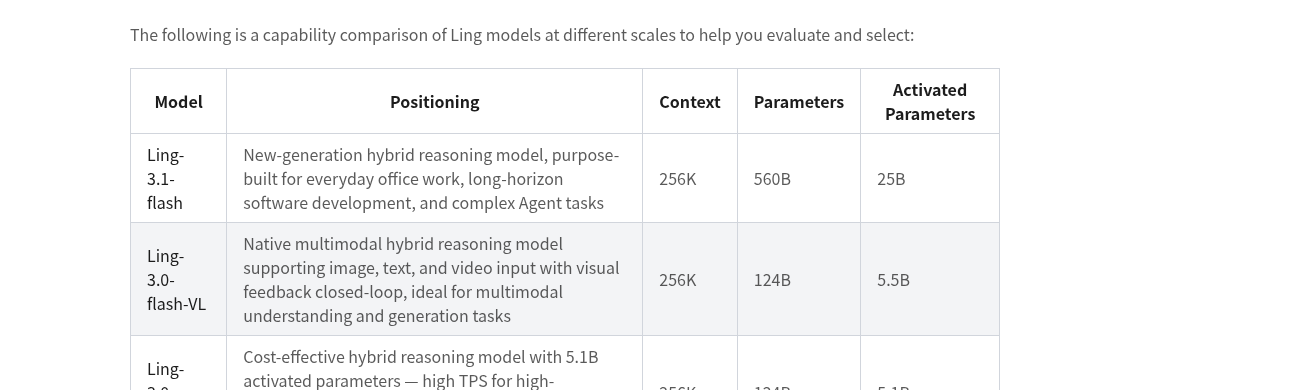
When Ant Group’s inclusionAI lab dropped Ling-3.1-flash on Hugging Face yesterday, the community reaction was less “wow” and more “wait, what?” Because calling a 560B-parameter model “flash” is like naming a freight train “Speedy.” The previous Ling-3.0-flash was 124B parameters. This one is 4.5x larger. The naming convention didn’t just stretch, it snapped.
But the size isn’t even the headline. The real story is the 1M-token context window, the architecture that makes it feasible, and the question of who exactly is supposed to run this thing on their own hardware.
From 124B to 560B: What Exactly Happened Here?
Let’s get the numbers straight. Ling-3.1-flash packs:
| Spec | Value |
|---|---|
| Total Parameters | 560B |
| Active Parameters (per token) | 25B |
| Context Window (declared) | 1M tokens |
| Context Window (served today) | 256K tokens |
| Transformer Layers | 63 KDA + 9 Gated MLA (7:1 ratio) |
| Routed Experts | 512 |
| Activated Experts | 8 |
| Shared Experts | 1 |
| Vocabulary Size | 157,184 |
That’s a sparsity ratio of roughly 1 in 22. Only 25B of those 560B parameters fire per token. This is the MoE (Mixture of Experts) playbook executed at a scale that would’ve been unthinkable a year ago.
The architecture itself deserves a closer look. The 7:1 KDA (Kimi Delta Attention) to Gated MLA ratio means only one layer in eight keeps a global attention path. The rest use linear-time attention, which is what makes the 1M context window theoretically possible without quadratic blowup. This continues the hybrid linear architecture trend we saw introduced in Ling-3.0, but the linear share has been significantly increased.
Community observers were quick to note the irony. One Reddit user pointed out that flash models are now approaching DeepSeek V3 in size, which prompted another to reply that “up to 400B MoE are absolutely local for everyone.” That’s technically true if “local” means “an $166K rack-mounted server cluster.” As one commenter put it, we’ve reached the point where these aren’t “silly little homelab curiosities anymore”, they’re engineered from day one for datacenter deployment.
The Benchmark Story: From 0 to 46 in One Version
The most dramatic numbers come from Terminal-Bench 4.0. Ling-3.0-flash scored a flat 0%. Ling-3.1-flash scores 46.03%. That’s not an incremental improvement, that’s a different species of model.

To put that in perspective, the model went from being completely incapable of terminal-based tool use to outperforming models like GLM-5.2 on the same benchmark. One commenter noted that GLM-5.2’s poor showing makes no sense, until you realize that model wasn’t trained for terminal control. As another user astutely observed, “If a model wasn’t trained for a type of task, it will not perform that task well. That’s all there is to it.”
The benchmark ledger on BenchLM tells a more nuanced story. On SWE-bench Pro, Ling-3.1-flash scores 68.7% versus Claude Opus 5.5’s 89.9%. On BrowseComp, it hits 91.7%, just 0.8% behind the leader. On AutomationBench, it scores 52.5% against DeepSeek V4.1 Flash’s 54.8%. The model is competitive, not dominant, in the agentic and coding categories.
There’s a dirty secret in these numbers, though. The SWE-bench Pro and DeepSWE results use LingCode, a custom harness built on the open-source coding agent Pi. It’s designed for “complex, long-horizon coding tasks that run for hours, involve hundreds of rounds of tool calls, and require repeated context compaction.” The harness details aren’t fully specified, and the benchmarks aren’t independently reproduced. Treat those numbers as vendor-reported claims, not verified facts.
The Free Lunch (That Ends Without Warning)
Here’s where things get spicy. Ant Group’s own pricing table shows Ling-3.1-flash at ¥0.00 for input, output, and cache reads. That’s right, the “free” row in a sea of paid rates.
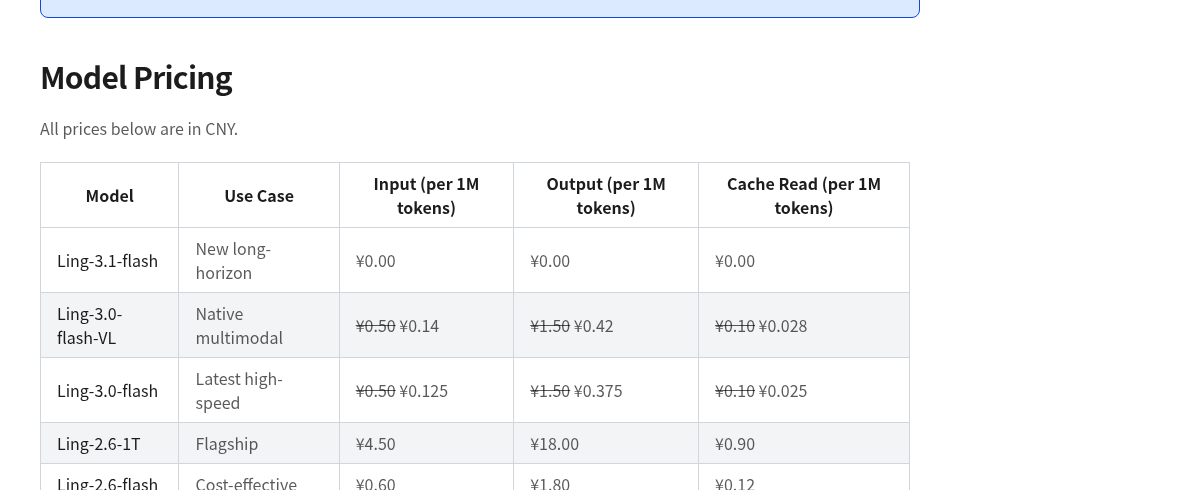
But this is a promotional window, and it has an expiration date that’s already set. The free period ends October 13, 2026, which means by the time you’re reading this, it’s likely over. Ant’s announcement says the sequence is: trial at 256K context, then paid service at up to 1M, with open-sourced weights following at that switch.
Here’s the catch: the model is already open-sourced as of October 14, 2026. The weights are live on Hugging Face under inclusionAI/Ling-3.1-flash. So the “promotional” pricing and the open-source release happened simultaneously, which is a somewhat unusual move. It’s also worth noting that the released configuration sets max_position_embeddings to 262,144, not 1M. The 1M number is a claimed ceiling, not what the released checkpoint actually supports.
Can You Actually Run This Thing?
Let’s talk hardware requirements, because this is where the “open weights” story gets complicated.
At full BF16 precision, the model takes about 534GB of weights. That’s not a typo. But Ant Group’s own testing shows real progress on the quantization front: applying MXFP4 to experts and block-FP8 to dense layers cuts weights from ~534GB to ~292GB. That’s enough to fit on 4 Hopper GPUs instead of 8.
| Setup | Configuration | Performance |
|---|---|---|
| 8x H200 | TP8 + EP8 | 604ms TTFT |
| 4x H200 | Quantized | ~1.36 QPS |
| 4x GB300 | TP4 + EP4 | Not specified |
The SGLang day-0 image includes MTP (NEXTN) speculative decoding and Hopper decode optimizations. Enabling SGLANG_ENABLE_FP8_BLOCK_GEMV=1 and SGLANG_ENABLE_FUSED_KDA_OUTPUT_QUANT=1 gets you roughly 10% faster batch-1 decode. vLLM also has day-0 support with expert parallel and MTP speculative decoding enabled by default.
For context on how this compares to other recent releases, DeepSeek V4 Flash demonstrated that large models can run on single GPUs with million-token context, which makes the 4-GPU requirement for Ling-3.1-flash feel less impressive. But the model sizes are different, DeepSeek V4 Flash is notably smaller. And the 3TB/s high-bandwidth flash standard that’s emerging could eventually make running models like this on commodity hardware more realistic.
The reality is that “local” for Ling-3.1-flash means a serious cluster investment. This isn’t a model you’ll be running on your gaming rig. The era of the single-GPU frontier model is still a ways off for 560B-parameter behemoths.
What Can It Actually Do?
Ant Group’s positioning for Ling-3.1-flash is refreshingly specific: “new-generation hybrid reasoning model, purpose-built for everyday office work, long-horizon software development, and complex Agent tasks.”
The model card claims strong performance on:
- GDPVal-AA V2.1 (office tasks)
- HealthBench Professional (medical communication)
- FrontierSWE (software engineering)
- Terminal-Bench 4.0 (terminal-based tool use)
- Automationbench (automation)
- MCP-Atlas (tool use)
- SkillsBench (capability assessment)
Vendor-reported test results include a Lua-to-x86-64-ELF compiler built from scratch in about 17 hours of continuous execution, with 178 of 182 tests passing (97.8%). A Pyright optimization pass achieved a 1.432x speedup with all 2,279 tests passing. A Rust reimplementation of a C image library took about 20 hours, passing all 30 checks.
The model reportedly found and patched a stack-buffer-overflow in the open-source OceanBase database’s calibration parser, autonomously. That’s the kind of real-world capability that matters more than any benchmark score.
On the Artificial Analysis Intelligence Index, Ling-3.1-flash scores 41, roughly double its predecessor’s score of 20. It ranks fifth among 175 models on that index, generating 212.1 output tokens per second with a 1.87-second time to first token.
The Real Talk: What’s Actually New Here?
Let’s cut through the marketing. Three things distinguish Ling-3.1-flash from what came before:
1. The size-to-name disconnect. “Flash” models were supposed to be the cheap, fast tier. A 560B-parameter model with 25B active parameters per token isn’t “flash” by any reasonable definition. It’s a frontier-class model with a misleading name. The community has already dubbed it “Chonk Ling 3.1 Flesh”, which feels more accurate.
2. The 512-expert architecture. That’s a dramatically wider expert pool than the previous generation used. With 8-of-512 experts selected per token, the model has enormous capacity for specialization. Whether that translates to real-world capability improvements (versus benchmark gaming) remains to be seen, but the architecture is genuinely interesting.
3. The pricing strategy. Free during a promotional window, then paid. Open-sourced at the same time as the promotion ends. This is a land-grab play, and it signals that Ant Group is serious about competing in the Western AI market. The DeepSeek V4 Flash already demonstrated that aggressive pricing can disrupt the market, and Ant Group seems to be following the same playbook.
Should You Care?
If you’re building agentic systems that need long context windows, yes. The 1M-token window (when served) would let you process entire codebases, extended conversations, or massive documents in a single pass. That’s genuinely transformative for certain workloads.
If you’re looking for a local model, no. This isn’t it. The quantization path to 292GB means you need serious hardware. As one commenter noted, only Meta, Nvidia, Qwen, and Google are really focused on models under 50B parameters, and even that focus seems to be waning. The Xiaomi MiMo-V2.6-Flash-RL model showed that $854K can produce a self-improving open-weight model, but that’s a different scale entirely.
If you’re benchmarking AI models for production, proceed with caution. The vendor-reported numbers should be verified independently before you commit. The SWE-bench Pro and DeepSWE results come from a custom harness that hasn’t been fully documented, and the “1M context” claim isn’t reflected in the released checkpoint’s max_position_embeddings setting.
The Bottom Line
Ling-3.1-flash is a genuinely impressive piece of engineering. The hybrid linear attention architecture at this scale is notable, the pricing strategy is aggressive, and the open-weight release makes it accessible to anyone with the hardware to run it.
But let’s be honest about what it isn’t: it’s not a “flash” model, it’s not a local model, and it’s not a fully verified benchmark leader. It’s a frontier-class model that happens to be open-weights, with a context window that could change how we build agentic systems, once the 1M claim becomes a served reality rather than a roadmap promise.
The Qwen3.8-Flash-Next MTP implementation showed us how speculative decoding can accelerate inference without quality loss. The DeepSeek V4 Flash’s pricing curve showed us how cost-efficient inference can disrupt markets. Ling-3.1-flash combines elements of both, wrapped in a misleading name and bundled with a 1M-token promise that isn’t quite delivered yet.
Watch this space. The weights are out, the community is poking at them, and within weeks we’ll know whether the benchmarks hold up under independent testing. Until then, treat the numbers as promising but unverified, and check your hardware budget before you get excited about running it locally.