DeepSeek V4 Flash 0731 Just Drew a Kill Line That Broke the AI Pricing Curve
We’re going to talk about a blue dot on a scatter plot. Not the kind that shows up in your GPS when you’re lost. The kind that makes every AI pricing executive in Silicon Valley suddenly check their blood pressure.
That dot is DeepSeek V4 Flash 0731, and it just drew what one observer called a “kill line” that makes the standard performance-per-dollar trade-off look laughable. On the Artificial Analysis Intelligence Index, this post-training refresh scored 50, a 10-point jump over the previous V4 Flash, while costing roughly three cents per weighted task.
Everything cheaper scores lower. Everything that scores higher costs dramatically more. That’s not a competitive position. That’s a market correction.
The 10-Point Jump That Came From Nowhere
Here’s what makes the 0731 update genuinely spooky. DeepSeek didn’t change the architecture. They didn’t scale up parameters. They didn’t train a new model. The V4 Flash 0731 is the same 284B total parameter, 13B active parameter Mixture-of-Experts model as the original V4 Flash released in April 2026. Same size. Same context window (1M tokens). Same architecture.
But it scored 50 on the Intelligence Index versus the previous 40. That’s a 25% improvement in a model that didn’t physically change size.
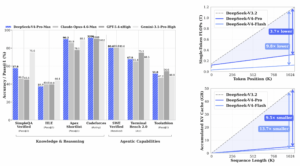
The improvements are spread across every evaluation category. GPQA Diamond went up 1 point to 91%. SciCode jumped 5 points to 50%. Humanity’s Last Exam climbed 5 points to 37%. CritPt gained 9 points to 17%. AA-LCR rose 3 points to 66%. Total output token usage for the benchmark suite actually fell 12%, from ~234M tokens to ~206M tokens, meaning the model is doing more with significantly less text.
But the most interesting improvement is in the hallucination numbers. The AA-Omniscience Index moved from -23 to -16, a 7-point gain driven entirely by a reduced hallucination rate dropping from 96% to 84%. Accuracy stayed flat at 37%. DeepSeek didn’t teach the model to be smarter. They taught it to lie less.
This isn’t a new architecture. It’s a post-training optimization pass that extracted massive gains from an existing model. That’s what makes the implications terrifying for competitors.
The Cache Discount That Destroys Margins
The raw pricing for DeepSeek V4 Flash 0731 is already aggressive: $0.14 per million input tokens and $0.28 per million output tokens on DeepSeek’s first-party API. But the real weapon is the cache hit discount.
DeepSeek offers a 98% cache hit discount on their first-party API, dropping the cache hit price to $0.0028 per million input tokens. For context, most of the industry offers a 90% discount. That 8% difference compounds into a massive structural advantage for any workload with repeated context, which is most enterprise workloads.
The effective pricing data from OpenRouter shows exactly how this plays out in practice. Over the past 30 days, the weighted average input price across all providers was $0.030 per million tokens, roughly 78% below the list price. DeepSeek’s own cache hit rate on OpenRouter sits at 93.84%, and their effective input price drops to $0.013 per million tokens.
Compare that to the absolute pricing of competitors. GPT-5.6 Luna, which scores 51 on the same index (just 1 point ahead of DeepSeek), costs roughly 60% more per task even after OpenAI’s recent 80% price cut. The gap is absurd.
As one observer noted, you could run several DeepSeek calls, including a retry or two, before you get near the upper-right cluster of more expensive models. That’s not price competition. That’s a structural moat.
Why the Graph is Lying to You (A Little)
Before we get carried away with the hype, let’s be honest about what the graph actually shows.
The Artificial Analysis v4.1 index is English-only and text-only. “Cost per task” means a weighted evaluation task, not the bill for your specific 200K-context agentic workflow. The benchmarks used to construct the index are standardized, and they don’t capture every real-world use case.
The community skepticism is worth noting. As one developer pointed out, “if being on the Pareto line killed all those below it, then most of the chart would already have been killed by other models.” Luna, for example, scores only slightly above DeepSeek on this index but does significantly better on DeepSWE and Agents’ Last Exam. There are workloads where Luna will give a massive advantage.
Context matters. The index is a directional signal, not a comprehensive evaluation. DeepSeek V4 Flash 0731 is phenomenal at the broad set of tasks captured by the Intelligence Index, but it’s not a universal winner.
That said, the position on the curve, lower left, where cost is low and performance is high, is hard to wave away. Most models that land there are compromised on quality. This one isn’t.
Local Inference Changes the Calculus
There’s another dimension to this story that the cloud pricing charts don’t capture. Something genuinely surreal is happening in the local inference community.
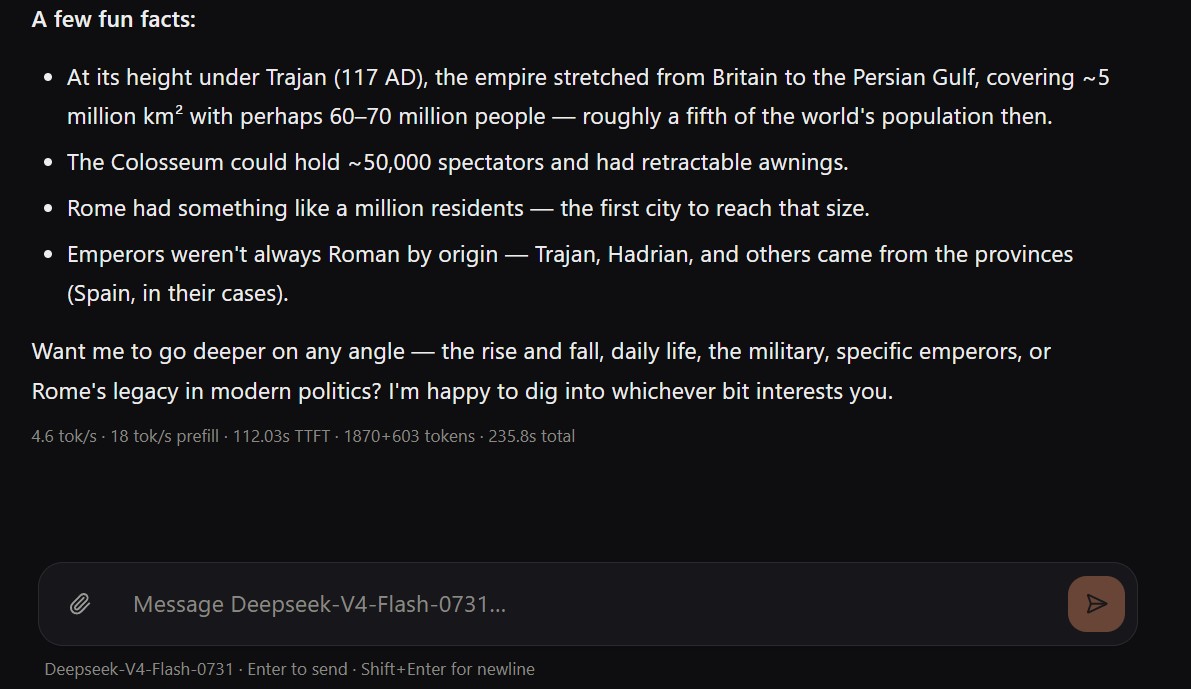
One user reported running DeepSeek V4 Flash 0731, a frontier model, on an Intel Windows PC with a very average 24GB of VRAM. In less than 20 months, we’ve gone from super expensive cloud-only models to running a Q3 quant of a 284B-parameter model on consumer hardware. It’s slow, sure. “Slow as porridge”, in the user’s words. But it runs.
This has triggered an avalanche of hardware flexing that could be a LinkedIn post collection in its own right. Users are running the model on 256GB DDR5 builds, dual 3090 setups, and Mac Studio M20 Ultra clusters. One user described their “low tier” 256GB DDR5 with 48GB VRAM setup as modest.
The practical takeaway is that local deployment of DeepSeek V4 Flash is possible on high-end consumer hardware, with reasonable quality at Q3 or higher quantization. For many use cases, particularly coding assistants, document processing, and agent workflows, running this model locally eliminates API costs entirely. The initial hardware investment ($2,000 to $10,000) amortizes quickly against API costs for heavy users.
This shifts the conversation from “which API is cheapest” to “can I just eliminate the API entirely.” For anyone who has ever watched a cloud bill spiral, that’s an appealing proposition.
What Happens When the Pro Model Gets the Same Treatment
Here’s the part that should keep the competition up at night.
DeepSeek V4 Flash 0731 is a Flash model. The current Pro preview point on the Artificial Analysis chart scores worse than Flash 0731. Pro hasn’t won anything in this comparison yet.
But if the same post-training optimization techniques that gave Flash a 10-point jump get applied to the finished Pro model, the implications are staggering. The Pro model is 1.6T total parameters with 49B active, massively more capable architecturally. If a similar optimization pass yields proportional gains, the Pro model could challenge the absolute top of the index (currently Claude Mythos 5 at 82.92 and Claude Fable 5 at 82.67) at a fraction of the cost.
Closed-source model providers rely on a performance premium to justify their pricing. If DeepSeek can extract GPT-5.6-equivalent performance from a post-training pass on a smaller architecture, and then do the same for the Pro model, the premium evaporates.
As one developer noted, “I keep looking at the size of the Flash update and wondering what happens if the finished Pro gets a similar post-training jump.” That’s the question that keeps foundation model pricing teams up at night.
The Deeper Structural Shift
The DeepSeek V4 Flash 0731 release isn’t just a competitive pricing move. It signals a structural shift in the AI industry that has been building for the past year.
The early AI market was characterized by massive capital expenditure on training, with pricing set to recoup those costs. DeepSeek has systematically challenged that model at every level. Their training efficiency advantages are well-documented. Their inference optimization techniques, including speculative decoding through DSpark that claims 85% faster generation, continue to push the efficiency frontier. And now, their post-training optimization is extracting gains from existing architectures that competitors can’t replicate.
The result is a pricing model that challenges the entire justification for AI bubbles and forces honest questions about what intelligence is actually worth.
The previous DeepSeek V3.1 release achieved a 71.6% pass rate on the Aider coding benchmark while reducing the cost of Claude 4 by a factor of thirty-two. The V4 Flash 0731 is doing the same thing at a higher performance tier. The trend line is clear. Costs are dropping exponentially while performance continues to climb.
The Bottom Line
DeepSeek V4 Flash 0731 is a disruptive release because it proves that massive performance improvements are available from existing architectures through optimization alone. No parameter scaling. No new training runs. No billion-dollar compute clusters.
The implications are straightforward for anyone building with AI:
- If you’re paying premium API prices for capabilities DeepSeek matches, you are overpaying.
- If you’re betting on proprietary models maintaining a performance lead, you are assuming optimization techniques that benefit everyone will only benefit you.
- If you’re ignoring local deployment as an option, you are missing a rapidly closing window where consumer hardware can run frontier models.
The question isn’t whether DeepSeek V4 Flash 0731 is the best model. It’s whether the cost-performance curve of AI is bending so hard that “good enough at 1/50th the price” becomes the default choice for most applications.
The blue dot on that scatter plot says yes.