We’re going to talk about a blue dot on a scatter plot.
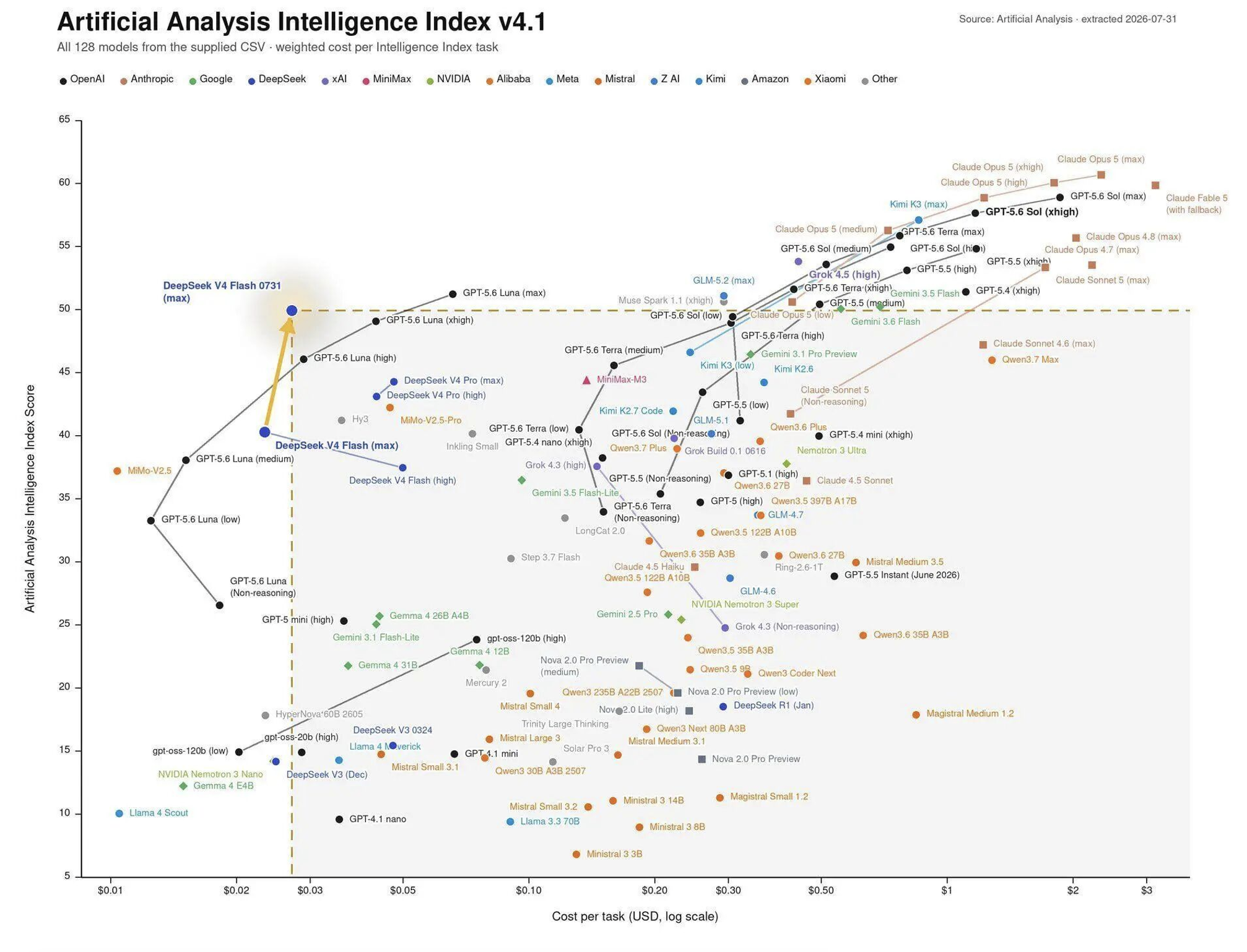
Not the kind of blue dot that shows up in your GPS when you’re lost. The kind that makes every AI pricing executive in Silicon Valley suddenly very uncomfortable. That dot is DeepSeek V4 Flash 0731, and it just drew what one observer called a “pretty brutal kill line” on the Artificial Analysis index. The name might sound like clickbait, but the data earns it.
Here’s the headline: DeepSeek V4 Flash 0731 scores around 50 on the Artificial Analysis intelligence index at roughly three cents per weighted task. Everything cheaper scores lower. Everything that scores higher sits way farther to the right on the cost axis. There’s a reason the developer community spent 35 comments arguing about this single chart. Let’s dig into why this matters, what it actually means, and where the hype starts to fall apart.
The Dot That Breaks the Curve
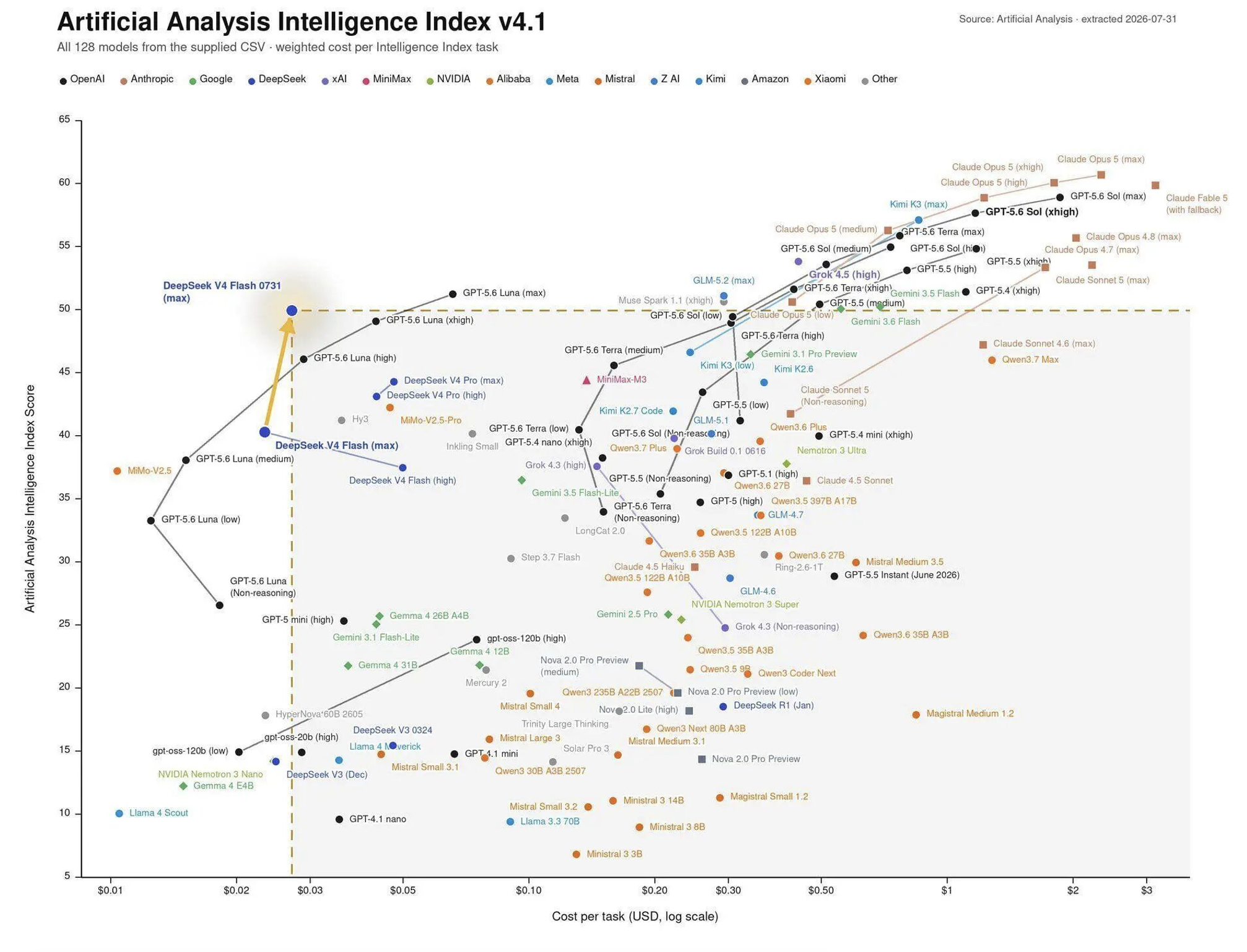
The most absurd part of this chart isn’t the dot itself, it’s the dot sitting almost directly beneath it. The older V4 Flash checkpoint scores around 40 on the index. The new 0731 post-training update jumps to roughly 50. And the cost? Barely moved. We’re talking about a ~25% performance increase from what is explicitly a post-training rerun, not a new architecture, not a bigger model, just better alignment and agent behavior.
The price gap buys several DeepSeek calls, including a retry or two, before you get anywhere near the upper-right cluster of frontier flagships. For a “Flash” model, the volume tier, the cheap one, the model you’d use for classification and extraction at scale, this is nuts.
Let’s put the pricing in perspective. The regular rates are $0.14 per million input tokens and $0.28 per million output tokens on cache miss. But the third-party market has already found cheaper: StreamLake offers the same model at $0.088 input and $0.176 output. Over the past 90 days, the cheapest input price has fallen 37%, from $0.140 to $0.088 per million tokens. The model’s cache-hit input price is even more absurd: $0.0028 per million tokens, cheaper than many embedding models charge for a single API call.
Compare that to GPT-5.6 Sol at $30 per million output tokens, or Claude Opus 4.8 at $25. As we covered in our earlier analysis of DeepSeek’s pricing strategy, that’s a 50x to 150x cost advantage. This isn’t a discount. This is a different universe of economics.
What “Cost Per Task” Actually Means
Before you start rewriting your entire infrastructure strategy, let’s be clear about what the chart is measuring. The skepticism in the Reddit thread is warranted, one developer asked exactly the right question about what “per task” means, and the answer is less straightforward than the marketing implies.
The “task” is a standardized weighted evaluation unit, a blended average of typical real-world workloads rather than a single simple prompt. It tracks the cost and performance of running benchmark suite test queries. It accounts for average token consumption within those standardized tasks. But it does not reflect a model that gets chatty or loops inefficiently on your specific custom prompts. It’s not the bill for your exact coding run or that 200k-context mess you’ve been debugging all week.
The index itself is Artificial Analysis v4.1, English-only and text-only. So the “DeepSeek wins everything” takeaway would be nonsense. What’s harder to wave away is the model’s position in the lower-left corner of that chart. The efficiency frontier moved, and DeepSeek brought the frontier along with it.
Same Architecture, Different Behavior
Here’s the part that should genuinely worry competitors: the performance jump came without any architectural change. The official release notes state plainly that DeepSeek-V4-Flash-0731 has the same model structure and size as the Preview version. Only the post-training was rerun. That has three practical consequences:
- Latency and cost profiles stay stable. No parameter-count change means no reason to expect different throughput or price. And indeed, no price change was announced.
- Your prompts may shift behavior anyway. Post-training is exactly what changes tool-calling style, refusal behavior, and verbosity. If you have prompt-brittle agent scaffolding, re-run your evals this week.
- Self-hosters are unaffected for now. This was an API-side upgrade, no new open weights were released with the changelog.
The agent benchmark scores DeepSeek reports are striking for a “cheap” model:
| Benchmark | V4-Flash (official) | What it measures |
|---|---|---|
| Terminal Bench 2.1 | 82.7 | Long-horizon terminal/shell agent tasks |
| NL2Repo | 54.2 | Building a working repo from natural-language spec |
| Cybergym | 76.7 | Security/CTF-style agentic reasoning |
| DeepSWE | 54.4 | Real-world software engineering issue resolution |
| Toolathlon (verified) | 70.3 | Multi-tool orchestration under verification |
| Agent Last Exam | 25.2 | Hard, open-ended agent reasoning |
| Automation Bench (Public) | 25.1 | End-to-end workflow automation |
| DSBench-FullStack | 68.7 | Internal full-stack development suite |
| DSBench-Hard | 59.6 | Internal hard coding-agent suite |
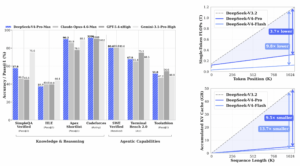
The one awkward detail: the current Pro preview point is worse than Flash 0731 on the same chart. Pro hasn’t won anything yet in the agent benchmarks. You can’t help but wonder what happens if the finished Pro gets a similar post-training jump, the pattern we flagged in our look at DeepSeek’s open-weight strategy suggests this is a deliberate playbook, not an accident.
The Elephant in the Chart: Local Hardware
Here’s the pushback that keeps this from being a one-sided victory lap. The chart measures cloud API costs. It doesn’t measure what it costs you to run a model on your own hardware, and for a lot of developers, that’s the relevant metric.
The local-vs-cloud debate gets fierce here. Qwen 3.6 27B runs fine on a single 24GB consumer GPU. DeepSeek V4 Flash, with its 284B total parameters (13B activated), requires enterprise-grade setups. One developer put it bluntly: “Local doesn’t mean really small, poor people machine. Local can be a 256GB DDR5 build, which can easily run DSF4.” Another noted that on a MacBook M5 Max with 128GB RAM, Qwen 3.6 27B gets q8_0 quantization with huge context, no KV cache compression, something you can’t replicate with a quantized DeepSeek Flash on similar hardware.
And the cost-per-task metric has a blind spot here. There is a vocal argument that Qwen 3.6 35B can’t possibly take 25x the resources of DeepSeek V4 Flash, one runs on a laptop, the other needs a $10,000 setup for similar speeds. The cloud pricing chart makes Qwen look hopelessly expensive per task, but the actual deployment cost tells a different story if you already own the hardware.
The fair conclusion: DeepSeek’s pricing reset is transformative for cloud workloads. It’s not automatically the right answer for local deployments, where the true cost of ownership favors smaller, quantized models you can run on hardware you already own.
The Cache Discount Nobody’s Talking About
The most underrated number in DeepSeek’s pricing sheet is the cache-hit rate. At $0.0028 per million tokens for V4 Flash, cached input is essentially free. For agent workloads, RAG pipelines, and chat applications that repeatedly send the same system prompt or document context, this changes the math dramatically.
But there are caveats. DeepSeek describes caching as “best effort”, it doesn’t guarantee a hit rate. Unused cache entries are usually cleared after hours to days, so a one-time warm-up doesn’t establish a permanent discount. And the honest way to budget is to log the prompt_cache_hit_tokens and prompt_cache_miss_tokens fields in the usage object and measure your actual hit share before committing budget.
There’s also the announced-but-not-yet-active 2x peak-hour pricing. DeepSeek says every billing item will cost double during two daily Beijing-time windows (09:00, 12:00 and 14:00, 18:00 UTC+8). The effective date is still TBA, but if you’re routing production traffic through DeepSeek during those hours, your bill could double without warning once the policy activates.
The Migration Checklist
If you’re already on DeepSeek’s API, the July 31 update is painless. The model string stays deepseek-v4-flash, the endpoint stays the same, and you automatically get the 0731 checkpoint. Here’s the short checklist:
- Keep the model string, no change, no endpoint change, no schema change.
- Re-run your agent and tool-calling evals, post-training changed behavior, so your evals from last week may not hold.
- If you run a Codex-style harness, try the native Responses API path and drop your translation shim. DeepSeek specifically adapted Flash for Codex, and the documentation is in their agent integrations guide.
- Don’t switch to V4-Pro for agent work on price grounds alone, Flash now leads on the published agent suites.
- Measure your cache hit rate before assuming the $0.0028 price applies to your workload.
The Takeaway
The “kill line” language is a bit dramatic. Being on the Pareto frontier doesn’t kill every model below it, there are other requirements for each use case, and models that score lower on the Artificial Analysis composite can still be the right choice for specific workloads. The people who point out that most of the chart would already be empty if the Pareto line “killed” everything below it aren’t wrong.
But the underlying shift is real. DeepSeek V4 Flash 0731 delivers performance roughly 25% above its predecessor at essentially the same cost, on the same architecture, with nothing but a post-training rerun. It beats the Pro preview on agent benchmarks while costing a fraction of what Pro-tier models typically charge. It’s available from 17 providers, with third-party pricing already driving the effective rate well below DeepSeek’s own list price. And the speculative decoding work DeepSeek is shipping on top suggests the efficiency gains aren’t slowing down.
The price/performance curve doesn’t look broken because of a gimmick. It looks broken because one team decided that making the cheap model dramatically better was a better strategy than making the expensive model slightly cheaper. That’s not a single dot on a chart, that’s a roadmap. And everyone else in the industry just got a look at it.