A Reddit user recently posted a screenshot of their DeepSeek bill: over 1.9 billion tokens processed for less than $23. The comment thread immediately split into two camps. One side pointed to DeepSeek’s published research on compressed sparse attention (CSA) and Mixture-of-Experts routing. The other side, with equal conviction, called it “state-subsidized dumping” and questioned how any company could sell inference below raw hardware cost.
So which is it? Is DeepSeek genuinely redefining the efficiency frontier of large language models? Or is this a politically-motivated price war that can’t hold?
The answer is deeply uncomfortable: it’s both, and the distinction matters far less than you think.
The Architecture That Makes the Numbers Possible
Let’s start with what’s undeniable. DeepSeek’s engineering team has pulled off something real. Their latest paper (arXiv:2607.05147) and published API documentation reveal a stack that cannot be dismissed as mere subsidy:
| Metric | DeepSeek V4 Flash | DeepSeek V4 Pro |
|---|---|---|
| Total Parameters | 284B | 1.6T |
| Activated Parameters | 13B | 49B |
| Context Window | 1M tokens | 1M tokens |
| Max Output | 384K tokens | 384K tokens |
| Input (Cache Miss) | $0.14/M tokens | $0.435/M tokens |
| Input (Cache Hit) | $0.0028/M tokens | $0.003625/M tokens |
| Output | $0.28/M tokens | $0.87/M tokens |
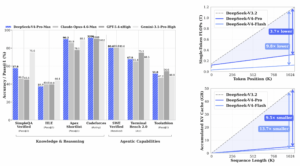
The Mixture-of-Experts (MoE) architecture is the headline act. Only 13 billion parameters activate per token on the Flash model, and 49 billion on the Pro. That’s roughly 4-5% of total parameter count per forward pass. OpenAI and Anthropic keep their sparsity ratios under lock and key, but comparable MoE models from other labs typically activate 20-30% of total parameters. DeepSeek’s ratio is essentially saying “we have a massive brain, but we only wake up the neurons that matter for your specific question.”
That alone cuts compute by 5-10x compared to dense models.
But the real magic lives in the hybrid attention mechanism. DeepSeek combines three distinct attention strategies:
- Compressed Sparse Attention (CSA), compresses KV cache tokens and uses a selector to retrieve only the most relevant memories
- Highly Compressed Attention (HCA), dense attention applied to extremely compressed token representations
- Dense attention for recent tokens, no compression on the most recent context window
This triplet means the model can process a 1M token context window without the quadratic memory explosion that plagues vanilla transformers. The KV cache optimization alone reduces memory requirements by an estimated 60-80% versus standard implementations, and they’ve written custom MegaMoE kernels to make the whole thing sing on hardware.
The Cache-Hit Economy That Changes Production Math
The numbers above are headline rates. The real cost tells a different story.
OpenRouter’s effective pricing data for DeepSeek V4 Pro reveals that customers are paying a weighted average input price of just $0.027 per million tokens, not the $0.435 list price. How? A 94.6% cache hit rate.
Here’s what that looks like in practice. One user reported processing “19 billion input and 60 million output tokens” with a 98.8% cache hit rate. At cache-hit pricing of $0.003625 per million input tokens, that 19 billion tokens effectively cost roughly $69 in input. The output, at $0.87 per million, added about $52. Total bill for nearly 20 billion tokens: ~$121.
Grok or Sonnet would have charged north of $10,000 for equivalent volume.
The cache mechanism works because DeepSeek uses byte-stable prefix caching. If your system prompt, tool definitions, and static document context are identical across requests, and they should be, the API recognizes the byte-level match and charges the cached rate. The loop is append-only on the user side, aligned to DeepSeek’s byte-stable prefix cache. Long sessions hold 90%+ cache hit rates.
This is not subsidy. This is a server-side optimization that rewards structured engineering. The developers who build applications that preserve prompt stability benefit disproportionately. Those who haphazardly restructure prompts or randomize ordering pay full price.
Where the “Subsidy” Argument Gets Real
Here’s where the narrative gets uncomfortable. DeepSeek’s raw pricing, even before caching, is impossible to fully reconcile with Western compute economics.
The cost to run inference on a single H100 node capable of serving DeepSeek V4 Flash (requiring ~160GB VRAM) runs roughly $3,000-6,000 per month on cloud GPU rental. A single customer with 24/7 usage generating 250 tokens per second across 2,500 concurrent requests could consume an entire node’s capacity. At DeepSeek’s listed pricing of $0.14/M input and $0.28/M output, that customer would generate monthly revenue of approximately $18,000-36,000 in output alone. That pencils out, barely.
But the 2500 concurrent request limit on V4 Flash with 99.95% uptime suggests DeepSeek is running infrastructure at a scale that Western venture capitalists would call irrational. The context is important: China has massive government investment in AI infrastructure, subsidized electricity, and a state-backed mandate to capture market share in foundational AI.
The question becomes not “are they subsidized?” but “at what point does state-backed loss-leader pricing cross into anti-competitive dumping?”
DeepSeek’s consumer chat is completely free. No subscription. No ads. No data monetization that’s been disclosed. 5 million free API tokens on signup with no credit card. These are behaviors that signal a company playing a long game where shareholder returns are not the primary objective.
The Architectural Innovation vs. Brute-Force Scaling Debate
This narrative fits into a larger pattern in AI development. The industry has spent years obsessed with parameter count and training compute as the primary vectors for progress. DeepSeek’s approach represents a fundamentally different philosophy: architectural innovation over brute-force scaling.
A recent post on architectural innovation vs brute-force scaling strategies explored exactly this tension. The argument goes that serious architectural improvements, like DeepSeek’s CSA/HCA hybrid attention, can deliver more efficiency gains than simply throwing hardware at the problem. DeepSeek’s results validate this thesis.
But the embrace of open-weight, MIT-licensed models adds another dimension. The open-weight model efficiency and distillation tradeoffs discussion highlights how these releases create downstream ecosystems. When DeepSeek’s weights are available for anyone to run locally or fine-tune, the API pricing isn’t just a transactional relationship, it’s a beachhead for ecosystem capture.
The Real Cost: Reliability, Sovereignty, and Hidden Tax
Before you swap every OpenAI integration to DeepSeek’s base URL, consider the full production picture. Low token price is not the same as low production cost.
DeepSeek’s infrastructure is based in China. All API requests route through Chinese servers. During peak hours, which in practice means during North American business hours when demand spikes, users report higher latency and occasional 503 errors. The API has no published SLA and operates on a best-effort basis.
The latency data from OpenRouter tells a nuanced story. While DeepSeek’s direct API has a respectable 1.21s median latency and 99.95% uptime, third-party providers like DeepInfra (0.84s) and Together (0.60s) offer faster response times, at the cost of 3-4x higher pricing per token. When throughput matters, Baseten’s 85 tok/s blows past DeepSeek’s 45 tok/s.
| Provider | Input/M | Output/M | Latency | Throughput | Uptime |
|---|---|---|---|---|---|
| DeepSeek (Direct) | $0.435 | $0.87 | 1.21s | 45 tps | 99.95% |
| Together AI | $1.74 | $3.48 | 0.60s | 68 tps | 99.20% |
| Baidu Qianfan | $0.7453 | $1.491 | 0.67s | 55 tps | 99.38% |
| Baseten | $1.74 | $3.48 | 0.67s | 85 tps | 99.54% |
For applications handling sensitive or regulated data, the Chinese data jurisdiction is a dealbreaker regardless of price. Italy’s GDPR ban on DeepSeek R1 in 2025 was the first domino. More will follow as data protection authorities scrutinize the cross-border data flows.
This creates a segmented market: price-sensitive, latency-tolerant, non-sensitive workloads can fully exploit DeepSeek’s pricing advantage. Enterprise, regulated, or latency-sensitive workloads must route through premium providers like AWS Bedrock or Azure, where DeepSeek models cost several times the direct rate, though still below Western competitors.
Who Wins and Who Loses
The most explosive effect of DeepSeek’s pricing isn’t on the competitors, it’s on the unit economics of everything built on top of AI.
Consider coding agents. Tools like Kilo Code, pi.dev, and OpenClaw are collectively consuming hundreds of billions of tokens per month on DeepSeek models alone, according to OpenRouter’s app traffic data. Hermes Agent, a self-improving AI agent by Nous Research, has consumed over 2 trillion tokens of DeepSeek V4 Pro. At cache-hit pricing, that’s roughly $5,400 in input costs. At GPT-5.5 rates, the same volume would cost approximately $540,000.
The AI infrastructure cost dynamics and engineering hype cycles are being rewritten in real time. Startups that would have burned through $50,000/month on API costs are operating on $500-1,000/month budgets. Agentic workloads that were economically infeasible become viable. The entire cost basis for AI-native products shifts downward.
For Anthropic and OpenAI, this creates an impossible strategic bind. If they match DeepSeek’s pricing, their margins evaporate, they lack the Chinese state backing and have fiduciary duties to shareholders. If they don’t match, they lose the developer mindshare to a cheaper alternative that performs comparably on most benchmarks.
The likely resolution isn’t price warfare. Western labs will retreat upmarket toward enterprise reliability, custom fine-tuning services, and data sovereignty guarantees, the things DeepSeek cannot easily provide from Hangzhou.
The Pragmatic Verdict
DeepSeek’s pricing is revolutionary efficiency and clever subsidization. The two are not mutually exclusive.
The architectural innovations, CSA, HCA, MoE sparsity ratios, custom kernel optimization, are real and represent genuine breakthroughs in inference efficiency. The cache-hit economics are brilliant engineering that rewards well-structured applications. At the architectural level, DeepSeek has earned its pricing advantage.
But the scale of infrastructure, the absence of margin pressure, the free consumer tier, and the geo-political context all point to a pricing strategy that no purely commercial Western entity could sustain. At the business level, the state-backed subsidy narrative holds water.
For developers and startups, the practical question is simpler: Does it work for your use case at acceptable reliability?
Start with the free 5 million token grant. Benchmark against your current provider using real payloads, not marketing examples. Measure cache-hit rate, latency distribution, tool-calling accuracy, and retry frequency. If the numbers work and data sensitivity isn’t a blocker, the cost savings are too large to ignore.
But build in fallback routing. Use OpenRouter or a multi-provider strategy so that when DeepSeek’s API has a peak-hour hiccup, and it will, your application gracefully degrades to a more expensive but reliable alternative. The optimal strategy in 2026 is not “pick the cheapest provider.” It’s “engineer for the cheapest provider with automatic fallback to reliability.”
The dark magic of DeepSeek’s pricing is that it forces every engineering team to make a conscious choice about how much reliability they’re willing to trade for cost. That calculation didn’t exist two years ago. Now it defines the new frontier of AI economics.