A Reddit user gave their local Qwen3.8-27B model a single prompt: pull up their university class schedule from the school’s notoriously convoluted website. No step-by-step instructions. No human checkpoints. No cloud API.
The model executed 80 tool calls, navigating the messy web of institutional portals, handling authentication, scraping the right pages, and returning the schedule. Unattended.
Then someone asked it to investigate a stranger on social media. The model found a public video, downloaded it, extracted frames every few seconds to “watch” the content, installed OpenAI’s Whisper to transcribe the audio, and selectively zoomed in on and brightened specific frames to identify what was happening.
All of this on a single RTX 3090. All of it without a single API call to OpenAI, Anthropic, or Google.
Welcome to the new reality of local AI agency, and it’s arriving a lot faster than most people expected.
The “Brain Damage” Quant That Started the Conversation
The story begins with a joke. A user with just 8GB of VRAM tried Unsloth’s 1-bit quantization of Qwen3.8-27B, a compression so aggressive it’s practically a skeleton of the original model, and shared the results. The community response was equal parts laughter and shock. One screenshot showed the model confidently telling the user “no motherfucker, you tell me the latest Python version” in a hilariously inverted power dynamic.
But underneath the comedy lay something significant. Even at 1-bit, the model retained enough capability to run on hardware that previously couldn’t dream of a 27B parameter model. The 1-bit quant comes in at around 6.2GB, small enough for practically any modern laptop with decent RAM.
That’s the entry point everyone’s excited about. But the real story isn’t what a 1-bit quant can do, it’s what a properly configured Q4 quant can do when you give it the right tools and enough autonomy.
80 Tool Calls, Zero Human Intervention
The class schedule example deserves unpacking, because it’s not just impressive, it’s structurally different from what local models have been capable of. University websites are hostile to automation. They’re riddled with session tokens, redirect chains, popup modals, and inconsistent markup. Even a well-crafted scraper often fails.
Qwen3.8-27B didn’t just scrape a simple page. It navigated the full authentication flow, figured out which pages contained schedule data, extracted the relevant information, and returned it in a usable format. Eighty tool calls means the model was making decisions at every step: this page didn’t work, try this one, this link looks relevant, follow it, this data is what we need, extract it. That’s not pattern matching, that’s genuinely autonomous problem-solving.
The author reported their setup: Unsloth’s Q4_K_S quantization with KV cache quantized to q8, running through pi-agent with a custom AGENTS.md file that instructed the model to always consult external resources for facts. The Brave Search extension handled web queries. The model had built-in command-line access. And critically, it was served through LM Studio on Linux.
The result? A local AI that behaves less like a chatbot and more like a competent research assistant who doesn’t need to be micromanaged.
The Video Investigation Nobody Asked For
The second example is where things get genuinely unsettling in the best way possible.
Asked to investigate a user on a social media network, Qwen3.8-27B:
- Found a public video associated with the user
- Downloaded it to local storage
- Extracted frames at intervals to create a visual timeline
- Installed OpenAI Whisper and ran transcription on the audio
- Analyzed the content by selectively zooming and brightening frames to understand context
Think about what that sequence represents. The model identified a task, decomposed it into sub-tasks, installed software it didn’t have, executed a complete media analysis pipeline, and made judgment calls about which frames mattered. That’s not a language model generating text. That’s an agent operating in the world, using tools in sequence to accomplish a complex goal.
Yes, the user provided credentials and context. But the model made every intermediate decision. It’s the difference between giving someone a recipe and giving someone a kitchen with ingredients and letting them figure out the meal.
The Tool-Calling Trap: What Actually Breaks
Before you get too excited, there’s a critical caveat.
Unsloth’s head researcher explicitly warns against using 1-bit quant for agentic workflows. The reasoning is mathematical, not opinionated. Testing shows that over 32 tokens, 1-bit quant diverges from BF16 accuracy by a staggering 92%. That means the longer a conversation gets, the more likely the model is to:
- Fail to call tools entirely
- Call tools repeatedly in a loop
- Call the wrong tool altogether
Unsloth’s Divergence-300 benchmark paints a clear picture:
| Quantization | Accuracy over 32 tokens | Divergence from BF16 |
|---|---|---|
| 1-bit (UD-IQ1_S) | ~8% | 92% |
| 2-bit (UD-Q2_K_XL) | ~21% | 79% |
| 4-bit (UD-Q4_K_XL) | ~68% | 32% |
Only general knowledge is retained at heavy quantization levels. The nuanced reasoning required for multi-step tool orchestration simply doesn’t survive. If you experience excessive looping, Unsloth recommends cranking presence_penalty to 1.5 or higher, a fix that helps but doesn’t cure.
The community has already discovered this the hard way. One user reported good success with Q3_K_XL and q8_0 KV quantization at full native context with vision enabled, but saw performance tank from ~1500pp and ~44tg to ~123pp and ~1.28tg when multi-token prediction was enabled. Every optimization has a trade-off.
The Sweet Spot: Why Q4_K_S Is the Real Hero
Here’s what makes the 80-tool-call story so remarkable: it didn’t happen on the bleeding edge of quantization. It happened on a conservative Q4_K_S setup with quantized KV cache. That’s not a parlor trick, it’s a practical configuration that runs on widely available hardware.
The Qwen3.8-27B memory requirements look like this:
| Quantization | Approximate Memory | Hardware Target |
|---|---|---|
| 4-bit | 17-19 GB | RTX 4090 / 24GB Mac |
| 6-bit | ~24 GB | Single 24GB card |
| 8-bit | ~31 GB | 32GB+ cards |
| BF16 | ~56 GB | 80GB-class only |
A single RTX 3090 (24GB) runs the 4-bit quant comfortably with room for context. That’s not exotic hardware, it’s a used card that goes for a few hundred dollars. The barrier to entry for frontier-adjacent AI agency has collapsed.
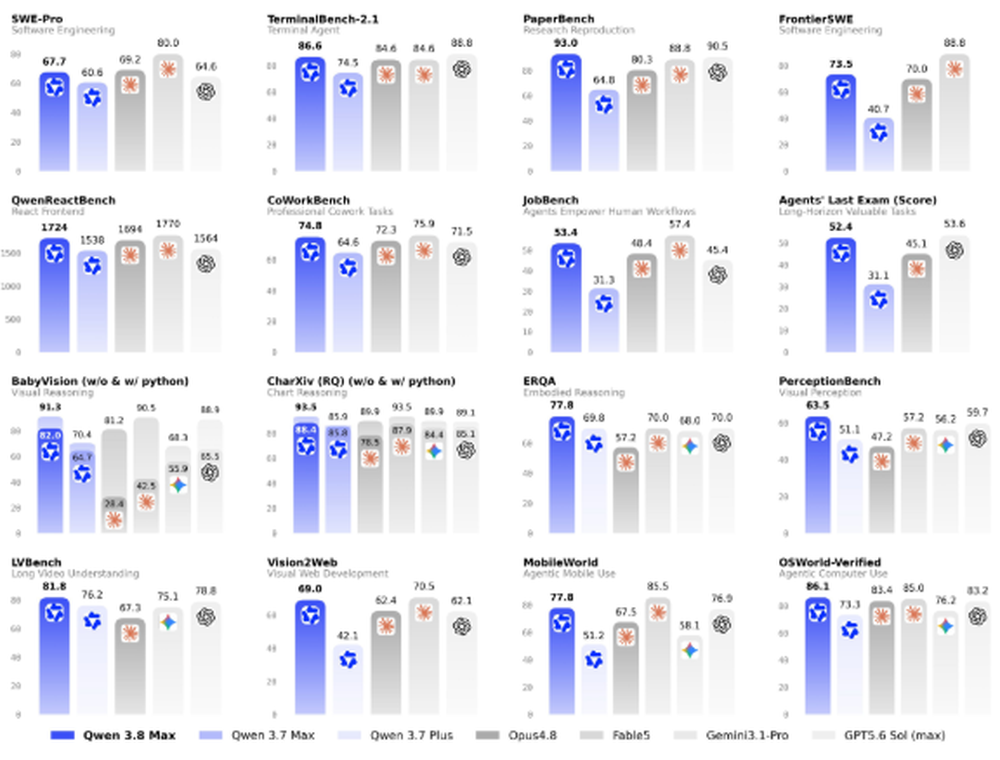
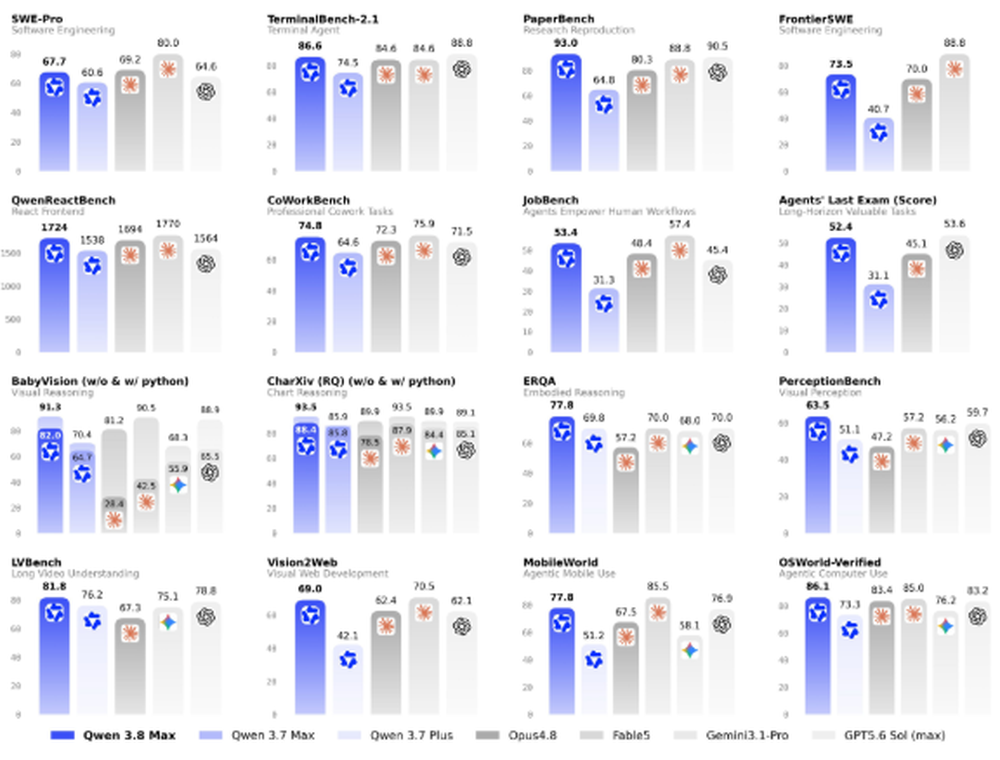
The official model card shows why this matters for agentic coding: SWE-bench Pro scores of 61.7 versus 53.5 for the previous generation. On OSWorld-Verified (computer-use style VL tasks), it hits 84.3. These are not incremental improvements, they’re categorical jumps in what’s achievable on local hardware.
The Setup That Unlocks This: Beyond the 3-Command Guide
If you want to replicate these results, you don’t need to wrestle with complex infrastructure. KDnuggets demonstrated a streamlined path using Ollama and OpenCode:
curl -fsSL https://ollama.com/install.sh | sh
ollama serve & ollama pull qwen3.8:27b
ollama launch opencode --model qwen3.8:27b
Three commands. That’s it. The model loads, OpenCode launches, and you’re directing a local coding agent that can build, test, and debug applications without cloud dependencies. In under two minutes, it can scaffold a complete Python application, run tests, and provide a project summary.
But for the kind of autonomy described above, you’ll want more control. Here’s the practical path:
1. Serve with LM Studio or llama-server. This gives you an OpenAI-compatible endpoint without additional infrastructure.
2. Wire up an agent framework. Pi agent, OpenCode, or even a custom Python script using the OpenAI SDK:
from openai import OpenAI

client = OpenAI(base_url="http://localhost:8000/v1", api_key="local")

completion = client.chat.completions.create(
    model="Qwen/Qwen3.8-27B",
    messages=[{"role": "user", "content": "Research this topic and compile findings."}],
    extra_body={
        "chat_template_kwargs": {
            "enable_thinking": True,
            "preserve_thinking": True,
        },
    },
    reasoning_effort="xhigh",
    stream=True,
)
3. Configure your AGENTS.md carefully. Tell the model to consult external sources for facts. Set up search extensions. Grant command-line access. The model will handle the rest.
4. Enable thinking but manage the context budget. The QWE academy guide highlights the critical trade-off: preserve_thinking=True maintains consistency across agent steps but bloats context with historical reasoning. Long agent loops need it. Casual chats don’t. Toggle per workload, not as a global default.
The Security Nightmare Nobody’s Talking About
Here’s the part that should make you uncomfortable: this autonomy cuts both ways.
A model that can “watch” videos and transcribe audio is a model that can be weaponized. A model that can scrape university schedules is a model that can scrape banking portals. The uncensored Qwen3.6 variants already demonstrate that safety fine-tuning is easily stripped during quantization. Give a stripped model command-line access and tool-calling capability, and you’re not just running a chatbot anymore, you’re running an automated agent with real capabilities in the real world.
The community’s response has been characteristically unfazed. When someone joked about a 2% chance of the model calling rm -rf /, the reply was laughter. But this isn’t a joke. The tools that enable benign autonomy, web scraping, file manipulation, package installation, are the same tools that enable destructive or malicious behavior.
And unlike cloud APIs, there’s no content filter, no usage policy, no safety layer between a local model and the system it’s running on. If you give it root access, it has root access. Period.
The Context Problem That Will Bite You
There’s another subtle issue that most hands-on reports glaze over: the tension between thinking and context.
Qwen3.8-27B’s native 262,144-token window is impressive, but thinking traces eat it fast. A 30-minute reasoning session can consume 10,000+ tokens of internal monologue before the model even starts responding. On the default preserve_thinking=True, every historical thought stays in the window, growing each turn until “why is this slow?” becomes the most common question.
The previous generation’s context optimization worked around this by carefully pruning. But with autonomous agents, you’re in a bind: strip thinking traces and the model re-derives the same plan every turn (wasting tokens on re-planning), keep them and you eventually OOM or hit context limits mid-task.
The documentation is clear that weights fitting doesn’t mean the workload fits. A 4-bit model on 24GB can still OOM once thinking traces, images, and a fat system prompt share the KV cache. The practical answer is to start with shorter max_model_len and expand only after you’ve validated the workflow.
The Bigger Picture: What This Actually Means
The story everyone will tell is “local AI is now capable.” The story nobody wants to tell is what happens next.
When a 27B model on consumer hardware can autonomously execute complex multi-step tasks, researching, investigating, coding, analyzing, the economics of AI shift. You don’t need to route sensitive data through cloud APIs. You don’t need to pay per token. You don’t need to trust a third party with your prompts. The death of cloud AI has been predicted repeatedly, but this is the first time the hardware reality actually matches the hype.
More importantly, the Apple-style extreme compression making 27B models run on mobile devices suggests this capability is about to become ubiquitous. Qwen3.8-27B isn’t the end of this curve, it’s an early checkpoint.
The community consensus around the Qwen3.6-27B release was that dense models were the future. Qwen3.8-27B validates that bet and extends it. The ik_llama.cpp optimizations that achieved 72.9 tok/s on 24GB VRAM matter more than ever when your agent is running 80 tool calls per task.
The Bottom Line
Qwen3.8-27B running at Q4_K_S quantization is the first local model that genuinely crosses the agency threshold. It’s not just answering questions or writing code, it’s executing multi-step plans, installing software, navigating hostile websites, and analyzing media. All on hardware that’s in hobbyist-grade PCs today.
The 1-bit quant is a fun proof of concept, and a cautionary tale about the limits of aggressive quantization. But the real breakthrough is that a reasonable quant on reasonable hardware delivers unreasonable capability.
If you’re running an RTX 3090 or better, the practical takeaway is straightforward: download the Q4_K_S or Q4_K_XL GGUF, wire it up to your favorite agent framework, and let it work while you supervise. The model’s predecessor was impressive, this one is autonomous.
And for everyone else: start planning for what happens when your laptop, not a cloud API, can run a private investigator, a coding agent, and a research assistant simultaneously.
The cyberpunk future isn’t coming. It’s already running on someone’s RTX 3090 right now.