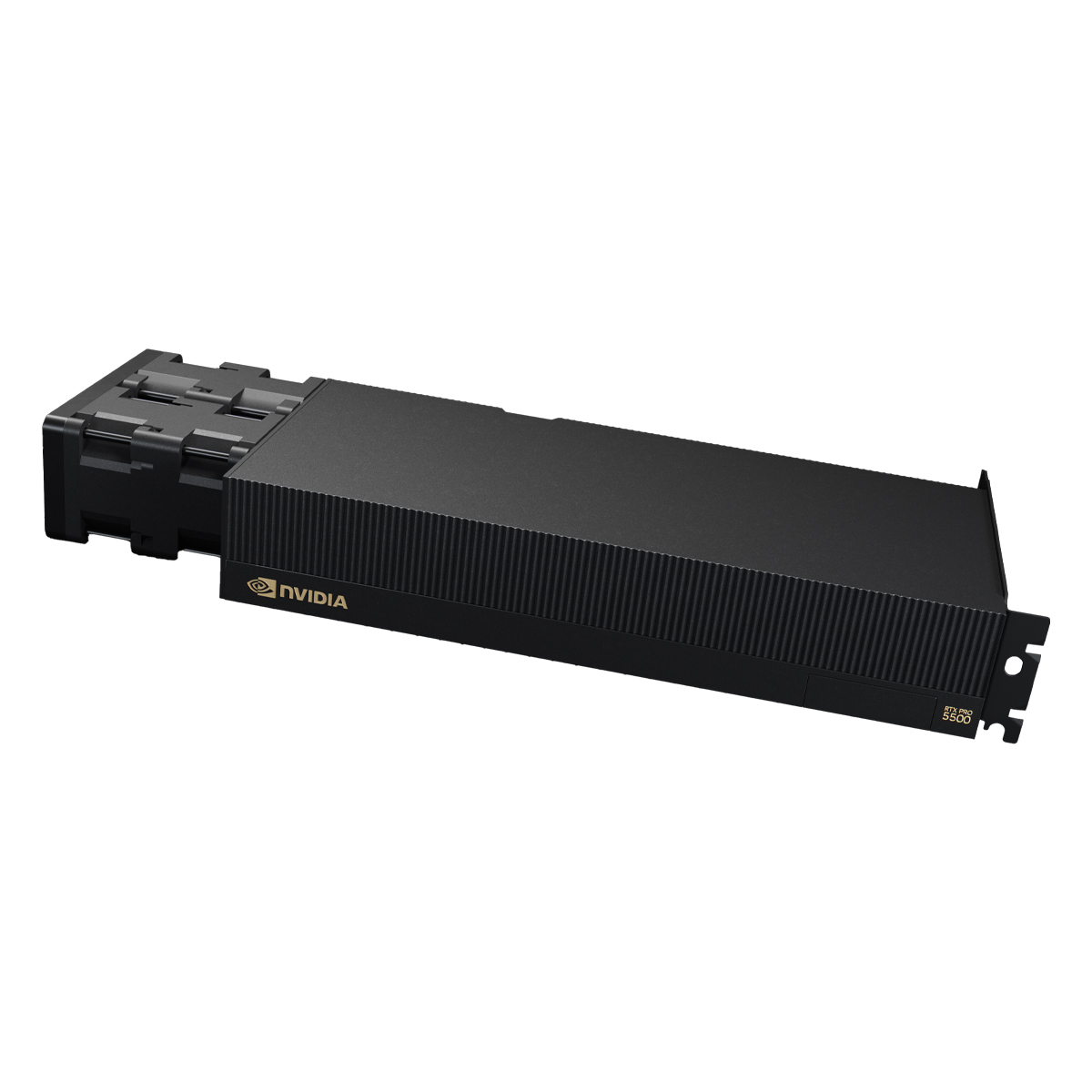
The company that once threw Jensen Huang on stage to unveil a glorified graphics card for gamers has quietly dropped a 600-watt, 84GB monster designed for server racks. The gaming era of NVIDIA isn’t just transitioning, it’s being systematically dismantled in favor of AI margins that make the old graphics business look like a lemonade stand.
Let’s dig into what this card actually is, why the specs raise more questions than they answer, and what it signals about where NVIDIA is steering the industry.
The RTX 5090’s Split Personality
Here’s the headline spec that should make you pause: the RTX PRO 5500 shares the exact same GB202 die and 21,760 CUDA core count as the consumer RTX 5090. Same silicon, same streaming multiprocessors, same theoretical compute ceiling. The difference? NVIDIA strapped 84GB of ECC GDDR7 memory onto the pro version, 2.6 times the 32GB found on its gaming sibling.
The pricing strategy is where this gets interesting. The RTX PRO 5000 with 48GB currently commands around $8,599, 9,200 on the street. Given the PRO 5500 sits much closer to the flagship PRO 6000 in terms of hardware, industry estimates place it somewhere north of $10,000. Tom’s Hardware frames it bluntly: NVIDIA makes substantially more profit putting recycled GB202 dies into the PRO 5500 than a GeForce RTX 5090.
You don’t need an MBA to see the play here. NVIDIA has essentially taken a die they were already shipping to gamers, added 52GB of VRAM they have in abundant supply, and is selling it for three times the price. The “revolutionary” part isn’t the hardware, it’s the margin structure.
The Memory Configuration Mystery
The 84GB VRAM figure raises an immediate technical question: how exactly did NVIDIA arrive at that number? A 416-bit interface? 448-bit? 28 modules in clamshell configuration? The spec sheets are genuinely contradictory right now.
PNY’s now-removed listing claimed a 416-bit memory interface, but that math doesn’t work. Thirteen 32-bit channels can’t cleanly produce 84GB with standard GDDR7 modules. A 448-bit interface with fourteen 3GB (24Gb) modules in clamshell mode, however, produces exactly 84GB, matching the memory subsystem used in the China-exclusive RTX PRO 6000D. That configuration also explains the 1,398 GB/s bandwidth figure, which works out to roughly 25 Gbps per module.
Here’s the counterintuitive part: the PRO 5500’s memory bandwidth is only 4% higher than the PRO 5000, and it’s a full 22% behind both the PRO 6000 and the RTX 5090. NVIDIA deliberately downclocked the memory chips to stay below the flagship’s 1,792 GB/s throughput. This is a segmentation strategy disguised as a specification.
That choice matters more than most buyers realize. As we’ve explored in the context of local AI inference, memory bandwidth often determines real-world performance more than raw compute. A card with 84GB of VRAM running at modest bandwidth is built for capacity-hungry workloads, not speed-sensitive inference.
What Can You Actually Do with 84GB?
NVIDIA markets this card as the Swiss Army knife of professional AI: agentic AI pipelines, physical simulation, rendering, scientific computing, and video production. The 84GB pool means you can hold substantially larger models, longer context windows, and multiple concurrent models without offloading to system memory.
For practical purposes, this translates to running 70B-parameter models with quantization at full context, or a substantial chunk of the quantization techniques that have been making waves in the local AI community. You could theoretically fit Muse Glimmer’s full 256k context window, which fits impressively on a single 3090 at lower precision, with massive room to spare.

The MIG support adds another layer of utility. The card can split into two fully isolated 42GB instances, each with dedicated memory, cache, and compute cores plus guaranteed quality of service. For rack deployments, that means two teams sharing one card without worrying about noisy neighbors. It’s effectively the GPU cluster approach but hardware-native and with proper isolation guarantees.
This Is an Infrastructure Card, Not a Workstation Card
Pay attention to the language NVIDIA uses around the RTX PRO 5500: “rack-mounted workstation deployment”, “choice of air- or liquid-cooled thermal solutions”, “letting teams centralize, share, and scale workstation GPU power across the enterprise.”
Translation: this card isn’t designed to sit under someone’s desk. It’s designed to live in a server room where IT can allocate GPU resources remotely. The 600W TDP, dual-slot form factor, and active airflow requirements all point to managed infrastructure rather than desktop workstations.
The liquid-cooled RXM form factor strengthens that interpretation. NVIDIA is positioning this alongside their enterprise virtualization stack, enabling the kind of centralized GPU pools that DIY builders have been cobbling together with consumer hardware, just with proper vendor support and warranty coverage.
The Backlash Was Swift and Predictable
The hardware community didn’t waste time pointing out the obvious. The prevailing sentiment across technical forums is that this is essentially “a cut-down PRO 6000 sold at a markup to fill the gap between the 5000 and 6000.” One commenter noted the pricing is likely “more than a ZJ”, which is about as concise a technical assessment as you’ll find anywhere.
Others pointed out the more uncomfortable truth: NVIDIA’s pricing structure has become less about hardware costs and more about capturing AI budgets. The wholesale price hikes on the PRO 6000, which has nearly doubled from its original MSRP to $16,000, suggest NVIDIA is testing exactly how much AI budgets will bear.
The Reveal: this is NVIDIA’s real strategy. They’ve essentially created a pricing ladder where each rung costs $2,000, 3,000 more and offers marginal capacity improvements. The PRO 5500 at $10K+ sits between the $9,200 PRO 5000 and the $16,000 PRO 6000, filling the “bridge” position with a card that’s closer to the flagship in performance than its naming suggests.
What the Spec Table Actually Tells Us
The full RTX PRO Blackwell lineup tells a compelling story about NVIDIA’s segmentation strategy:
| Card | CUDA Cores | VRAM | Bandwidth | TDP |
|---|---|---|---|---|
| RTX PRO 6000 | 24,064 | 96GB GDDR7 | 1,792 GB/s | 600W |
| RTX PRO 5500 | 21,760 | 84GB GDDR7 | 1,398 GB/s | 600W |
| RTX PRO 5000 | 14,080 | 48, 72GB GDDR7 | 1,344 GB/s | 300W |
| RTX PRO 4500 | 10,496 | 32GB GDDR7 | 896 GB/s | 200W |
| RTX PRO 4000 | 8,960 | 24GB GDDR7 | 672 GB/s | 140W |
The PRO 5500’s 21,760 CUDA cores leave only 11% of the GB202 die disabled, the same configuration as the RTX 5090. That’s notably less cut-down than the PRO 6000D (19,968 cores) and dramatically more than the PRO 5000 (14,080 cores). NVIDIA isn’t binning heavily defective chips here, they’re making a deliberate product decision to target AI buyers with a card that has maximum compute overhead and capacity.
That point deserves emphasis: the PRO 5500 is a better AI compute card than the RTX 5090 while being cheaper to produce (same die, less memory bandwidth to validate). The consumer card exists to subsidize the pro lineup’s development, the pro card exists to capture AI margin.
Where Does This Leave the AI Infrastructure Conversation?
The launch timing is notable. NVIDIA is pushing the RTX PRO 5500 into a market where DIY multi-GPU builds are delivering surprising results, and local inference quality continues to improve rapidly. The value proposition of a $10K card with 84GB of VRAM is increasingly competitive against building your own cluster, but not always clearly better.
The PRO 5500 does have advantages over consumer alternatives: ECC memory, MIG partitioning, enterprise-grade driver validation, and support contracts. For organizations running production workloads, those features justify the premium. For hobbyists and researchers pushing the limits, NVIDIA’s existing optimized models and local AI tools might offer better bang for buck.
The Bigger Picture: NVIDIA Has Fully Pivoted
Tom’s Hardware hit the nail on the head when they noted that “Nvidia stopped being a gaming company years ago.” This announcement makes that transformation explicit. The RTX PRO 5500 isn’t an evolution of the workstation GPU, it’s a repackaging exercise designed to maximize AI margins.
The economics are undeniable: NVIDIA can sell the same silicon as a $2,000 gaming card or a $10,000 AI workstation card. The only difference is memory configuration and driver support. In a market where AI budgets are expanding rapidly, the choice is obvious.
For enterprise architects evaluating GPU infrastructure, the PRO 5500’s appeal depends on workload patterns. If you need capacity for large models with modest inference speed requirements, the 84GB pool is attractive. If you’re running latency-sensitive inference, the memory bandwidth cap might become a bottleneck, especially compared to the PRO 6000’s significant bandwidth advantage.
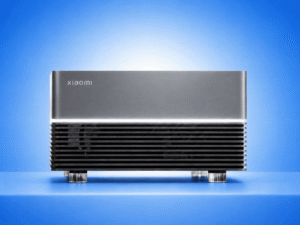
The Gorgon Halo mini PC with 192GB unified memory and Xiaomi’s 1.22TB/s AI Cube are pushing into this same capacity-optimized space from different angles. The PRO 5500 is NVIDIA’s answer: a professionally supported, capacity-focused AI accelerator that avoids cannibalizing their own data center GPU sales.
The Verdict: Who Should Care
If you’re running a research lab or enterprise AI team that needs 84GB of VRAM with ECC, MIG partitioning, and vendor support, the PRO 5500 fills a genuine gap in the lineup. The $10K+ price tag is justified relative to the PRO 6000’s $16K MSRP, if you can actually get it at MSRP.
If you’re an individual developer or small team building AI infrastructure on a budget, the 16x RTX 5060 Ti cluster or a six-card 3090 setup might deliver comparable capacity at a fraction of the cost, albeit with more operational complexity and no support guarantees.
What’s undeniable is that NVIDIA has made a strategic bet: enterprise AI budgets will absorb $10K+ workstation cards as easily as they’ve absorbed $30K+ server GPUs. The RTX PRO 5500 is the test case. If it sells well, expect the “gamer-to-AI repackaging” pipeline to become a standard part of NVIDIA’s product strategy.
The pricing will land in the “contact sales” territory, which is NVIDIA-speak for “if you have to ask, you can’t afford it.” That’s not the response of a company serving its legacy gaming community, it’s the response of a company that’s identified where the real margins live and is systematically moving in that direction.
Welcome to the new NVIDIA. It doesn’t need a stage show to sell hardware anymore.