Every AI vendor wants to tell you their model is “the one.” The one that finally makes local AI feel instant. The one that fits on your device. The one that doesn’t need a data center the size of a football stadium to run a decent chatbot.
NVIDIA just dropped Nemotron-3.5-Bolt-E4B-4GB, and for once, the claims are worth looking at twice. This isn’t another 405B-parameter monster requiring a cluster of H100s. It’s an 8B-parameter model with 4B effective parameters, quantized down to fit in roughly 4GB of memory, and it’s designed for exactly one thing: fast, conversational, edge-based AI assistants that actually respond quickly.
The “revolutionary” part isn’t just the size. It’s the speculative decoding tech underneath it.
Why Time-to-First-Token Is the Real Edge AI Killer
Let’s talk about why edge AI has been stuck in the uncanny valley for so long. It’s not that small models can’t hold a conversation. It’s that they take two to three seconds to generate the first token, and by the time they do, you’ve already pulled out your phone to check something else.
Text generation runs in two phases. Prefill ingests the whole prompt in one compute-bound pass. Then decoding produces one token per forward pass, and here’s the ugly part: at batch size one, decoding is memory-bound, not compute-bound.
An 8B model in bf16 on an H100 reads its weights once and hits roughly 208 tokens/second ceiling, just from memory bandwidth. That’s fine for streaming a long response, but it means the first token takes forever. For a voice assistant, the difference between 200ms and 2000ms latency is the difference between “feels natural” and “feels like a robot from 2015.”
NVIDIA’s answer to this is DFlash, a speculative decoding drafter that turns the latency problem on its head.
DFlash: The Art of Guessing Well
Here’s the core insight behind speculative decoding: decoding is memory-bound, so verifying multiple tokens in one forward pass costs almost the same as generating one token. If you can guess the next seven tokens cheaply, the target model can check them all at once and accept the ones that make sense.
NVIDIA open-sourced a DFlash drafter companion, a 360M-parameter model stored in a 737MB GGUF file, that pairs with the Nemotron-3.5-Bolt-E4B target. The drafter is a five-layer Qwen3-style decoder that takes hidden states from the target model and proposes an 8-token block in a single non-causal forward pass. The target verifies them in one pass and accepts up to 7 of them.
The acceptance length numbers are the meat here:
| Category | AL, greedy (t=0) | AL, sampling (t=1) |
|---|---|---|
| writing | 2.98 | 2.92 |
| roleplay | 2.79 | 2.57 |
| reasoning | 3.88 | 3.52 |
| math | 5.87 | 5.67 |
| coding | 4.62 | 4.17 |
| Overall Average | 3.88 | 3.63 |
Math acceptance is the bright spot at 5.87 tokens per round. That means for every target model forward pass, the model nets nearly 6 tokens instead of 1. At low batch sizes, this directly translates into wall-clock speedup. There’s a detailed technical explanation of DFlash’s block diffusion approach in the papers, but the practical takeaway is simpler: this is how you get a model that fits in 4GB to feel like it’s running on a server.
For a deeper dive into the whole speculative decoding landscape, from EAGLE-3 to DSpark and how these parallel drafters work, the AstraBlog technical post on speculative decoding is one of the best reads out there. It frames the problem perfectly: large language models spend most of their decoding time not computing, but waiting. Every new token requires reading all the model weights from memory, only to multiply them by a single vector. The question is how to check several tokens for the price of one.
The Gemma 4 Connection and What It Means
Nemotron-3.5-Bolt-E4B isn’t trained from scratch. It’s further post-trained from Google’s Gemma-4-E4B-it, which itself is an interesting piece of engineering. The “E4B” designation means 4B effective parameters, the model uses Per-Layer Embeddings (PLE) to maximize parameter efficiency. Rather than adding more layers or parameters, each decoder layer gets its own small embedding table for every token, which is memory-heavy but compute-light. That’s why the model shows as 8B total parameters but only 4B effective.
NVIDIA took that base and applied its post-training recipe: multi-environment reinforcement learning using GRPO across instruction following, multi-step tool use, multi-turn conversations, and structured output environments. The full-precision BF16 version is available for those who want to do their own post-training, but the Q4_K_M quantized version is what most people will run.
The benchmarks tell a clear story. On RoleBench, the quantized Bolt-E4B-4GB hits 71.21 versus 60.51 for Gemma-4-E4B-it Q4_K_M. On IHEval, 82.40 versus 66.61. On IFBench, 64.00 versus 42.67. The pattern is consistent: NVIDIA’s post-training significantly improves instruction following, tool use, and conversational grounding, exactly the things you need for a device assistant that’s supposed to actually do things, not just chat.
The model also supports conversational mode, which strips back textual formatting for shorter, more natural responses suited to spoken interaction. Combined with thinking budget control, developers can trade off reasoning depth against latency on the fly.
Deployment Reality Check
The Ollama integration is already live. ollama run nemotron-3.5-bolt:e4b will pull the 7.2GB, 7.9GB model and run it locally with 128K context support. Unsloth has GGUF quantizations ranging from a 3.74GB Q2_K_XL up to the full 15.1GB BF16. NVIDIA’s official Q4_K_M release measures in at 6.18GB.
Let’s be honest about memory. The model card says “4GB VRAM + system RAM” for the Q4_K_M variant. That’s optimistic. A practical deployment with decent context length is going to want 8GB+ of VRAM headroom, which is still remarkably small for an 8B model with reasoning capabilities. The llama.cpp serving recipe shows the flags clearly:
llama-server \
  -m NVIDIA-Nemotron-3.5-Bolt-E4B-Q4_K_M.gguf \
  -md NVIDIA-Nemotron-3.5-Bolt-E4B-DFlash-BF16.gguf \
  --spec-type draft-dflash \
  --spec-draft-n-max 7 \
  -ngl 99 \
  -fa on \
  --jinja \
  --port 8000
The DFlash drafter is served alongside the main model, and llama.cpp handles the speculative decoding loop. The draft model doesn’t include token embeddings or an output head, it borrows those from the target at runtime, keeping the GGUF file to just 702.68 MiB.
The vLLM recipe is equally straightforward:
vllm serve "$MODEL" \
  --served-model-name "nemotron-bolt" \
  --speculative-config "{
    \"method\": \"dflash\",
    \"model\": \"$DRAFTER_CKPT\",
    \"num_speculative_tokens\": 7
  }"
Both paths give you an OpenAI-compatible API endpoint. The model uses a Gemma 4 chat template with support for tools, function calling, and configurable reasoning modes.
The Elephant in the Room: Benchmark Hype vs. Real-World Results
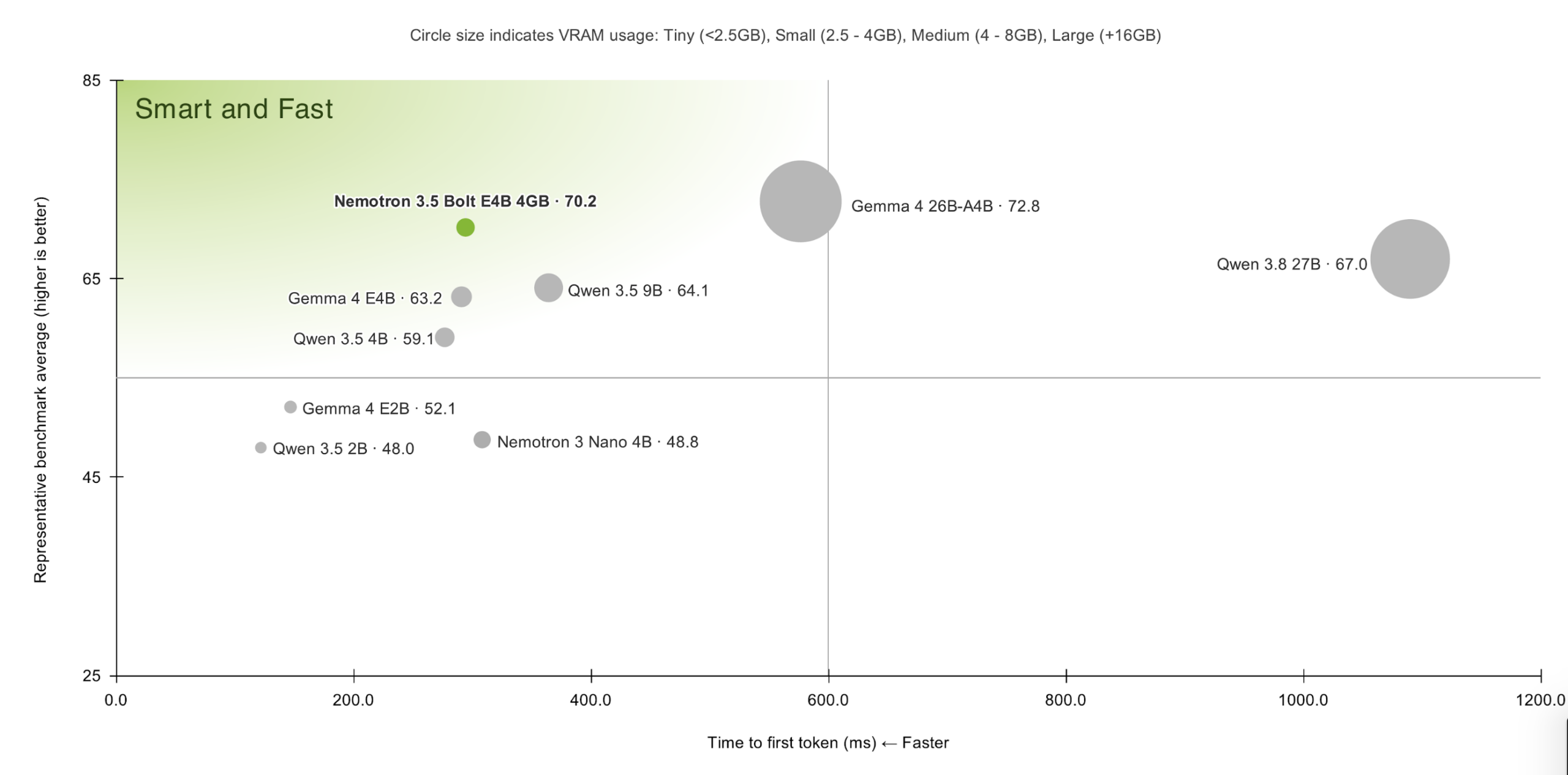
Before you get too excited, the community had questions about NVIDIA’s benchmark choices. On Reddit, there was a healthy spirit of skepticism about the model’s claimed performance relative to Qwen 3.8 27B, with some arguing there’s no way a 4B-effective model beats a 27B model on raw intelligence. The response pointed to the technical report, which shows the benchmarks were chosen to reflect assistant-style use cases, conversational ability, tool use, and roleplay, not general reasoning benchmarks where larger models still dominate.
There were also early user reports worth noting. One developer who tested Bolt-E4B head-to-head with Gemma E4B found significantly better memory consolidation and long-context recall from NVIDIA’s post-training, but also flagged repeated hallucinations during memory extraction tasks, noting they’d stick with plain Gemma based on that. Another comparison against MiniCPM5-2B was eagerly anticipated but didn’t materialize in the source thread.
The TL;DR: this is a specialized assistant model, not a general-purpose reasoning monster. Benchmark scores on roleplaying datasets look great. Scores on hard reasoning tasks like Tau2-Bench tell a more nuanced story, Qwen 3.5 4B still leads there with 75.06 versus Bolt’s 55.10.
The Bigger Picture: NVIDIA’s Edge AI Strategy
Bolt-E4B is one half of NVIDIA’s edge strategy. The other half is the 74B-A9B model that crams 74 billion parameters into 24GB using native 2-bit quantization. That model trades some accuracy for vastly better agentic capabilities, it can handle coding, tool use, and reasoning tasks with 9B active parameters. The Nemotron 3.5 Bolt 74B-A9B coverage shows it hitting 86.43 on GPQA Diamond even at the heavily compressed IQ2 quantization, which is genuinely impressive for a model that fits in 24GB.
Bolt-E4B is the conversational companion to that. It’s optimized for intelligence per GB, not raw capability. NVIDIA’s blog frames it as “optimized for intelligence per GB for fast conversational agents.” That’s a different design center than “squeeze every last token of intelligence into the footprint.”
This also connects to NVIDIA’s broader Nemotron lineage. Nemotron Nano 2’s optimization for edge AI and low-latency inference set the pattern, and Nemotron 3.5 Lightning’s efficiency and speed for edge and local AI refined it. Bolt-E4B feels like the culmination of that work, a purpose-built assistant model with the inference acceleration baked in.
Why This Matters for Your Next Project
If you’re building a voice assistant, an interactive character, or any kind of always-on device AI, the old equation was: cloud for intelligence, edge for privacy, and never both at once. Bolt-E4B with DFlash speculative decoding shifts that equation.
The key specs to remember:
- 8B total parameters, 4B effective, Q4_K_M quantization
- 64K context window
- 6.18GB GGUF file size
- DFlash drafter adds 737MB for 3.88 avg acceptance length
- Multi-turn tool use, reasoning on/off, conversational mode
- OpenMDW-1.1 license, commercially usable
For context, that acceptance rate of 3.88 means roughly 4 tokens generated per target model pass. At decoding speeds typical for a 4B-effective model on consumer hardware, that’s the difference between “acceptable” and “instant.”
The model is also a perfect base for fine-tuning. The BF16 release includes all the pieces needed for SFT and RL applications. NVIDIA even mentions that the post-training data has a cutoff of May 2026, so the knowledge base is fresh.
The Verdict
Bolt-E4B won’t replace your reasoning-heavy coding assistant for complex engineering tasks. If you need MCP-Atlas scores above 50, the 74B-A9B model is still a better bet. But for the specific problem of building a fast, local conversational assistant on constrained hardware, this is the most practical open model released so far.
The integration ecosystem is already deep. Ollama support shipped on day one, llama.cpp is ready with the DFlash drafter, Unsloth has optimized quants, and vLLM supports it with reasonable configuration. That’s not a toy release, that’s a production-ready stack.
If you’ve been holding off on building that local AI assistant because everything felt too slow, this is your entry point. Fire up ollama run nemotron-3.5-bolt:e4b and see what it feels like to have something respond before you finish asking.