EmbeddingGemma 2 is the most capable model for on-device multimodal embeddings, natively mapping combinations of text, images, audio, and video into a unified embedding space.
That’s the official line from Google DeepMind. But for anyone who’s actually tried to deploy embedding models in production, the more interesting question isn’t whether it works, it’s whether your infrastructure can handle what happens next.
Google’s predecessor, the original EmbeddingGemma, racked up over 20 million downloads powering on-device search and privacy-first RAG pipelines. The sequel doesn’t just iterate, it fundamentally changes what you can do with a sub-1B parameter model. And that has architectural implications most teams haven’t planned for.
Breaking Down the Architecture: What’s Actually New
Built on the Gemma 4 architecture and released under Apache 2.0, EmbeddingGemma 2 packs 740M total parameters into a modular design that spans four distinct configurations. The base text and code backbone runs at just 270M parameters, a 130M transformer paired with a 140M embedder, with optional vision (170M) and audio (300M) encoders that you can load selectively.
This modularity isn’t just a nice-to-have. It’s the difference between deploying a 270MB model on a phone and needing 1.3GB of storage for the full multimodal stack. And for microservices architectures, that choice ripples through everything from container image sizes to cold start latency.
| Active Modalities | config_kwargs | Effective Size |
|---|---|---|
| Text only | {"vision_config": None, "audio_config": None} |
270M |
| Text and image | {"audio_config": None} |
440M |
| Text and audio | {"vision_config": None} |
570M |
| Full multimodal | {} |
740M |
The architecture runs 24 layers with a model dimension of 512, hidden dimension of 2048, and uses grouped-query attention with a 5:1 local-to-global ratio. The vocabulary sits at 262,144 tokens, and mean pooling projects everything into a shared 512→768 dimensional space.
But here’s the part that should grab your attention: the 8,192-token context window is 4x larger than EmbeddingGemma 1. That means roughly 5.5 minutes of audio, 29 images, 58 video frames, or interleaved combinations thereof, all processed locally on consumer hardware.
The Benchmark Story: Code Gets a Serious Upgrade
The headline numbers are impressive. EmbeddingGemma 2 scores 14% higher than its predecessor on MTEB Code, jumping from 68.76 to 78.68. According to the official model card, that 9.92-point improvement makes it genuinely competitive for local codebase indexing and semantic code search.
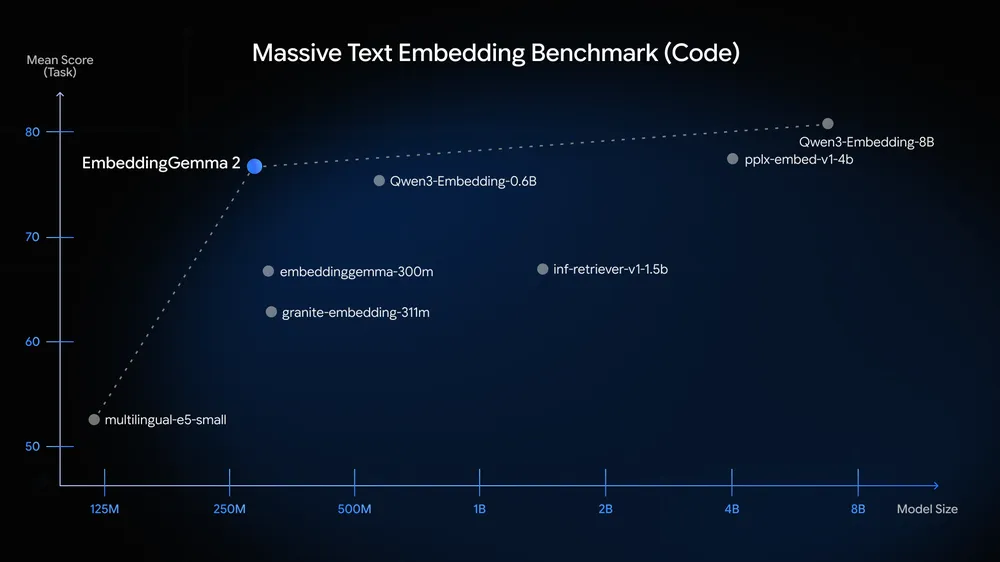
The full benchmark table tells a more nuanced story:
| Modality | Benchmark | Metric | EmbeddingGemma 2 | EmbeddingGemma 1 |
|---|---|---|---|---|
| Text | MTEB (multilingual, v2) | Mean(Task) | 61.36 | 61.15 |
| Code | MTEB (code, v1) | Mean(Task), NDCG@10 | 78.68 | 68.76 |
| Image | MIEB (lite) | Mean(TaskType) | 64.64 | – |
| Image | MMEB v2 – Image | Mean(Task), Hit@1 | 57.28 | – |
| VisDoc | MMEB v2 – VisDoc | Mean(Task), NDCG@5 | 67.84 | – |
| Video | MMEB v2 – Video | Mean(Task), Hit@1 | 50.67 | – |
| Sound | MSEB (Retrieval) | Mean(Task), MRR@10 | 69.54 | – |
| Audio | MAEB | Mean(Task) | 49.39 | – |
Multilingual text performance holds steady at 61.36 (up from 61.15), which matters if you’re serving over 100 languages. But the real flex is matching or outperforming specialist models more than twice its size across vision, audio, and document retrieval tasks.
Matryoshka Representation Learning: The Storage Hack That Actually Works
Here’s where things get interesting for anyone who’s priced out vector databases recently. EmbeddingGemma 2 uses Matryoshka Representation Learning (MRL), which means you can truncate output vectors from 768 dimensions down to 512, 256, or even 128 dimensions without retraining.
The storage math is compelling. In bfloat16 precision, a million 768-dimensional vectors consume roughly 1.5GB. Truncate to 128 dimensions and that drops to 250MB, a 6x reduction that lets you fit six times as many embeddings in the same memory budget.
But the quality trade-offs deserve scrutiny:
| Output Dimension | Compression | MTEB (multilingual) | MTEB (code) | MIEB (lite) | MMEB v2 Overall | MSEB Retrieval | MAEB |
|---|---|---|---|---|---|---|---|
| 768d (Full) | 1:1 | 61.36 | 78.68 | 64.64 | 59.01 | 69.54 | 49.39 |
| 512d | 1:1.5 | 61.17 | 77.24 | 64.32 | 58.38 | 69.18 | 49.21 |
| 256d | 1:3 | 60.41 | 76.18 | 63.13 | 56.24 | 66.76 | 48.91 |
| 128d | 1:6 | 57.89 | 71.41 | 59.06 | 45.65 | 56.71 | 46.92 |
At 256 dimensions, you retain most of the quality on text and code and about 95% on image, video, and speech retrieval. But at 128 dimensions, the MMEB score craters from 59.01 to 45.65, a 23% drop that makes those vectors nearly useless for multimodal queries. The developer guide is blunt about this: 128d is best suited for text-only workloads, and you should validate against your own data before deploying it for anything multimodal.
The Integration Reality Check: What 191MB Actually Buys You
Google’s on-device claims are striking: with quantization on a Pixel 11 Pro, text-only weights require about 191MB of active RAM, while the full multimodal model needs roughly 567MB. That’s a fraction of what larger models demand, but it’s not free. And the Google AI Edge team measured 37.3ms per image on a MacBook M5 Pro GPU using a 70-token vision budget, impressive, but that’s on a relatively powerful laptop, not a decade-old Android phone.
For microservices, the deeper issue is that embeddings aren’t just an inference problem, they’re a storage, caching, and retrieval problem. Every embedding you generate for a query against a 128-dimensional index needs to be truncated and re-normalized before it hits your vector database. Miss that step and you’re scoring 768-dimensional queries against 128-dimensional documents, which produces plausible-looking results that are silently wrong.
The Hugging Face model card flags this explicitly: slicing a unit-length vector doesn’t preserve unit length. You must L2-normalize after truncating, and queries and documents must share a dimension. Skipping this degrades ranking quality silently, no errors, just bad results.
The Precision Trap: float16 Will Bite You
Here’s a gotcha that will waste hours of your life if you miss it. EmbeddingGemma 2’s activation range exceeds what float16 can represent. Run inference in float16 and the model returns NaN or silently degraded embeddings. No error. No warning. Just broken similarity scores that look plausible.
The model card recommends bfloat16 or float32, with bfloat16 being the preferred default on hardware with native support. You can check programmatically with torch.cuda.is_bf16_supported() and set the dtype accordingly:
dtype = torch.bfloat16 if torch.cuda.is_bf16_supported() else torch.float32
model = SentenceTransformer("google/embeddinggemma-2", model_kwargs={"torch_dtype": dtype})
This is the kind of detail that separates production systems from demos. And it’s exactly the sort of thing that gets lost when a model goes viral on Hacker News before the integration guides catch up.
Task Prefixes: Small Strings, Big Quality Differences
EmbeddingGemma 2 uses short task instruction prefixes to steer representations for specific tasks. The official documentation lists seven distinct prompt names, each optimized for a different workflow:
| Use Case | Task Type | Prompt Name |
|---|---|---|
| Web/document search | Asymmetric | SearchQuery |
| Question answering | Asymmetric | QuestionAnswering |
| Fact checking | Asymmetric | FactChecking |
| Code search | Asymmetric | CodeRetrieval |
| Text classification | Symmetric | Classification |
| Clustering | Symmetric | Clustering |
| Measuring similarity | Symmetric | SentenceSimilarity |
For asymmetric tasks like retrieval, queries and documents use different prefixes. Documents with titles should be formatted as title: {title} | text: {content}. Skip the prefix and quality degrades noticeably, the model still works, but you’re leaving accuracy on the table.
query = "What causes the northern lights?"
document = "The northern lights are caused by charged particles from the sun.."

query_emb = model.encode(query, prompt_name="SearchQuery")
doc_emb = model.encode(document, prompt_name="Document")

print(model.similarity(query_emb, doc_emb))
Shared Context Means Shared Trade-offs
The 8,192-token context window is shared across all modalities, and each media type consumes it at a fixed rate. The model card breaks it down:
| Modality | Token Cost | Max Input |
|---|---|---|
| Text | 1 token per subword | 8,192 tokens |
| Image | 280 tokens per image (default) | ~29 images |
| Video | 140 tokens per frame (default) | ~58 frames |
| Audio | 25 tokens per second | ~327 seconds |
Interleaved inputs draw from the same budget, so mixing modalities reduces what fits. You can configure the vision token budget from 70 to 1120 tokens per image, trading latency and token count for quality. Default video sampling runs at 1 frame per second (configurable), and audio should be supplied as 16kHz mono.
# Interleaved: one embedding for a product listing with text, photo, and video
listing_emb = model.encode({
    "text": "Waterproof trail shoe. <|image|> Grip test on wet rock: <|video|>",
    "image": "trail_shoe.jpg",
    "video": "grip_test.mp4",
})
query_emb = model.encode("waterproof trail shoes", prompt_name="SearchQuery")

print(model.similarity(query_emb, listing_emb))
Is This Actually Better Than the Competition?
The comparison table from MarkTechPost’s analysis puts EmbeddingGemma 2’s strengths and weaknesses in context:
| Feature | EmbeddingGemma 2 | Qwen3-VL-Embedding-2B | LCO-Embedding-Omni-3B | Gemini Embedding 2 |
|---|---|---|---|---|
| Parameters | 740M (270M text-only) | 2B | 3B backbone | Not disclosed |
| Images | Yes | Yes | Yes | Yes |
| Video | Yes | Yes | Yes | Yes |
| Audio | Yes | No | Yes | Yes |
| Output dims (MRL) | 768 (512, 256, 128) | Up to 2048 | Not stated | 3072 |
| Context | 8,192 tokens | 32K tokens | Not stated | 8,192 tokens |
| License | Apache 2.0 | Apache 2.0 | Apache 2.0 | Paid API only |
Qwen3-VL-Embedding-2B reports 73.2 on MMEB-V2, but it’s roughly 2.7x the parameter count and doesn’t support audio. If your workload is vision-heavy and you have the hardware budget, Qwen might win. But for mixed-modality workloads running on consumer devices, EmbeddingGemma 2’s parameter efficiency is hard to beat.
And unlike the cost and performance trade-offs of running LLMs locally vs. cloud APIs, where cloud services often win on raw economics, embedding inference is cheap enough that on-device processing can genuinely compete, especially when you factor in the privacy benefits of never shipping user data to a server.
What This Means for Your Architecture
For teams building multimodal search or RAG pipelines, EmbeddingGemma 2 changes the calculus in a few ways:
You can now consolidate. Instead of running separate models for text, vision, and audio embeddings, one model handles everything in a shared vector space. That’s fewer services, fewer dependencies, and simpler infrastructure.
You can scale down. The modular architecture means you don’t pay for vision or audio encoders you don’t need. The 270M text-only configuration is roughly the same footprint as its predecessor. And if you’re already running Gemma 4 12B locally, the shared tokenizer and audio encoder mean a lower combined memory footprint for RAG pipelines.
You need to think about truncation upfront. If you’re building a vector index that might later include images or audio, choosing 128-dimensions to save storage will come back to haunt you when multimodal queries return garbage. Plan for 256d as the floor for any multimodal workload.
You should start with the sentence-transformers integration (v6.1.0+). The library handles selective encoder loading, task prefixes, and MRL truncation natively, which means fewer footguns in production.
The Bottom Line: Promising, With Caveats
EmbeddingGemma 2 is genuinely impressive for its size, and the Qdrant integration guide plus Unsloth’s fine-tuning recipes suggest the ecosystem is already rallying around it. Whether you’re building local semantic search or running edge inference on mobile, this model deserves serious evaluation.
But the “revolutionary” framing obscures some real integration work. The float16 trap, the MRL normalization requirements, the quality cliff at 128 dimensions, and the shared context budget all demand careful engineering. This isn’t a drop-in replacement, it’s a new capability that requires new practices.
The teams that succeed with EmbeddingGemma 2 won’t be the ones that treat it as another embedding model. They’ll be the ones that redesign their storage, caching, and retrieval pipelines around its capabilities and constraints. That’s the real opportunity, and the real work.