NVIDIA just dropped Nemotron 3.5 Lightning, and the local AI community is losing its collective mind. Rightfully so. A 30-billion-parameter Mixture-of-Experts model with only 3B active parameters that delivers 4x faster output speed than comparable models isn’t just incremental progress, it’s the kind of leap that makes you question why anyone still pays for frontier API access.
The timing is no accident. Meta dropped a coding model yesterday. Qwen’s next release is imminent. And NVIDIA, the company that sells the shovels in this gold rush, just made a compelling case that you don’t need a 500B-parameter behemoth to run serious agentic workloads. The prevailing sentiment on developer forums captures it perfectly: “Yesterday was META. Today is Nvidia, and tomorrow qwen. What a week.”
But let’s dig past the hype and look at what this model actually brings to the table, and where it falls short.
The Architecture: Mamba-2, MoE, and Attention Walk Into a Bar
The hybrid design of Nemotron 3.5 Lightning is the real story here. It’s not another dense Transformer variant or a pure MoE rehash. NVIDIA interleaved Mamba-2 state-space layers with MoE layers and select Attention layers, creating an architecture that balances linear-time sequence modeling with the capacity of sparse expert routing.
The numbers matter: 30B total parameters, 3B active per token. That’s the sweet spot where you get the capacity of a much larger dense model at a fraction of the compute cost. When a router sends each token to only a few experts, you’re effectively running a small model while maintaining the knowledge breadth of a much bigger one.
The model was pre-trained on over 20 trillion tokens with a data cutoff of September 2025, then put through a four-stage pipeline: pre-training with an NVFP4 recipe, continued pre-training for Multi-Token Prediction (MTP), supervised fine-tuning on synthetic data, and multi-environment reinforcement learning using GRPO. NVIDIA used its own Megatron-LM for training and NeMo RL for the RL stage.
The MTP layers deserve special attention. By training the network to predict multiple future tokens at each position, NVIDIA created richer training signals that translate into faster inference at deployment time. This isn’t a gimmick, it’s the same technique that powers speculative decoding strategies across the Nemotron 3 family, including the Nemotron-3 Super’s 4-bit training and hybrid Mamba-2 architecture.
Benchmarks: Great, But Not the King of the Hill
Here’s where things get honest. The benchmark table from the Hugging Face model card shows Lightning holding its own but not dominating every category:
| Task | Nemotron-3.5-Lightning | Qwen 3.6 35B A3B | Gemma 4 26B A4B |
|---|---|---|---|
| MMLU Pro | 81.94 | 85.63 | 85.20 |
| GPQA Diamond | 75.44 | 83.40 | 79.61 |
| SWE-bench Verified | 51.56 | 70.12 | 57.40 |
| PinchBench | 85.37 | 88.07 | 74.70 |
| IFBench (loose) | 71.88 | 63.71 | 77.25 |
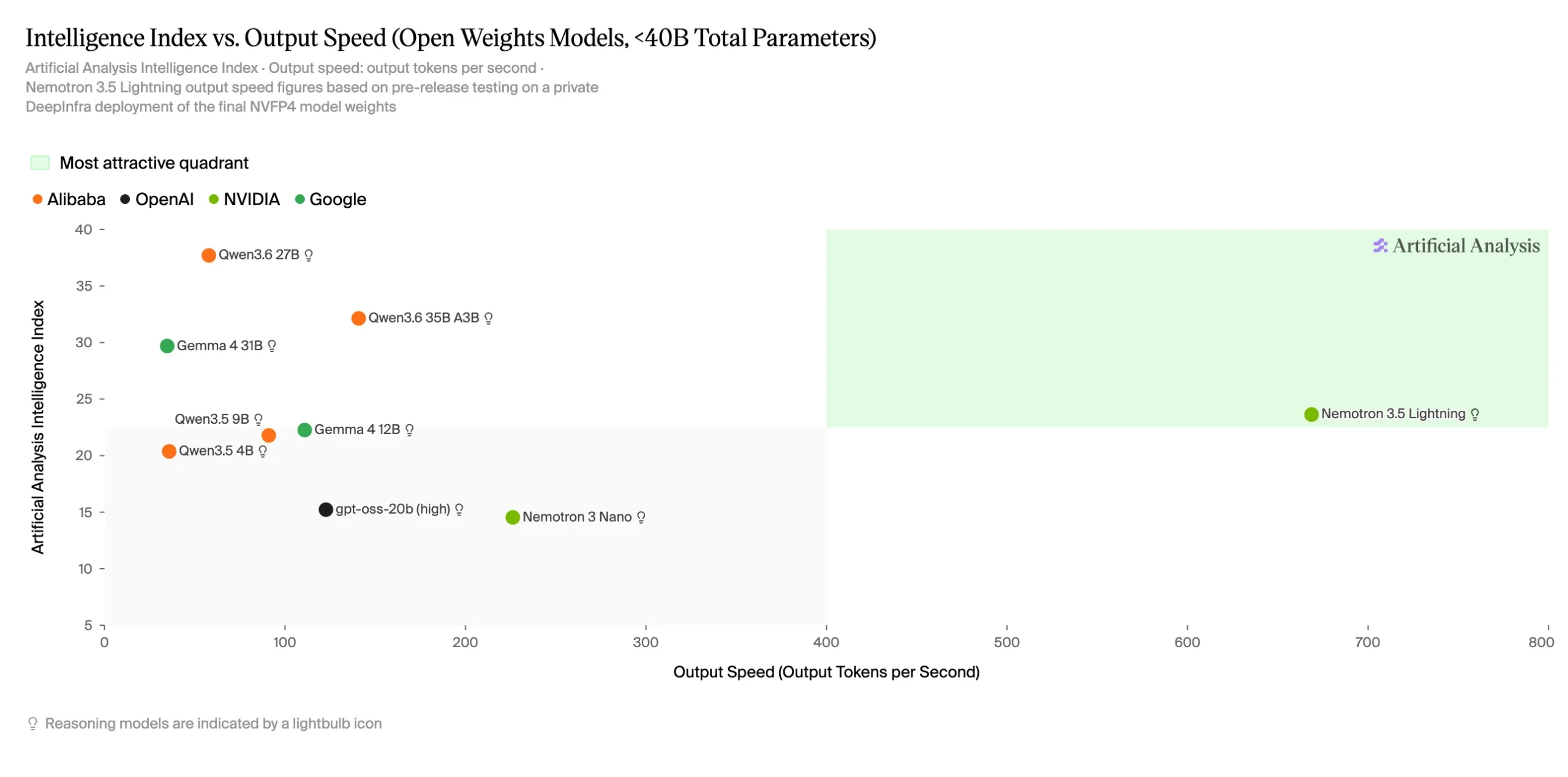
Qwen 3.6 35B still holds the accuracy crown in most reasoning and coding benchmarks. But raw accuracy numbers tell only half the story. The speed component is where Lightning separates itself. On PinchBench, Lightning reaches 86% accuracy while completing 10,000 tasks 30% faster than Qwen3.6 35B at similar accuracy. That’s the difference between a model that’s good on paper and a model that’s actually useful in production.
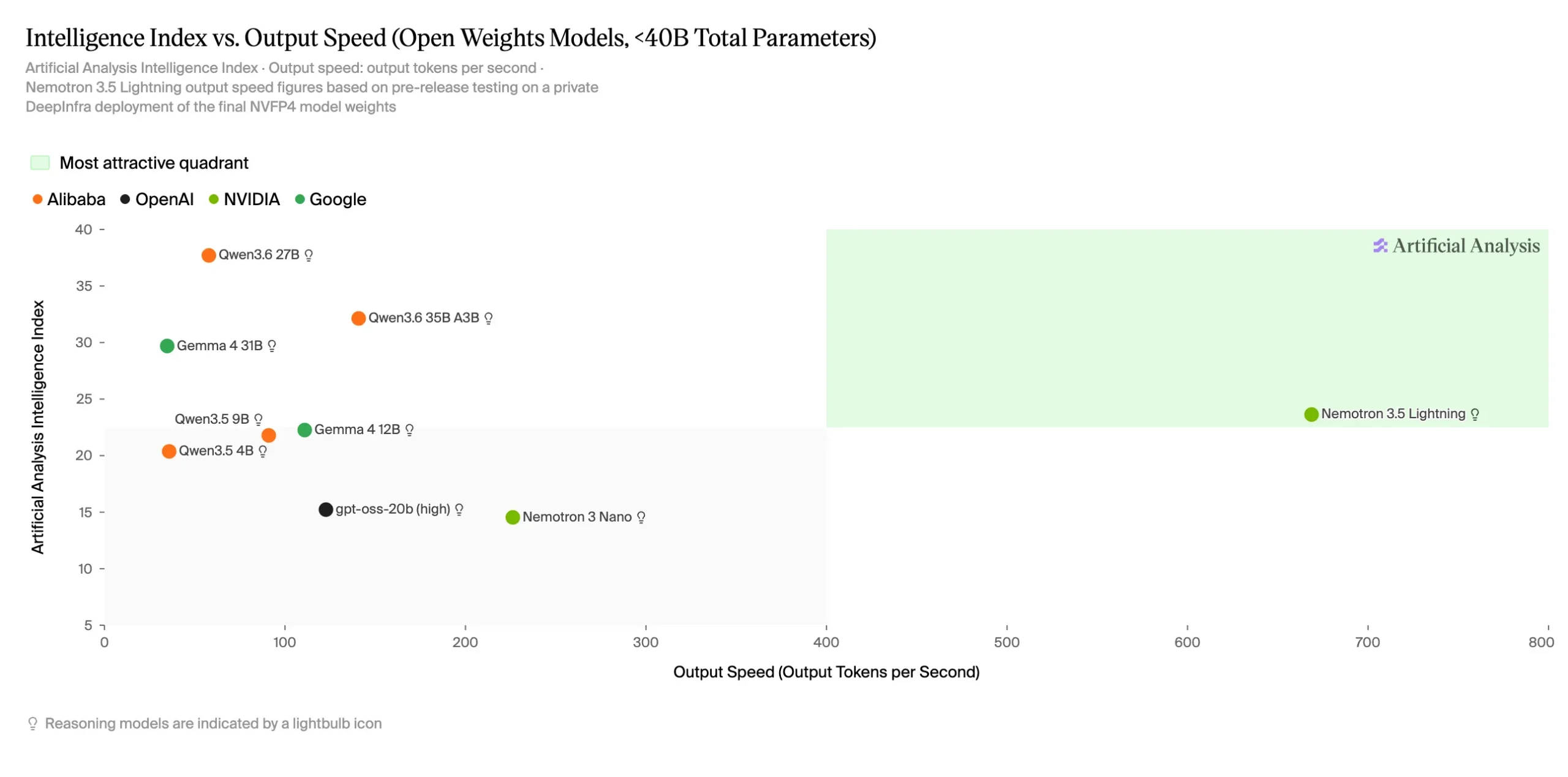
The Artificial Analysis Intelligence Index scatter plot confirms this positioning. Lightning sits squarely in the winning quadrant, high intelligence index combined with the fastest output speed in its class. That’s the efficiency frontier that matters for real deployments, not academic leaderboards.
Speculative Decoding: The Speed Secret Sauce
NVIDIA shipped Lightning with three speculative decoding strategies, and this is where the engineering gets genuinely interesting:
- DSpark: A semi-autoregressive drafter that proposes an entire block of candidate tokens in a single forward pass from a parallel backbone. Recommended for DGX Spark and low-concurrency data center deployments.
- DFlash: A lightweight block-diffusion model that generates an entire draft block in one forward pass.
- MTP: The baked-in multi-token prediction layers from training.
The deployment configurations show how these strategies play out in practice. On a single H100 for max throughput, the recommendation is no speculative decoding at all, the memory constraints of the Mamba cache at FP16 make it counterproductive. But for interactive scenarios on the same hardware, DSpark with 3 speculative tokens achieves 40+ TPS per user. On a GB200, DSpark with 5 speculative tokens powers a full 1M-token context window.
For local deployments, the numbers get even better. On a DGX Spark, the NVFP4 quantization combined with DSpark yields a model that sits right on the Pareto frontier for local AI, a thirty-billion-parameter model running efficiently on what’s essentially a desktop workstation.
The full vLLM recipe for a GB200 deployment shows the level of tuning involved:
vllm serve --model $MODEL_CKPT \
    --max-num-seqs 128 \
    --max-model-len 1048576 \
    --max-num-batched-tokens 10240 \
    --no-enable-prefix-caching \
    --async-scheduling \
    --speculative_config.model $DSPARK_CKPT \
    --speculative_config.num_speculative_tokens 5 \
    --mamba-backend flashinfer \
    --reasoning-parser nemotron_v3 \
    --tool-call-parser qwen3_coder \
    --enable-auto-tool-choice
This isn’t a model you just pip install and run. It requires careful tuning of the Mamba cache, expert parallelism, and speculative decoding parameters. The cookbook is essential reading before you even attempt deployment.
The NeMo Switchyard Play: Routing as the Real Innovation
NVIDIA didn’t just release a model, they released a routing library that makes the model part of a larger system. NeMo Switchyard is an open-source library that intelligently directs each request to the most capable and efficient model for the job. The pitch: instead of relying on one default model and either overspending or losing quality, enterprises can build systems where frontier models handle orchestration and Lightning handles the high-volume execution layer.
The partner results are genuinely impressive:
- LangChain achieved 74% lower cost on 145 multi-turn Deep Agents tasks by routing only 7% of calls to a frontier model, with only a 6% accuracy tradeoff.
- Ramp matched frontier model performance while cutting costs by 58% and runtime by 33%.
- Boomi sent 59% of traffic to a 5x faster fine-tuned model while maintaining 100% domain routing accuracy.
- NVIDIA’s internal benchmarks show Switchyard maintaining frontier-level accuracy while reducing task completion cost to nearly one-third of Opus 4.8 alone.
This is the “system of models” architecture NVIDIA has been pushing, a frontier reasoning model plans and orchestrates workflows while smaller specialized models like Lightning handle code review, tool use, security alert monitoring, and billing questions. It’s an acknowledgment that the era of single-model-everything is ending.
Open Weights, Open Data, Open Questions
NVIDIA released Lightning under the OpenMDW-1.1 license, which is permissive enough for commercial use. But the real story is what they released alongside the weights: the training data, the recipes, and the evaluation harnesses. The Nemotron pre-training datasets collection on Hugging Face is massive, and the post-training datasets are being released with gating for the full versions.
This transparency is a double-edged sword. On one hand, it enables reproducibility research and allows enterprises to audit what went into the model. On the other, those massive tables of synthetic data generated by proprietary models like DeepSeek-V4-Pro, GPT-5.5, and GLM-5 raise serious questions about the distillation arms race that’s consuming the AI industry.
NVIDIA representatives confirmed they used distillation to give Lightning similar capabilities to its larger Nemotron models. That’s the industry’s dirty secret, every “open” model these days is trained on outputs from closed frontier models, which creates a legal and ethical gray zone that regulators are still trying to wrap their heads around. Sen. Warner’s comment about open-source AI captures the tension: “I’m not sure this is a genie we can put back in the bottle.”
The performance challenges of Nemotron 3 in real-world reasoning benchmarks from earlier releases also serve as a cautionary tale. NVIDIA’s models have struggled to match Qwen’s reasoning capabilities in practice, even when benchmark numbers look competitive. Lightning’s SWE-bench Verified score of 51.56 versus Qwen’s 70.12 is a significant gap that no amount of speed can fully compensate for.
Deployment Realities: What You Need to Know
The BF16 release is positioned as a starting point for customization, post-training, domain adaptation, and creating quantized variants. For production inference, NVIDIA recommends the NVFP4 release, which brings the memory footprint down dramatically. The NVFP4 quantization uses a Four Over Six recipe with W4A16 on routed and shared experts, plus FP8 per-tensor dynamic scales on Mamba projections and KV cache.
The quantization costs are minimal. Comparing BF16 to NVFP4 on the benchmark suite shows at most a couple of points drop on most tasks, with some benchmarks actually improving (SWE-bench Verified goes from 51.56 to 52.80, GDPval-AA-V2 from 832 to 865). That’s remarkable, a 4-bit quantized model that sometimes outperforms its full-precision counterpart.
Hardware Support
Hardware support spans Blackwell (DGX Spark, GB200, RTX 5090), Hopper (H100, H200), and Ampere (A100 via W4A16). The single-GPU deployment story is compelling: 1x H100 80GB or 1x A100 80GB handles the full model, and a DGX Spark can run it locally. That’s what makes this interesting for edge deployments that Nemotron Nano 2’s edge AI efficiency and compact design started exploring.
Production Readiness
For enterprises evaluating this for production, the LLM inference ecosystem has also matured significantly. The ExLlamaV3’s optimized inference performance on NVIDIA GPUs benchmark results show that using the right inference engine matters as much as choosing the right model.
The Verdict: Speed Wins in Production
Nemotron 3.5 Lightning isn’t the smartest model in its class. Qwen 3.6 35B still owns the accuracy crown, and the Nemotron-3-Nano’s 30B model with 1M context and hybrid reasoning remains a solid alternative. But Lightning wins where it matters for enterprise agentic workloads: throughput, cost efficiency, and deployment flexibility.
The key insight is that agent efficiency isn’t about token generation speed alone, it’s about how quickly a model completes useful work. Lightning finishing 10,000 tasks 30% faster than Qwen at comparable accuracy means real cost savings in production. Pair that with the Switchyard routing library, and you have a compelling argument for a system-of-models approach where frontier APIs handle the hard planning tasks and a 25GB local model handles the high-volume execution.
The real question for enterprise architects is whether the accuracy gaps on coding and reasoning benchmarks actually matter for your specific workloads. If you’re deploying agents for cybersecurity alert enrichment, telecom network triage, or financial document processing, Lightning’s combination of speed, customization options, and permissive licensing makes it an extremely attractive option. If you need frontier-level code generation, you’ll still want a larger model, but you might not need it for every request.
NVIDIA’s strategy is transparent: free AI is great for hardware sales. Every local deployment of Lightning is a reason to buy a DGX Spark or a workstation with an RTX PRO. But unlike some vendor plays, this one actually delivers value to developers. The Nemotron-3 Ultra’s large-scale model optimization on limited GPUs showed what’s possible with aggressive quantization, Lightning demonstrates that small models can be genuinely useful, not just cheap.
The local LLM renaissance is real, and NVIDIA just made it significantly more interesting. The question isn’t whether you should evaluate Lightning, it’s whether your current agent infrastructure can afford not to.