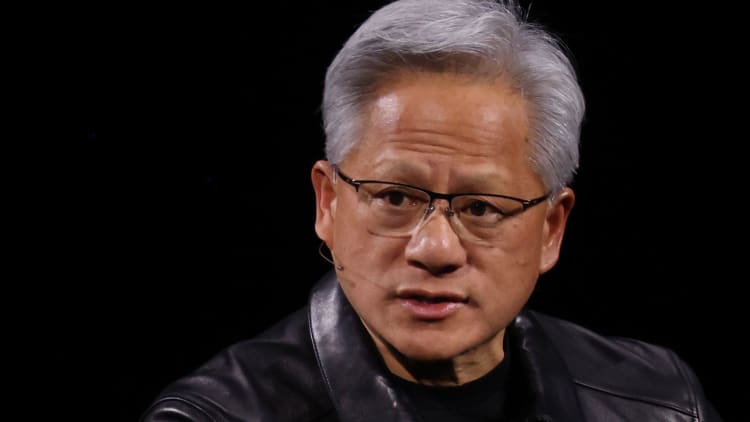
Jensen Huang built Nvidia from a Denny’s booth conversation in 1993 into a $4-5 trillion behemoth powering the AI revolution. He was the leather-jacket-wearing rockstar of Silicon Valley, the “Mr. AI” who made GPU chips as essential to modern computing as electricity. And in the span of roughly ten days, he lost all of it.
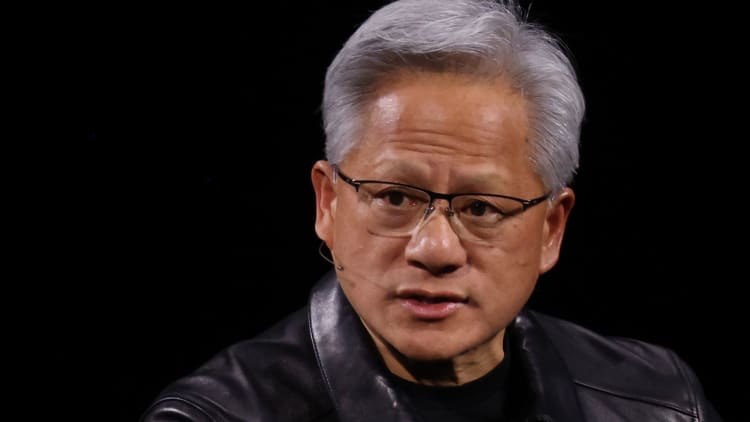
The timeline reads like a fever dream: first came reports of an affair with Alice Huang, a Singapore-based businesswoman believed by US intelligence to be a Chinese spy. Then the admission. Then another affair, this time with Kimberly Powell, Nvidia’s VP of healthcare. Then a Reuters report of an “intimate relationship” with yet another employee. By Thursday morning, the Nvidia board had made its decision: Huang resigned as President, CEO, and board member, effective immediately.
The market’s reaction was brutal. Nvidia’s stock plunged over 13% at the open, closing down 4.3%. The company had lost $2 trillion in market value since its October peak and more than $740 billion since Friday alone. Analysts raced to slash price targets, Baird cut theirs from $500 to $200 in one stroke. Retail traders, in a twist that says everything about modern markets, bought the dip with record-breaking enthusiasm, putting in net $111 million in the first 30 minutes alone.
But here’s what the headlines are missing: this wasn’t just a scandal. It was a stress test of the entire AI ecosystem’s institutional foundations, and the results are deeply unsettling.
The Founder Trap: When One Man Is the Company
You can’t understand this crisis without understanding how thoroughly Huang embedded himself into Nvidia’s DNA. This wasn’t just a CEO, this was the architect of the AI boom itself. He ran the company with about 60 direct reports, a deliberately flat structure that made him the indispensable hub connecting every major decision. His technical knowledge was “basically unique and impossible to replicate”, as Saxo analyst Neil Wilson put it.
Jeffrey Sonnenfeld, the Yale management professor, put it more bluntly in an interview with CNBC: Huang had become a “monarch”, so “co-branded that you can’t separate the CEO from the company.” Nvidia’s board reflected this dysfunction, prior to his exit, Huang was one of 11 members, the board had no chair, and none of the other 10 members were current or former S&P 500 CEOs. While the average independent director tenure in the S&P 500 is 7.8 years, Nvidia’s board members averaged 15 years of service.
That’s not a board. That’s a fan club. And when the fan club suddenly needed to make a hard decision about their idol, they had no institutional framework to fall back on.
The smoking gun? The board reportedly made the decision to oust Huang on Wednesday night, driven by the cascade of affair allegations. They worked late into the night on communications strategy and announced it Thursday morning. There was no succession plan, no heir apparent, no carefully managed transition. Just a desperate scramble to keep the ship from capsizing.
For every engineering leader reading this: your people are not the process. Your architecture is not the product. If you haven’t built systems and leadership depth that can survive your departure, you haven’t built a company, you’ve built a monument to yourself.
The Espionage Dimension: This Wasn’t Just About Affairs
Let’s be clear about what pushed this from personal scandal to national security crisis. Alice Huang wasn’t just a mistress, she was reportedly a Chinese intelligence asset, and her company Megaspeed was allegedly involved in smuggling advanced Nvidia chips into China. According to findings from private intelligence firm Tesari, she may have owned stakes in businesses that benefited Huawei, Nvidia’s biggest Chinese competitor.
The implications are staggering. The US intelligence community reportedly concluded she was a Chinese asset, and the New York Times reported that President Trump knew about it, yet the administration still allowed Nvidia to sell its advanced H200 chips to China in December 2025, in exchange for a cut of export sales. Democratic senators are now calling for investigations into whether the Trump administration willfully ignored a compromised relationship involving a man who was “putting America first, not their bottom line or their personal friendships”, as Chuck Schumer put it.
The fallout is already rippling through China’s underground GPU trade. One black market trader told CNBC that China’s smuggling operations have been told to pause work indefinitely, spooked by the expectation of increased US scrutiny. The black market price of a server with eight B300 GPUs, the still-banned cutting-edge chips, has hit 20 million yuan ($2.99 million), up five times from May and nearly six times the official US price of $550,000.
This is what a supply chain looks like when it becomes a national security vector. And it’s what happens when a single relationship compromises an entire country’s technological leadership.
The Financial Web: Nvidia Isn’t a Chip Company Anymore, It’s a Shadow Bank
Here’s the part that keeps regulators up at night: Nvidia has become what CNBC calls the “central bank of AI”, with $400 billion in total obligations to other firms, a sum that rivals the GDP of many nations.
These obligations take multiple forms:
| Obligation Type | Amount | Description |
|---|---|---|
| Cloud service commitments | $36 billion | Committed purchases from neoclouds (disclosed July 2026) |
| Data center leases | $20 billion | Leases signed for renting out capacity |
| OpenAI Ohio mega-campus backstop | $105 billion | Phased guarantee for OpenAI/SB Energy project |
| Wall Street credit program backstop | $125 billion | Guarantee for $500B program by Apollo, BlackRock, etc. |
These structures rely on what’s called “circular financing”, Nvidia helps its customers buy its own chips, creating a self-reinforcing cycle of debt and demand. When the economy is growing, this is productive. When it isn’t, it’s a house of cards. And now the dealer has just been removed from the table.
The Fed was already worrying about this in July, discussing the possibility of “broad-based repricing of assets” in the event of AI-sector problems. The Washington Post reported on Nvidia’s financing web and the new risks it poses after Huang’s exit. Analyst Sunaina Sinha Haldea sums it up well: “Lenders will ask harder questions about who is really carrying the risk in these structures.”
The good news? Nvidia isn’t a bank. Sheila Bair, the former FDIC chair who lived through 2008, says the company isn’t “too big to fail in a bank sense at all.” There’s enough equity cushion that even major losses wouldn’t trigger systemic collapse. But there’s a reason the IMF is watching this closely, because if Nvidia’s GPU values plummet, every company that borrowed money to buy them suddenly has a debt problem, and that problem spreads.
The Succession Question: Who Can Fill the Leather Jacket?
Colette Kress, Nvidia’s CFO, has been named interim CEO. She’s a seasoned operator with nearly 25 years of finance experience at Microsoft, Cisco, and Texas Instruments before joining Nvidia in 2013. Jim Cramer calls her “absolutely the one that you need right now”, and Dan Ives believes she can “steady the ship.”
But here’s the problem: a CFO is not a visionary founder. As analyst Michael Landsberg put it, “Part of the value proposition of this stock was not just its chips, but Jensen’s vision and ability to steer the company. The stock is now pricing in a leadership discount, as the Jensen premium evaporates.”
The internal candidates are talented but unproven at this scale:
- Ian Buck, VP of hyperscale and HPC, is the “father of CUDA” and the betting market favorite
- Bryan Catanzaro, VP of Applied Deep Learning, brings strong technical pedigree
- Michael Kagan, CTO, is another internal option
- Bill Dally, Chief Scientist, has the research credentials
External candidates face an impossible challenge: matching Huang’s technical depth and his political acumen and his industry gravitas. Trump has already weighed in, suggesting Tim Cook, because of course he did. Cook’s Apple is a hardware company, but the transition from consumer devices to AI infrastructure would be massive.
The more realistic external options are Lisa Su at AMD (ironically, Huang’s first cousin once removed) or Rene Haas at Arm Holdings. But poaching a rival’s CEO during a leadership crisis is like trying to fix a house fire with dynamite.
Here’s what the analysts miss: Nvidia’s real moat isn’t Jensen. It’s the software ecosystem, CUDA, the networking stack, the entire platform that makes switching to AMD or custom silicon a multi-year migration project. The chips matter, but the lock-in matters more. As one The Register analysis notes, Nvidia’s main advantage was “being considered a safe bet.” Now that’s gone. AMD’s Helios racks are already deployed at Anthropic, Meta, Microsoft, OpenAI, and Oracle, and the company can’t scale fast enough to capture all the demand. But they don’t need to absorb everyone. They just need to absorb the most security-conscious customers, the ones who ask “where does our data go?” and “can we trust the guy at the top?”
The Broader AI Fallout: This Changes Everything
The affair scandal isn’t just Nvidia’s problem, it’s the entire AI industry’s problem.
The US just lost its most powerful spokesperson for AI optimism. Cantor Fitzgerald’s CJ Muse says it bluntly: “We are giving up the lead in AI in my view to China. Jensen was the most optimistic supporter of AI.” That’s not hyperbole, it’s arithmetic. Huang’s position on open-source AI, his lobbying for export controls that would allow the US to maintain its lead, and his technical credibility all made him the industry’s de facto ambassador. Now he’s a liability.
The midterm elections, which handed Democrats control of both houses, guarantee this isn’t going away. Hakeem Jeffries is calling for classified briefings on the Nvidia situation. The incoming Democratic chairs of the House Intelligence and Foreign Affairs committees are investigating. Senator Tim Scott wants to drag Huang and Commerce Secretary Howard Lutnick before the Senate Banking Committee. And Democrats are already investigating whether Trump’s approval of H200 exports to China was a quid pro quo for political support.
Nvidia’s commitment of at least $26 million to Trump-backed projects and record $2.15 million in federal lobbying in Q3 is now a liability, not an asset. The entire Washington strategy built around Huang’s personal relationship with Trump has collapsed, and the new Congress is going to ask questions nobody wants to answer.
What Actually Happens Next: Three Scenarios
Scenario 1: The Calm Down.
Kress stabilizes the ship, Ian Buck gets promoted to permanent CEO, and Nvidia’s indomitable product roadmap, already solidified through 2028, carries the company through. The stock recovers as investors realize the chips are still the only game in town, and the scandal fades into a cautionary tale. This is the most likely short-term outcome.
Scenario 2: The Dorian Gray.
The combination of shareholder lawsuits (Rosen Law Firm has already filed), congressional investigations, and export control scrutiny chips away at Nvidia’s credibility. The “leadership discount” persists, AMD and custom silicon gain share, and Nvidia’s edge erodes over five years. The company remains profitable but loses its cultural dominance. This is the slow-burn outcome.
Scenario 3: The Reckoning.
The $400 billion in financial obligations becomes a serious problem. A major neocloud defaults, the Fed is forced to intervene, the AI bubble pops. Nvidia’s stock loses half its value, and the entire AI industry enters a downturn. This is the tail risk that regulators can’t dismiss but can’t fully model either.
Which outcome you get depends less on Nvidia’s chip roadmap and more on what Congress finds. “There are a lot of times corporate boards are beholden”, Sonnenfeld said. “They’re smitten by the CEO, kind of idolatry.” That’s not just a Nvidia problem, it’s a structural problem in every founder-led company where the founder’s myth exceeds their human reality.
The Takeaway for Every Tech Professional
This isn’t a story about a fallen billionaire, it’s a story about institutional fragility. The entire AI industry built its future on a single person’s vision and connections. When he fell, the whole house shook.
For engineers and technical leaders: your role is to build systems that outlive you. If your architecture depends on your personal knowledge, your team depends on your personal relationships, and your roadmap depends on your personal vision, you’re not building a sustainable organization, you’re building a hostage situation.
For executives and board members: succession planning isn’t a checkmark on a governance page, it’s survival planning. If your CEO is the only person who can explain the roadmap, negotiate with the government, and inspire your employees, you’ve already failed your fiduciary duty.
For founders: the uncomfortable truth is that your company will survive without you, and the transition will be smoother if you’ve prepared for it. The greatest gift you can give your organization isn’t your genius, it’s the institutional strength to continue after you’re gone.
The flowers placed outside Nvidia’s Santa Clara headquarters are a poignant symbol. They’re not just mourning Jensen Huang’s exit, they’re mourning the end of an era when one man could embody an entire industry. That era is over, and the AI industry is now learning what happens when the wizard behind the curtain gets exposed.
For Nvidia’s strategic moves in the AI chip war, the Groq acquisition looks different now, it was a bet that Jensen had the vision and credibility to see through. Without him, every acquisition, every partnership, every roadmap commitment becomes conditional. And with China’s open-weight AI models now just 4.4 months behind US frontier models, the margin for error has never been thinner.
This is what institutional failure looks like in real time. It’s messy, expensive, and avoidable. And it will happen again, because the next Jensen Huang is already running his company, already the only person who can explain the roadmap, and already convinced it can’t happen to him.
Maybe he should think about that the next time he looks in the mirror. The man looking back might not be there forever.