Muse Glimmer Fits on a Single RTX 3090, And That Changes Everything About Local AI
The “30B model needs 60GB of VRAM” rule just got smashed into pieces. Meta’s new Muse Glimmer 30B, a dense, multimodal, agent-focused model released under Apache 2.0, runs at full 256k context on a single RTX 3090 with its 24GB VRAM budget. Not at reduced context. Not with weights spilling into system RAM. The whole stack fits: the quantized main model, the KV cache, the perception encoder, and a speculative decoding drafter all coexisting comfortably in that 24GB envelope.
Early testing confirms it. One user on r/LocalLLaMA ran Muse Glimmer through llama.cpp with the Q4_K_XL quant, DFlash speculative decoding, and full 262,144-token context, and the whole setup consumed roughly 22, 23GB of VRAM, leaving headroom to spare. That’s not just a “nice to have” improvement. It’s the kind of memory efficiency that makes always-on local agents genuinely feasible on hardware that’s been on shelves since 2020.
Let’s dig into why this matters, how Meta pulled it off, and where the hype outruns the reality.
The Specs That Make It Possible
Muse Glimmer isn’t your typical 30B dense transformer. Meta made deliberate architectural choices to ensure the model could actually fit on consumer hardware without mutilating context length or capability.
Here’s what’s under the hood:
- ~29.6B total parameters across 52 layers with a hidden dimension of 6,656
- GQA ratio of 16:1 (32 query heads, just 2 KV heads), a massive reduction in KV cache memory
- Sliding window attention with pattern
[Local, Local, Local, Global]repeating, window size 2,048 - RoPE positional encoding with θ = 500,000 on local layers only
- A ~1.8B parameter ViT-G/14 perception encoder for vision input
- Context length of 131,072 default, up to 262,144 via override
That 16:1 GQA ratio is doing serious heavy lifting. With only 2 KV heads per layer, the KV cache stays remarkably lean. Independent testing measured roughly 1.8 GiB for 131k tokens of F16 KV cache, a number that would have seemed impossible a couple years ago when 30k tokens on a 3090 was considered tight.
The sliding window attention pattern deserves credit too. Three out of every four layers use local attention with a 2,048-token window, drastically cutting compute and memory during long-context processing. Global layers every fourth position still allow information to propagate across the full sequence, so you’re not sacrificing receptive field.
The Quantization Math: 55GB to 17GB
Full precision is a non-starter for consumer hardware. At BF16, Muse Glimmer’s weights alone demand roughly 55.7GB, forget about fitting that on anything short of a data center GPU. Meta’s answer was a two-tier quantization strategy:
| Variant | Accuracy Degradation | Target Hardware |
|---|---|---|
| Full Precision (BF16) | , | 64GB VRAM |
| K-Quant-Dynamic | 0.2% | 32GB VRAM |
| K-Quant-17GB | 1.0% | 24GB VRAM |
The K-Quant-17GB version drops the language model to under 17GB, leaving enough room in a 24GB envelope for everything else. The official GGUFs target both 24GB and 32GB configurations, and Meta validated these quants across 15 common benchmarks to quantify the degradation.
Here’s the kicker: that 1.0% degradation on K-Quant-17GB isn’t a marketing number pulled from thin air. Actual community testing confirms the model maintains strong performance on agentic tasks even at reduced precision. The architecture appears to be more quantization-robust than its peers, likely because Meta trained it with quantization in mind from the start.
For comparison, Unsloth’s Dynamic 2.0 quants push efficiency even further. The UD-Q4_K_XL variant weighs in at just 15.9GB, and the 2-bit UD-Q2_K_XL squeezes the entire model into 12.4GB, enough for 12-14GB VRAM setups. That means RTX 4080 owners can theoretically run this model too, though at reduced quality.
The Real-World Test: Full Context on a 3090
Benchmarks are nice. Real-world testing is better. Early adopter coder543 put Muse Glimmer through its paces on an RTX 3090, and the results are remarkable:
| Model | F16 KV Cache | Q8 KV Cache |
|---|---|---|
| Qwen3.6-27B | 70,000 tokens | 125,000 tokens |
| Gemma-4-31B | 52,000 tokens | 81,000 tokens |
| Muse Glimmer-30B | 262,144 tokens | 262,144 tokens |
That’s not a typo. Muse Glimmer runs at full 256k context on the 3090 while its competitors gasp for air at 70k and 52k respectively on F16 caches. The difference is architectural: that 16:1 GQA ratio and sliding window attention pattern translate directly into dramatically lower memory overhead per token.
Here’s the actual llama.cpp command that made it work:
llama-server \
  --model Muse-Glimmer-30B-UD-Q4_K_XL.gguf \
  --mmproj Muse-Glimmer-30B-mmproj-kquant.gguf \
  --spec-draft-model Muse-Glimmer-30B-DFlash-kquant.gguf \
  --spec-draft-ngl 999 \
  --spec-draft-n-max 15 \
  --spec-type draft-dflash \
  -c 262144 \
  --override-kv muse-glimmer.context_length=int:262144,dflash.context_length=int:262144 \
  -ngl 999 \
  -fit off \
  --parallel 1 \
  --flash-attn on \
  --no-warmup \
  --cache-type-k f16 \
  --cache-type-v f16 \
  --temp 1.0 \
  --top-p 0.95 \
  --top-k 64 \
  --reasoning-preserve \
  --jinja \
  --host 127.0.0.1 \
  --port 8080
The result: 22, 23GB VRAM used, leaving actual headroom on the 3090. Generation speeds hit 64, 124 tok/s depending on prose versus code, with prompt processing around 1,400 tok/s. A two-needle haystack test at ~150k tokens, one needle at the start, one at the end, retrieved perfectly on the first attempt, confirming this isn’t a soft-capped context window.
Compare that to the torture of running Qwen3.6-27B or Gemma-4-31B on the same card, where you’re constantly managing context budget and praying you don’t hit an OOM. This is a different class of local inference experience.
Benchmark Performance: It’s Complicated
Muse Glimmer holds its own against the competition, with caveats. Meta’s own benchmark tables show a nuanced picture:
| Benchmark | Muse Glimmer-30B | Gemma4-31B | Qwen3.6-27B |
|---|---|---|---|
| MCP Atlas | 75.5 | 54.2 | 62.5 |
| DeepSearch QA | 74.6 | 61.7 | 71.1 |
| SWE-Bench Pro | 51.2 | 36.9 | 50.2 |
| SWE-Bench Verified | 76.0 | 66.6 | 77.2 |
| OSWorld-Verified | 65.9 | 58.5 | 75.6 |
| TerminalBench 2.1 | 51.7 | 43.4 | 60.7 |
| GAIA2 | 43.3 | 36.4 | 40.0 |
| AIME 2026 | 94.7 | 89.2 | 94.1 |
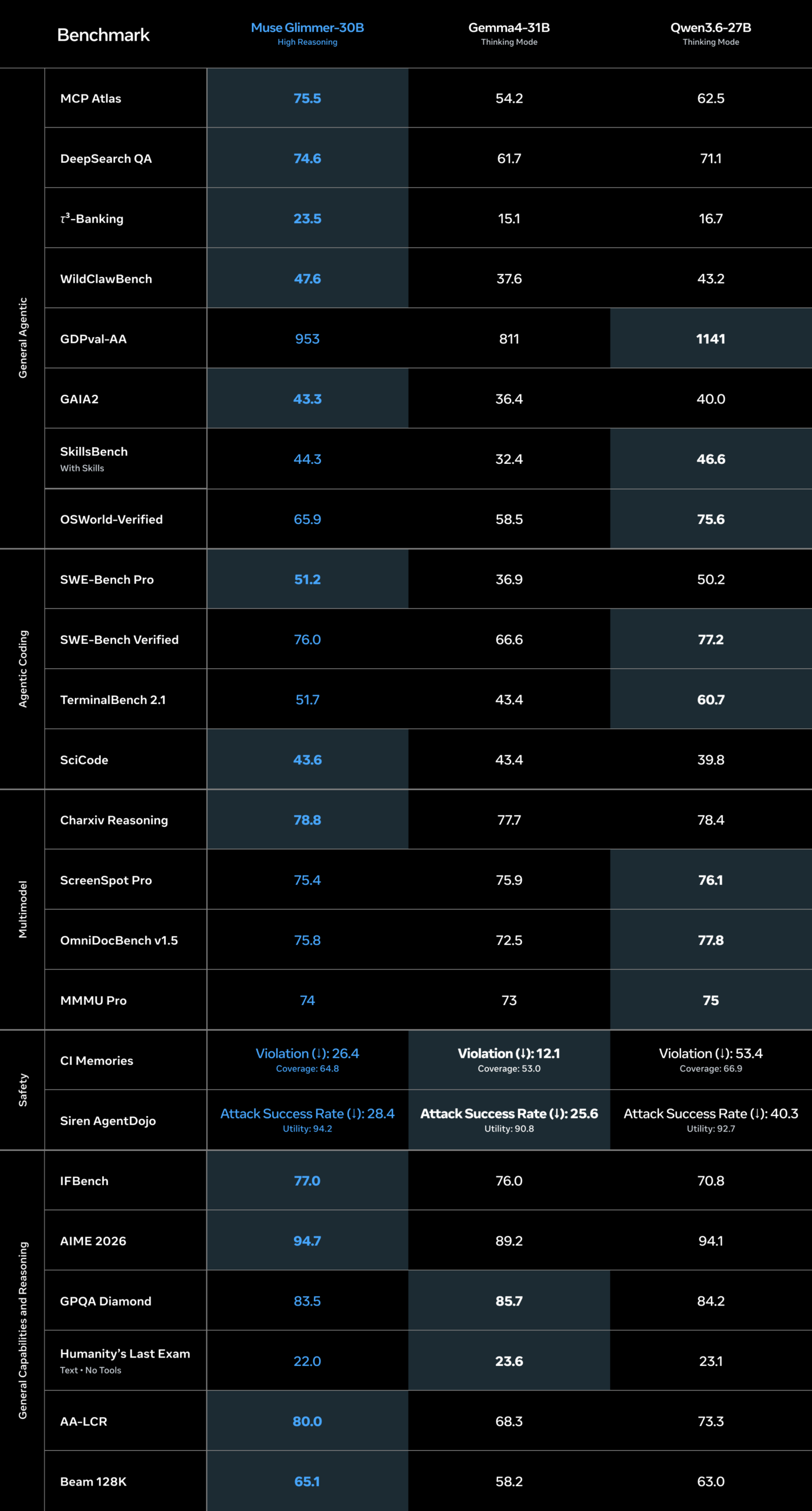
Muse Glimmer leads on agentic benchmarks like MCP Atlas, DeepSearch QA, and τ³-Banking, along with AIME 2026 and AA-LCR. It trails Qwen notably on OSWorld-Verified, TerminalBench 2.1, and SkillsBench. And it beats both rivals on IFBench (77.0 vs. 76.0 vs. 70.8) and Beam128K (65.1 vs. 58.2 vs. 63.0).
The biggest story isn’t any single benchmark, it’s the context window advantage. Early qualitative testing suggests Muse Glimmer feels roughly on par with Qwen3.6-27B for agentic coding, but it does so while offering a 3.7x larger usable context on the same GPU. For multi-turn tool use workflows that accumulate prompts, outputs, and intermediate reasoning steps, that difference is transformative.
The community has noticed. Developer sentiment is that Muse Glimmer works well as a general orchestrator model or as a verifier in a multi-agent setup, something the single model is explicitly trained for through its failure-recovery-focused post-training regimen. Dispatch a task to Qwen, have Glimmer review the output, the two-model consensus loop catches mistakes that either alone would miss.
One early user test noted that the model handles both coding and creative writing well, feeling slightly better than Qwen3.6-27B on the former and holding up against Gemma4-31B on the latter. That versatility is unusual for a model optimized specifically for agentic tasks.
DFlash Speculative Decoding: 3.1x Speedup
Local agents don’t just need to fit, they need to be fast. A model that takes minutes to plan its next step breaks the flow of real work. Meta’s answer is DFlash, a block-diffusion speculative decoding drafter that proposes entire blocks of 16 tokens in a single forward pass.
The main model verifies these proposals in parallel, accepting correct tokens and correcting wrong ones. Output quality is identical to standard sequential decoding, but the speedup is substantial:
| GPU | Baseline (tok/s) | With DFlash (tok/s) | Speedup |
|---|---|---|---|
| RTX 5090 | 74.9 | 233.4 | 3.1x |
| Apple M5 Max | 26.6 | 50.2 | 1.8x |
| Apple M4 Max | 23.7 | 37.8 | 1.5x |
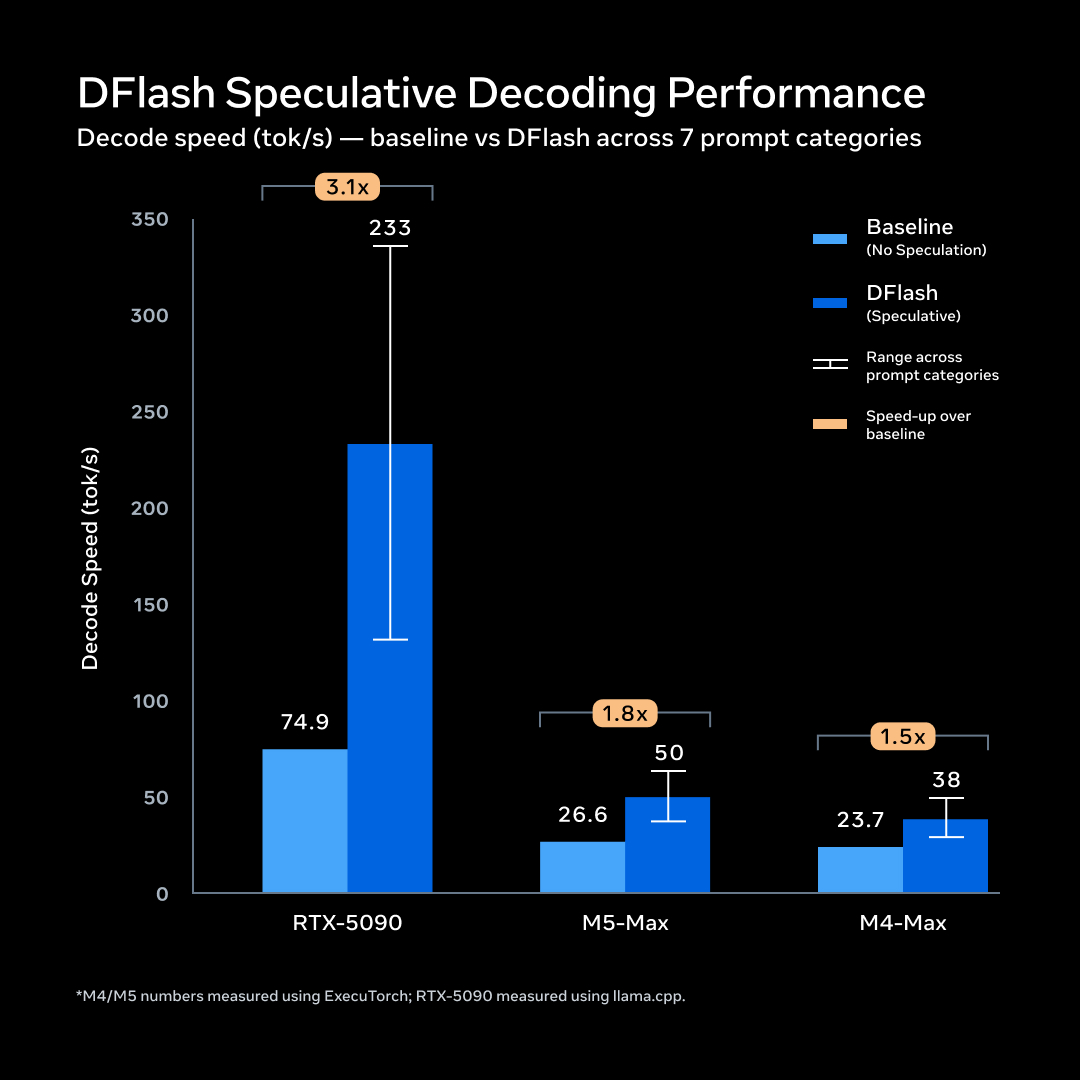
The RTX 5090’s 3.1x speedup is particularly interesting because it suggests the architecture scales well with GPU compute. The drafter has 5 layers (less than 10% of the main model’s depth), uses sliding-window attention with GQA, and can itself be quantized to keep memory overhead minimal.
For agentic workloads, these multipliers matter more than they do for simple chat. A single user request can trigger many model turns, tool calls, and verification steps. Every stage where the model needs to think, decide, and respond adds latency. DFlash attacks that problem at the generation layer, producing the same mathematical results as slow, sequential decoding but at interactive speeds.
The Licensing Angle: Apache 2.0 Changes the Game
This release has a licensing story that’s arguably as important as the technical specs. Muse Glimmer’s weights, quantizations, DFlash drafter, and perception encoder all ship under Apache 2.0. That’s the most permissive open-source license in common use, no custom restrictions, no monthly active user caps, no usage-policy strings attached.
Every single artifact is open:
- Full-precision BF16 weights
- 4-bit quantized variants (K-Quant-17GB and K-Quant-Dynamic)
- DFlash drafter head
- Perception encoder

And the ramification extend beyond this one model. Meta reportedly plans to release an open-weights version of Muse Spark 1.2 “soon”, per a post from Alexandr Wang. If that happens, a U.S. frontier model enters open circulation for the first time. The Chinese labs have been dominating open-weight AI, Qwen, Kimi, DeepSeek each ship thousands of “open” models, and by May 2026 four of the five most-used models on OpenRouter came from Chinese labs.
Muse Glimmer is a meaningful counterweight. Combined with OpenAI’s gpt-oss-20b release last year, it signals a U.S. shift toward permissive open licensing, a shift that has serious implications for teams building local agents on sensitive data without massive API budgets.
What’s Still Missing: The Honest Caveats
Before you rush to download the weights, here’s the reality check.
The 17GB model is the practical floor, not a ceiling. For image inputs, the perception encoder adds substantial VRAM overhead. One user reported VRAM usage spiking above 24GB when passing high-resolution images, a 14MP image nearly exhausted the 3090’s memory, though it did process with --parallel 1. Capping image resolution at 3Mpx helps, but you’ll want to test your specific multimodal workloads before betting on the 24GB envelope.
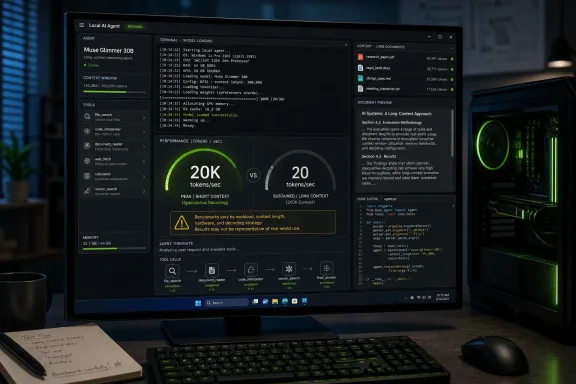
NVIDIA’s performance claims need independent verification. NVIDIA’s launch guidance reported “20K tokens/sec on a single GPU” in one section, then “over 20 tokens/sec/GPU” elsewhere. That’s a thousand-fold discrepancy, and one of those numbers is clearly wrong. Maybe both are. AMD’s preliminary Windows benchmarks show 24-53 tok/s on Ryzen AI Max+ 395 and Radeon systems, which aligns more closely with community testing on the 3090.
Quantization quality varies. One developer on r/LocalLLaMA noted that Q8 of Muse Glimmer feels worse than Q4 of Qwen3.5 27B in initial testing. That’s a single data point, and the claim cuts against Meta’s official 0.2%/1.0% degradation numbers. The truth likely depends heavily on your specific use case. You should A/B test on your own workload, not trust either the vendor or the skeptic blindly.
DFlash trades prompt processing for decode speed. When using the drafter, prompt processing drops from ~1,200 to ~800 tok/s on the same hardware. For heavily RAG-based workflows, you might prefer to disable speculation and accept slower generation in exchange for faster ingestion.
The local model landscape moves fast. Qwen3.8 27B is expected to drop within days, and it may well benchmark higher than Muse Glimmer in some categories. The context-window advantage is durable, that’s architectural, not merely performance-tuned, but raw intelligence is a moving target. Pick your model based on the characteristics that matter to your workflow, not just benchmark scores.
What This Means for Local AI
The practical implication is simple: running a 30B multimodal agentic model locally, on hardware you can buy for under a grand, with full context, is no longer theoretical. The KV cache optimization techniques that have been filtering into the ecosystem over the past year have finally converged with architectural choices that make 256k context feasible on 24GB.
This changes the calculus for any workload involving private documents, source code, or sensitive operational data. Instead of shipping that information to a cloud API and hoping the fine print protects you, you can run the entire agent stack locally. You achieve full data sovereignty, zero per-token costs, and query latency that’s immune to network conditions.
You also gain the ability to run multiple specialized agents simultaneously on one machine. Instead of one huge model doing everything, and struggling to fit in VRAM at useful context lengths, you can deploy a fleet of quantized Muse Glimmer or Qwen3.6 27B instances that body-swap in and out of GPU memory as tasks demand. That opens up genuinely new patterns for local AI.
The real-world performance of smaller models on consumer GPUs has been climbing steadily for months. Muse Glimmer’s launch doesn’t so much extend that trend as it jumps the curve entirely. The gap between “local-sized” and “cloud-sized” models just narrowed dramatically, and benchmark performance versus real-world deployment challenges is finally starting to align in consumers’ favor.
The next few weeks will tell us whether Muse Glimmer’s context window advantage holds up in real-world tasks or if Qwen3.8 27B moves the goalposts again. But the underlying trajectory is clear: modern AI agents are becoming a local-first technology, and the hardware to run them is sitting in millions of gaming PCs right now.
Your RTX 3090 just became a legitimate AI server. Might be time to start using it like one.