Muse Spark Open: The 816B-Parameter Flex That’s Already Courting Controversy
Meta just dropped the weights for Muse Spark Open, and the AI community is doing what it does best: celebrating the engineering, arguing about the benchmarks, and immediately questioning whether the safety training lobotomized the model.
The headline numbers are genuinely impressive. We’re talking 816B total parameters with only 42B active, a Mixture-of-Experts architecture that delivers frontier-adjacent capabilities without requiring a small power plant to run. The 1M-token context window puts entire codebases in scope, and native support for text, image, video, and audio makes this a genuinely multimodal workhorse.
But here’s where it gets interesting: the Reddit reaction was immediate and split. The prevailing sentiment on developer forums is that this release is a significant win for Western open weights, but there’s real skepticism about what the “additional safety post-training” actually cost in terms of raw capability.
The Architecture Under the Hood
Let’s dig into what makes this model tick. According to the model card on Hugging Face, Muse Spark Open pairs a Mixture-of-Experts Transformer with a Perception Encoder. The language model runs 62 layers with a hidden dimension of 8192 and 256 experts, eight of which activate per token through top-k routing. That’s a hefty routing overhead, but it’s what enables the model to activate only 42B of its 816B parameters at inference time.
The attention mechanism uses gated attention with QK-norm, 128 query heads, and 16 key-value heads in a grouped-query configuration with a head dimension of 64. The vocabulary sits at 202,048 tokens with untied input and output embeddings, a detail that matters for fine-tuning flexibility.
The Perception Encoder adds another 1.8B parameters across 50 layers with sparse attention (factor of four, meaning every fourth layer plus the final layer use full attention). This is what handles the multimodal inputs, and it’s a solid design for balancing compute efficiency with cross-modal understanding.
The model card also mentions a reasoning_effort parameter, low, medium, high, and xhigh settings with xhigh as the default. If you’re planning complex reasoning, coding, or agentic tasks, you’ll want to keep it there. Meta recommends temperature 1.0, top_p 1.0, and top_k disabled for most deployments.
The Benchmark Reality Check
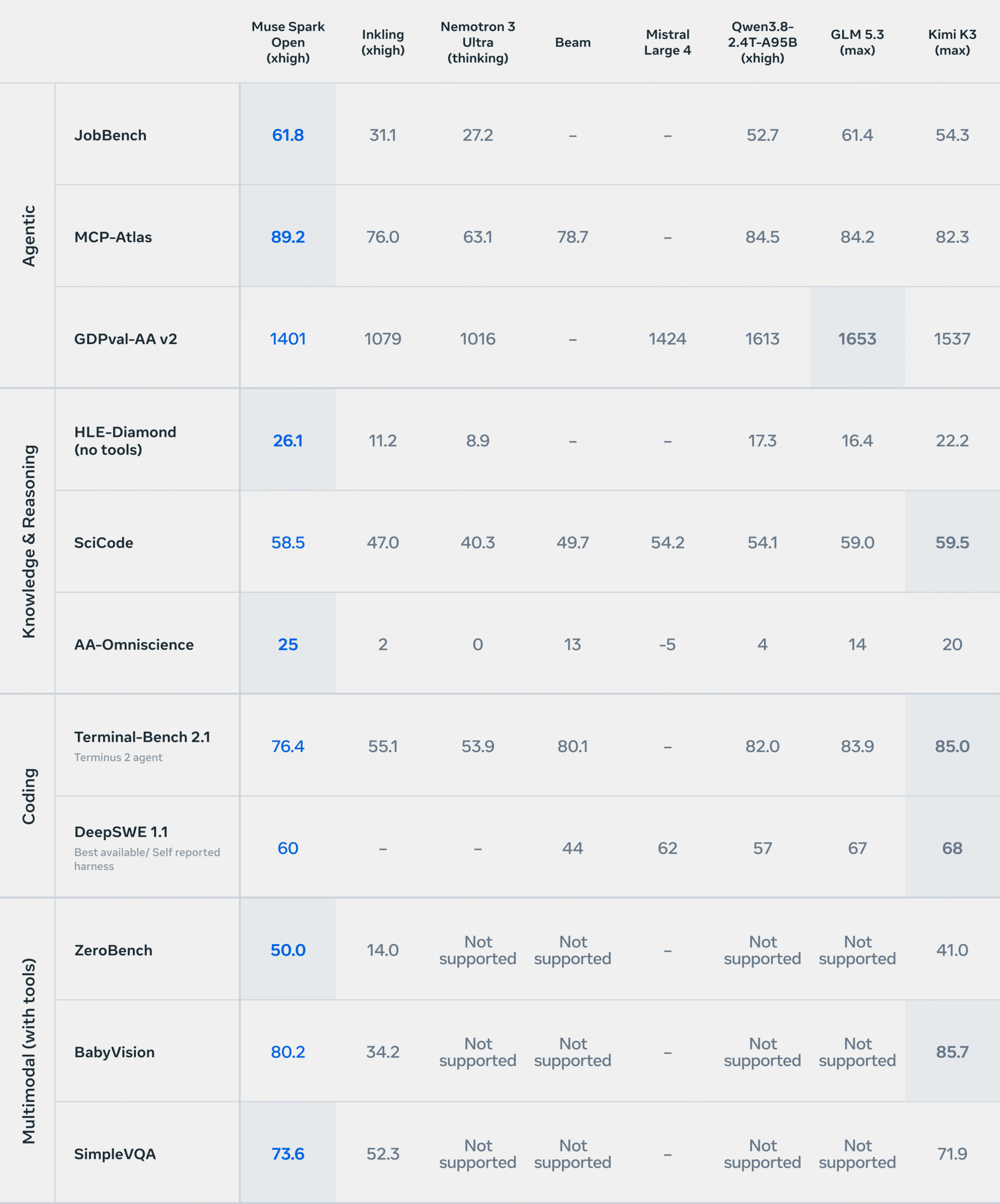
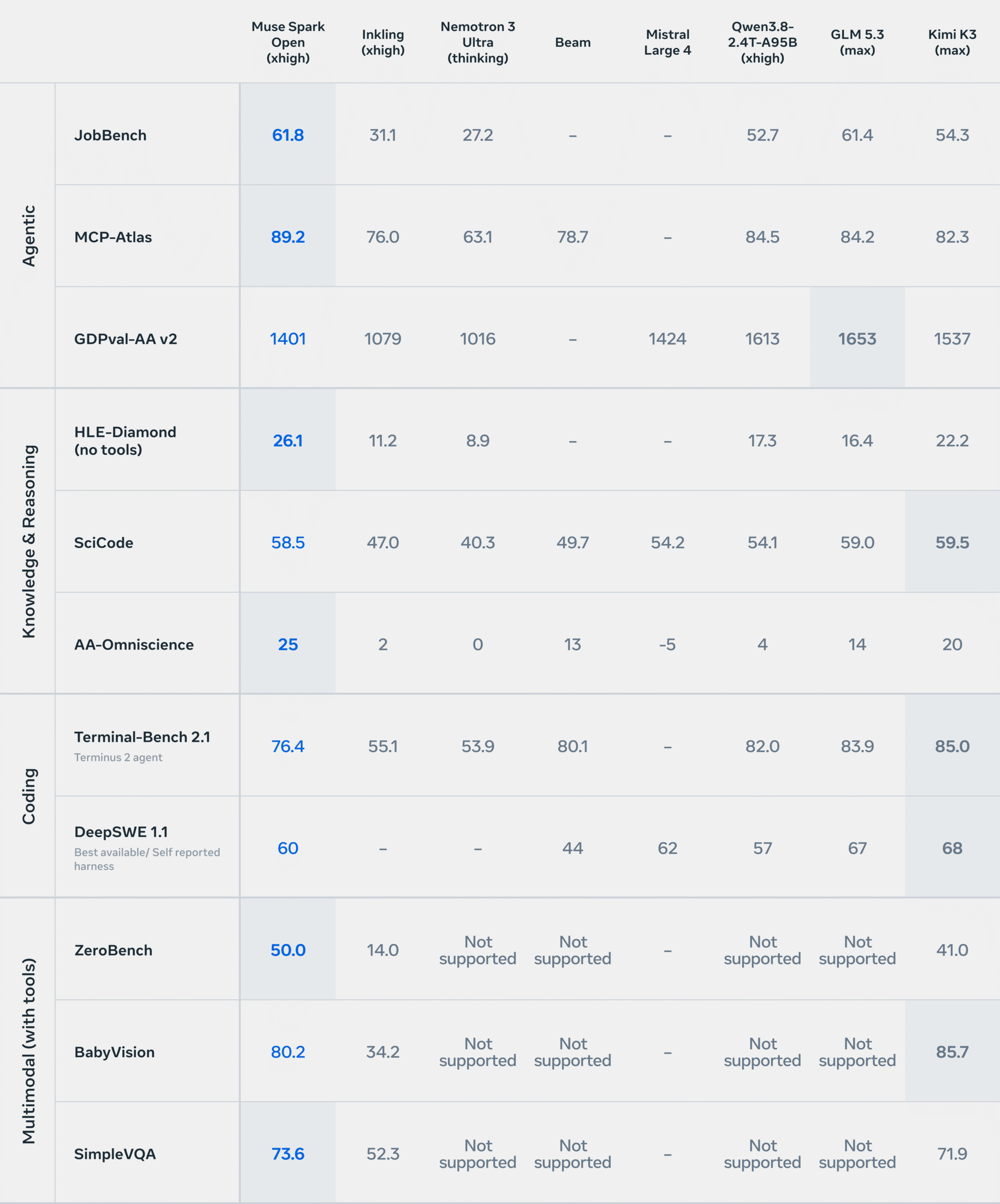
Meta’s own benchmark table is what happens when you release a model and let the community scrutinize it. On the Artificial Analysis Intelligence Index, Muse Spark Open scores 39. That’s respectable, but GLM 5.3 sits at 45, Kimi K3 at 44, and Qwen3.8-2.4T-A95B at 40.
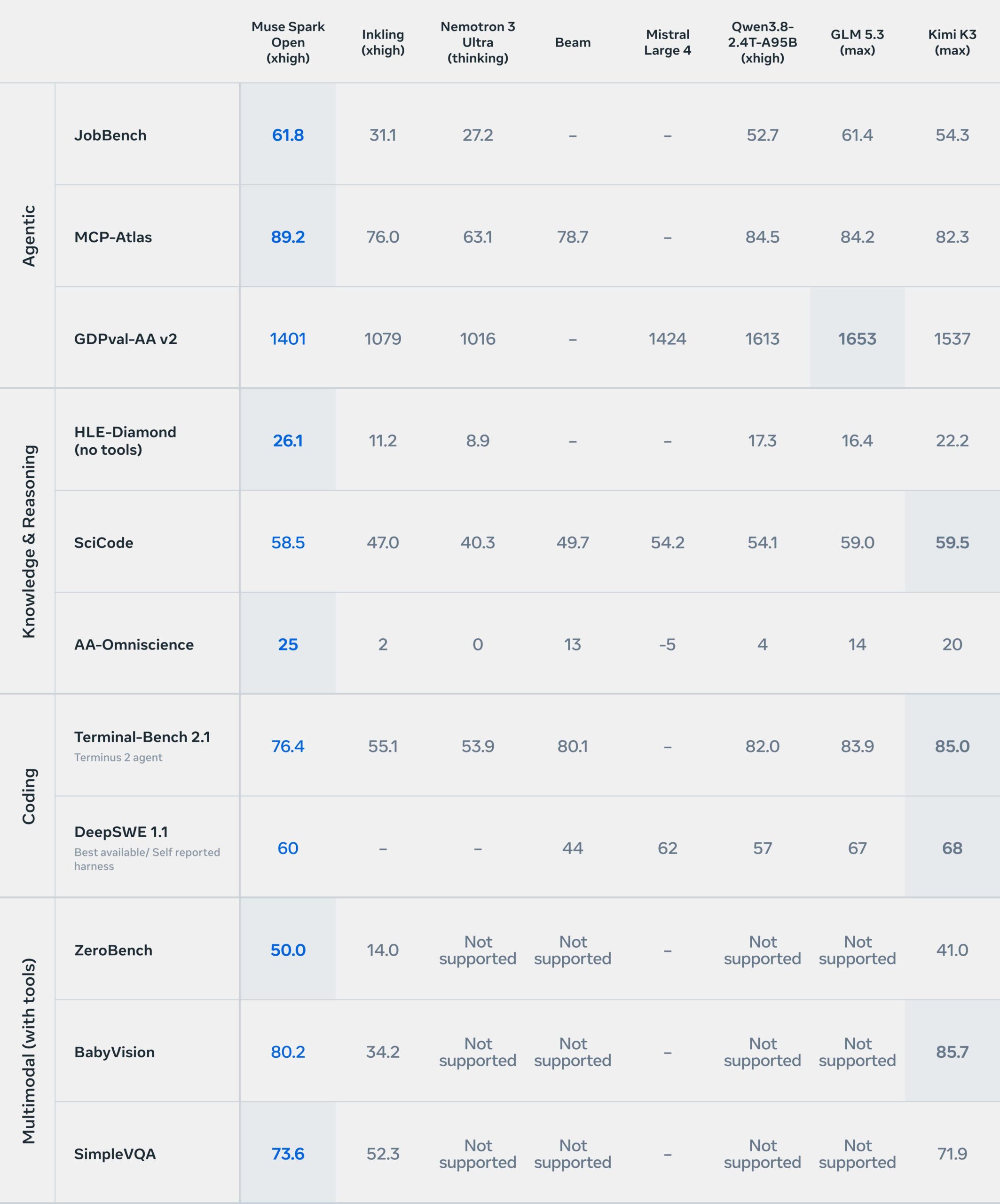
The agentic numbers are where Meta claims supremacy. JobBench at 61.8 and MCP-Atlas at 89.2 are the highest among the models listed in the card’s table. That’s the headline for developers building autonomous systems, and it’s a meaningful differentiator.
But the coding benchmarks tell a more complicated story. Terminal-Bench 2.1 shows 76.4, with Kimi K3 at 85.0 and GLM 5.3 at 83.9. DeepSWE 1.1 and SWE-Atlas-QnA follow a similar pattern, solid scores, but trailing the competition.
Knowledge and reasoning results are mixed too. GPQA Diamond at 89.0 is strong, but Qwen3.8-2.4T-A95B and Kimi K3 both hit 93.5. HLE-Diamond without tools lands at 26.1, which is low even for frontier models on that notoriously difficult benchmark.
The multimodal evaluations are interesting precisely because this is where “natively multimodal” should shine. ZeroBench at 50.0, SimpleVQA at 73.6, BabyVision at 80.2 (against Kimi K3’s 85.7), and VideoMMEv2 at 61.5 (against 65.4). The model holds its own but doesn’t dominate.
What do these numbers actually mean for practitioners? If you’re building agentic systems, Muse Spark Open’s benchmarks suggest it’s worth serious consideration. If you’re shipping code at scale, Kimi K3 or GLM 5.3 might serve you better. Most developers will want to run their own evals before committing to any of these models, the release notes and benchmark tables are starting points, not gospel.
The Lobotomization Question
The “safety post-training” controversy deserves a closer look. There’s a genuine tension between Meta’s commitment to open weights and its responsibility to prevent catastrophic misuse. But the community is asking pointed questions: did the additional safety training degrade model capability?
One commenter on the release thread put it bluntly: “Safety post-training makes models dumber and it can’t realistically be undone.” The argument is that safety fine-tuning scatters the learned representations, and no amount of subsequent fine-tuning fully recovers the original capability.
The skepticism isn’t entirely unfounded. Meta reports impressive safety metrics: refusing 99.2% of jailbreaks on their internal cyber benchmark and 94.8% aggregated across PolyGuard’s cyber subset, RedCode, and CyberBench 2024. Kimi K3, by comparison, sits at 75.5% and 70.2%. Those are strong numbers, but they suggest a model that’s been curated to err on the side of refusal.
There’s a real trade-off here. For cybersecurity researchers and red-teamers, heavily safety-trained models are often non-starters. The sentiment in the community is that uncensored alternatives like GLM 5.3 remain more useful for offensive security work. For enterprise deployments handling sensitive data, the safety post-training might be exactly what compliance teams want to see.
The deeper point is that “safe” and “capable” aren’t binary. Meta’s own tests show 98.1% honesty on the MASK benchmark and a 0% misbehavior rate on the Agentic Misalignment benchmark. But community benchmarks suggest the model scores lower than earlier Muse Spark versions on some evaluations, which raises the question of whether Meta compromised capability for safety compliance.
Meta’s stated position is that the released checkpoint was evaluated under their Superintelligence Scaling Framework and met the thresholds for release. The full evaluation report is coming soon, and that document will be essential reading for anyone trying to make an informed decision.
Two Mac Studios, One Frontier Model
The Apple Silicon optimization is the most genuinely surprising part of this announcement. Two M5 Ultra Mac Studios with 512GB of unified memory each, a combined terabyte, can host the entire model. The 1.2TB/s memory bandwidth on the M5 Ultra is the key enabler, reading only the small slice of parameters each token needs.
Meta’s demonstration is the kind of thing that makes you reconsider what “personal computing” means. They shipped real iOS changes to Ice Cubes (an open-source Mastodon client) entirely on-device, bug fixes, new features, full build. They also drove DaVinci Resolve end to end, reviewing footage frame by frame to identify the strongest moments and crop them vertically.
The throughput is roughly 20 tokens per second on that dual-Mac setup. That’s not cloud-inference speed, but it’s usable for agentic workflows and offline development. The cost question is real, though: a pair of M5 Ultra Mac Studios represents a substantial hardware investment, and local deployment doesn’t automatically beat cloud pricing. Since many developers have expressed frustration with cloud inference costs, this is a compelling option for those who already own the hardware.
For the rest of us, the model runs on all the major inference engines, SGLang, vLLM, TensorRT-LLM, Hugging Face Transformers, Apple MLX, llama.cpp, and Unsloth, with optimizations for AMD, Apple, Intel, and NVIDIA silicon. There’s also the custom Helion GPU kernels in SGLang, delivering 1.03, 3.95× kernel-level speedups on NVIDIA and AMD GPUs, plus a 3% end-to-end speedup on AMD MI350.
Weights, Quantization, and the Hardware Reality
The Hugging Face collection includes two versions: BF16 (822B) and NVFP4 (484B). If you’re planning to run this locally, the math is sobering. NVFP4 still requires at least 700GB of VRAM. BF16 needs around 2TB. That’s not consumer hardware territory, those are workstation or server-class allocations, unless you’re springing for the dual Mac Studio setup.
The NVFP4 weights deserve attention. They were calibrated in-house, which means the quantization quality is likely better than a rushed community conversion. For developers with 192GB or 256GB setups, the ability to fit Muse Spark Open with a substantial KV cache is genuinely valuable. There’s real appreciation in the community for shipping properly calibrated quantized weights out of the gate.
The License: Open-ish Weights
The Muse Model License is a step forward from fully proprietary models but stops short of permissive open source. The key provisions:
- Free use, copying, modification (including fine-tuning), derivative works, distillation, and distribution
- You must display “Built with Muse Spark Open” in your product’s UI or documentation
- If your model-as-a-service business exceeds $20 million in aggregate gross revenue in any 12-month period, you must notify Meta and enter a separate agreement
That $20 million threshold is interesting. It gives startups and mid-sized companies plenty of runway to build on Muse Spark Open for free, while creating a financial gateway for the largest players. The license also explicitly states Meta takes no ownership of your outputs, and the internal-use exemption means you can power your own products without triggering the notification requirement.
The usage policy prohibits use by individuals under 18 and bans illegal activity, malware creation, weapons development, operation of critical infrastructure, and intentional deception. For most legitimate developers, these are reasonable constraints.
The bigger question is what “open-weight” means in practice when the safety post-training, license terms, and hardware requirements all create friction. Meta’s Muse Glimmer release showed they can ship genuinely accessible models, the 30B model fits on a single RTX 3090. Muse Spark Open is a different beast entirely, and the [Muse Spark open weights release signaling a major shift in open-model availability](/blog/muse-spark-open-weights-signals-shift-open-model-landscape) might be the more consequential story for the ecosystem.
What This Means for the Frontier
The release cycle acceleration in AI is real. We’re seeing highly efficient open-weight models challenging frontier performance norms, and the accelerating AI model release cycles reshaping competitive dynamics suggest that the gap between “closed frontier” and “open weights” is narrowing faster than most people expected.
Muse Spark Open is a data point in that trend. It’s not the best model on every benchmark, but it’s the most capable US open-weight model to date, and it’s optimized to run on hardware you can actually own. That combination matters.
The local AI movement is building momentum. If you’re exploring what’s possible on consumer and prosumer hardware, Muse Glimmer enabling powerful local AI execution on consumer hardware is worth a look, it demonstrates that not every powerful model needs a terabyte of memory.
For developers evaluating Muse Spark Open, the practical path forward is straightforward:
- Pull the weights from the Hugging Face collection
- Test against your specific workloads, the benchmarks are informative but your evals matter more
- Check the VRAM requirements against your current infrastructure, the NVFP4 weights are the pragmatic choice for most deployments
- Read the license carefully if you’re building a commercial product
- Monitor the community discussions on Hugging Face forums, the real-world experience reports will surface quickly
The biggest takeaway? The frontier gap is no longer a chasm. Whether that’s good or bad depends on your use case, your hardware budget, and your tolerance for safety post-training. But the era of frontier-scale models running on your desktop is officially here, chonk and all.