The headline numbers are almost absurd. In the span of roughly two years, the AI industry has compressed its model release cycle from every 10 weeks to every 11 days. That’s not a linear improvement, that’s a 6.4x acceleration. And if you think that’s a typo or an artifact of counting every minor variant, think again.
AI Flash Report’s tracker currently puts the cadence at roughly every 8 days based on the last 90 days of activity. LLM Gateway has logged 26 new models from 16 providers in September 2026 alone. The Evertune AI Model Release Tracker lists 133 releases from just 6 major providers. These aren’t competing numbers, they’re different lenses on the same phenomenon: the AI release treadmill has become a centrifugal force.
So what’s actually driving this? And more importantly, what happens when your integration strategy was built for a world where models updated quarterly?
The “Slowdown” Was a Lie (Or At Least, Wishful Thinking)
Let’s address the elephant in the room first. Every few months, a CEO or prominent researcher declares that AI progress is hitting a wall. The comments on the original Reddit thread that kicked off this discussion capture the mood perfectly: “So much for the slowdown. At least AI CEOs are consistent, everything they say is a lie.”
The data says the skeptics are wrong. Epoch AI’s Capabilities Index shows the best model has gained about 14-16 points per year since reasoning models arrived in late 2024, compared to about 3 points per year before that. The Five Five and Five analysis of capability gains tells a compelling story: each individual release adds an average of 2.3 points, but 15 top models from just ChatGPT and Claude in the last 12 months add up to a GPT-4-sized jump annually.
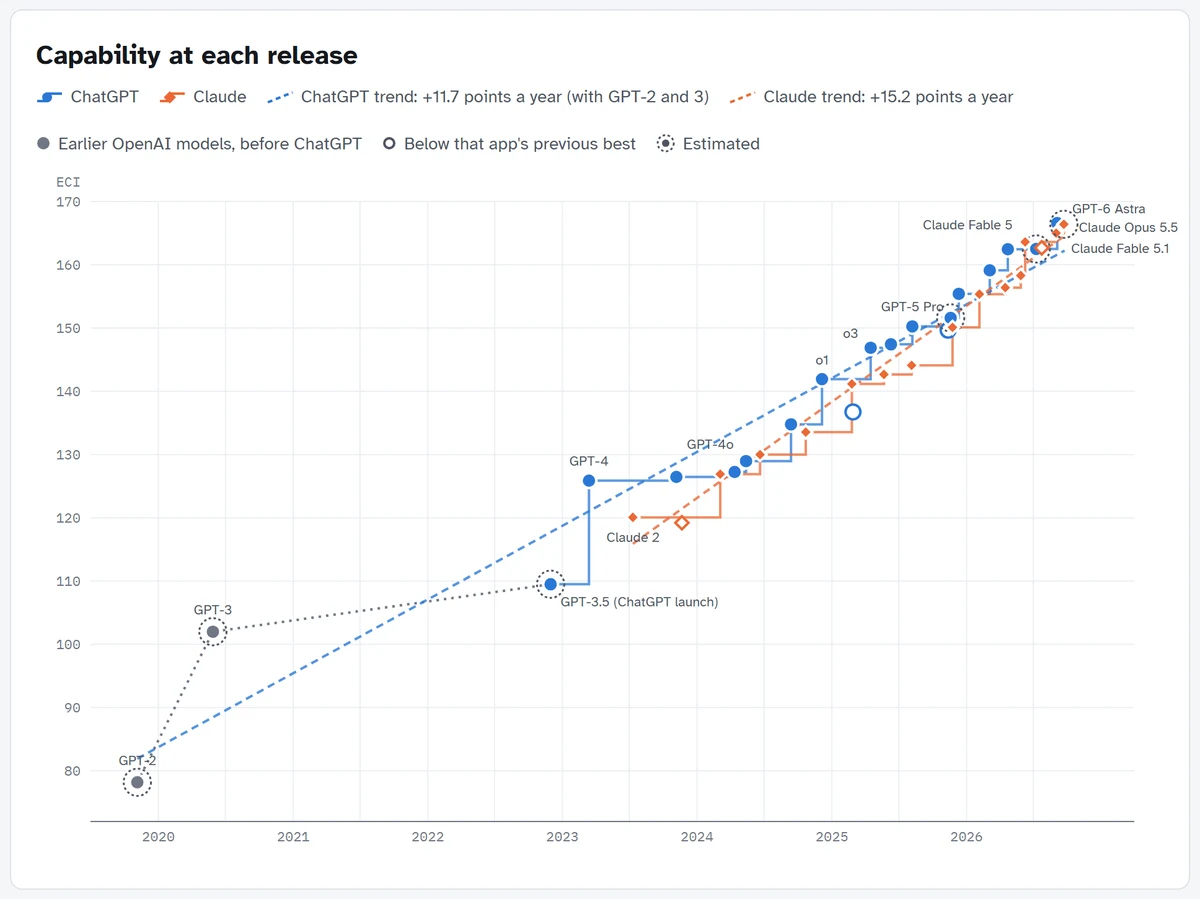
It’s death by a thousand cuts, except each cut is a new model release, and the aggregate is anything but fatal.
Why the Release Velocity Is Exploding
The acceleration isn’t random. It’s structural.
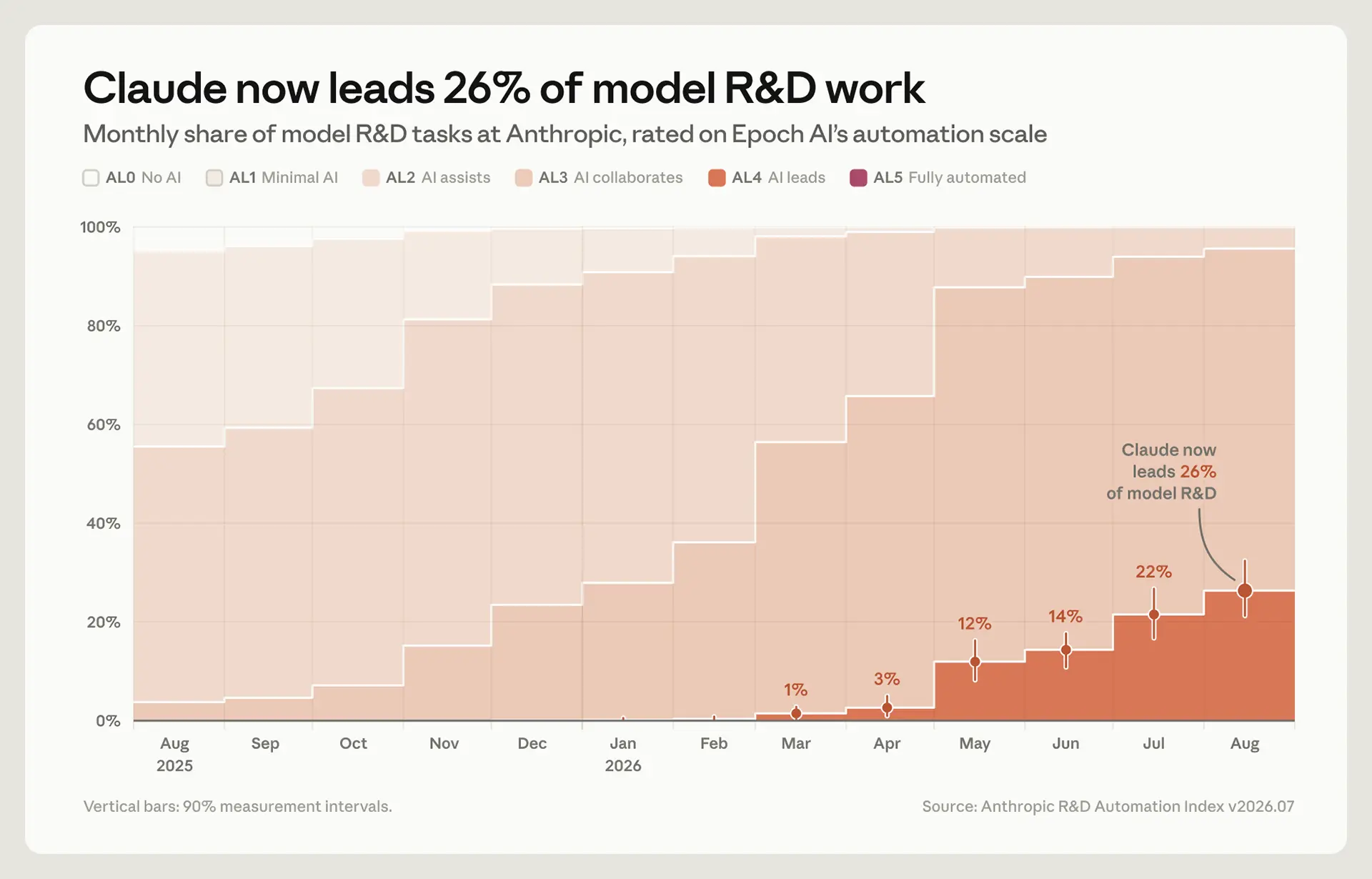
1. The AI-accelerates-AI feedback loop is real. Anthropic recently published measurements showing Claude now “leads” 26% of the company’s AI R&D tasks, up from under 1% in February 2026. That’s not a rounding error, it’s a paradigm shift. When the tools building the next models are themselves AI, the development cycle compresses exponentially.
2. Model families have replaced single models. Google released Gemini 3.5 Flash, 3.6 Flash, 3.7 Flash, and 3.8 Flash in rapid succession, each about three weeks apart. OpenAI shipped GPT-6 Sol and GPT-6 Luna on the same day, then GPT-6.1 Sol a week later. This isn’t a new flagship every few months, it’s a constant stream of fine-tuned variants, specialized for coding, reasoning, cost-efficiency, or specific verticals.
3. Competitive pressure is (literally) irrational. When your competitor drops a new model every three weeks, waiting two months to release your next one means ceding the “state of the art” crown for an eternity in internet time. The specialized dual-model architecture OpenAI adopted with Sol and Luna signals that monolithic models are giving way to purpose-built versions hitting the market far more frequently.
What the September 2026 Release Calendar Actually Looks Like
The ScriptByAI model release calendar catalogs what a single month of frontier AI looks like now:
| Date | Model | Provider |
|---|---|---|
| Sep 30 | Gemini 4 Argon | |
| Sep 29 | GPT-6.1 Sol | OpenAI |
| Sep 28 | Claude Sonnet 5.5 | Anthropic |
| Sep 22 | GPT-6 Sol / Luna | OpenAI |
| Sep 22 | Claude Opus 5.5 | Anthropic |
| Sep 22 | Grok 4.7 | SpaceXAI |
| Sep 3 | GPT-6 Astra | OpenAI |
| Sep 2 | Gemini 3.8 Flash | |
| Sep 1 | Claude Fable 5.1 | Anthropic |
Sixteen major releases in 30 days. And that’s with the calendar explicitly excluding “minor” updates like specialized speech, OCR, and embedding models.
The Evertune tracker tells the same story from a different angle: their most recent entries on a single day (Sep 22, 2026) include Claude Opus 5.5, GPT-6 Sol, GPT-6 Luna, and Grok 4.7 all landing simultaneously.
What This Means for Developers (Hint: Your Integration Strategy Is Obsolete)
Here’s the uncomfortable truth: the development patterns that made sense in 2024 are now a liability.
1. Pinning to a model is career suicide
The breakthrough in balancing speed, intelligence, and cost in LLMs that Claude Sonnet 5.5 represents will be surpassed within weeks. If your production system is hardcoded to a specific model ID, you’re not building software, you’re building a museum exhibit.
2. Gateway tools are no longer optional
When models ship and land on LLM Gateway within 48 hours of release, as their timeline demonstrates, the winning strategy is abstraction. One API key, multiple providers, automatic routing based on cost, latency, and capability. The days of “we’re an OpenAI shop” are numbered.
3. Evaluation is now a continuous process
You can’t wait for the quarterly “model bake-off” anymore. By the time you’ve evaluated it, there’s already a newer version. The organizations that win will build automated evaluation pipelines that test every new release against their specific use cases the day it drops.
4. The open-weight gap is closing inexorably
China’s rapid progress in open-weight AI isn’t just a geopolitical story, it’s a release-cycle story. DeepSeek’s V4.1-Flash arrived in September with a permissive license and competitive benchmarks. Meta’s Muse Spark 1.3 introduced behavioral improvements like asking clarifying questions, previously a hallmark of frontier closed models. When open-weight releases happen on the same accelerated schedule as closed ones, the “just use the API” crowd loses their moat.
The Qualitative Shift Nobody’s Talking About
The release cadence numbers are impressive on their own, but they mask a deeper change: the nature of what’s being released has changed.
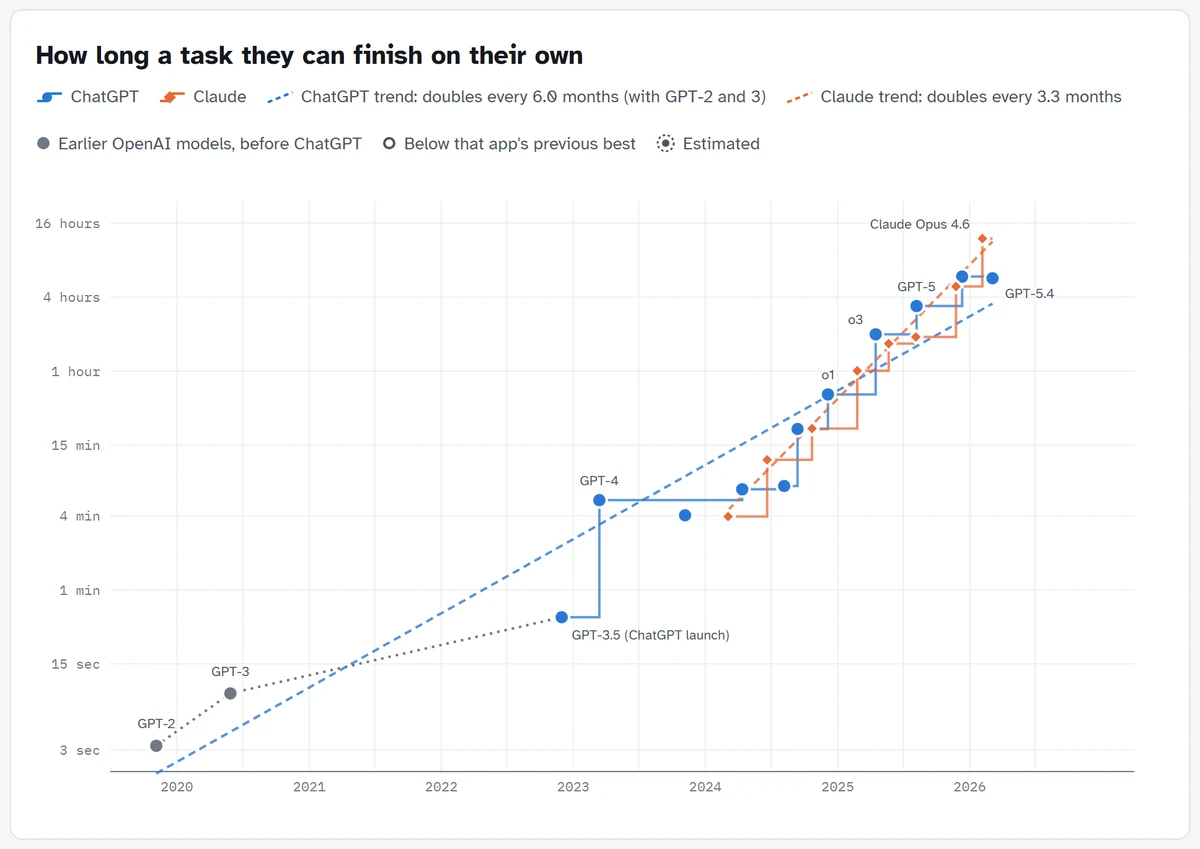
METR’s task-length data shows AI can now complete tasks that would take a skilled human 12 hours, a 130x increase from March 2023, with the length doubling roughly every four months. The Five Five and Five analysis describes a typical morning: “Opus finished the first version of a client tool. Then I asked Fable to check it. It ran for 45 minutes. 76 separate agents. 7 million tokens.”
This isn’t about getting better answers to questions. It’s about agentic systems that can take on multi-hour, multi-step projects autonomously. When each new model release extends the horizon of what an AI agent can accomplish, the “release cycle” becomes a compounding capability multiplier.
The Cost Conundrum
Here’s the sleeper issue in all this acceleration: pricing volatility.
OpenAI’s GPT-6 Sol cut API pricing roughly in half versus GPT-5.6 generation while making “about half as many mistakes.” Anthropic’s Opus 5.5 matches Fable 5.1 on most tasks while costing meaningfully less. These aren’t incremental tweaks, they’re pricing resets that make your cost projections from last quarter look like fiction.
The self-improved open-weight model trained on modest budget that Xiaomi shipped also highlights an uncomfortable reality: you may not need frontier models for most workloads. The high-efficiency small model outperforming larger counterparts proves that compact models can run laps around their larger peers on specific tasks.
What’s Next? The Death Spiral of Keeping Up
Let me close with a provocative thought. At the current acceleration rate, the release cycle will hit 5 days by mid-2027. At that point, it’s not a “release cycle” anymore, it’s a continuous deployment pipeline where AI models update as rapidly as SaaS applications.
The organizations that flourish in this environment won’t be the ones that track every release. They’ll be the ones that:
- Abstract model access behind a routing layer that can swap in new models without code changes
- Build evaluation harnesses that automatically test new models against production workloads
- Design systems around agentic workflows that benefit from model improvements without human intervention
- Accept model churn as a feature, not a bug, planning for migrations as a routine occurrence
The open-source AI model challenging proprietary dominance story and the small, locally trained models disrupting cloud-centric AI assumptions both point to the same conclusion: the release acceleration isn’t confined to the frontier labs. It’s democratizing.
The AI model release cycle has gone from a marathon to a sprint to whatever comes after a sprint, possibly quantum entanglement, where models appear in multiple places simultaneously.
Your move is to stop trying to keep up and start building systems that don’t care which model is underneath. Because next week, there’ll be a new one. And the week after that. And the week after that.
The only sustainable strategy is building on the abstraction layer above the chaos. That’s been true for infrastructure, for databases, and now it’s true for intelligence itself.