Here’s the headline that’s about to make some very expensive model-training runs feel deeply awkward: a small lab with offices in Switzerland and South Africa just dropped Hemmingway-1, a 27B parameter model that’s beating GPT-5.5, Claude’s Opus 4.8, and most of the frontier roster on Emotional Intelligence benchmarks, at roughly 1/40th of the compute cost.
The model is a Qwen 3.8-27B fine-tune, released under Apache-2.0, optimized for creative writing, roleplay, and the kind of everyday communication that most LLMs absolutely butcher: texts, emails, and notes that actually sound like a human wrote them. And while the claims deserve scrutiny, the early data suggests something significant is happening in the open-weights space.
The 27B Model That’s Punching Way Above Its Weight
Let’s get the numbers out of the way, because they’re the reason this post exists.
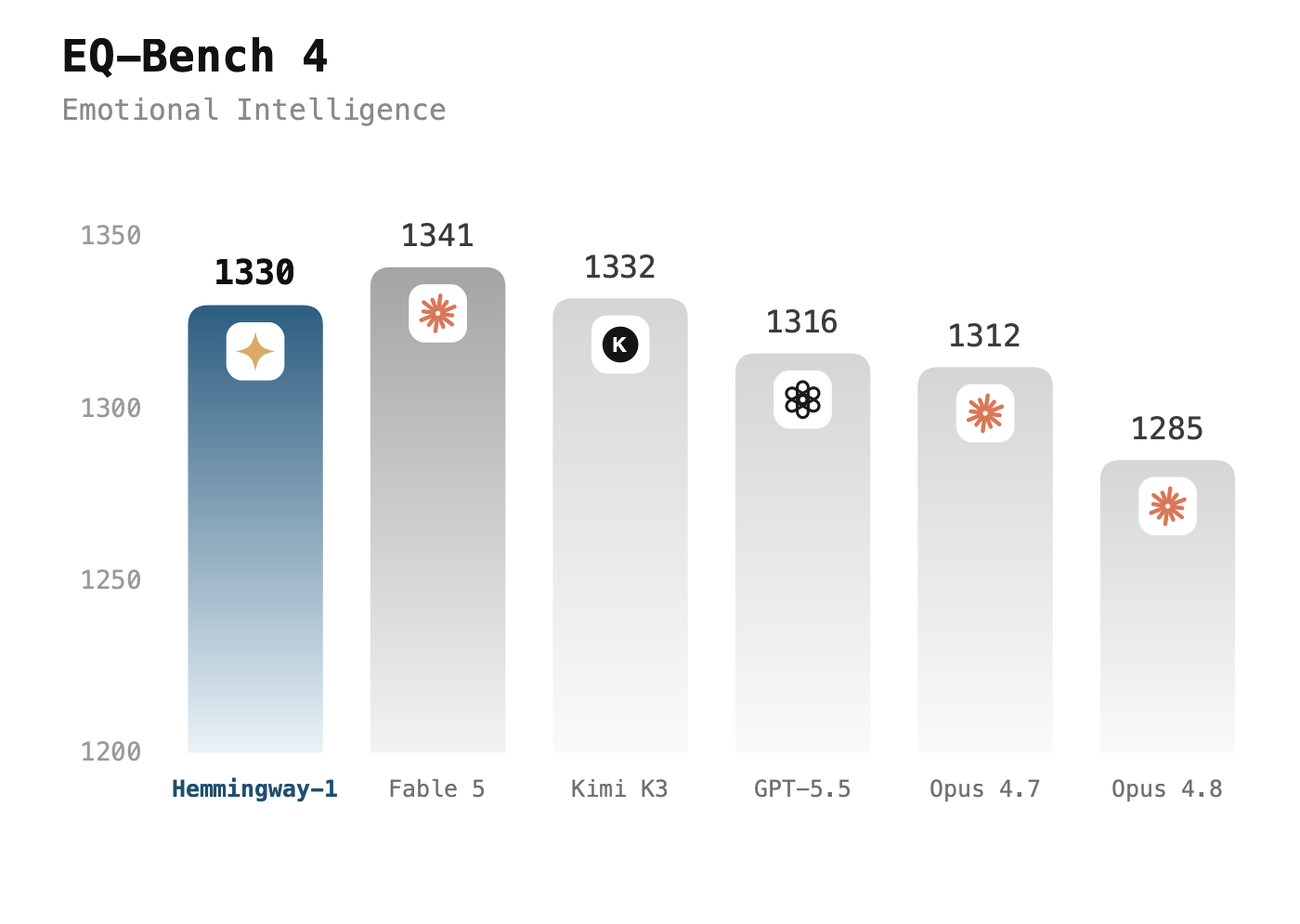
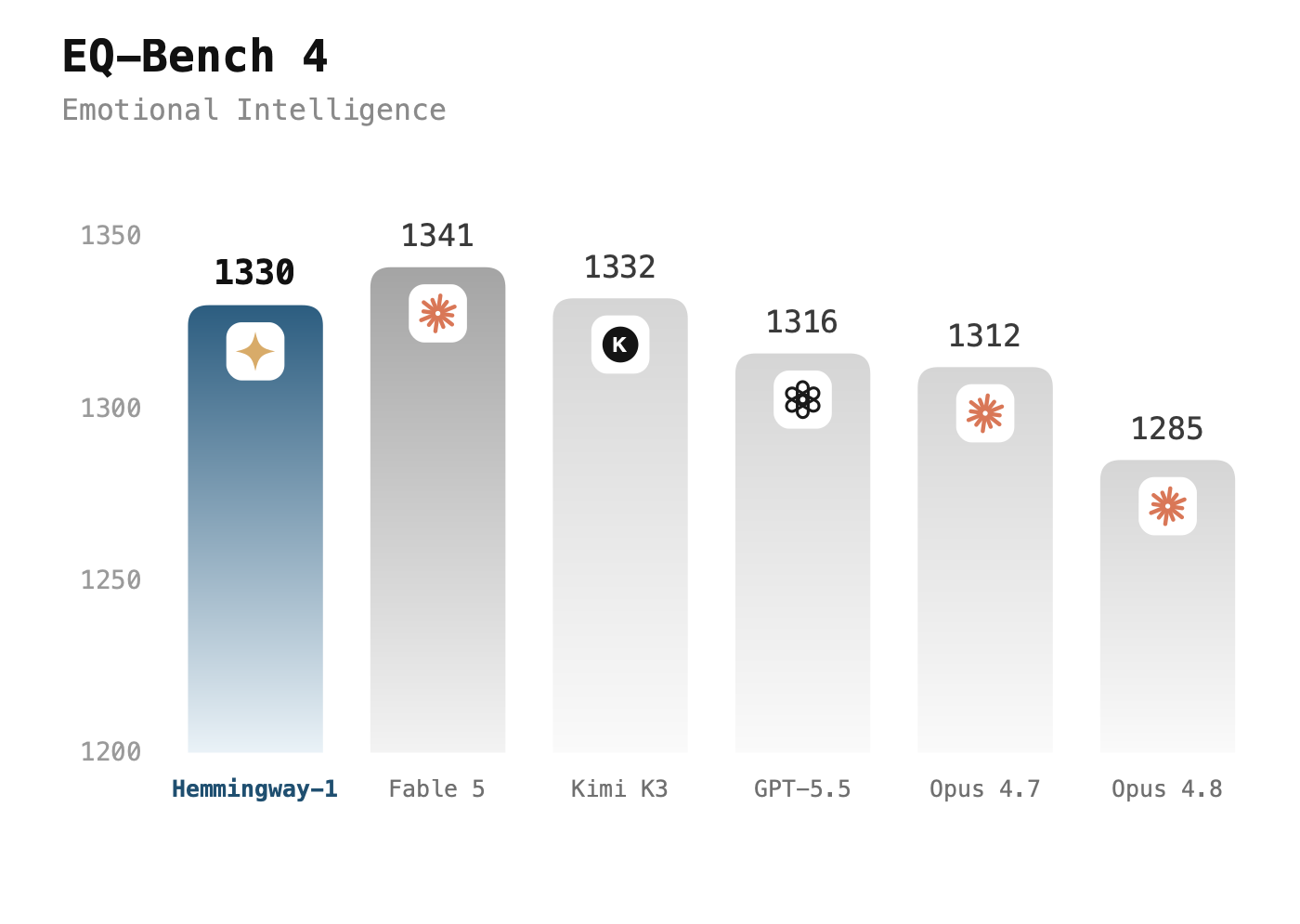
On EQ-Bench 4, the public Emotional Intelligence benchmark, Hemmingway-1 scores 1330, right behind Claude Fable 5 and ahead of GPT-5.5, Opus 4.7, and Opus 4.8 (see the full breakdown below).
On the lab’s own CommunicationBench, where 80 real-world requests were judged in blind A/B matchups, it beat Fable 5.1 and came in 50 points ahead of GPT-6 Astra. Kimi K3, GLM-5.3, Grok 4.6, and DeepSeek V4 Pro all finished behind it.
The model’s human-likeness scores are arguably more interesting: when judges were asked “which of these two responses did a person write?”, Hemmingway-1 finished 26 points clear of the next best model.
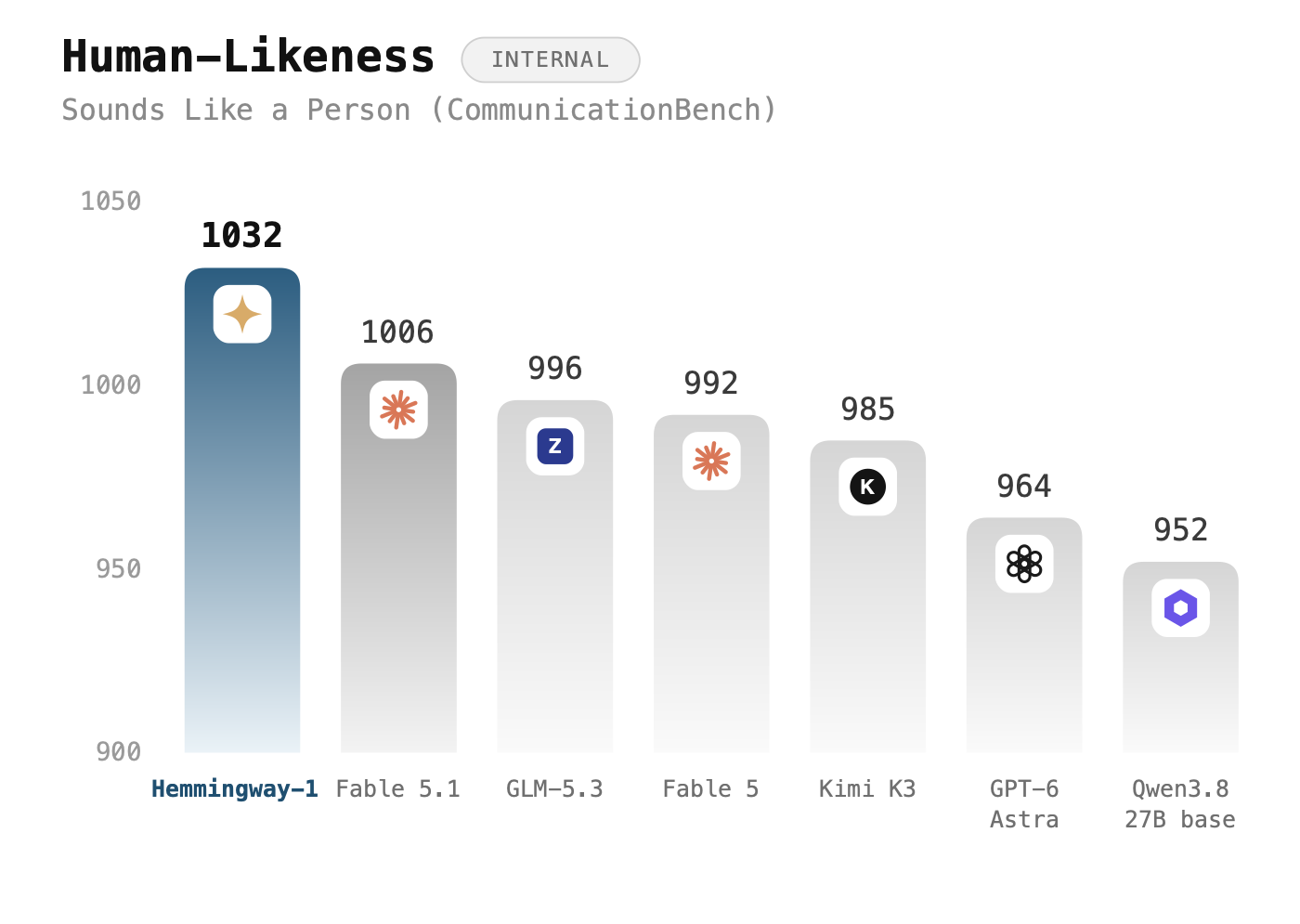
Now, a caveat: CommunicationBench, Human-Likeness, and StoryBench are the lab’s own benchmarks. They disclosed this upfront in their model card, ran blind matchups in both orders, and used a different model as the judge. That’s more transparent than most frontier labs get. But self-reported benchmarks are still self-reported, and the community is right to demand independent verification.
The Real Story: Fine-Tuning Is Eating the Frontier
Here’s what makes Hemmingway-1 genuinely notable, beyond the benchmark chest-thumping: it’s a fine-tune of Qwen 3.8-27B, which itself is already resetting expectations for what local AI can do. The lab confirmed this directly, noting that the base model’s intelligence “transferred very well across domains.”
This is the pattern that should worry the frontier labs. We’re seeing a cascade of capable open base models, Qwen 3.8 27B running locally now rivals cloud subscriptions in real-world tasks, and specialized fine-tunes are layering on top of them to deliver domain-specific performance that rivals models 10-20x their size.
The Muse Spark open weights release already suggested the frontier gap was evaporating. Hemmingway-1 is the creative-writing proof point.
It Writes Like a Person Because It Wasn’t Trained to Write Like an AI
The most striking claim from the lab isn’t the benchmark scores, it’s the qualitative feedback from testers who described it as “the best AI they’ve ever used for writing” and noted it “genuinely sounds human.”
The model card breaks down where Hemmingway-1 wins and loses:
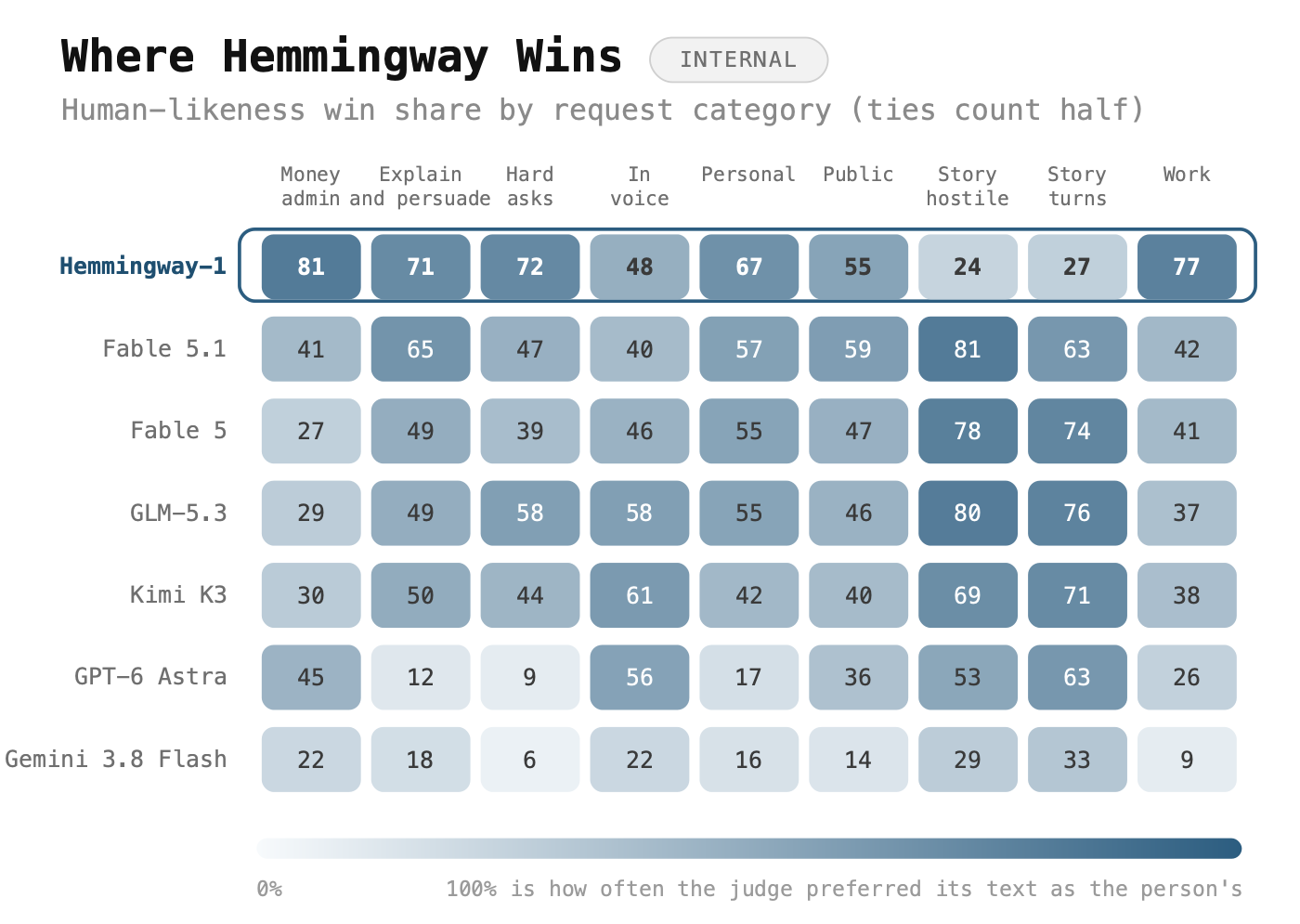
The category breakdown reveals something specific: it dominates on money and admin requests, work communication, “hard asks” you keep rewriting, and persuasion-heavy messages. On hard asks, GPT-6 Astra wins judge preference just 9% of the time. Hemmingway-1 gets 72%.
But here’s the honest part: it loses on hostile storytelling and long story turns. As the lab puts it, “the story models are better at those, and that is fair.”
That’s the unglamorous truth about specialized models. They’re not universal. What Hemmingway-1 does is target a specific pain point, the agonizing process of drafting a difficult message or an emotionally charged email, and nail it.
You Get a Message, Not a Memo
Ask most frontier models for a text to your landlord about a broken boiler, and you’ll get a preamble, three options, and a paragraph explaining your options. This behavior is so endemic that the lab built a benchmark around it.
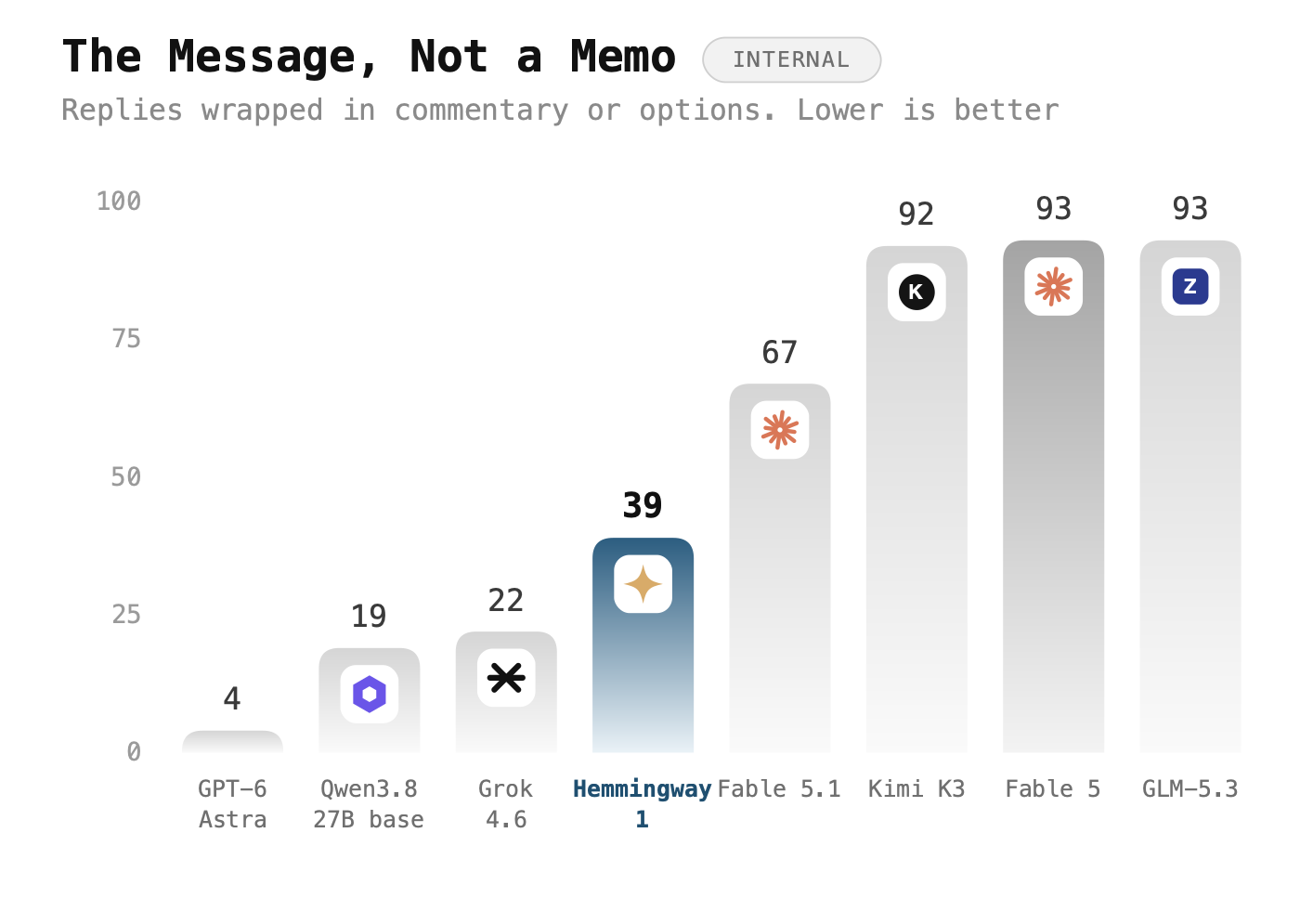
The results are brutal: Fable 5, GLM-5.3, and Kimi K3 bury the actual message in commentary, options, and notes in more than nine out of ten responses. Hemmingway-1 just gives you the text.
This is the unsung failure mode of modern LLMs. We’ve optimized for capability and reasoning while completely ignoring the fact that for everyday communication, users want a draft they can send, not a collaboration session with an anxious intern who needs to show their work.
The lab’s approach, solving the overthinking problem that plagues Qwen 3.8 27B, appears to have carried through to the fine-tune, and the result is a model that treats your time as the most valuable resource in the interaction.
What This Means for Local AI and the Hardware You Own
The practical implications are significant. This is a 27B parameter model, which means it’s eminently runnable on consumer hardware. We’ve already seen configurations that push 73K context onto 16GB VRAM with Qwen3.8-27B, and the model’s 262,144 token context window doesn’t hurt.
Here’s how to run it with vLLM:
vllm serve Altworld/Hemmingway-1 --max-model-len 262144
Or with Transformers:
from transformers import AutoModelForCausalLM, AutoTokenizer

model_id = "Altworld/Hemmingway-1"
tok = AutoTokenizer.from_pretrained(model_id)
model = AutoModelForCausalLM.from_pretrained(model_id, device_map="auto", dtype="auto")

messages = [{"role": "user", "content": "Write the text I send my landlord about the broken boiler."}]
ids = tok.apply_chat_template(messages, add_generation_prompt=True, return_tensors="pt").to(model.device)
out = model.generate(ids, max_new_tokens=512)
print(tok.decode(out[0][ids.shape[-1]:], skip_special_tokens=True))
The weights are on Hugging Face under Apache-2.0, which means commercial use is unrestricted. The community has already produced 12 quantized versions for llama.cpp, Ollama, and LM Studio.
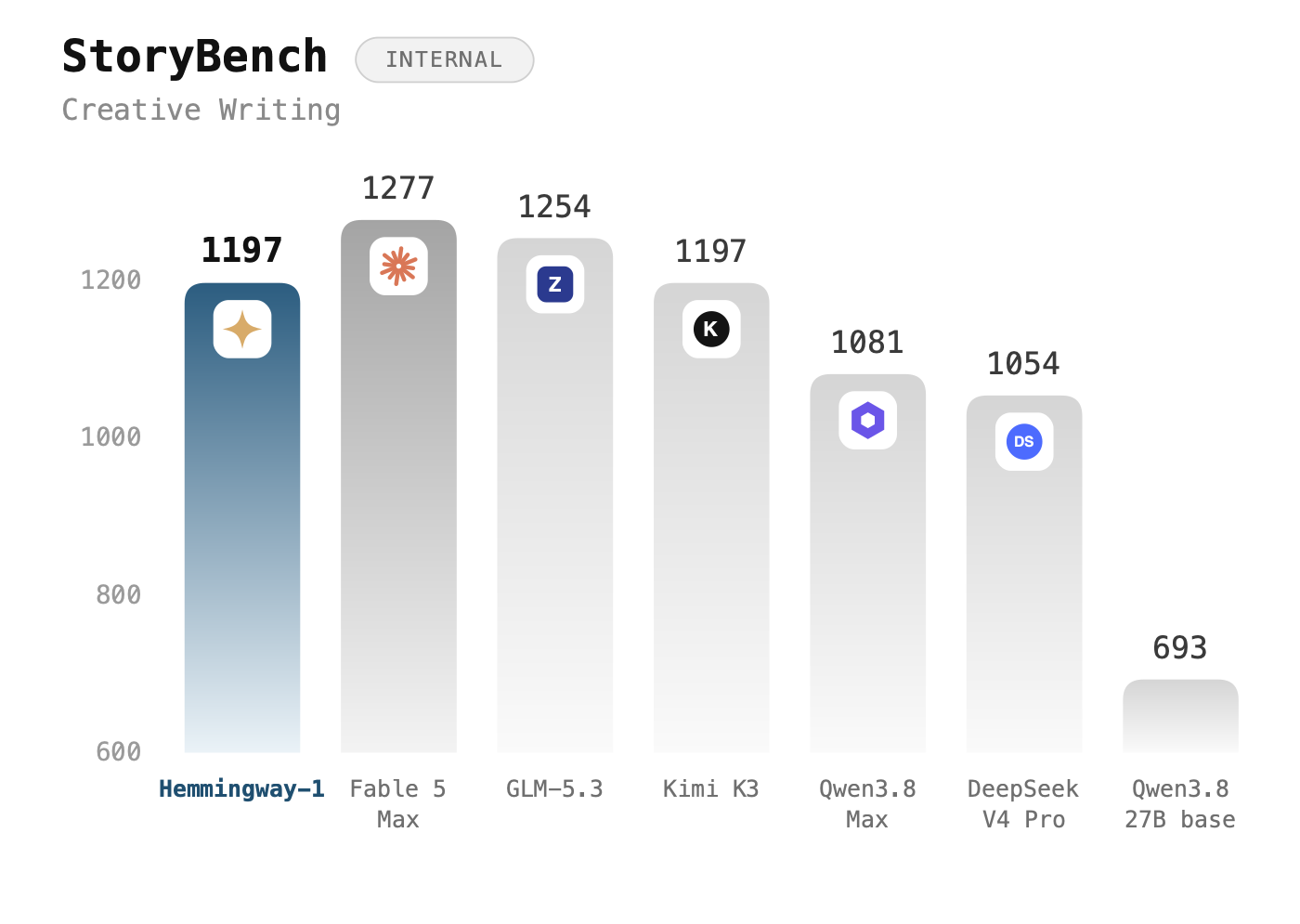
For a sense of how this plays out in practice, the lab’s StoryBench results show the model sitting level with Kimi K3, comfortably ahead of Qwen3.8-Max and DeepSeek V4 Pro, and 504 points above its own base model:
The Skeptic’s Corner: What Deserves Scrutiny
Before we crown a new creative writing champion, let’s apply the same skepticism this subreddit is famous for, and rightfully so.
It’s a Qwen fine-tune. The model card is transparent about this, but the lab’s claims need to be weighed against the fact that there are literally thousands of RP and fiction fine-tunes on Hugging Face built on Qwen 3.8 27B. Several commenters were quick to point this out, noting the model is entering a crowded field with “dozens/hundreds/thousands” of competitors depending on how you define the category.
The benchmarks are partly self-built. CommunicationBench, Human-Likeness, and StoryBench are the lab’s own creations. That doesn’t invalidate them, but independent replication is essential before treating them as ground truth. EQ-Bench 4 is public and externally run, which lends credibility to the Emotional Intelligence claims.
Creative writing quality is subjective. The “human-likeness” metric is clever, but it’s still a proxy. And the lab itself admits defeat on hostile storytelling and long story turns, which happen to be the domains where Claude Fable 5 and dedicated story models excel.
One commenter offered a useful baseline challenge: while some of the hostility toward the lab’s post was unfair, the core skepticism about comparing a 27B fine-tune to frontier models is healthy. And they had a point that deserves attention: for serious creative writing, the community has been gravitating toward Gemma-based models, with some arguing Qwen’s prose “feels less natural” even after fine-tuning.
The Bigger Picture: We’re Entering the Long Tail
The most profound implication of Hemmingway-1 isn’t the model itself, it’s what it represents. A two-person lab (or whatever Altworld’s actual headcount is) can now build a domain-specialized model that outperforms frontier giants in a specific area.
The economics are staggering. The lab claims 40x cost reduction versus equivalent API usage. When Qwen 3.8-27B was already making cloud subscriptions feel unnecessary, a fine-tune that adds meaningful domain expertise at zero marginal cost changes the calculus for startups and individuals alike.
We’re also seeing the beginning of autonomous agent use cases on local hardware, Qwen3.8-27B has already demonstrated it can execute complex multi-step tasks independently. A model like Hemmingway-1 that can draft communications with genuine human tone could be a meaningful component in those pipelines.
And the hardware trend lines help: 26B models on edge devices is no longer fantasy. The compression techniques being developed for phones will eventually make models like this runnable on devices most people already carry.
The Bottom Line
Hemmingway-1 deserves your attention, but not for the reason the lab hopes. The headline claim, “frontier performance at 40x lower cost”, is compelling but unverified. What’s actually demonstrated is something more subtle and more interesting: targeted fine-tuning on a capable open base model can produce dramatic improvements in a specific domain.
The model costs nothing to download, runs on hardware you might already own, and is licensed for commercial use. That’s the open-weights advantage in action, and it’s getting harder for the closed frontier to argue with it.
The creative writing benchmark wars just got a new contender. And the AI establishment just got another reminder that their trillion-parameter moats are looking increasingly porous.
Try it yourself at hemmingway.io or pull the weights from Hugging Face.