Mark Zuckerberg dropped a bombshell on X yesterday that most of the AI world is still processing: “Muse Spark 1.3 is rolling out today with frontier performance almost too cheap to meter… Next up 🍉 and Muse Spark open weights releases coming soon.”
Let that sink in. Meta just confirmed that its flagship frontier model, the one currently trading blows with GPT-5.6 and Opus 5, is getting open weights. The same company that popularized open-source AI with Llama is about to do it again, only this time the stakes are exponentially higher.
For anyone who’s been tracking the generative AI landscape, this isn’t just another model release. It’s the moment the “frontier gap” argument, the idea that open models lag closed ones by 6-18 months, officially dies.
The Benchmark Scorecard Nobody’s Talking About
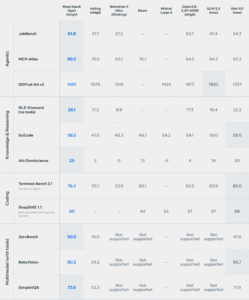
Meta’s official benchmark comparisons for Muse Spark 1.3 tell a story that would have been unthinkable twelve months ago. Against GPT 5.6 Sol (max) and Opus 5 (max), Muse Spark 1.3 isn’t just competitive, it’s taking the crown in several categories:
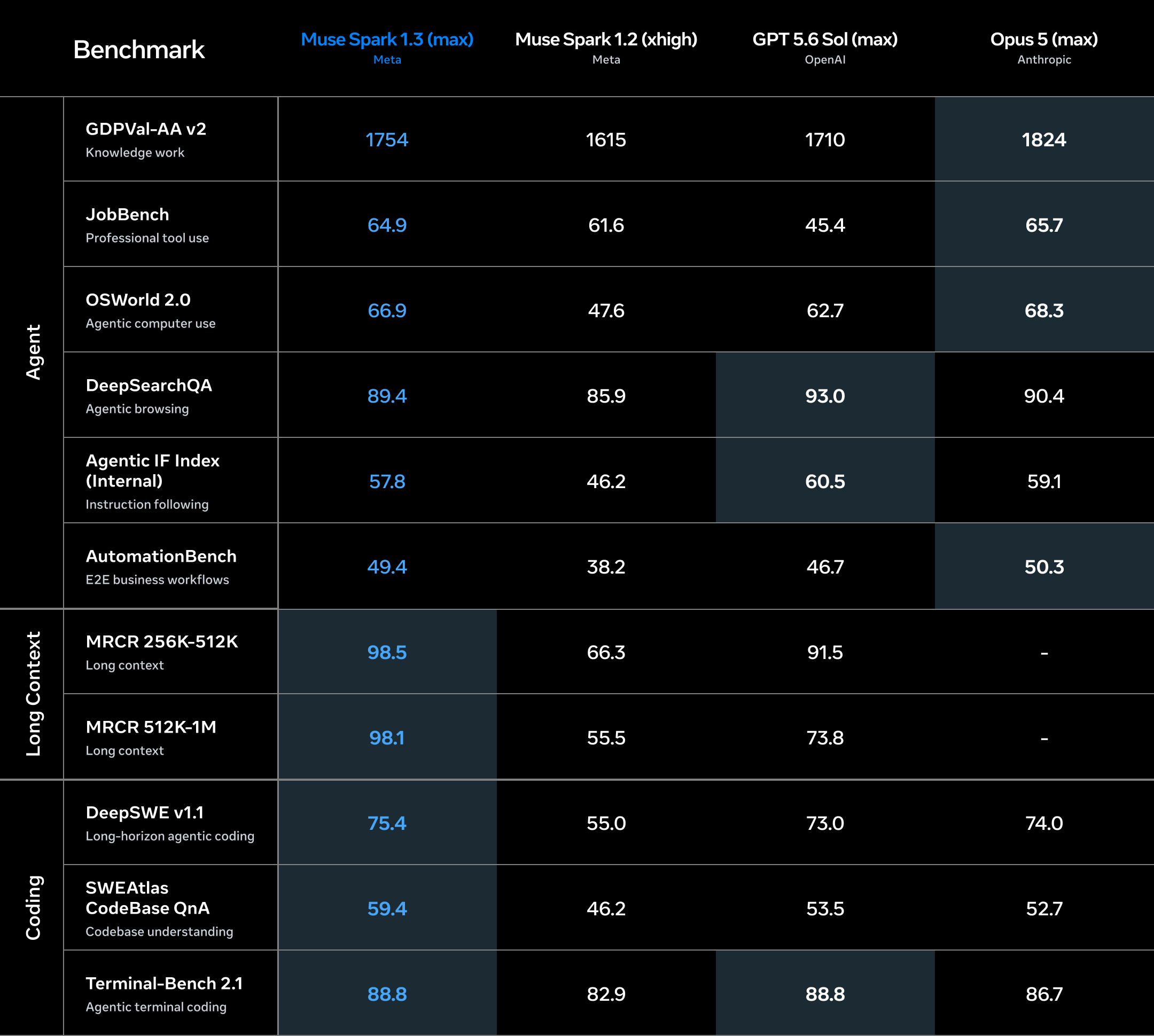
The agent and coding evals show Muse Spark 1.3 matching or exceeding both Anthropic’s and OpenAI’s flagship offerings. The instruction-following numbers are particularly brutal for the competition.
But here’s what’s actually interesting beyond the raw scores: the sentiment on r/LocalLLaMA suggests this isn’t isolated. As one commenter put it, “all of these 7-8 labs are on the same level and hardly behind from frontier by a few months at max.” The community is starting to realize that the gap between open and closed models has collapsed to a matter of weeks, not quarters.
The “Secret Sauce” Debate Is Over
There’s a recurring argument in AI circles that frontier labs possess some mystical training pipeline, arcane reinforcement learning techniques that mere mortals can’t replicate. It’s the kind of thinking that justifies $200/month subscriptions and enterprise API contracts.
But the current landscape suggests otherwise. The community consensus is emerging that what separates frontier labs isn’t secret sauce but scale and compute. One thread response captured it perfectly: “I believe there are still some secret RL sauce… in niche areas like robotics, gameplay, frontier physics/math, world modelling etc.” For coding, security, and anything GitHub-adjacent? “At this moment there is really no gap.”
This has profound implications. If the gap is closed for coding, the highest-value commercial use case, then open weights stop being a “good enough” alternative and become a first-class citizen.
What Actually Changed in Muse Spark 1.3
Beyond the benchmark hype, the technical improvements in 1.3 are substantial:
- 20% fewer tool calls and 25% fewer tokens in internal engineering comparisons, that’s not a minor efficiency tweak, that’s a fundamental change in how the model approaches problems
- Improved long-horizon agentic work with better calibration on what constitutes irreversible actions
- Native multimodal perception that “runs through a real execution environment instead of scripted steps”, this is the big one for creative applications
- Stronger adversarial robustness against prompt injections and manipulation attempts
The agentic improvements are worth dwelling on. The new model can juggle “multiple workflows in a single, long thread” and proactively corrects gaps in its plan. It asks clarifying questions when prompts are ambiguous and confirms before taking consequential actions. That’s not just an incremental update, that’s shifting the human-AI collaboration model.
The Creative Multimodal Angle That Changes Everything
Here’s where things get spicy. Muse Spark models have demonstrated remarkable capabilities in multimodal tasks, generating everything from engineering simulation reports to audio mixing deliverable documents. The Meta research examples include:
- An X-wing flow-simulation report with tabular CFD results
- A complete bass cleanup and full-mix workflow document
- A county parks and recreation board presentation
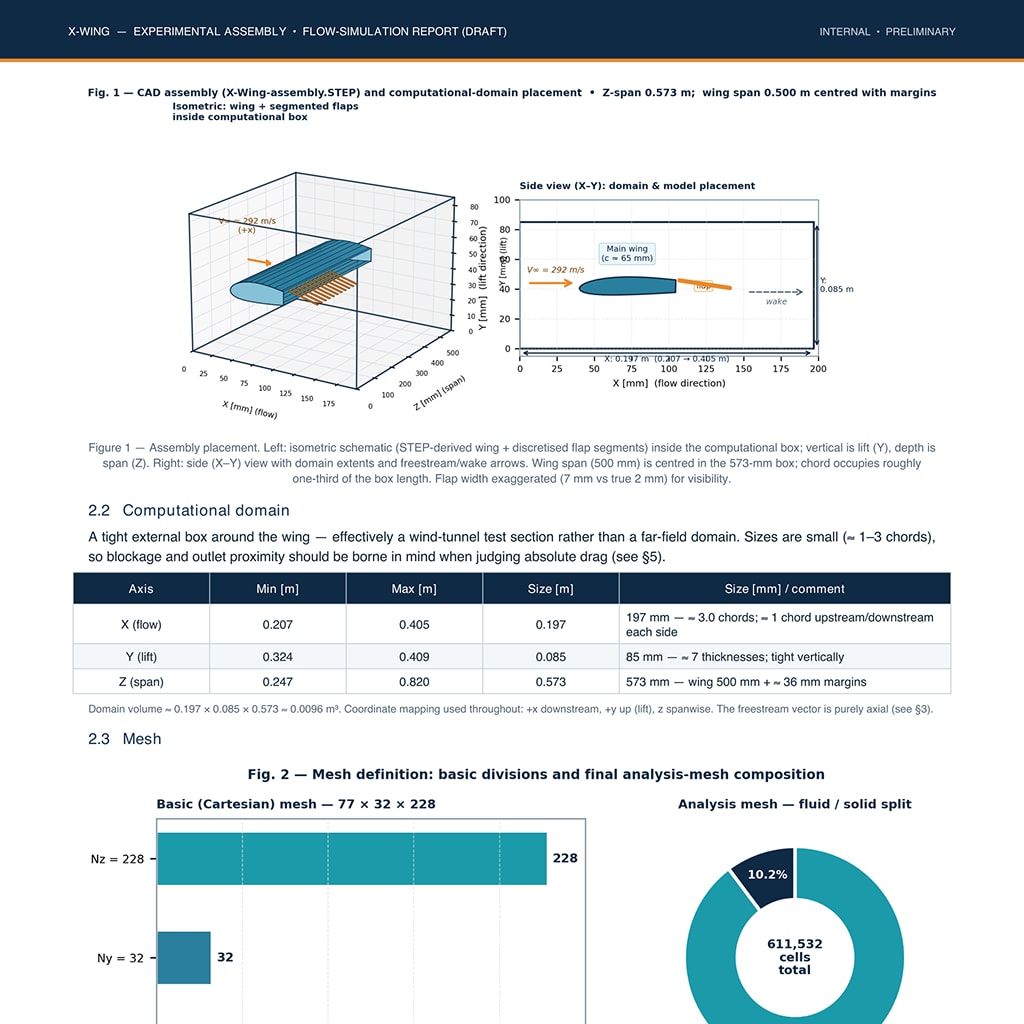
These aren’t toy examples. These are professional-grade deliverables across engineering, audio production, and public administration. When open weights hit, anyone with a decent GPU can fine-tune these capabilities for their specific domain.
The creative and multimodal applications are where the real disruption hits. Stable Diffusion and DALL-E have been the default for open generative art, but a frontier-tier multimodal model with open weights changes the calculus entirely.
The Hardware Question: Can You Even Run It?
The elephant in the room: this model is big. Real big. The Reddit thread about open weights had one user hoping it fits on a single DGX Spark and joking that if it requires two, they’ll be bankrupt.
This is where Muse Glimmer’s efficient local deployment on consumer hardware becomes relevant. Glimmer 30B runs at full 256k context on a single RTX 3090, the same GPU many developers already own. If Meta applies similar optimization principles to Spark’s open weights release, the hardware barrier drops significantly.
The community’s experience with Glimmer is instructive. Despite being “overlooked”, users consistently report it outperforms Qwen 3.8:27b for non-coding tasks and is “superior at reasoning with thinking turned off.” One user described it as generating “incredible KV cache and token efficiency” while another praised its agentic workflow performance. The pattern is clear: Meta knows how to ship models that run well on consumer hardware.
The Meta-Distillation Effect Nobody’s Discussing
Here’s the genuinely interesting long-term implication that most coverage will miss. There’s a theory gaining traction in the community that we’re seeing a “meta-distillation effect”, the internet is becoming saturated with AI-generated content, including vibecoded repositories and AI-slop documentation. Every frontier lab crawls this content and trains on it.
In other words, models are now improving each other directly, without human intervention. One Reddit user put it bluntly: “We are already in AGI mode as AI models are improving each other without humans knowing.”
If true, this creates a compounding acceleration loop. Every open-weights release doesn’t just democratize access, it feeds the training data ecosystem that all labs, open and closed, depend on. The open weights release of Muse Spark isn’t just a product decision, it’s a strategic move that accelerates the entire field.
What This Means for the Business of AI
The pricing signal from Meta is aggressive. Muse Spark 1.3 API access starts at $1.25 per million input tokens and $4.25 per million output tokens. That’s “almost too cheap to meter” territory, as Zuckerberg put it.
Combined with the open-weights promise, this creates an impossible competitive environment for closed-model startups. Why pay premium API prices when you can self-host frontier performance? Why build your product on a model you don’t control when the weights are dropping?
There are cost and efficiency trade-offs of running open-weights models locally to consider, Apple Silicon isn’t always the bargain it appears. But the trend is unmistakable: local inference is becoming more viable with every release cycle.
The Anthropic Conspiracy Theory That Won’t Die
No analysis of this space is complete without acknowledging the persistent community theory about Anthropic. The narrative goes something like: Anthropic is deliberately holding back more capable models, drip-feeding releases only when competitors get close. Their API pricing keeps climbing despite efficiency improvements, Fable 5.1 costs more than Fable 5, and they seem utterly unbothered by competitive pressure.
Whether true or not, this perception shapes the market. If even the community suspects closed labs are throttling their best work, the credibility of the “frontier premium” collapses further. Open weights from Meta only accelerate this perception shift.
The Verdict
The Muse Spark open weights release isn’t just another model drop. It’s a declaration that the open-weights paradigm isn’t a compromise, it’s the destination. Frontier performance at consumer prices, with full model control and no usage telemetry.
For developers, the implications are straightforward. The architectural challenges introduced by open-weights models in distributed systems are real, but they’re solvable. The hardware performance factors critical for open-weights model inference are increasingly well-understood. And platforms like HuggingFace continue to adapt their model hosting policies to accommodate the flood of open-weights releases.
The frontier gap didn’t just shrink. It evaporated.
And the next few weeks, when those weights actually drop, are going to be chaos in the best possible way.
Get your GPUs ready.