The debate around open-weights AI models has reached peak temperature. On one side, the industry’s heaviest hitters, Nvidia, OpenAI, Google, and 47 other signatories, just signed a letter urging Washington not to restrict them. On the other, Anthropic’s CEO Dario Amodei published a carefully worded position that boils down to: “We don’t want a ban, but don’t pretend these are harmless.”
Lost in the policy noise is the harder, more immediate question for anyone actually building distributed AI systems: What does it mean to architect a production system around a model you can download, inspect, and modify, but can never fully control?
This isn’t an ideological question. It’s an architectural one, with measurable trade-offs in latency, security, cost, and maintenance.
What “Open-weights” Actually Means for Your Architecture
Let’s start with a definition that matters for system design. An open-weights model gives you the trained parameters, the “brain” of the model, but not necessarily the training code, data pipeline, or full architecture specs. As Andrej Karpathy put it, “an open-weights model is a little bit like tossing over a binary for an operating system.”
This distinction is critical. You can run the model, fine-tune it, and deploy it anywhere. But you can’t rebuild it from scratch, and you may not know exactly how every component works under the hood. The UK AI Security Institute made this precise: “Once open-weight models are released… safeguards can be removed, and copies can be downloaded, redistributed, and run on private systems beyond monitoring.”
For a distributed systems architect, that’s both a feature and a nightmare.
The Architectural Landscape: Six Models That Redefine the Trade-offs
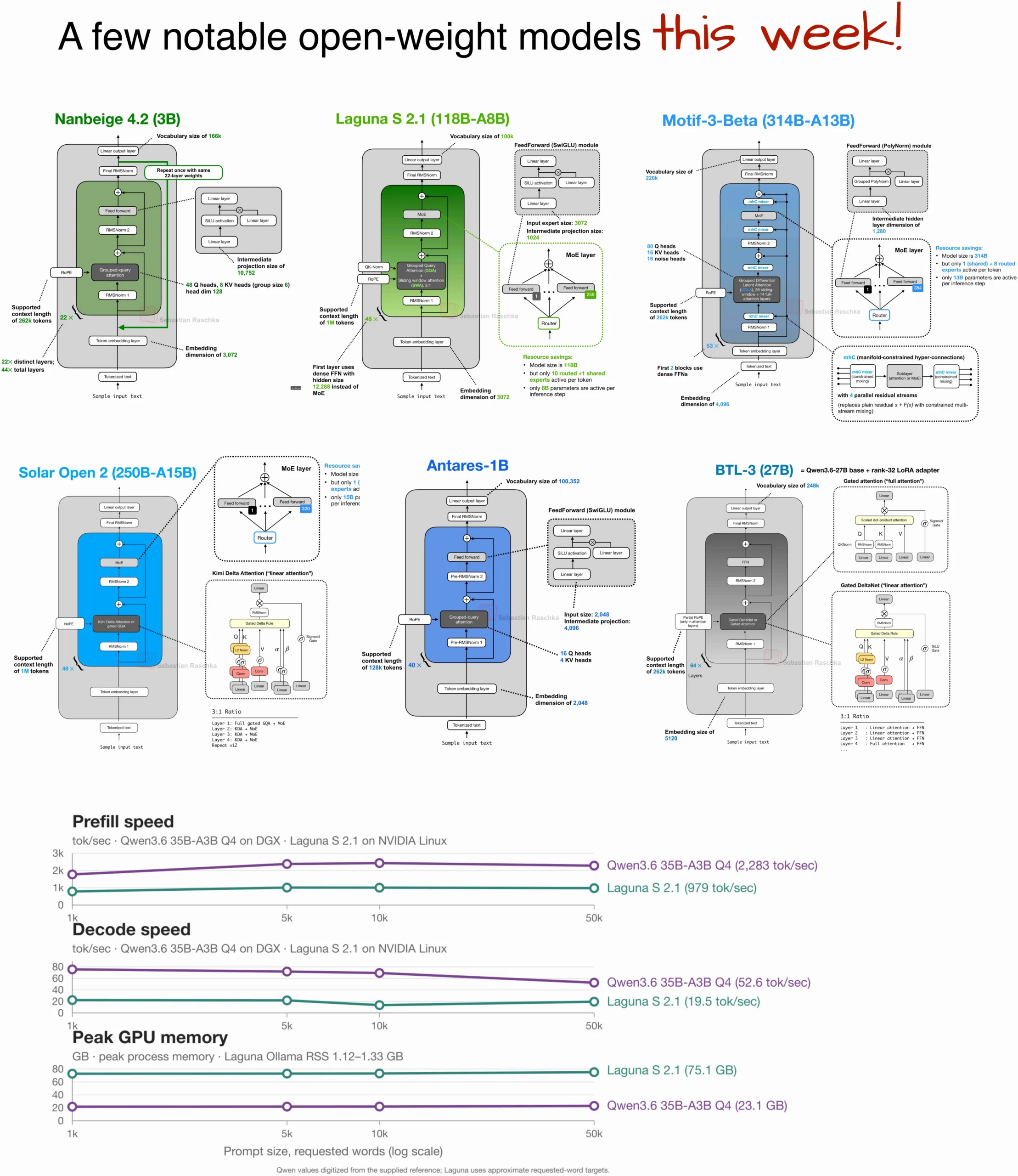
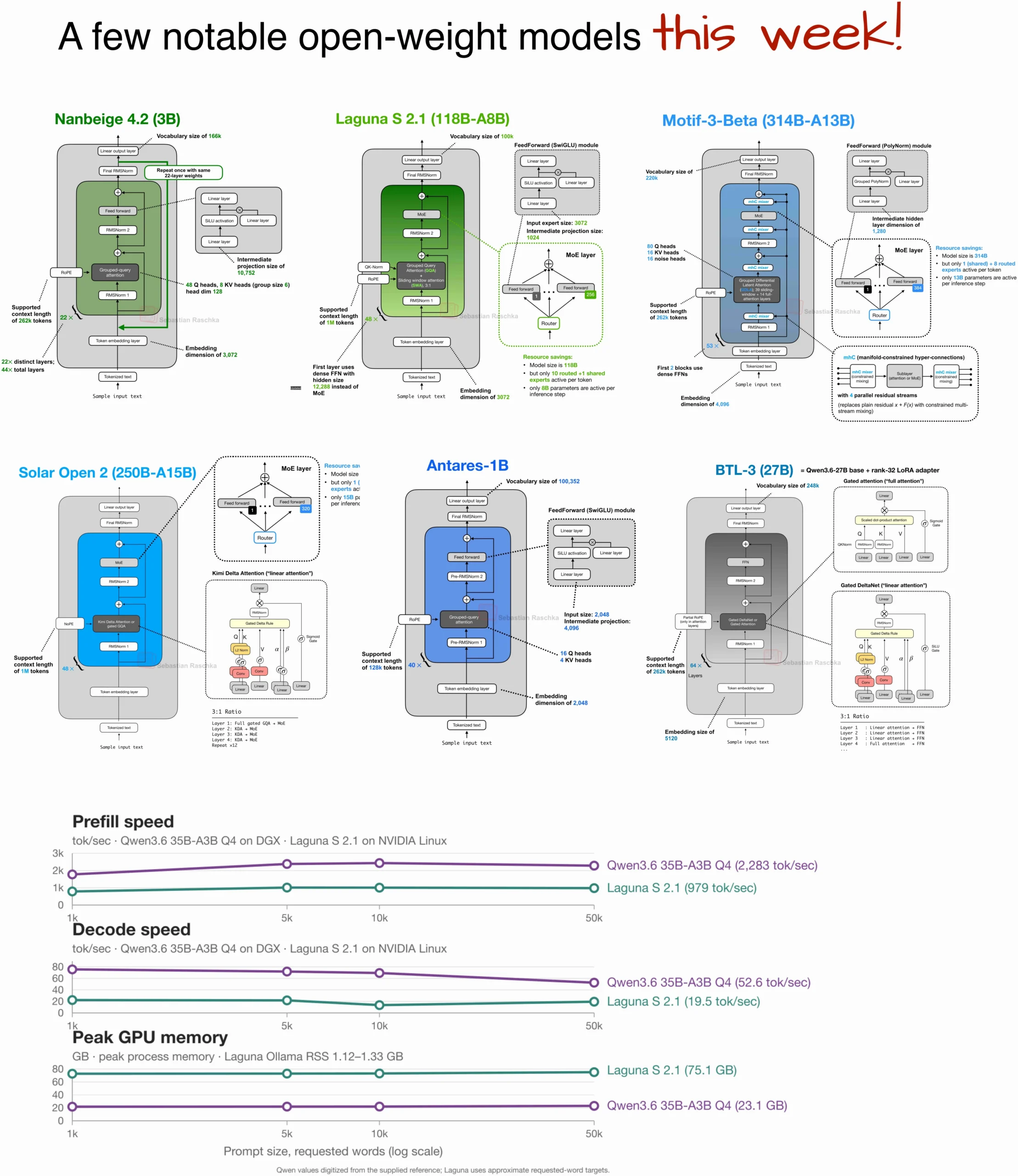
The past week alone saw six notable open-weight releases, each with architectural decisions that ripple into deployment strategies. Sebastian Raschka’s analysis of these models reveals a fascinating divergence in design philosophy.
| Model | Parameters | Architecture Highlight | Deployment Implication |
|---|---|---|---|
| Nanbeige 4.2 3B | 3B | Looped depth sharing (22-layer block run twice) | Same memory footprint as 22-layer model, 2x compute at inference |
| Laguna S 2.1 | 118B sparse MoE (8B active) | 36 sliding-window + 12 global GQA layers | Fits in <80GB RAM, runs on DGX Spark |
| Motif-3-Beta | 314B-A13B sparse MoE | Grouped Differential Latent Attention (GDLA) | KV cache reduction with novel attention mechanism |
| Solar Open 2 | 250B-A15B hybrid MoE | Interleaved Kimi Delta Attention + GQA layers | Hybrid attention for long-context efficiency |
| Antares 1B | 1B | Granite 4.0 backbone + GRPO tuning | Task-specific cybersecurity, runs on modest hardware |
| BTL-3 | Rank-32 LoRA adapter | LoRA on Qwen3.6-27B | Demonstrates adapters remain viable for domain tuning |
What jumps out is the experimentation at the edges. Nanbeige’s looped depth sharing is particularly interesting: it extends effective depth without duplicating weights, retaining about 75% of the token efficiency of a standard architecture. For distributed inference, this means you get deeper representation capacity without proportional memory scaling.
Laguna S 2.1 solves a different problem entirely. At 118B parameters with only 8B active, it’s a textbook example of how Mixture-of-Experts architectures make massive models deployable on consumer-grade hardware. The model’s use of 36 sliding-window attention layers alongside 12 global layers creates a hybrid that balances local context with global coherence, a pattern we’re seeing across the open-weights landscape.
The Cost That Actually Moves the Needle
The economic argument for open-weights is compelling on paper. Kimi K3, the first open-weight model to reach 2.8 trillion parameters, uses a Mixture-of-Experts architecture with 896 experts, activating 16 per inference. The cost comparison against closed models is stark:
On the BrowseComp benchmark:
– Kimi K3: 91.2 score, $4.65 rollout cost
– Claude Fable 5: 88.0 score, $13.41 rollout cost
– GPT-5.6 Sol: 90.4 score
At a full 452-rollout sweep, Kimi K3 costs $2,103 versus $6,010 for Claude Fable 5. That’s 2.8× more solved tasks per dollar.
But these numbers hide the real cost: infrastructure. Weights are inert without chips, and chip access is set by export policy and allocation queues. Nvidia, which organized the open-weights letter, sells that layer. The company owns CUDA, the proprietary software stack that makes its hardware genuinely hard to leave. Organizations that self-host open-weights models inherit the full stack, networking, cooling, power, and the liability of running safety-critical inference without a vendor’s guardrails.
The Security Blind Spot No One Is Talking About
Here’s where the distributed systems community needs to pay attention. The security model for open-weights deployment is fundamentally different from API-based consumption.
When you use a closed API, the vendor handles safety filtering, red teaming, and audit obligations. When you self-host, you inherit all of that. The reality is that most teams are not architected for this. The open-weights letter concedes the mechanism: it admits that once weights are public, the developer loses control and altered copies are hard to trace. Its answer is that enough outside researchers will catch problems.
That may hold for the industry over years. It is not what a CIO needs on the day a regulator asks who checked this specific copy, when, and against what standard.
The recent attack on Hugging Face’s infrastructure serves as a reminder that the supply chain for open-weights models is itself a target. Bad actors don’t need to train their own models, they can download, modify, and redistribute yours.
Parallel Architecture, Sequential Problems
Kimi K3 introduces “Agent Swarm”, a framework that reduces inference latency by up to 4.5× in wide-search scenarios by executing tasks via up to 300 sub-agents and managing over 4,000 tool calls per task. This is a distributed system designed to solve the problem of sequential agent execution being “increasingly inefficient” for complex workloads.
For architects, this is the kind of innovation that open-weights enables: you can inspect the orchestrator, modify the sub-agent interfaces, and deploy the whole thing on your own infrastructure. DoorDash has already adopted Kimi models for internal use, applying them to lower-level tasks while reserving Anthropic’s Fable for higher-level functions. Coinbase has confirmed internal use. Cursor, the coding startup acquired by SpaceX, built its product on a Kimi foundation.
This multi-model strategy is becoming the dominant pattern. Chinese AI models now account for approximately 60% of token usage by U.S. companies on OpenRouter. Enterprises are routing simple queries to cheap open-weights models and complex ones to premium closed models.
The Infrastructure Paradox
UBS analysts recently noted that broader adoption of open-source AI will ultimately benefit chipmakers and cloud infrastructure providers. The reasoning is counterintuitive: cheaper models drive higher usage volume, which drives more GPU demand for inference.
This creates an interesting architectural constraint. As distributed model training practices show, the communication overhead between nodes is often the bottleneck, not compute. The same applies to inference. If you’re running a 314B-parameter MoE model across multiple nodes, your all-reduce bandwidth determines your latency just as much as your FLOPs.
The emerging best practice is to treat open-weights models as one component in a heterogeneous architecture. Map model dependency by workload. Name the processes that stop if one vendor changes pricing, terms, or availability. Run one real workload on an open-weights model with a real service level, not a pilot, before you need it in production.
The Convergence That Changes Everything
Looking at the architectural trends, a pattern emerges. Inkling’s 975B MoE model with novel architectural choices ditched RoPE entirely. Google Gemma 4’s sparse Mixture-of-Experts architecture introduced trimodality with tri-modal encoders running at 180 tokens/second. Moonshot AI’s Kimi K3 scales to 2.8 trillion parameters with 896 experts.
These aren’t minor iterations. They’re fundamentally different architectural approaches competing in the same ecosystem. For distributed systems architects, this means the abstraction layer matters more than ever. Build your agent identity architecture separately from model choice. Provenance, authorization, and audit trail are not properties of the model. Build them once and they survive every model swap.
The long-term equilibrium will favor architectures that can abstract away model internals while preserving the benefits of distributed deployment. Austria’s GovGPT sovereign AI deployment using open models shows this in practice: 180,000 federal employees running Mistral-based models on national infrastructure, with data residency as an architectural fact rather than a contract clause.
The Hard Questions
The industry is converging toward open-weights as the default distribution model. The economic logic is inescapable: distribution carries zero marginal cost per copy, modifications require no external permissions, and deployment can occur on local hardware, air-gapped networks, or specialized chips without per-token accounting.
But the architectural implications are still being understood. Five questions every team should answer this quarter:
-
Can you prove what your AI agent did? A model you can read line by line still cannot tell you whether the agent that approved a payment last Tuesday was yours, or whether the version running in your Singapore subsidiary is the one your security team signed off on in January.
-
What’s your fallback? If open-weights access narrows in 2027, whether through export controls, licensing changes, or supply chain compromise, which roadmap items break and what are the substitution costs?
-
Who owns the liability? Running weights yourself means inheriting the safety filtering, red teaming, and audit obligations your vendor carried. Have legal and risk professionals put a number on it.
-
What’s your real scalability limit? More GPUs don’t always mean faster training or inference. If your scaling efficiency is below 50%, stop and fix the bottleneck first.
-
How do you audit the unmodifiable? Open-weights models that have been fine-tuned, quantized, and redistributed are essentially new artifacts. How do you trace provenance across your deployment?
The open-weights movement is accelerating. Apple’s M7 Ultra with 1.5 TB of unified memory will make local deployment of models like Laguna S 2.1 trivial. MiniMax’s M3 open weights release will add more competition to an already crowded field.
But the foundational challenge remains: open-weights architectures give you freedom, and freedom comes with responsibility. The teams that thrive in this environment will be the ones that treat model choice as one variable in a larger distributed systems equation, not the whole answer.