When a gaming company best known for dropping players into a battle royale island announces it has trained a competitive foundation model from scratch, the AI community has every right to raise an eyebrow. That’s precisely the position KRAFTON, the South Korean studio behind PUBG, put everyone in this week with the release of Raon-1 mini, a 30B Mixture-of-Experts (MoE) model that claims to go toe-to-toe with Alibaba’s Qwen lineup.
And here’s the kicker: the early benchmarks suggest they might actually be right.
A 30B Model That Thinks It’s Bigger
Raon-1 mini isn’t just another fine-tune of an existing open model. KRAFTON AI says it designed and trained this thing entirely from scratch, using what they describe as an original architecture incorporating recent innovations from across the research landscape. The spec sheet reads like a greatest hits album of 2025-2026 AI research:
- Hybrid attention: 18 linear attention layers paired with 7 full attention layers
- Raon Delta Attention (RDA): Their own take on Kimi’s Delta Attention, decoupling the erase and write gates for better long-context performance
- Raon-mHC: A computationally cheaper version of DeepSeek’s manifold-constrained hyper-connections
- 128 experts with only 6 routed plus 1 shared active per token
- Native 262,144 token context with NoPE (no positional encoding)
The result? A model with 28.8B total parameters that only activates 4.3B per token. That’s the entire value proposition in one number: near-dense-quality performance at a fraction of the inference cost.
The Benchmarks: Cherry-Picking or Genuine Competition?
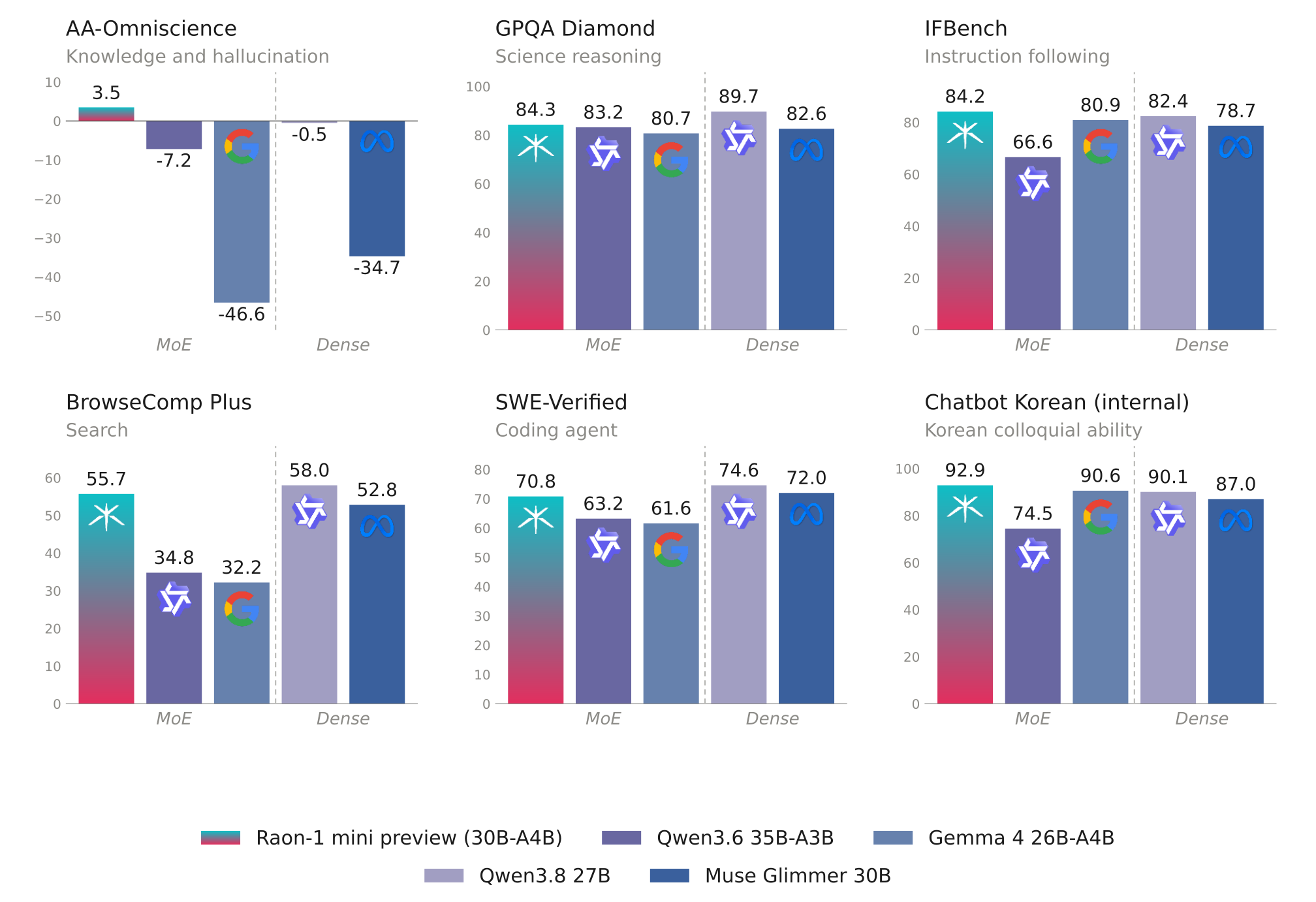
KRAFTON published results across 17 benchmarks comparing Raon-1 mini against Qwen3.6-35B-A3B, Gemma 4 26B-A4B, and the larger dense Qwen3.8-27B. The headline numbers are genuinely impressive for a first release from a gaming company:
| Benchmark | Raon-1 mini (30B-A4B) | Qwen3.6-35B-A3B | Gemma 4 26B-A4B | Qwen3.8-27B (dense) |
|---|---|---|---|---|
| GPQA Diamond | 84.3 | 83.2 | 80.7 | 89.7 |
| AIME 2026 | 93.3 | 92.9 | 87.1 | 98.8 |
| IFBench | 84.2 | 66.6 | 80.9 | 82.4 |
| BrowseComp Plus | 55.7 | 34.8 | 32.2 | 58.0 |
| SWE-Verified | 70.8 | 63.2 | 61.6 | 74.6 |
Raon-1 mini beats Qwen3.6-35B on GPQA Diamond (84.3 vs 83.2), crushes it on instruction following (84.2 vs 66.6 on IFBench), and blows it away on agentic web browsing (55.7 vs 34.8 on BrowseComp Plus). Even against the much larger dense Qwen3.8-27B, it holds its own in several categories.
The most dramatic gap shows up where it matters most for KRAFTON’s home turf: Korean conversation. On their internal Chatbot Korean benchmark, Raon-1 mini scores 92.9 versus Qwen3.6’s 74.5, a massive 18-point swing that suggests this model was built with a Korean-first lens.
But before we anoint KRAFTON as the new AI overlord, some caveats are warranted.
The model underwhelms on MMLU Pro (76.5 vs Qwen3.6’s 85.9), suggesting weaker general knowledge. Terminal-Bench Lite is a disaster (47.0 vs 63.3 for Qwen), meaning real-world terminal operations might struggle. And GDP.pdf long-context understanding (5.8) trails both comparably-sized MoE models and the dense alternatives.
Also worth noting: these are vendor-published numbers. The judge model is gpt-5.6-luna, evaluated by KRAFTON’s own team. Independent verification will need to wait for the full technical report and third-party evals. The open-source community on Reddit has already started poking holes, with one developer noting that “tons of models look good on their own benchmarks” and cautioning that real-world performance often diverges significantly.
The Architecture Deep Dive: What Makes This Different
The hybrid attention design deserves closer scrutiny because that’s where the real engineering innovation lives. Traditional transformers maintain a KV cache that grows linearly with context length, expensive at scale. KRAFTON’s approach uses fixed-size state for 18 of the 25 layers, meaning those layers don’t contribute to cache growth. Only the 7 Gated MLA layers maintain a KV cache, clocking in at about 8 KiB per token in BF16.
For a 262K context window, that’s a significant efficiency win. Long-context applications, document analysis, multi-turn agent conversations, codebase understanding, become dramatically more affordable.
The model also ships with a DFlash2 draft model for speculative decoding. On a single NVIDIA B300, KRAFTON reports up to 2.18× higher output throughput with speculative decoding enabled:
| Benchmark | AR · C=1 (tok/s) | DFlash2 · C=1 (tok/s) | Speedup |
|---|---|---|---|
| GSM8K | 296.3 | 646.3 | 2.18× |
| MATH-500 | 308.0 | 666.6 | 2.16× |
| HumanEval | 305.4 | 607.9 | 1.99× |
| MBPP | 307.0 | 604.1 | 1.97× |
The speedup persists at higher concurrency, though it narrows, 1.65-1.71× at C=8 and C=32. That’s still substantial for production workloads where throughput equals revenue.
The Strategic Play: Cost Efficiency as Competitive Weapon
KRAFTON’s Chief AI Officer Lee Kang-wook frames this as a deliberate strategic choice: “With a cost-effective large language model that raises performance while lowering the cost burden, we will widen the scope of AI use across a range of industries.”
This isn’t marketing fluff. The MoE architecture means inference costs run roughly proportional to the 4.3B activated parameters, not the 28.8B total. For Korean enterprises weighing on-premise deployments versus US or Chinese API calls, a model that runs on commodity hardware could shift the economics significantly.
The company has also been building toward this for years. Their AI research organization claims 54 papers at major conferences including NeurIPS, ICML, and ICLR, with nine main-track papers accepted at NeurIPS 2026. This isn’t a weekend project, it’s a five-plus-year investment that’s finally going public.
The Timing Question: China Export Restrictions and Open Model Supply
One detail that hasn’t gotten enough attention: the timing of this release coincides with discussions about China potentially restricting exports of its most capable AI models. The open-source community has grown heavily dependent on Chinese models, Qwen, DeepSeek, GLM, and others dominate the Hugging Face leaderboards for open-weight models.
If China tightens restrictions on top-tier model exports, the open AI ecosystem faces a sudden supply gap. KRAFTON’s Raon-1 mini lands as a potential alternative for organizations seeking capable open models outside the Chinese ecosystem.
There’s debate about whether such restrictions would actually materialize, some argue China benefits from undercutting US commercial AI companies with free top-tier models. But the uncertainty alone creates demand diversification pressure, and non-Chinese open models become strategically valuable assets.
The Practical Question: Should You Run It?
For the model-curious developer, Raon-1 mini ships with an unusually complete stack. The Hugging Face repository includes:
- MXFP8 and NVFP4 quantizations, the latter enables inference on a single RTX 5090 (32 GB VRAM)
- Apple Silicon MLX support for Mac users
- GGUF quantizations for llama.cpp and LM Studio
- vLLM integration with a spec’d-out server configuration including DFlash2 support
- Agent harness compatibility with Hermes Agent, Pi, and OpenCode
Getting started is straightforward if you’re comfortable with gated model access (approval is automatic):
pip install -U huggingface_hub
hf auth login

# Then serve with vLLM using their fork
VLLM_REF="raon-1-mini-preview"
VLLM_USE_PRECOMPILED=1 uv pip install \
    "vllm @ git+https://github.com/krafton-ai/vllm.git@${VLLM_REF}"

vllm serve KRAFTON/Raon-1-mini-preview \
    --host 127.0.0.1 \
    --port 8000 \
    --served-model-name Raon-1-mini-preview \
    --max-model-len 262144 \
    --max-num-batched-tokens 16384 \
    --max-num-seqs 128 \
    --gpu-memory-utilization 0.85 \
    --kv-cache-dtype fp8_e4m3 \
    --enable-prefix-caching \
    --spec-method dflash \
    --spec-model KRAFTON/Raon-1-mini-preview-dflash2 \
    --spec-tokens 7
The first start takes about 10 minutes for kernel compilation, subsequent starts reuse the cached kernels.
If you’ve got an RTX 5090, the NVFP4 checkpoint runs with a similar configuration but a reduced max context (32K tokens) and tighter batching limits.
One notable quirk: the model is designed for thinking mode, and KRAFTON explicitly recommends against disabling it. The presence penalty differs by task, set to 0 for coding/math, 1.5 for everything else. Follow the recommended sampling parameters (temperature 1.0, top_p 0.95, top_k 20) or you’ll likely get mediocre results and blame the model.
The Verdict: Real Competition, With Caveats
Raon-1 mini represents something genuinely significant: a gaming company demonstrating that competitive foundation model development is no longer the exclusive domain of Big Tech and AI startups. The five-year investment in AI research is paying off with a credible, cost-effective model that challenges established players on multiple axes.
The model’s strengths in Korean conversation, instruction following, and agentic tasks make it immediately useful for Korean enterprises and developers building agent-based systems. The Apache 2.0 license means no strings attached for commercial use, a deliberate contrast with some competitors’ more restrictive licensing.
But the caveats are real. The published benchmarks are vendor-claimed. The general knowledge gap on MMLU Pro and weakness on terminal tasks suggests this is a model optimized for certain workloads, not a universal solution. The long-context performance trails the dense comparison models, potentially limiting document-heavy applications.
The Full version and technical report will tell us more about training data, compute budget, and methodological choices. Until then, treat the benchmarks as promising signals rather than verified fact.
What’s clear is that KRAFTON just made the open model landscape more interesting. Whether Raon-1 mini becomes a cornerstone of Korean AI infrastructure or fades into the long tail of also-ran releases depends on what the independent evals reveal and how well the official release addresses the gaps.
One thing’s for sure: the next PUBG update is going to have some seriously competent NPCs.