The numbers are jarring. PrismML claims it compressed a 27-billion-parameter version of Alibaba’s open-source Qwen 3.6 model from roughly 54 GB down to less than 4 GB. The compressed version allegedly runs with all 27B parameters active on an iPhone 15 or newer. If true, that’s not an incremental improvement, it’s a fundamental shift in what’s physically possible on mobile silicon.
But as always with early-stage AI hype, the gap between “can run” and “works well” is a chasm you could drop a data center into.
The Wizard Behind the Curtain: Extreme Quantization
PrismML’s technology, dubbed Bonsai 27B, relies on a process called extreme quantization. Normally, a neural network stores its weights, the learned values that define its behavior, using 16-bit floating point precision. PrismML reduces each value to just one or three possible values. That means moving from 16-bit to roughly 1-bit or 2-bit representations.
Here’s the claim breakdown:
| Metric | Stated Improvement |
|---|---|
| Memory Usage | 10-15x less |
| Inference Speed | 6-8x faster |
| Energy Consumption | 3-6x less |
| Performance Retention (1-bit) | ~90% |
| Performance Retention (ternary) | ~95% |
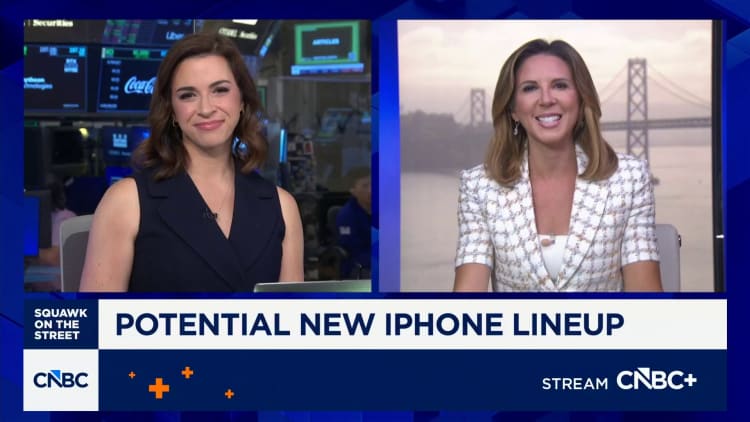
The startup’s CEO, Babak Hassibi, told CNBC that the trade-off is real: “factual recall weakens before skills such as reasoning, math and coding.” In other words, the model might still be able to write Python, but it might also confidently tell you the capital of France is “Lyon.”
Why Apple Is Having This Conversation
Apple’s AI strategy has always had a fundamental tension. The company sells privacy as a core differentiator, “what happens on your iPhone, stays on your iPhone.” But the best AI models today live in the cloud. Every Siri query that hits Apple’s servers costs money, introduces latency, and creates a privacy surface area.
Running more AI on-device solves three problems simultaneously:
- Privacy: Data never leaves the device
- Cost: No cloud inference bills for millions of daily queries
- Latency: Local inference is faster than a round trip to a data center
The timing is also convenient. PrismML’s public release happened just one day after Apple opened the public beta of iOS 27, which contains the long-delayed overhaul of Siri. Apple needs on-device AI to work, and it needs it now.
Horace Dediu, founder of Asymco, put it simply: “They’re trying to figure out how big a model and how clever a model they can fit on the device.”
This isn’t just about Siri either. Carolina Milanesi from Creative Strategies pointed out that smaller models could unlock on-device features like “computational photography, video generation and health or fitness tools that rely on sensitive personal data.”
Apple’s vertical integration gives it a unique advantage here. It designs the chips, the operating system, and the software stack. If PrismML’s technology works, Apple can optimize every layer for maximum performance.

The Caveats No One Wants to Talk About
Let’s address the elephant in the room, which was eloquently articulated in the Reddit thread covering this news:
“They’re really evaluating our technology right now”, Hassibi said of Apple. This means absolutely fucking nothing. This could be as simple as “we emailed them about our model and they gave a polite response.”
That Reddit comment, while blunt, captures the reality. Apple evaluates hundreds of technologies every year. Most of those evaluations lead nowhere. Hassibi himself characterized the discussions as “very early” and said “it remains unclear where they will lead.”
The skepticism is justified for several concrete reasons:
Battery life is the unspoken killer. Phil Solis, who leads IDC’s research on client processors, warned that power consumption may be the biggest open question. A model that’s capable enough to be used frequently could drain a phone’s battery even if it requires less memory. Running a 27B parameter model continuously, even a quantized one, is a thermal and power nightmare.
Real-world testing hasn’t happened. Tarun Pathak at Counterpoint Research said the ultimate test will be “millions of queries, thousands of device combinations and robust testing at scale.” Controlled demos are one thing. Running on millions of devices with varying usage patterns is another entirely.
Performance loss is measurable. PrismML acknowledges losing “a few percentage points” of performance. The real question is which “few percentage points” those are. If factual recall degrades first, as Hassibi admitted, then the model becomes less reliable for the very use cases, like answering questions, where accuracy matters most.
What This Means for the Chip Industry and Your Wallet
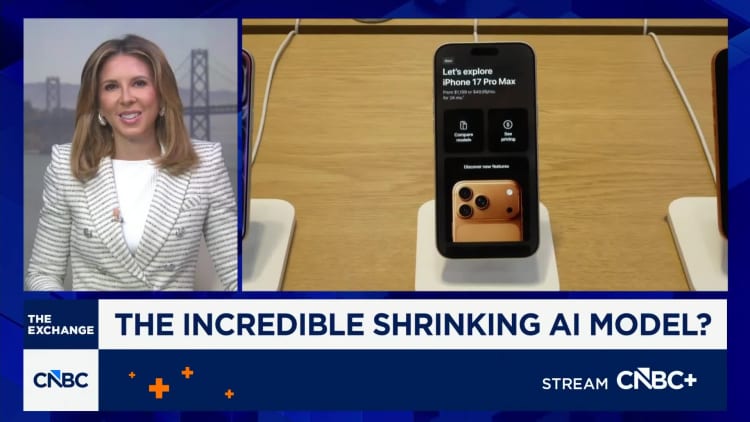
This isn’t just a technical discussion about model compression. It’s also a story about memory costs, chip demand, and the price of your next iPhone.
Morgan Stanley estimates that Apple’s average DRAM cost per bit could rise 190% year over year in fiscal 2027, with NAND costs up about 180%. The firm expects Apple to raise the starting price of comparable iPhone 18 models by about $200 to protect margins.
If PrismML’s technology works, it could help Apple avoid some of those cost increases. A model that needs less memory means Apple can use cheaper, lower-capacity memory chips. That’s good for Apple’s margins and potentially good for consumers’ wallets.
But analyst Gil Luria at D.A. Davidson argues that shrinking models won’t reduce overall chip demand. It will just shift where those chips live. “It’s not that you’re not going to need the chip”, Luria said. “You’re still going to need the GPU, and you’re still going to need the memory.”
Efficiency breakthroughs can also lead to more use rather than lower spending. Cheaper, faster AI enables new products and prompts consumers to run models more often. This is the Jevons paradox applied to AI.
The market has already shown sensitivity to this. Micron shares plunged in March after Google published its TurboQuant paper on cutting memory use without hurting model performance. The stock later recovered, but the reaction showed how skittish investors are about anything that threatens the AI chip boom.
The Road Ahead: From Phones to Robotics
Hassibi told CNBC that Google’s open-source Gemma model is next in the pipeline, followed by “much larger models, including those from frontier labs that today generally require datacenter hardware.”
The technology, according to PrismML, could ultimately extend beyond phones to robotics, autonomous systems, and other products that need to make decisions quickly without relying on a cloud connection. “It’s very important that the intelligence be local and that it can run fast”, Hassibi said.
This aligns with a broader industry trend toward edge AI. Running inference locally enables real-time decision-making for autonomous vehicles, drones, medical devices, and industrial robotics, applications where latency isn’t just inconvenient, it’s dangerous.
PrismML’s approach also has implications for content creation tools like the Bonsai Studio app they shipped, which handles diffusion-based image generation entirely on-device with no internet required.
The Bottom Line: Manage Your Expectations
Let’s be brutally honest about what this news actually means.
Apple and PrismML are in preliminary discussions. No deal has been signed. No technology has been proven at scale. The compression claims are impressive on paper, but they need independent verification.
What this news does signal is that Apple recognizes a fundamental truth: it cannot rely on the cloud forever. The company’s AI strategy depends on making on-device models powerful enough to handle the vast majority of user queries, with only the most demanding tasks sent to the cloud.
For practical context on how Apple Silicon handles local AI workloads today, check out our analysis of Apple’s unified memory for local AI workloads. The M7 Ultra chip, with its rumored 1.5 TB of unified memory, represents Apple’s long-term bet on keeping AI processing local rather than ceding control to cloud providers.
PrismML’s extreme quantization is one potential path. But Apple’s own chip roadmap, including the rumored skipping of M6 Pro/Max to focus on on-device AI with the M7, shows that Apple is betting on multiple horses.
The real question isn’t whether PrismML’s technology works in a demo. It’s whether it works at scale, on millions of devices, with acceptable battery life and reliability. That question won’t be answered by press releases or CEO quotes.
As Counterpoint’s Pathak put it: “The ultimate test will be millions of queries, thousands of device combinations and robust testing at scale.”
For now, treat this as an interesting development worth watching, not a revolution that’s already arrived.
For developers wanting to experiment with local AI models, Alibaba’s Qwen3-VL series provides a functional alternative for running multimodal AI on consumer hardware today. If you’re interested in the practical deployment challenges, our guide on running production AI on Apple Silicon covers the memory constraints and quantization trade-offs you’ll face.
Apple’s desperate for this technology to work. But wanting something and having it are two very different things.