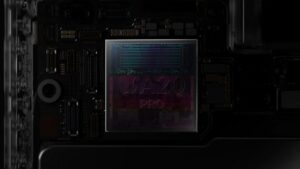
The M6 Pro and M6 Max are dead. Long live the M7.
That's the bombshell from Mark Gurman at Bloomberg that dropped yesterday, sending ripples through the Apple ecosystem. Apple is reportedly canceling the higher-end variants of its upcoming M6 chip, effectively skipping an entire generation of high-performance silicon. Instead, the company is sprinting toward the M7 family, a line of processors built from the ground up for on-device AI inference.
This isn't a minor roadmap tweak. It's a surgical strike on Apple's own predictable release cadence. And it signals something much bigger: Apple believes the future of computing isn't in the cloud, but sitting on your lap, processing models locally without ever touching a server.
Here's what's actually happening, why it matters for anyone running AI workloads, and the uncomfortable trade-offs that come with it.

The Boldest Silicon Pivot Since the M1
Let's be clear about what Apple is actually doing. The company isn't canceling the base M6. That chip is still on track for a launch in late 2026, destined for entry-level Macs like the MacBook Air and the base MacBook Pro. You'll get improvements: a roughly 30% memory bandwidth bump to 200GB/s (up from 153GB/s on the M5), a redesigned GPU with up to 12 cores (versus 10), an upgraded Neural Engine, and better video encode/decode.
What you won't get is a Pro or Max version of that chip. For the first time since Apple Silicon launched in 2020, a chip generation will ship with only a base configuration. The M6 generation will be a one-and-done play.
Bloomberg's sources indicate that the M7 generation is being accelerated by as much as six months. The timeline looks like this:
| Chip Variant | Expected Release Window |
|---|---|
| Base M6 | Late 2026 |
| M5 Ultra (Mac Studio) | Late 2026 |
| Base M7 | First half 2027 |
| M7 Pro / M7 Max | Late 2027 |
| M7 Ultra | 2028 |
The M7 family, codenamed Delos, is explicitly designed for on-device AI processing. The base M7 alone is rumored to hit 240GB/s memory bandwidth, a 57% jump over the M5's 153GB/s. Pro and Max variants scale bandwidth up from there, with the M7 Max potentially exceeding 1TB/s.
This is Apple admitting that the architectural foundation of its current high-end chips wasn't built for the AI workloads that are about to dominate.
Why Bandwidth Is Suddenly the Battleground
Memory bandwidth isn't a sexy spec. It doesn't make for great marketing slides. But for running large language models and multimodal AI locally, it's the single most important bottleneck.
Most developers running models like Llama 3 or Mistral on Apple Silicon have already discovered this the hard way. The M5 Max can theoretically hit 614GB/s of bandwidth, which sounds impressive until you realize that a 70B parameter model in FP16 requires roughly 140GB of memory just to load, and memory bandwidth determines how fast you can feed tokens through the inference pipeline.
The math is brutal. A model that requires 140GB of memory running on a chip with 200GB/s bandwidth has a theoretical maximum throughput that's fundamentally constrained by how fast the chip can shuffle data from memory to compute units.
Apple's focus on the M7 line suggests they've recognized that current M5 Max local AI performance simply isn't competitive for the next wave of applications. The 1TB/s+ bandwidth targets for the M7 Max aren't incremental improvements, they're architectural necessities.
The "Borneo" Architecture: A Ground-Up Rethink
The decision to skip the M6 Pro/Max becomes clearer when you understand what's reportedly coming in the M7. The architecture, codenamed "Borneo", isn't just M6 with more cores. It's a fundamental rethinking of how the chip handles matrix operations and spatial-temporal reasoning.
The standard M-series architecture was built for traditional computing and rendering. To keep pace with massive local context windows and heavy LLM/multimodal inference, Apple needs an architecture built from the ground up for spatial-temporal reasoning and matrix multiplication. The M7 is that redesign.
Splitting engineering resources to build an incremental M6 Max, only to replace it months later with a completely overhauled M7, would have been wasteful. Apple is essentially sacrificing a year of high-end sales to avoid building a dead-end architecture.
This aligns with broader industry trends. Nvidia's RTX Spark chips are coming to Windows laptops, bringing dedicated AI acceleration. AMD, Intel, and Qualcomm are all racing to build better on-device inference silicon. Apple needs to leapfrog, not iterate.
The M5 Ultra: A Bridge Chip for Pro Users
Before you start panicking about buying a high-end Mac in 2026, there's a major caveat. Apple is still planning to release an M5 Ultra chip in a refreshed Mac Studio later this year.
The specs for the M5 Ultra are genuinely monstrous. According to Bloomberg, it will feature approximately 36 CPU cores and 80 GPU cores. Apple has tested configurations supporting up to 768GB of unified memory, a number that would make it one of the most capable local AI workstations money can buy.
The M5 Ultra Mac Studio is the bridge product for professionals who need high-end compute in 2026. It'll be expensive, and Apple's recent price hikes, driven in part by the ongoing memory shortage, won't help. But for anyone running serious local AI workloads, it might be the most practical option until the M7 Ultra arrives in 2028.
The caveat, however, is that component constraints could complicate its launch timeline. The memory crisis isn't just driving up prices, it's making certain high-capacity configurations difficult to source and manufacture.
The Privacy Play and the Cloud Cost Illusion
Apple's on-device AI push isn't just about performance. It's about a philosophical bet that users will care deeply about where their data gets processed.
This puts Apple in an interesting position. While competitors like Microsoft and Google are aggressively pushing cloud AI integration, Apple is doubling down on the idea that the most important AI workloads should never leave your device. This aligns with Apple's broader strategy around privacy, and it creates a real differentiation point in a market that's increasingly concerned about data sovereignty.
The move also challenges the prevailing wisdom about AI economics. Running inference in the cloud has a recurring cost, API calls, GPU compute, data transfer. Running it locally has a high upfront cost (that $4,299 MacBook Pro) but zero marginal cost per query. For developers and organizations running high-volume inference, the cost and performance trade-offs of local Apple Silicon AI are becoming increasingly attractive.
What This Means for Developers Right Now
If you're building on Apple Silicon today, this roadmap shift has immediate implications for your hardware decisions.
Don't buy a base M6 Mac for serious AI work
The base M6 will be a fine chip for everyday computing, but with 200GB/s bandwidth and limited GPU cores, it's not going to provide a meaningful upgrade for local inference workloads. If you're running models today on M1/M2 hardware, the base M6 won't change your calculus.
Consider the M5 Max or wait for M7 Pro/Max
The M5 Max, with 614GB/s bandwidth, remains a solid choice. The M5 Ultra Mac Studio, if it ships on time, will be a legitimate workstation for large model inference. But the real leap comes with the M7 generation, 240GB/s for the base chip, and over 1TB/s for the Max variant.
Watch the memory ceiling
The practical considerations for running production AI on Apple Silicon are fundamentally about memory. The M7's focus on bandwidth is important, but unified memory capacity remains the hard constraint on what models you can run. Apple's testing of 768GB configurations in the M5 Ultra suggests they understand this, but it remains to be seen whether the M7 generation will push capacity further.
Don't ignore the smaller model trend
The M7's focus on on-device AI also aligns with a broader industry shift toward smaller, more efficient models. The 1B-parameter model achieving 76% on HumanEval and the 30B model running on a Raspberry Pi both point to a future where you don't need a data center to run useful AI. Apple's on-device bet is that this trend accelerates, making local inference not just viable but preferable.
The Uncomfortable Truth
Apple's decision to skip the M6 Pro/Max is a gamble. It leaves a hole in the high-end Mac lineup for potentially 12-18 months. Creators, developers, and AI researchers who would normally upgrade to the latest Pro chip will have to wait.
The company is betting that the M7's AI-focused architecture will be worth the wait. They're betting that on-device inference becomes a primary use case rather than a niche. And they're betting that the performance leap from LPDDR5X to LPDDR6, the architectural overhaul, and the dedicated AI acceleration will make the M7 generation feel like the M1 moment all over again.
But there's a risk. The competitive landscape is moving fast. Nvidia, AMD, Intel, and Qualcomm are all shipping AI-specific silicon. The memory crisis isn't resolving quickly, and Apple's broader AI strategy, including its privacy focus, only works if the hardware delivers.
If the M7 doesn't deliver a transformative leap in local inference performance, Apple will have spent a year ceding the high end of the market for nothing.
But if it does? The M7 could redefine what's possible on a laptop. And that's a bet worth paying attention to.