Remember when we all thought the DGX Spark was going to be the budget AI workstation king? Yeah, about that.
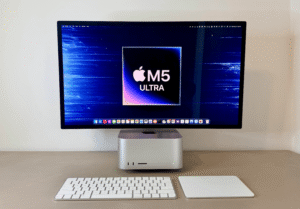
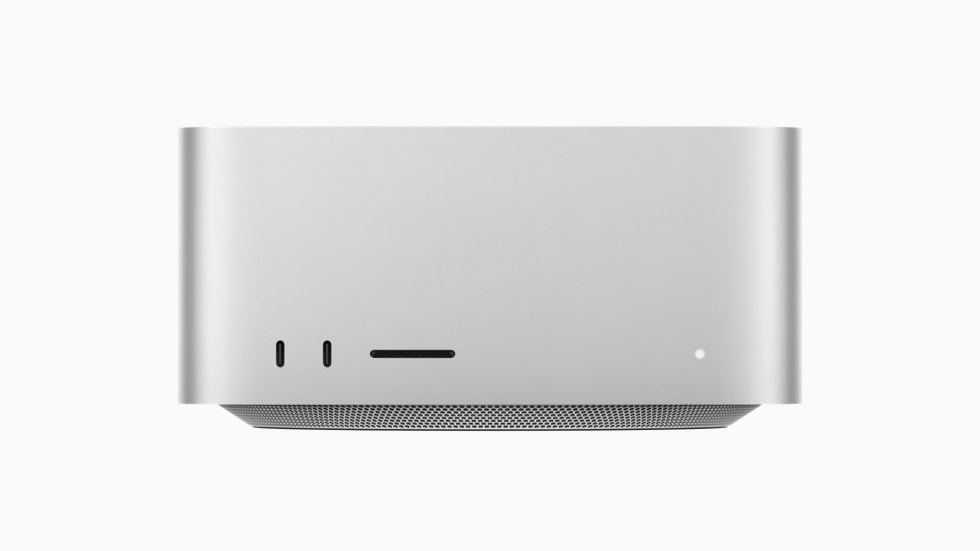
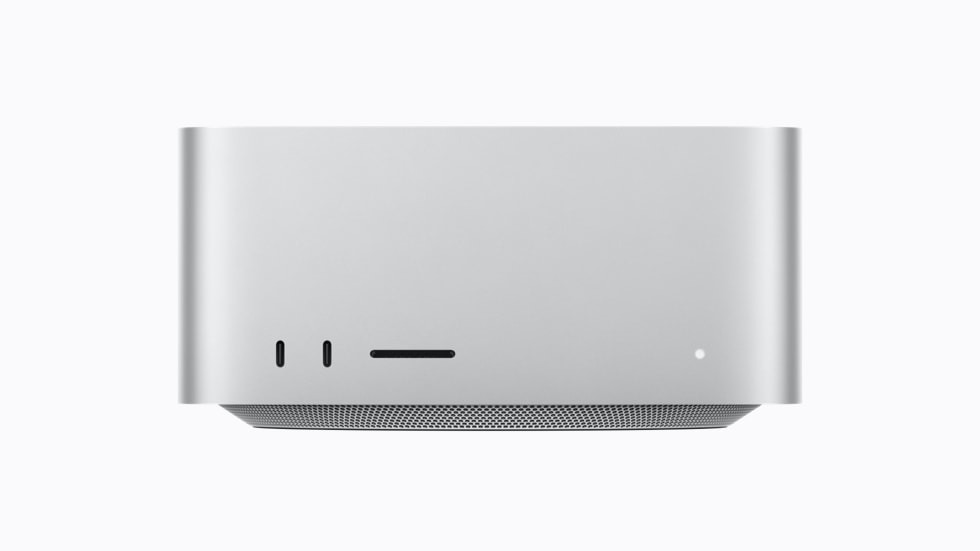
Apple just dropped the M5 Ultra with a jaw-dropping 1.2TB/s of memory bandwidth, and the AI hardware community is collectively picking its jaw up off the floor. The new Mac Studio isn’t just iterating, it’s fundamentally changing what’s possible for on-device inference, and it’s making a lot of expensive GPU setups look like overpriced space heaters.
The Numbers That Should Scare NVIDIA
Let’s put this in perspective. The RTX 5090, NVIDIA’s flagship consumer card, offers 1.8TB/s memory bandwidth. But here’s the kicker: it only has 32GB of VRAM. The M5 Ultra delivers 1.2TB/s across up to 512GB of unified memory.
That’s not a typo. Half a terabyte of memory at 1.2TB/s bandwidth.
To match that memory capacity with 3090s, you’d need around 16 cards at roughly $800-1,000 each on the used market. That’s $13,000-16,000 in GPUs alone, before you factor in the server board, CPUs, RAM, PCIe extenders, dual 1600W power supplies, and the Frankenstein modding required to make it all work. The technical analysis of M5 Max performance showed even the previous generation was competitive, the Ultra doubles down on that advantage.
The M5 Ultra 256GB model starts at $9,499. A 512GB option lands in October, with estimates placing it around $14,000-17,000. Suddenly, that GPU monstrosity doesn’t look so smart.
Wait, What’s Actually Under the Hood?
The M5 Ultra uses next-generation UltraFusion technology to combine two dual-die M5 Max chips into a quad-die architecture, a first for Apple silicon. The inter-die bandwidth hits over 4.4TB/s with connection density improved by more than 6x. The four dies behave as a single unified processor, which is exactly what you need for memory-hungry AI workloads.
The specs read like a checklist of everything AI inference demands:
– Up to 36-core CPU (12 super cores, 24 performance cores)
– Up to 80-core GPU with Neural Accelerators in every core
– 32-core Neural Engine
– 1.2TB/s unified memory bandwidth (50% more than M3 Ultra)
– Up to 512GB unified memory
The Neural Accelerators are the sleeper feature here. These are matmul units built directly into each GPU core, handling the matrix multiplication that dominates LLM workloads. Apple’s prior work on M5 Max’s local inference capabilities showed how these accelerators actually perform in practice.
The DGX Spark Comparison Nobody’s Talking About
NVIDIA’s DGX Spark specs are suddenly looking rough. With just 273GB/s of memory bandwidth, a single DGX Spark isn’t even in the same zip code as the M5 Ultra. The prevailing sentiment among AI researchers is that you’d need two DGX Sparks (around $8,600-9,200 total) to match the M5 Ultra’s memory bandwidth, and even then, the decode performance wouldn’t come close because the Spark’s bandwidth is crippling for token generation.
Real-world benchmarks from the community already show M5 Max hitting 700+ tokens per second prefill on Deepseek-V4-Flash. Because the Ultra scales almost linearly with double the bandwidth and dedicated neural engine compute, projections of 1,200-1,400 tokens per second prefill and 50+ tokens per second generation for non-quantized models aren’t fantasy, they’re the baseline expectation.
For decode-heavy workloads, which is most interactive AI use, memory bandwidth is the bottleneck. The practical realities of running production AI on Apple Silicon reveal that this bandwidth advantage translates directly to token throughput.
“But Can It Game Though?”
Every single time Apple drops a powerful chip, someone crawls out of the woodwork to complain about gaming. To which I say: a used PlayStation 5 costs $280. This machine was never meant for gaming.
Apple’s positioning is laser-focused on AI and heavy production workloads. The press release literally touts “accelerate tasks like running large language models” as a headline feature. This is a workstation for people whose rent depends on inference speed, not frame rates.
And the translation layer scene has evolved significantly. CodeWeavers’ Crossover and the broader Mac gaming ecosystem have made massive strides. But let’s be real: nobody’s dropping $10K on an M5 Ultra to play Cyberpunk at 4K.
The Economics of Local AI Just Shifted
Here’s where things get genuinely spicy. The local LLM cost illusion debate has raged for months, is it actually cheaper to run models locally or just hit OpenRouter? The M5 Ultra tilts the scales decisively.
Consider the alternatives:
| Option | Memory | Bandwidth | Cost | Power Draw |
|---|---|---|---|---|
| M5 Ultra Mac Studio 256GB | 256GB | 1.2TB/s | $9,499 | ~150W |
| 2x DGX Spark | 256GB total | 273GB/s each | ~$8,600+ | ~350W+ |
| 8x RTX 3090 | 192GB | 936GB/s each | $10K+ used | 2,800W+ |
The last option requires a 240V circuit. The Mac Studio plugs into a standard wall outlet.
One developer summarized it perfectly: they’d been running two DGX Sparks for prefill and an M3 Ultra for decode, passing KV cache between them. That convoluted setup exists because no single affordable machine had enough bandwidth. The M5 Ultra eliminates that complexity entirely.
The 512GB Elephant in the Room
The 512GB option is what’s really got AI researchers salivating. It’s not just about running bigger models, it’s about running entire model families simultaneously or loading frontier-class models with massive context windows without quantization.
A 512GB unified memory pool means:
– Deepseek-V4-Flash fully unquantized with huge context
– GLM 5.2 comfortably self-hosted
– Multiple models resident in memory for quick switching
– Large datasets loaded entirely into local memory
The caveat? The 512GB configuration doesn’t ship until late October, and early estimates suggest $20K+ pricing. As one commenter noted, we’re approaching house-down-payment territory for some folks.
Clustering: Because One Is Never Enough
Thunderbolt 5 with RDMA (remote direct memory access) support means you can cluster multiple Mac Studios into a shared memory pool. Apple claims a four-system cluster delivers up to 3x faster AI inference than a single system.
This is significant because it addresses the one criticism Apple silicon faced: you couldn’t scale beyond a single machine. Now you can. For enterprise teams, this creates a compelling on-prem AI alternative that doesn’t require dedicated server rooms or liquid cooling.
The Reality Check
Before you max out your credit cards, let’s address the elephant in the room: Apple’s pricing has gotten aggressive. The M3 Ultra 256GB model launched at $5,599. The M5 Ultra 256GB starts at $9,499. That’s a 70% price increase in two years.
Component shortages, particularly RAM prices, are driving this. But it’s hard to call the M5 Ultra overpriced when your alternative is a $20K+ custom server build that uses 20x the power.
The M5 Max version, starting at $2,499 with 614GB/s bandwidth, is arguably the sweet spot for individual developers. Apple’s strategic push toward on-device AI makes sense when you realize how this pricing cascades down.
What This Means for the Next Year
The GPU shortage isn’t ending anytime soon. NVIDIA’s prices keep climbing, and the used market for 3090s has become a seller’s paradise. The M5 Ultra doesn’t just compete, it makes those GPU farms look like an expensive insurance policy against technology that’s already obsolete.
For AI researchers, data scientists, and serious developers, the calculus is simple: the M5 Ultra offers H100-adjacent memory bandwidth at a fraction of the cost, in a machine that sips power and sits quietly on your desk.
The 3090 farm era isn’t dead yet, there’s still a market for people who don’t want to commit $10K+ to a single machine. But the writing is on the wall. When Apple can deliver this much memory bandwidth in a consumer form factor, the economics of local AI inference change forever.
And honestly? If you’re running production AI workloads and can afford the entry fee, the M5 Ultra is the first machine that makes you not care about cloud API costs at all. Apple’s bet on unified memory and future chip strategies is paying off in ways that make even the most cynical hardware reviewers do a double-take.
The only question left is whether NVIDIA’s response will come fast enough to matter.