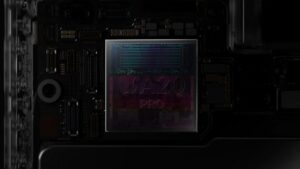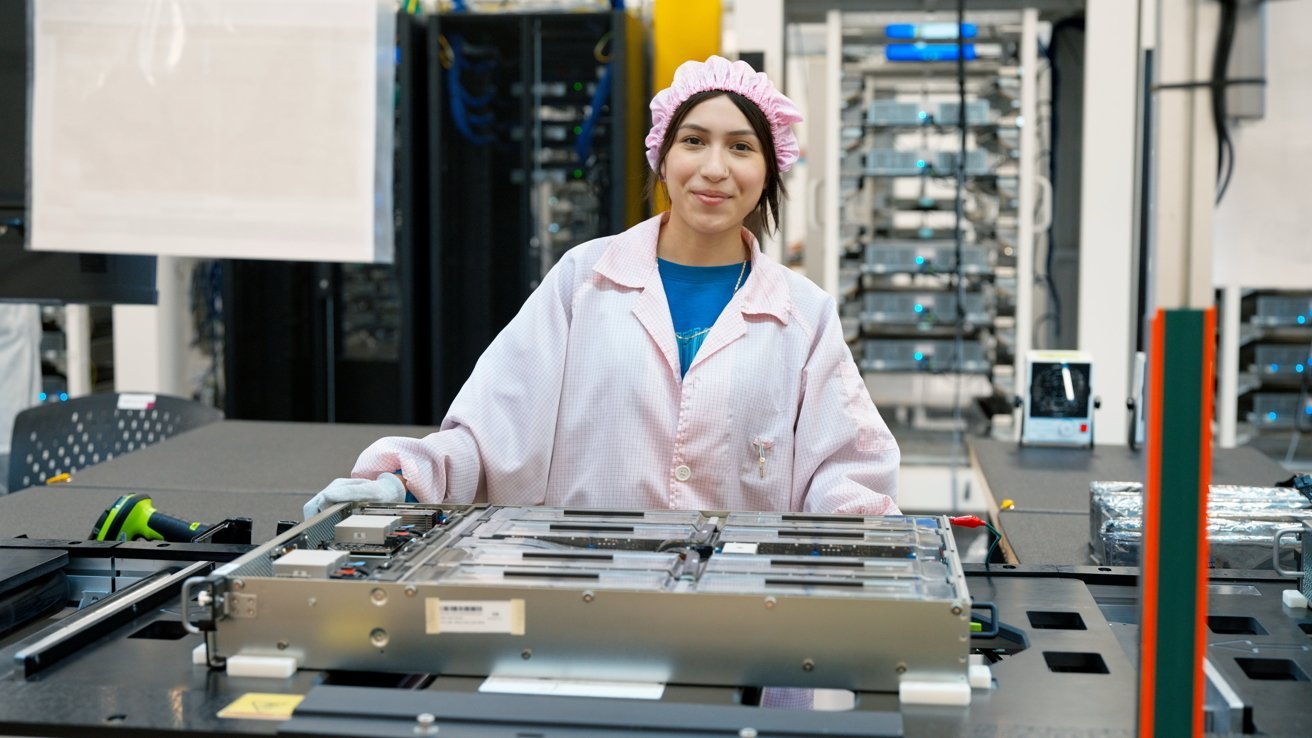
The photo dropped on X with the clinical caption “苹果M5服务器”, “Apple M5 Server”, and the tech world collectively lost its mind. 643.6K views later, we’re still picking our jaws up off the floor.
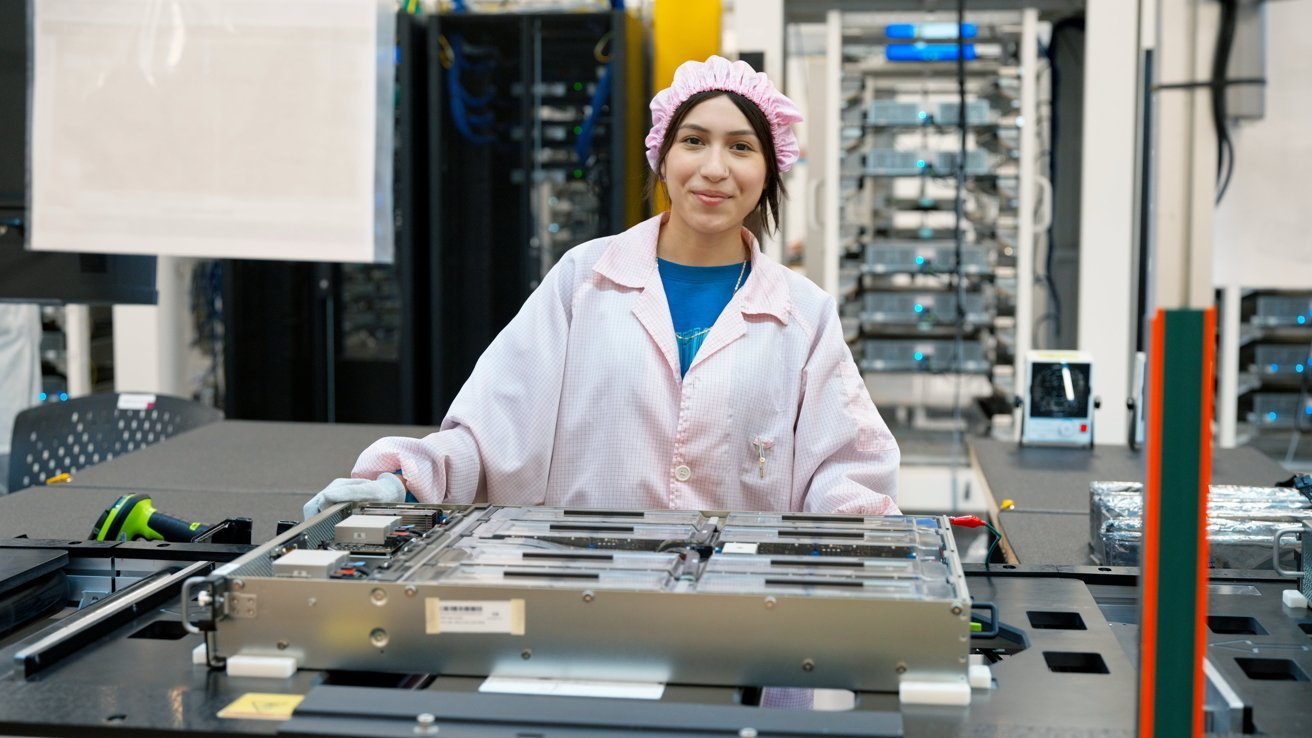
What @hsuchingpo shared on August 24 wasn’t just another grainy leaked render. It was a detailed look inside what appears to be Apple’s Private Cloud Compute (PCC) server hardware: a custom 2U chassis packed with 32 M5 chips, arranged in four columns of eight hot-swappable compute modules. The Apple logo, visible on the silicon after thermal paste was cleaned off, removes all doubt about the provenance.
This isn’t just a hardware story. It’s the clearest signal yet that Apple is building a full-stack AI infrastructure play that extends its on-device privacy philosophy into the cloud, and it might be smarter than anything the AI hyperscalers are doing.
What the Leaked Photos Actually Show
Let’s get the details straight before we speculate.
The server photos reveal a 2U rack-mountable chassis with four columns of hardware. Each column holds eight smaller computer elements, PCIe-style cards with blue ejector latches, clearly designed for field replacement. That’s 32 processors per enclosure.
Each board features a single M5 package under thermal paste, with VRM circuitry along the lower edge and a gold edge connector plugging into the backplane. A service diagram taped inside the lid lists 14 numbered board positions, each with its own Apple part number (APN). The board itself carries an Apple-style sticker reading 631-13397.
A smart cooling design uses front-to-back airflow through each column, with heatsink fins oriented to maximize air passage. The sides and baseboard join via a clear plastic cover that encloses each column, forcing air through the passage. It’s the kind of meticulous thermal engineering you’d expect from a company that obsesses over every millimeter inside an iPhone.
The account that posted the photos added a crucial detail: the server requires a Mac Studio for “software control.” This means the PCC units aren’t standalone compute nodes, they’re accelerators that extend a control plane running elsewhere.
M5 vs. M5 Ultra: The Great Silicon Debate
Here’s where the speculation gets interesting. Early reporting suggested Apple might deploy M5 Pro and M5 Max chips in its PCC servers, possibly even M5 Ultra variants to maximize performance. But the leaked photos tell a different story.
Forum analysis comparing the board dimensions to known M3 Ultra packages suggests these are base M5 chips, not the larger Ultra variants. The logic is straightforward: an M3 Ultra die package is roughly the same size as an entire PCB blade in the leaked images. You physically cannot fit an Ultra-class chip on that form factor.
The skeptics have a point. Apple’s M3 Ultra delivers significantly more raw multi-core performance. But here’s the counterintuitive insight: raw performance isn’t the goal. As Gizmochina’s analysis notes, the M5’s higher efficiency means multiple units can be packed densely into one enclosure without major thermal headaches.
Let’s do the math on what 32 base M5 chips in a 2U enclosure actually delivers. Based on the M5’s specs:
- Base M5 comes in 9 and 10 CPU core variants (the difference being one disabled performance core in the iPad version)
- GPU options range from 8 to 10 cores
- The NPU is identical across variants
Worst case: 288 CPU cores total (96P + 192E core design). Best case: 320 CPU cores (128P + 192E). GPU cores range from 256 to 320. The NPU yields a total of 512 cores across the enclosure.
That’s a lot of compute in a 2U footprint, and it sips power relative to what NVIDIA’s Ampere and Grace Blackwell solutions draw for comparable workloads.
This Is Not an Xserve Sequel
Every time Apple server hardware surfaces, the Xserve crowd emerges from the woodwork asking for a return. One reply to the leak captured the sentiment perfectly: “I wish Apple would reintroduce Xserve. There’s actual merit for the product existing now.”
Here’s the reality: Apple isn’t building this for you. It’s not building this for me. And it’s definitely not building this to sell to enterprises.
This hardware exists for one reason: to serve Siri AI queries and power Apple Intelligence features that can’t run entirely on-device. The design choices, hot-swappable boards, dense packaging, efficiency-optimized base M5 chips, all point to a vertically integrated cloud AI service, not a general-purpose server product.
Private Cloud Compute: The Privacy Play That Actually Matters
The leak’s timing matters. It comes as speculation grows around Hugging Face potentially being acquired for $13 billion, and as Apple’s competitors pour billions into hyperscale AI infrastructure. Apple’s response? Build their own silicon, own the full stack, and extend their on-device privacy architecture to the cloud.
Apple’s Private Cloud Compute architecture is genuinely different from what Google, Microsoft, and Amazon offer. Instead of using traditional server processors, PCC relies on device-class silicon, essentially extending the company’s on-device privacy approach to larger-scale AI work in the cloud.
The security implications are significant. PCC is designed to ensure that Apple’s own engineers can’t access user data processed by these servers. The hardware enforcement, verifying the software running on each node before trusting it with data, is a fundamental architectural bet. And this leaked hardware is the physical embodiment of that bet.
This also explains a frustrating recent trend: the inability to get higher memory configurations in Mac Studios. If Apple is diverting M5 Ultra-class silicon to its cloud infrastructure, consumer devices suffer the supply consequences. Your loss is Siri’s gain.
The Hugging Face Angle: Why Apple Might Actually Buy
The Hugging Face sale speculation adds another layer to this story. With OpenRouter already snapped up by Stripe, the “GitHub of AI models” is reportedly exploring a sale at a valuation of $13 billion or more.
Most conversations about potential acquirers focus on NVIDIA, Microsoft, or Google. But Apple deserves serious consideration. The argument against: Apple doesn’t typically buy platforms for hosting models, it builds its own walled gardens. The argument for: Apple needs a way to distribute and manage local AI models across billions of devices.
Consider the trajectory. Apple is cramming a 27B-parameter model onto iPhones through partnerships with startups like PrismML. The company’s Bonsai AI compression technology pushes extreme 1-bit quantization to get models onto consumer hardware. Meanwhile, the M5 Max’s 614GB/s memory bandwidth makes local inference genuinely viable on Apple Silicon.
A Hugging Face acquisition would give Apple the model distribution infrastructure it currently lacks, a way to make thousands of models available to developers and users within Apple’s ecosystem, all running locally on Apple silicon. The infrastructure play is coherent, even if it doesn’t fit the traditional “Apple builds everything in-house” narrative.
The counterargument from the discussions is worth noting: Microsoft, with its GitHub playbook, seems like the more obvious buyer. And there are legitimate concerns about any single big tech company owning the primary repository for open-source AI models. But Apple’s focus on local AI execution makes it a more interesting fit than most people give it credit for.
What This Means for the AI Landscape
Apple’s server strategy represents a fundamentally different approach from the hyperscalers. While Microsoft, Google, and Amazon build ever-larger GPU clusters with NVIDIA silicon, Apple is using its own custom chips, designed for efficiency and privacy rather than raw throughput.
The approach has tradeoffs. Base M5 chips won’t compete with H100s or GB200s on raw training performance. But Apple doesn’t need to train frontier models on this infrastructure, it needs to run inference for consumer AI features with strict privacy guarantees. That’s a very different workload profile, and the M5’s efficiency makes it surprisingly well-suited.
This also connects to longer-term strategic bets. Apple is reportedly skipping M6 Pro and Max chips entirely to accelerate development of AI-optimized M7 chips. If Apple is willing to sacrifice an entire generation of high-end consumer silicon to focus on AI, the server infrastructure leak starts making even more sense. The company is all-in on AI, it’s just doing it on its own terms.
The Architecture Lesson
From an enterprise architecture perspective, there’s something genuinely instructive here. Apple didn’t bolt AI onto their existing infrastructure, they designed new infrastructure specifically for their AI workloads and security requirements. The result is a custom 2U server with 32 hot-swappable M5 nodes, field-serviceable boards, and privacy guarantees enforced at the hardware level.
The lesson isn’t that everyone needs custom silicon. It’s that workload-specific infrastructure design matters. Apple analyzed their AI inference requirements, their security guarantees, and their efficiency targets, then engineered a solution that meets all three. That’s the same discipline any engineering team should apply when building AI infrastructure, whether it’s a two-node on-prem cluster or a multi-region cloud deployment.
The Bottom Line
The leaked M5 server photos offer the clearest picture yet of Apple’s AI infrastructure strategy. The company isn’t trying to out-NVIDIA NVIDIA. It’s building a privacy-first AI architecture that extends from the Neural Engine in your iPhone to custom server hardware in Texas data centers.
The design choices, base M5 chips over Ultra variants, hot-swappable boards, efficient cooling, Mac Studio control planes, reveal a system engineered for deployment at massive scale with minimal power consumption. That’s the Apple way: not the fastest or the most powerful, but the most elegant solution to the problem as defined.
Whether Apple also makes a play for Hugging Face remains to be seen. But one thing is clear: Apple is building the infrastructure for a future where AI runs where your data lives, on your devices, and in Apple-controlled servers that even Apple’s own engineers can’t peek into. The “Apple is behind on AI” narrative may need a serious revision.
The hardware is real. The photos are real. And if this leak is accurate, Apple’s AI infrastructure is far more sophisticated than most analysts have been willing to admit. The AI race isn’t just about who has the biggest GPU clusters anymore. It’s about who builds the most intelligent, most private, most efficient architecture for delivering AI to actual users. Apple just showed their hand, and it’s a better one than most people expected.
One more thing, if anyone from Apple is reading this: developers would love some official word on whether the cost-efficiency math of local AI on Apple Silicon makes sense for their use cases. The speculation is fun, but documentation would be better.