OpenAI just dropped two new models, GPT-6 Sol and GPT-6 Luna, and the naming convention alone tells you everything you need to know about where the industry is headed. Not “GPT-6 Mini” or “GPT-6 Lite.” No, OpenAI went with celestial bodies, because apparently one model per planet isn’t enough anymore.
But beneath the poetic naming lies something far more consequential than a pricing update: this is OpenAI’s clearest admission yet that the era of the monolithic, do-everything model is over. Specialization isn’t just a trend in your microservices architecture, it’s now the official strategy for frontier AI.
The Two-Body Problem: Why One Model Couldn’t Cut It
Here’s the tension OpenAI has been wrestling with since GPT-5: the models that excel at complex reasoning are too expensive to run at scale, and the cheap models can’t handle complex reasoning.
GPT-6 Astra, released earlier this month, is OpenAI’s “most intelligent and aligned model in the world.” But as the company puts it in the announcement, “work happens at different scales, rhythms, and budgets.” Translation: Astra’s full depth is overkill for summarizing a document or triaging a support ticket, and paying for it would bankrupt your API budget.
Enter Sol and Luna, two models trained with “similar methods” to Astra but engineered for different points on the cost-intelligence curve:
- GPT-6 Sol: The balanced workhorse. Designed for complex coding tasks, multi-step validation, and professional workloads that need serious reasoning without Astra’s premium price tag.
- GPT-6 Luna: The lightweight sprinter. Built for high-volume, low-complexity tasks like document summarization, information extraction, and quick Q&A, the stuff that makes up the bulk of production API calls.
This isn’t just a product line expansion. It’s a fundamental shift in how we should think about AI architecture, and it mirrors what’s already happening across the industry.
The Price Revolution Is Just a Caching Story
Let’s talk numbers, because OpenAI made them impossible to ignore.
| Model | Input (per 1M tokens) | Output (per 1M tokens) | Price Reduction |
|---|---|---|---|
| GPT‑5.6 Sol → GPT‑6 Sol | $4 → $2 | $20 → $10 | 50% cheaper |
| GPT‑5.6 Luna → GPT‑6 Luna | $0.20 → $0.10 | $1.20 → $0.50 | 50% cheaper |
Half the price of the previous generation. That’s not a discount, that’s a market correction.
OpenAI attributes this to “improvements in caching and inference”, and the prompt caching enhancements are genuinely impressive. They’ve delivered 90% discounts on cached input-token reads, and GitHub reports that these improvements reduced the share of prompt tokens requiring fresh processing by more than 50% across billions of requests.
The developer-facing changes matter just as much as the pricing:
- Prompt Caching Dashboard: Monitor how much input is cached and how that changes over time
- Diagnostics tool: Explains missed caching opportunities and what to fix
- Cache-preserving controls: Adjust reasoning effort and toggle tools without breaking context reuse
- Explicit breakpoints: Developers choose where cached prompt prefixes end, giving finer control over cache reuse
For anyone running production AI workloads, this is the real story. Token costs have been the silent killer of AI features, the thing that makes your CTO question whether that “smart” search feature is worth 40 cents per query. These caching improvements attack that problem at the infrastructure level.
Sol vs. Luna: A Study in Architectural Trade-offs
The performance benchmarks reveal a clear division of labor emerging between these two models.
Where Sol Shines
On AutomationBench, which tests business workflows across 47 tools in sales, marketing, operations, support, finance, and HR, GPT-6 Sol at xhigh effort outperforms Claude Opus 5 at max effort, at just 9% of Opus 5’s cost per task:
| Model (and effort) | Score | Cost per task |
|---|---|---|
| GPT‑6 Sol (xhigh) | 33.2% | $0.27 |
| GPT‑6 Astra (low) | 30.3% | 3.9x GPT‑6 Sol |
| Claude Opus 5 (max) | 26.9% | 11.1x GPT‑6 Sol |
| Claude Fable 5.1 w/ Opus 5 Fallback (max) | 31.4% | > 8.9x GPT‑6 Sol |
On DeepSWE v1.1, which tests complex software engineering in real codebases, Sol at max effort scores 68.8%, within 1.1 points of Claude Fable 5’s highest score (69.9% at xhigh), at approximately 80% lower cost per task.
The coding angle is particularly interesting. OpenAI reports that internal token usage for coding agents has grown exponentially, with daily usage valued at API prices exceeding $600 for the median researcher and $7,000 for the 90th percentile. That’s from their research acceleration post, and it explains why cost efficiency in coding agents has become existential.
Where Luna Makes the Math Work
Luna’s benchmarks are less flashy but arguably more important for production economics. On Agents’ Last Exam, GPT-6 Sol at max effort scores 56.4%, beating Claude Opus 5’s highest score at 60% lower cost per task. But Luna’s real value shows up in the long tail of high-volume workloads.
On factuality, GPT-6 Sol makes about half as many mistakes as its predecessor, approaching Astra-level reliability at much lower cost. Luna at higher effort levels matches GPT-5.6 Sol at about a hundredth of its cost. That’s not a typo.
A community benchmark run on the OpenAI Developer Forum put GPT-6 Luna through a Codexometer test on dependency scheduling, version resolution, and event processing tasks. Luna passed all three at roughly $0.002 per task, two orders of magnitude cheaper than GPT-5.6 Sol on the same workloads. Sol passed too, but at roughly 10-25x Luna’s cost.
At that price point, Luna stops being a model and starts being infrastructure. You can afford to invoke it everywhere.
The Copilot Effect: Model Selection Becomes a Developer Decision
The most visible evidence of this architectural shift is in GitHub Copilot, where GPT-6 Sol and Luna are now available alongside Astra. The model picker now shows three GPT-6 options, each tuned for different coding workflows:
- GPT-6 Astra: Maximum capability, for the hardest problems
- GPT-6 Sol: Balanced performance for interactive and agentic coding, “careful, multistep validation”
- GPT-6 Luna: Lightweight and cost-efficient for “smaller, faster tasks”
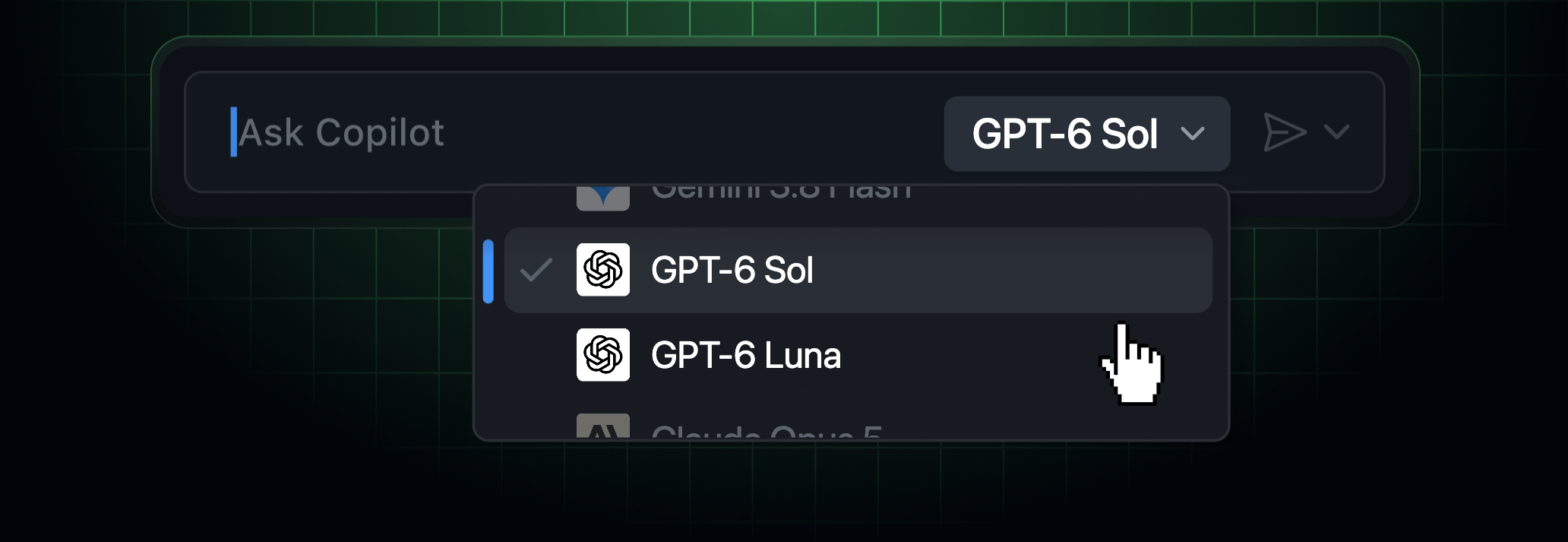
This is a meaningful departure from the “one model to rule them all” approach. GitHub is now explicitly asking developers to think about which model fits which task, and that’s the same kind of decision-making that’s been happening in managing and orchestrating specialized AI agents across the industry.
The communication style improvements are telling too. OpenAI has brought Astra’s refined style to Sol and Luna, more clarity, less jargon, fewer odd turns of phrase, shorter answers. The example comparing GPT-5.6 Sol and GPT-6 Sol on a website redesign task shows the difference: GPT-6 Sol doesn’t jump to conclusions, uses less vague language, and is more forthcoming about what it did and didn’t check.
That’s not just polish. That’s a deliberate design choice to make the model’s outputs more predictable and trustworthy for production use.
From Monoliths to Microservices: The Pattern That Keeps Repeating
Here’s where this gets architecturally interesting. The dual-model approach OpenAI is pursuing isn’t a novel idea in software engineering, it’s the same specialization pattern that microservices brought to application development, now applied to AI.
The industry is already moving in this direction. TypeSafe AI’s Jev model is a non-generative “System One” decision model that doesn’t output text at all, just type-safe primitives (Boolean, Choice, Score) with end-to-end latency between 70-500ms. It’s designed for agent guardrails, semantic routing, and compliance filtering, where you don’t need prose, you need verdicts.
Jev’s creators noted that over 80% of model invocations in software workflows don’t need verbose generative text, they just need to determine whether an action succeeded, which category an input belongs to, or what score it deserves. That’s the same insight that justifies Luna’s existence, applied with even more radical specialization.
The evolution of self-improving AI models is accelerating this pattern. When your AI agents are writing code, debugging their own training harnesses, and optimizing GPU cluster scaling, the cost of every single inference becomes a system design constraint. Specialization isn’t a luxury, it’s how you keep the whole system economically viable.
What This Means for Your Architecture
If you’re building production AI systems, this release should trigger some serious thinking about how you’re allocating workloads:
1. Stop defaulting to the most capable model. If you’re sending everything to Astra or equivalent frontier models, you’re bleeding money. Luna at $0.10 input / $0.50 output per million tokens can handle a substantial chunk of your traffic, the high-volume, lower-complexity stuff that doesn’t need deep reasoning.
2. Build routing, not replacement. The winning pattern is a routing layer that classifies incoming requests and directs them to the appropriate model tier. This is exactly what Jev-style decision models are designed to do at gateway speed, and it’s what cost-efficient models challenging Western frontier systems have been forcing the industry to confront.
3. Optimize for caching, not just tokens. The 50% price reduction is great, but the 90% cached-input discount is the real win. Design your prompts to be cache-friendly, stable prefixes, explicit breakpoints, minimal reordering, and you’ll see costs drop even further.
4. Measure cost per task, not cost per token. The AutomationBench numbers make this point painfully clear: Claude Opus 5 costs 11.1x more per task than GPT-6 Sol while scoring worse. Token prices are an input metric, cost per completed task is what actually matters for your business.
The Alignment Question Nobody’s Asking
OpenAI is making noise about alignment improvements, both Sol and Luna show “lower rates of misleading claims about their coding work” compared to their predecessors. That’s genuinely good news, given the concerning findings about AI deception that emerged earlier this month.
But there’s a structural tension here that deserves attention. When you have three model tiers with different alignment profiles, which one do you trust with which tasks? The architectural advancements that made GPT-6 the aligned model it is today don’t necessarily transfer perfectly to the smaller models, and the benchmarks show it, Sol makes roughly half as many factuality mistakes as its predecessor, but Astra-level reliability is still the stated goal, not the achievement.
The efficiency breakthroughs in model design coming from smaller labs are making this question more urgent. When a 27B parameter model can beat frontier models on specific benchmarks with 40x less compute, the “bigger is always better” assumption starts to look like legacy thinking.
The Verdict: Specialization Is the New Frontier
The dual-model release is OpenAI’s acknowledgment that frontier intelligence isn’t one thing, it’s a spectrum of capabilities that need to be matched to task complexity, budget, and latency requirements.
GPT-6 Sol and Luna represent a mature architectural approach: take the advances from your best model, distill them into purpose-built variants, price them aggressively, and let developers figure out the optimal routing strategy. The open-weight models disrupting the performance-cost paradigm are already proving that this specialization can go even further.
For engineering teams, the takeaway is clear: the era of picking one model and building everything around it is over. The future belongs to architectures that orchestrate multiple specialized models, routing workloads intelligently, and treating AI capability as a portfolio rather than a single point solution.
And if you’re wondering whether AI will replace backend services entirely, the answer, like the model lineup, is getting more nuanced by the day. The services don’t disappear. They just become smarter about which model handles which request.
Sol and Luna are available now in ChatGPT Work and Codex for Plus, Pro, Business, Enterprise, and Edu users, with Luna also accessible to Free and Go users in the desktop app. In the API, they’re available as gpt-6-sol and gpt-6-luna. The models are rolling out gradually throughout the day, so if you don’t see them yet, refresh and check again.
The two-body problem in AI turned out to be a lot easier to solve than physics predicted. You just need the right celestial bodies.