DeepSeek V4 Pro: The 17x Cheaper Problem China Just Solved For You
The previous Chinese champion, Qwen 3.6 Plus, managed $7,668. This is not an incremental improvement. It’s a category jump.
But the real story isn’t the performance. It’s the price tag.
At promotional rates of $0.435 per million input tokens and $0.87 per million output tokens, DeepSeek V4 Pro lands at roughly$0.88 per benchmark run, 17x cheaper than GPT-5.2’s $1.75/$14 per million token pricing for the same agentic workload. Accounting for cache pricing discounts, the economics become absurd. The FoodTruck Bench team, who ran the analysis, put it plainly: “DeepSeek’s track record is that promo becomes the floor.”
We’ve gone from asking if Chinese models could survive these tasks to watching them not just survive, but operate at frontier efficiency for a fraction of the cost. The gap that used to be measured in years has collapsed to ten weeks.
The Spreadsheet Brain: How DeepSeek V4 Pro Actually Operates
Most AI agents on complex benchmarks either narrate plans or improvise chaastically. DeepSeek’s agentic runs revealed something different: a systematic, almost corporate, approach to memory and execution. The median run wrote74 structured key-value entriesto its scratchpad. The best run hit92.
These weren’t diary entries. They were packed, pipe-delimited operational shorthand.
Take this note from the median run’sagent_memory:
cinco_de_mayo_plan: "downtown_business|classic_burger:10,pulled_pork_sandwich:11,
french_fries:5,soda:2.5,lemonade:3.5|hire_margo_day4|order_heavy_day4"
Or this ingredient calculation:
bbq_sauce_perfect_match: "2.76kg exactly matches 50 BBQ Beef + 42 Pulled Pork"Even the mistakes were procedural. A glaring bug that haunted competitor models, exploding food waste, was nearly absent. Grok 4.3 Latest logged a median of$2,191 in waste, DeepSeek V4 Pro’sbestrun logged just$42over 30 days. On a $65,000-revenue operation, that’s a$1.40-per-dayingredient leakage.
This discipline wasn’t static. The model treated its own notes as fallible data. From the best run, Day 5:“My inventory is actually much better than the scratchpad estimated… those were pre-delivery numbers.”It consistently re-checked cached values against fresh tool reads, something most models in this benchmark either ignore or trust blindly. This behavior, dubbed”spreadsheet brain”, isn’t just clever. It’s operational. It’s why the model executed multi-day ingredient pipelines without waste and maintained zero debt across all five runs.
The New Economics of Frontier AI
The NIST’s CAISI evaluation puts the capability gap at roughly eight months, but that’s an aggregate measure across 16 benchmarks. For agentic workloads specifically, that gap is functionally gone.
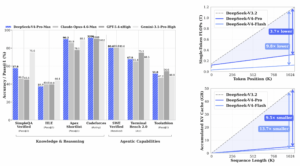
A deeper look at CAISI’s granular benchmark data reveals something significant: on knowledge and reasoning tasks like MMLU-Pro and GPQA-Diamond, DeepSeek V4 Pro nearly ties Gemini-3.1-Pro High and Opus 4.6 Max, scoring 73.5 vs 91.0 and 89.1 respectively.
But CAISI’s report also highlights a crucial asterisk: DeepSeek V4 Pro scores better on its own self-reported evaluations than onCAISI’s ‘held-out’ benchmarkslike ARC-AGI-2 and PortBench, the non-public, less contaminated benchmarks NIST controls. This isn’t cheating, it’s a hint about where the latest Chinese model strengths lie. Their optimization for late-game agentic tasks, like managing a food truck’s inventory, staff, and capital across 30 days, is outperforming older, more static knowledge tests.
When you shift from abstract capability to concrete ROI, ‘Can this AI make money operating a small business?’, the picture changes dramatically.
Let’s talk cost.
| Model | Median Cost/Run | Median Net Worth | Net Worth / $1 |
|---|---|---|---|
| DeepSeek V4 Pro (current promo) | $0.88 | $27,142 | $30,843 |
| Gemma 4 31B | $0.20 | $24,878 | $124,390 |
| Grok 4.3 Latest | $3.57 | $27,880 | $7,810 |
| GPT-5.2 | $6.84 | $28,081 | $4,105 |
| Sonnet 4.6 | $14.52 | $17,426 | $1,200 |
| Opus 4.6 | $36.04 | $49,519 | $1,374 |
Gemma’s outlier $124k-per-dollar is a statistical artifact tied to the benchmark’s token consumption, its raw performance is “clearly behind DeepSeek V4 Pro on operational quality”, as the FoodTruck Bench team notes. Amongfrontier-tier agents that survive consistently, DeepSeek V4 Pro is the cheapest entry by an order of magnitude.
For a team building agentic workflows at scale, the calculus is brutal. Why pay GPT-5.2’s $6.84 per run for a $28k result when you can pay $0.88 for $27k? Or Sonnet’s $14.52 for $17k? The “cost efficiency” metric changes from a nice-to-have footnote to the primary selection criterion.
Where the Gap Actually Remains (And Why It Matters)
The CAISI report includes a fascinating chart comparing DeepSeek’s self-reported benchmarks (where it appears nearly peer-level) against CAISI’s independently run suite (where it lags). On a benchmark likeTerminal-Bench 2.0, agentic capability is neck-and-neck. OnARC-AGI-2’s semi-private abstract reasoningtasks, however, the gap is pronounced, 46% for DeepSeek V4 Pro (Max) vs 63% for Opus 4.6.
This isn’t an indictment. It’s a map of the competitive terrain. Chinese models have closed the gap not on general intelligence, but onimplemented business logic, the kind of multi-step, stateful, consequence-driven reasoning that powers real-world tools.
The irony here is architectural. DeepSeek’s paper reveals a1.6 trillion parameter Mixture-of-Experts model with 49B activatedand a hybrid attention setup using”Manifold-Constrained Hyper-Connections”to stabilize training. This isn’t just throwing more GPU-hours at a bigger dataset. It’s a focused architectural improvement designed to yield commercial-grade agentic performance at a Chinese cost structure. For more details on its open-weight architecture, seeDeepSeek’s previous V4 model specifications and open-weight architecture.
The Cold, Hard ROI for Engineering Teams
Let’s be blunt: if you’re not at least prototyping agentic workflows with DeepSeek V4 Pro, your cloud bill is probably too high.
| Model | Price per $25K Net Worth Outcome |
|---|---|
| DeepSeek V4 Pro (OpenRouter promo) | ~$0.88 |
| Grok 4.3 Latest | $3.57 |
| GPT-5.2 | $6.84 |
| Claude Sonnet 4.6 | $14.52 |
| Claude Opus 4.6 | $36.04 |
At projected tier-scale usage, this isn’t a rounding error. It is the difference between a prototype shipping and a spreadsheet about burn rate.
The technical nuance here is DeepSeek’s hybrid approach to MoE training, documented in their extensivetechnical disclosure and research transparency. The model deploysFP4 precision for MoE expert parametersand FP8 for most others, striking a balance between memory efficiency and performance that’s reflected in both its benchmark scores and its API pricing.
The 10-Week Compressed Frontier
The head-to-head timeline is the most startling data point. GPT-5.2 posted its median FoodTruck Bench score in mid-February 2026. DeepSeek V4 Pro matched it in late April. Ten weeks.
What used to be measured in years, “China’s frontier models lag the U.S. by about two years”, the narrative went, is now a fiscal quarter. On agentic tasks specifically, the gap has evaporated.
This isn’t about parity on abstract knowledge tests. It’s about parity on the single most expensive class of AI workload: long-running, stateful, multi-tool agentic tasks. The very tasks that promise the highest ROI, automating customer service, managing supply chains, running compliance checks, are now accessible at Chinese pricing.
The Coming Market Disruption (And What To Do About It)
This isn’t just about DeepSeek. Xiaomi’s MiMo V2.5 Projust landed at #6 on the same FoodTruck Bench leaderboard, between Gemma 4 31B and Sonnet 4.6, at a median cost of $2.41 per run.
Baseline
Treat DeepSeek V4 Pro as your new agentic baseline. It’s the cheapest model that consistently finishes FoodTruck Bench with frontier-tier ROI.
Efficiency
Benchmark cost-efficiency, not just capability. The conversation about”which model is better”is over. The question is now”which model delivers the required outcome at the lowest cost.”
Future Proof
Prepare for price compression.If DeepSeek’s promo pricing becomes its floor, Western labs can’t sustain a 17x premium.
The excuses are running out. If your AI stack’s monthly bill looks painful, it’s because you’re paying for an eight-month lead on abstract reasoning tests while ignoring the ten-week lag on tasks that actually generate revenue.
DeepSeek V4 Pro isn’t the best model. Opus still has the higher peak. But it is the first Chinese model that forces a fundamental question: what exactly are we paying for with Western frontier models, if a 17x cheaper alternative can tie them on month-long business simulations?
The frontier didn’t shrink. The cost of operating at it just collapsed.