The Mechanism: How Binary g128 Defies Physics
The core innovation is a quantization scheme PrismML calls “binary g128.” Every model weight, which normally lives as a 16-bit floating-point number, is reduced to a single sign bit: either -1 or +1. Each group of 128 of these binary weights shares one FP16 scale factor. The result is an effective bit-width of just 1.125 bits per weight, a staggering 14.2x reduction from the FP16 baseline.
| Format | True bits/weight | Size | Reduction |
|---|---|---|---|
| FP16 (baseline) | 16.0 | 54 GB | 1.0x |
| Binary g128 | 1.125 | 3.9 GB | 14.2x |
The magic here is that this isn’t a half-measure. Unlike most “low-bit” builds that keep certain sensitive layers (like embeddings or the LM head) at higher precision, Bonsai applies this binary representation end-to-end. Every projection, every attention mechanism, every output layer is binary. There are no high-precision escape hatches.
This was made possible by a base model uniquely suited for the job. Bonsai is built on Qwen3.6-27B, the dense model that’s been rewriting expectations about local LLM performance. Its hybrid-attention backbone, roughly 75% linear attention layers, is what makes a 262K-token context window practical on a phone. A conventional full-attention stack would drown in memory bandwidth.
Benchmark Sanity: Where the Intelligence Actually Lives
The aggregate headline, 89.5% of FP16 benchmark performance, obscures a more interesting pattern. The degradation is not uniform, it’s highly selective, and that selectivity reveals how the model preserves its reasoning core.
| Category | FP16 | 1-bit Bonsai 27B | Retention |
|---|---|---|---|
| Math | 95.33 | 91.66 | 96.1% |
| Coding | 88.74 | 81.88 | 92.3% |
| Knowledge & reasoning | 83.15 | 73.39 | 88.3% |
| Instruction following | 78.47 | 65.74 | 83.8% |
| Agentic / tool calling | 80.00 | 66.03 | 82.5% |
| Vision | 72.61 | 59.57 | 82.0% |
The reasoning backbone, math and coding, stays within four points of full precision. This stands in stark contrast to conventional low-bit builds of the same base model. For example, the Qwen3.6-27B IQ2_XXS (“2-bit”) variant at 9.4GB scores only 72.73 overall and collapses to 57.5 on AIME26. Bonsai’s 1-bit build, at less than half the size, scores 87.08 on AIME26, demonstrating that the quantization approach preserves complex chain-of-thought reasoning that conventional methods destroy.
This is why the intelligence density metric matters. The formula D = -log2(1 - score/100) / size_GB captures how much capability per gigabyte a model delivers.
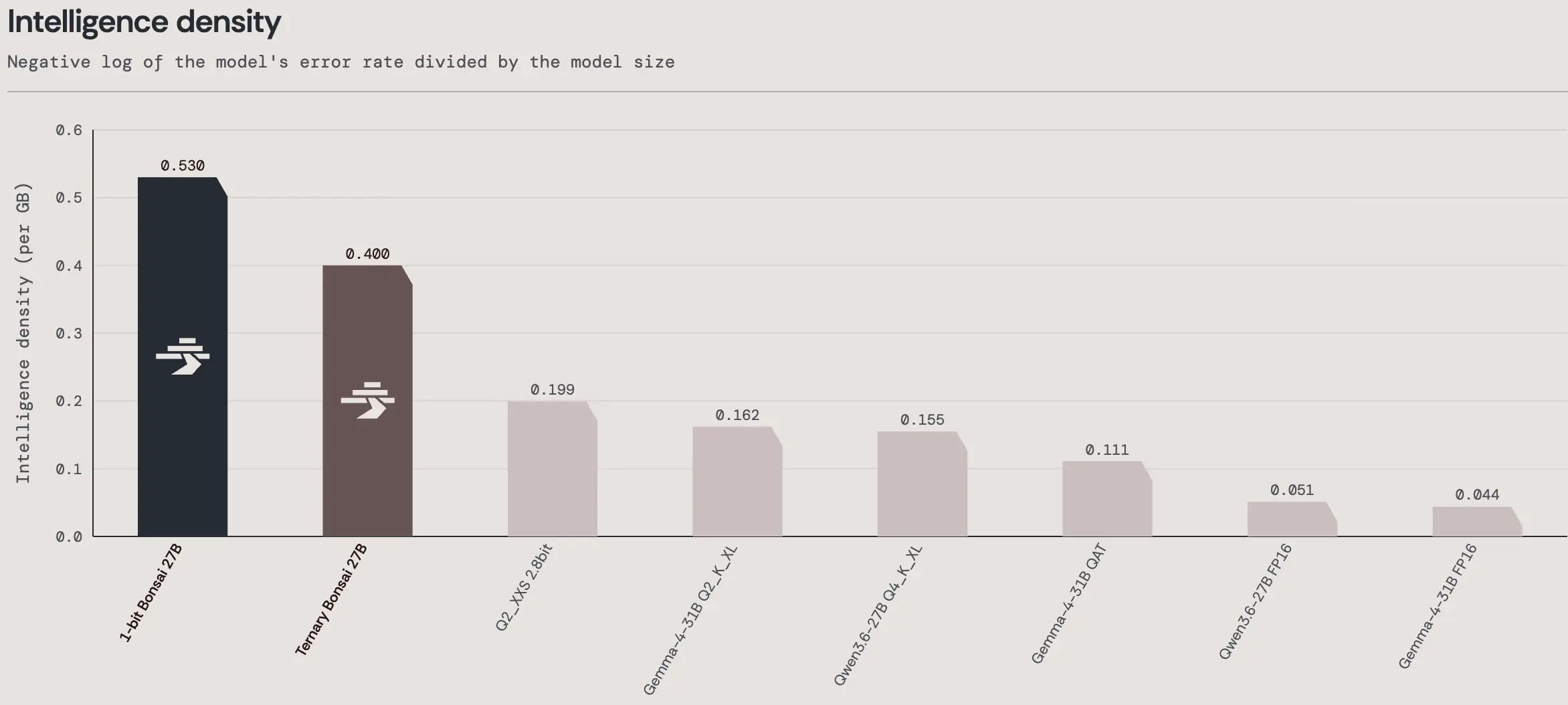
1-bit Bonsai 27B delivers 0.530 intelligence density per GB, roughly 2.7x the densest conventional build and over 10x FP16. No conventional quantization of Qwen3.6-27B or Gemma-4-31B exceeds 0.2. Each gigabyte of storage in a Bonsai deployment translates into far more usable intelligence than any other approach.
The Heat Reality: Performance Under Throttle
Real-world performance data from the Hugging Face model card tells a more complex story. On a cold iPhone 17 Pro Max, the 1-bit model generates 11.0 tokens/second, but in a sustained battery-drain test, it settled to 10.8 tok/s and generated 672 tokens per 1% of battery charge, roughly 67,000 tokens on a full charge.
The battery consumption is not trivial. The model’s memory footprint at various contexts:
| Build | Weights | 4K ctx | 100K ctx |
|---|---|---|---|
| 1-bit Bonsai (MLX) | 4.21 GB | 5.9 GB | 12.2 GB |
| Qwen3.6-27B “4-bit” (Q4_K_XL) | 17.6 GB | 19.2 GB | 25.6 GB |
| 27B 16-bit (GGUF bf16) | 51.25 GB | 52.6 GB | 59.3 GB |
The 1-bit build handles a 100K-token context at 11.6, 12.2 GB without any KV-cache compression, a budget that fits mainstream laptops. Enabling the 4-bit KV cache drops the 100K peak to ~6.8 GB, and the full 262K window fits in ~9.4 GB peak.
However, the model is thermally limited. Early testers reported the chip throttling after roughly five minutes of sustained generation. PrismML’s own data shows decode energy on the M5 Pro at 0.275 mWh/token, an order of magnitude more efficient than datacenter GPUs. But that efficiency advantage on battery power comes with the trade-off that sustained performance drops below the cold peak.
The Apple Connection: Why This Matters Beyond Benchmarks
The commercial implications are already in play. PrismML CEO Babak Hassibi confirmed that Apple is evaluating the compression technology for potential on-device use. Apple’s struggles with AI model compression highlight the industry demand for efficient edge inference that Bonsai directly addresses.
This isn’t a speculative partnership. Apple’s own foundation models have struggled on benchmarks, and at WWDC 2026, the company unveiled a revamped Siri built on Google’s Gemini technology, with complex queries routed to Nvidia GPUs in Apple’s cloud. A licensing deal with PrismML would give Apple an in-house path to bring 27B-class reasoning to the iPhone without relying on cloud infrastructure or third-party models.
PrismML has also demonstrated that the technique generalizes beyond language models. Bonsai Image 4B applies the same 1-bit quantization to image generation models, reducing memory usage to 1/8.3 of the original while running in a browser via WebGPU.
The Limitations: What Gets Squeezed Out
The quality-footprint trade-off is real. The 1-bit model’s drop in vision and instruction-following categories is significant, 82% retention versus 96% for math. Agentic tool-calling, critical for autonomous workflows, falls to 82.5%. The model also struggles with non-English languages, early testers reported that Bonsai hallucinates heavily when prompted in languages other than English, likely because the binary representation disproportionately affects the model’s ability to maintain cross-lingual representations.
PrismML is transparent about this. The ternary variant (Ternary Bonsai 27B, 5.9 GB, 94.6% retention) is explicitly positioned as the quality-oriented operating point for laptops and GPUs. The 1-bit variant is for the phone, a deliberate concession where the smaller footprint justifies the quality gap.
What This Unlocks for Edge AI
Bonsai 27B fundamentally changes the economic calculus of on-device AI. An AI agent making hundreds of sequential model calls, each carrying context, producing structured output, feeding into the next step, becomes cost-free on-device. The privacy implications are equally profound: prompts and responses never leave the hardware, enabling sensitive use cases that cloud-based AI legally cannot touch.
NVIDIA’s NVFP4 quantization achieves efficient 27B model inference but at 22GB, contrasting directly with Bonsai’s 3.9GB 1-bit breakthrough on iPhone-class hardware. The difference isn’t incremental, it’s existential. One fits on a single GPU, the other fits in your pocket.
The Verdict
Bonsai 27B is not a parlor trick. It’s a genuine architectural breakthrough that proves low-bit representations can sustain the kind of chain-of-thought reasoning and agentic behavior that defines modern AI. The model is available under Apache 2.0, supported on Apple MLX, CUDA, and through llama.cpp forks. Performance benchmarks for Qwen 3.6 27B on consumer GPU hardware provide a useful comparison point against Bonsai’s iPhone inference speeds.
The trade-offs are clear: vision and instruction-following suffer, the model hallucinates on knowledge tasks, and sustained generation is thermally constrained. But for a model that fits in 3.9GB and generates 11 tokens per second on a phone, the reasoning core that survives, math at 91.66, coding at 81.88, AIME at 87, is a massive win for edge AI.
PrismML’s promise that “early computers filled rooms, but now they fit in your pocket. AI is following the same path” is more than marketing copy. It’s the accurate description of a technology transition that just got a lot faster.