Somewhere between “we need 10,000 H100s to do anything useful” and “actually, your laptop is fine”, there’s a sweet spot that most of the industry has been ignoring. Jeff, a 0.8B parameter decision model trained on consumer hardware, just proved that spot exists. And it’s causing the kind of existential crisis usually reserved for mid-life sports car purchases.
The numbers are almost embarrassing in their simplicity: ~30ms latency, sub-1B parameters, trained at home. No distributed training cluster. No massive data center footprint. Just a model that does its job, making bounded, typed decisions, faster than most cloud APIs can even acknowledge your request.
What’s Actually Different About Decision Models
Traditional LLM inference is painfully sequential. The model generates text left to right, one token at a time, each step depending on the last. This autoregressive decode loop is where the compute cost lives, and it’s why you need massive GPU clusters for even moderately sized models to feel responsive.
Decision models skip most of that. The vLLM Semantic Router team’s Decision 1.0 release illustrates this nicely. Their architecture scores all candidates for a question in a single forward pass, no autoregressive generation needed. For the hybrid decoder models like Lux, they combine Gated DeltaNet with full attention and use a shared candidate head to produce typed probabilities.
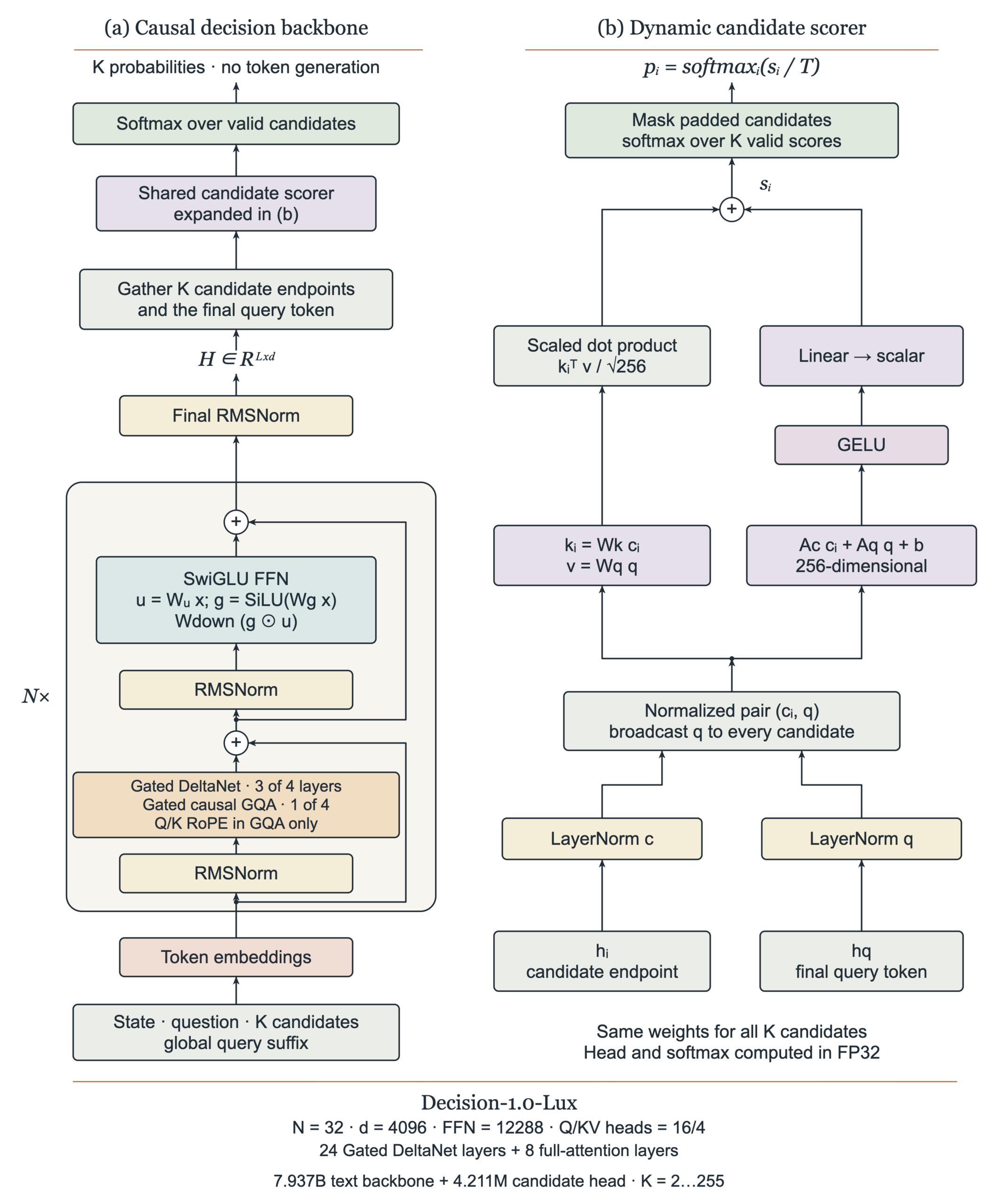
The result is a model designed around the decision itself: compare alternatives, return probabilities, let the application take the next step. No JSON repair. No free text parsing. No hallucinated confidence scores.
The Red Hat team’s work on running decision models via vLLM shows just how much compute this saves. Their DiffusionGemma implementation uses a “structured-read mode” where the canvas is seeded with an answer template, only the answer slots are left as noise, and a single denoising step reads the probability distribution at each slot. Early benchmarks showed 162 decisions/second with 32 concurrent requests on a single DGX Spark. Google’s Cloud Run deployment reported 300+ decisions/second at batch 32.
These aren’t exotic numbers reserved for cloud deployments. These are achievable on hardware that fits on a desk.
The Latency Argument That Changes Everything
Here’s where Jeff’s ~30ms figure becomes genuinely uncomfortable for cloud-centric AI advocates. That’s not just “fast enough.” That’s faster than the network round trip to most cloud providers. That’s local-first latency that makes cloud APIs feel like you’re sending decisions via carrier pigeon.
The Bifrost project’s detailed benchmark plan for Jev-style decision inference on CPU-resident models lays out just how viable this is. Their targets: excellent is under 250ms for a small decision bundle, good is under 500ms, acceptable is under 1 second. Jeff’s numbers blow past even their “excellent” tier by an order of magnitude.
This matters because of what it enables architecturally. When decisions happen in milliseconds on local hardware, you can put them in hot paths where cloud APIs would introduce unacceptable latency. The Bifrost issue on bounded inference describes exactly this use case: routing decisions, retry vs backoff classifications, post-action success verification, all the unglamorous, high-volume decisions inside every application.
The Quality Gap Is Narrower Than You Think
Skeptics will immediately ask about quality. A 0.8B model can’t possibly match what a frontier model does on complex decisions, right? Partially true, but the gap is closing faster than most people realize.
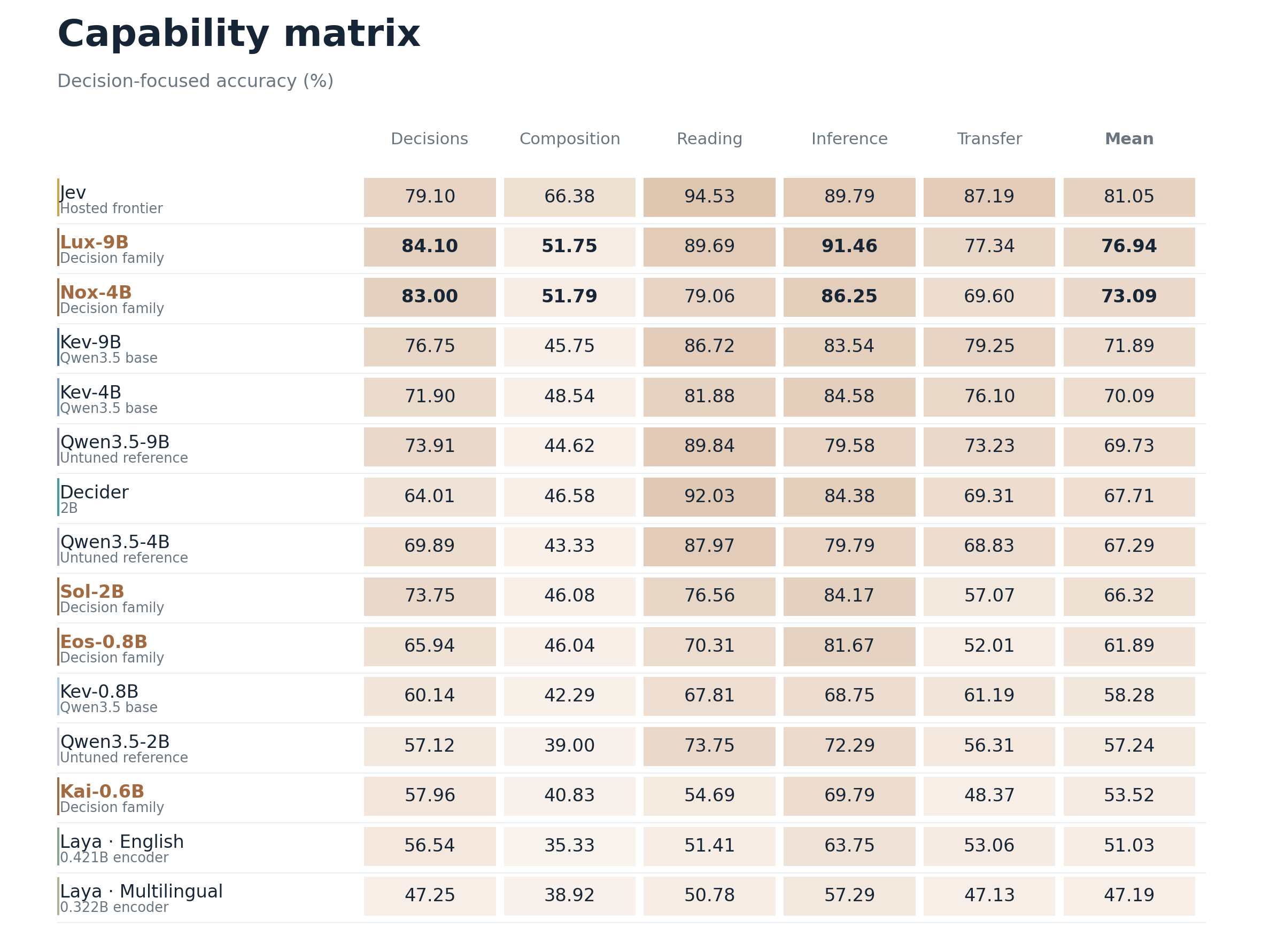
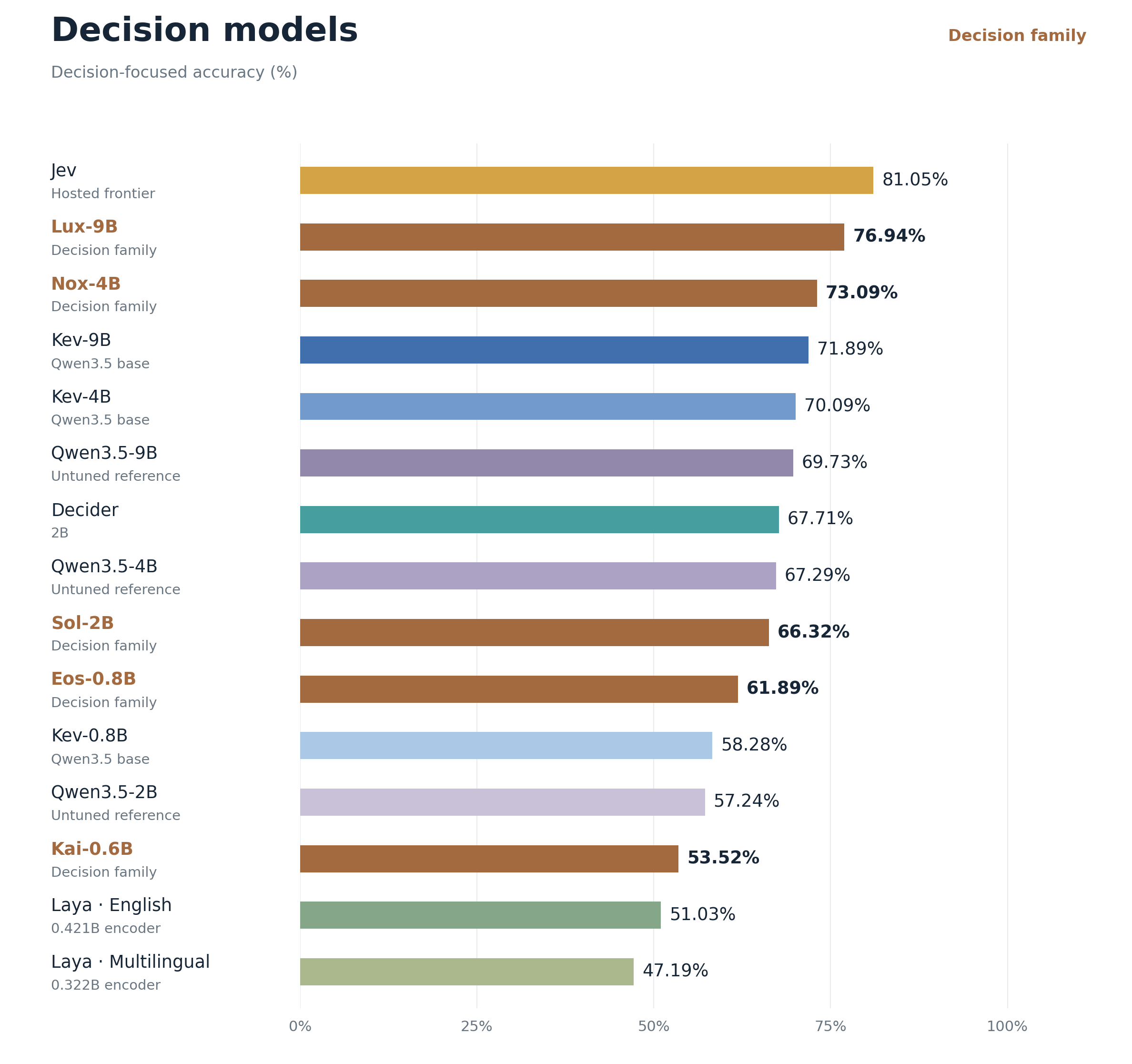
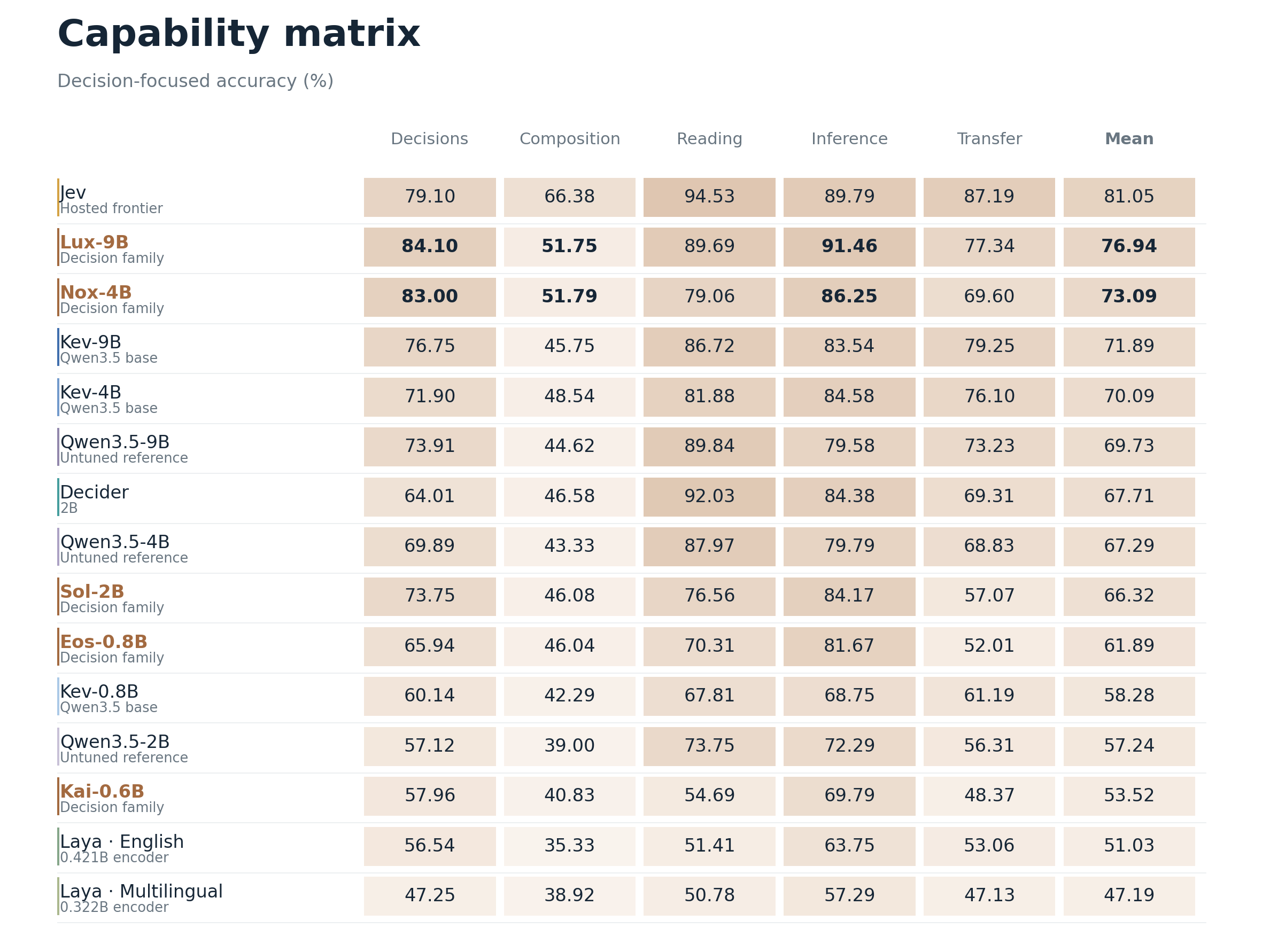
The Decision 1.0 release benchmarks are illuminating here. On their 54-task suite spanning 3,766 scored decisions across composition, reading, inference, and transfer, Lux-9B reached 76.94 overall. Nox-4B hit 73.09. Sol-2B managed 66.32. Even the diminutive Eos-0.8B scored 61.89, and Kai-0.6B hit 53.52.
The hosted Jev reference sits at 81.05. So there’s still a gap, but look at what’s closing it. A 0.8B model running locally at 30ms is already at 61.89% of the hosted reference on a general benchmark. And that’s without task-specific fine-tuning, which the Decision 1.0 models support explicitly.
For specific, bounded decisions, ticket routing, retry triage, escalation determination, a finely-tuned small model can match or exceed a general-purpose frontier API. The Summa42 issue on decision engines makes the architectural argument perfectly: use the least cognitive mechanism sufficient for the work. A general-purpose reasoning LLM shouldn’t be required to decide accept | retry | escalate when a specialist micro-decision model can do it better, cheaper, and faster.
The Infrastructure Implications Are Brutal
This shift has uncomfortable implications for everyone who’s spent the last two years building cloud-centric AI infrastructure. If small, locally-trained decision models handle most real-world decisions effectively, what exactly is the multi-million dollar GPU cluster for?
The answer, ironically, is the same thing it was before: doing the things that genuinely require massive scale. The Red Hat article is refreshingly honest about this. Decision models aren’t a replacement for LLMs. They’re a new building block that sits beside them. The pattern most teams will adopt is a fast decision model in the request path for routing, gating, and classification, with a generative model behind it for work that needs language and reasoning.
But here’s the uncomfortable part: most of the “work that needs language and reasoning” in production systems is nowhere near as complex as we’ve convinced ourselves it is. The insight from Jev’s architecture is that enterprises have been making these decisions with AI for a while. Search and e-commerce teams routinely run small generative models with structured output as zero-shot classifiers. The only novelty is admitting that this is the actual workload, not the exception to it.
The Data Boundary Argument Gets Real
There’s another dimension to this that’s harder to quantify but arguably more important: data sovereignty. When your decision model runs locally, your data doesn’t leave your infrastructure. Period.
The Bifrost issue makes this concrete. Regulated industries, air-gapped environments, and sovereign or public sector deployments can’t send every routing decision to a third-party endpoint. They need the pattern, not the dependency. A local 0.8B model isn’t just a cost optimization, it’s sometimes the only option that’s legally permissible.
Red Hat is clearly positioning for exactly this. Their DiffusionGemma work highlights that the model is already validated on their platform, weights are open, and the decision engine runs on hardware you control. The FP8-dynamic and NVFP4 variants reduce the memory footprint to roughly a third of BF16. This isn’t a theoretical future, it’s available today on Red Hat AI Inference preview builds.
The Open-Source Counterattack
What’s particularly delicious about this moment is the timing. TypeSafe released Jev as a hosted API with no published weights. Within days, the community was building alternatives. The Kev repository describes a Jev-like family of decision models built on Qwen3.5/3.8 that you can train and run yourself. Jeff is another open-weights implementation. The Decision 1.0 models from vLLM Semantic Router are Apache 2.0 licensed.
This is the same pattern we’ve seen with LLMs, but compressed into weeks instead of years. Proprietary model drops, community reverse-engineers the approach, open-source alternatives emerge, and within months the proprietary advantage evaporates. The CLM-8B rebuild of Jev’s System One interface demonstrates exactly this dynamic.
The clear message: the decision model category is being commoditized before it even reaches general availability.
The Batch Processing Elephant
One area where the local approach has a clear advantage that’s underappreciated: batch decision-making. The Decision 1.0 models’ native Python API accepts up to 128 independent requests and 512 total decisions in a single local SDK batch submission.
Think about what that enables. Applying a policy to a stack of invoices. Triaging a stream of incidents. Assessing thousands of agent traces. All locally, all in milliseconds per decision, all without sending data to a third party. The capability matrix from the Decision 1.0 release shows the models hold up well across composition and inference tasks, not just simple routing.
This is where the cloud-centric AI narrative really breaks down. It’s not just that you can run these locally, it’s that batching locally eliminates the two biggest costs of cloud-based decision-making: network latency and per-request pricing. When the marginal cost of a decision approaches zero, you start finding decisions everywhere. The AI assistant stack maintenance becomes a local infrastructure concern rather than a cloud cost center.
The Memory Budget Is the New Negotiation
Running these models at home isn’t magic, it’s memory engineering. The practical guide to running local LLMs with Ollama outlines the memory budget math that makes this feasible:
| Available model memory | Practical starting point | Context starting point |
|---|---|---|
| 4 to 8 GiB | 1B to 4B model at Q4 | 4K to 8K |
| 8 to 16 GiB | 7B to 10B model at Q4 | 8K |
| 16 to 32 GiB | 14B to 20B model at Q4 | 8K to 32K |
A 0.8B model at Q4 quantization fits comfortably in the 4-8 GiB tier. That’s a machine you could buy for under $1,000. The Bifrost team’s targeting of ~8GB accelerator memory for a “comfortable always-on decision worker” is achievable with off-the-shelf hardware.
The interesting nuance from their analysis is that decision-mode workloads can be substantially more CPU-friendly than normal chat inference. Because autoregressive decode is minimized or eliminated, the workload is dominated by prefill and candidate scoring. Shared-prefix/KV reuse can amortize one operational state across many bounded decisions. You don’t need a GPU for this, a modern CPU with good memory bandwidth can handle it.
The Enterprise Architecture Shift
For software architects, this isn’t just a curiosity, it’s a fundamental restructuring of how AI components should be deployed. The Summa42 proposal outlines a decision hierarchy that makes the architecture explicit:
- L0: Deterministic computation / hard rules
- L1: Bounded decision mechanisms (classifiers, rankers, micro-decision models)
- L2: Cheap general-purpose LLM decision providers
- L3: General/strong reasoning executors
- L4: Human / privileged review
The principle: use the lowest-cost mechanism that can satisfy the required quality, uncertainty, latency, safety, and provenance contract. Most decisions belong in L0 or L1. Only a small subset genuinely requires L3 reasoning.
This inverts the current architecture pattern where every decision goes to the largest available model. The AI assistant stack sprawl problem is partly a result of treating every cognitive task as equivalent. Typed decisions through a small local model, with escalation paths to larger models only when quality or confidence thresholds demand it, that’s a radically different infrastructure conversation.
The Role of Web Scraping in the Local AI Stack
One practical integration that’s emerged naturally: combining local decision models with cloud-based data collection. The Scrapfly + Ollama workflow demonstrates this pattern elegantly. The cloud handles the messy, infrastructure-heavy task of fetching and parsing web content, while the local model handles the inference.
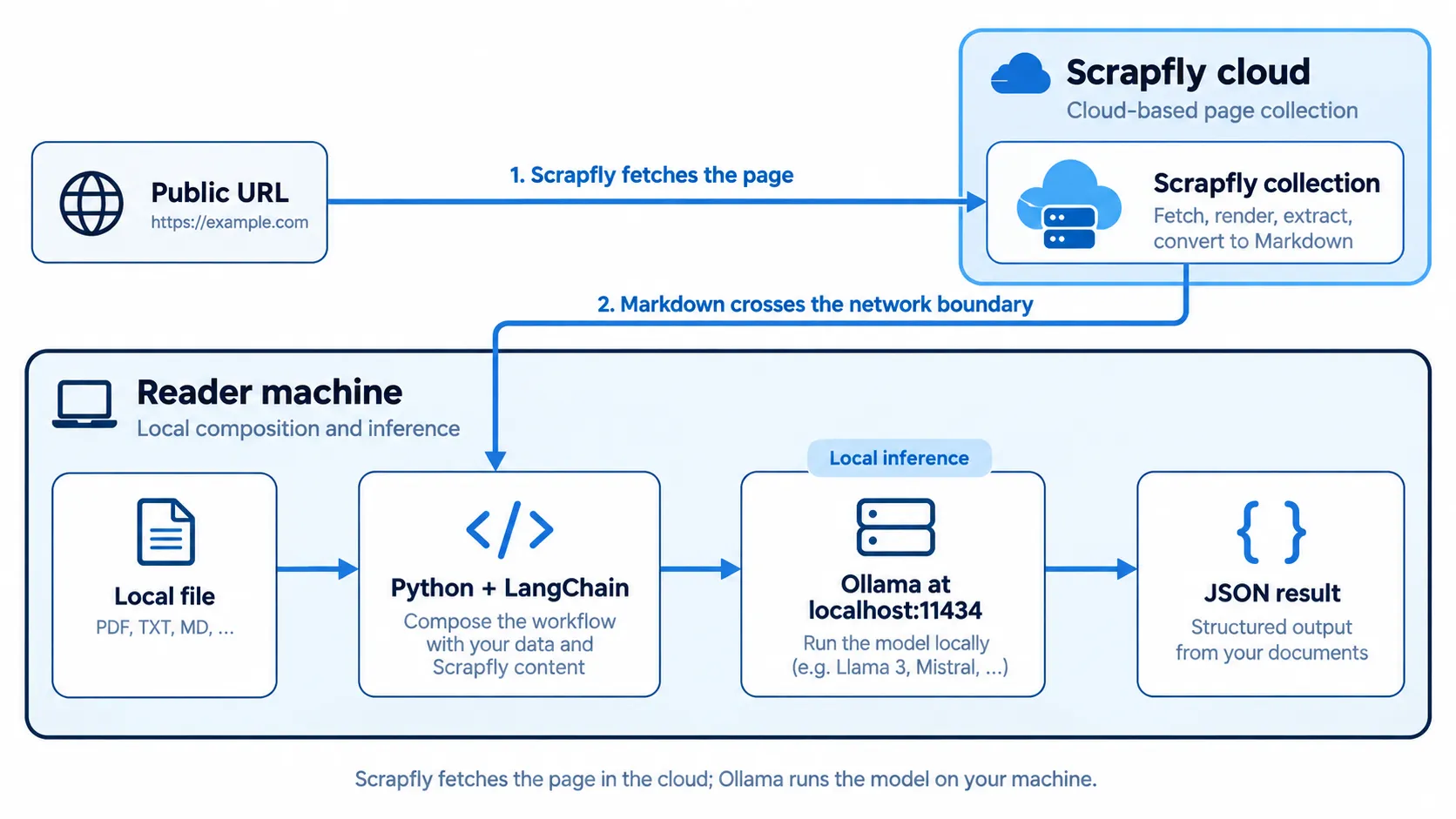
This division of labor is worth highlighting: it’s not “everything local” vs “everything cloud.” It’s about matching infrastructure to workload type. Web scraping requires IP rotation, anti-bot bypass, and JavaScript rendering, things that are genuinely easier in a managed cloud service. Decision-making on the collected content is a different problem that increasingly belongs on local hardware.
The architecture behind local LLM workflows with Ollama shows how this split works in practice. The local server at localhost:11434 handles inference, while collection services handle the network-heavy fetching.
What This Means for Your Career
Here’s the brutally practical takeaway: if you’re an engineer or architect who’s spent the last two years becoming expert in “just throw it at the cloud AI API”, you need to recalibrate. The skill that’s about to become valuable is knowing when not to use the big model.
The challenges of managing enterprise AI tool sprawl are partly a product of treating every AI need as a prompt engineering problem. The engineers who will lead the next wave are the ones who understand decision models, local inference, and infrastructure matching, not just API orchestration.
The local AI infrastructure powered by clustered Mac Studios trend points in the same direction. People are building serious local compute clusters, not because they’re cheaper, but because they offer sovereignty, control, and latency that cloud can’t match.
The Verdict: Cloud AI Is Overkill for Most Decisions
The uncomfortable truth that Jeff and its peers have exposed: most production AI decisions don’t require cloud-scale infrastructure. They require bounded inference, typed outputs, and low latency, all of which small local models deliver.
This isn’t an argument against cloud AI entirely. Frontier models still have their place for genuinely complex reasoning, language generation, and open-ended tasks. But the assumption that all AI workloads need cloud infrastructure has been quietly invalidated by a 0.8B model trained on someone’s desk.
The infrastructure implications ripple outward. If tiny models like Jeff and Liquid AI’s LFM2.5 represent the future of decision-making, then a huge portion of the planned AI infrastructure spend is misallocated. The assumption that real AI requires massive cloud deployment has been challenged, and the challenger is winning.
The decision is made. The latency is 30ms. And it’s all running on hardware you can buy at Best Buy.
The only question left is whether the industry is brave enough to admit that the emperor’s GPU cluster might not have been necessary after all.