For years, the holy grail of local AI has been simple: run the biggest, baddest model without renting someone else’s GPU and praying your data doesn’t end up in a training set. The obstacle was always the same, VRAM. A single RTX 6090 might scream, but it’s still capped at a paltry 32GB. Apple’s answer was bigger unified memory pools, but eventually you hit the ceiling of one socket.
Then Apple and EXO Labs dropped a bomb that redefines “the ceiling.”
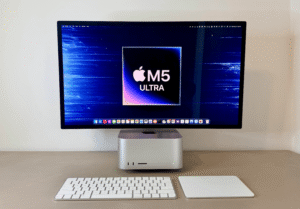
According to EXO Labs’ announcement on X, a year of stealth collaboration with Apple on low-latency RDMA over Thunderbolt 5 means you can now cluster four M5 Ultra Mac Studios into a single logical inference machine with an aggregate memory bandwidth of ~4.8TB/s. As EXO’s maintainer explained on Reddit, this isn’t just marketing fluff, the memory bandwidth scales linearly because of how tensor parallelism works. Pre-RDMA, the bloated macOS TCP/IP stack added ~1ms of latency per synchronization, which mathematically capped throughput at a miserable 6.41 tokens/sec on models like GLM-5.3. RDMA slashes that to under 10 microseconds.
Let’s break down why this is a bigger deal than the spec sheet suggests, and why it might just be the most important thing Apple has done for AI in 2026.
The 4.8TB/s Myth-Buster: Why Bandwidth Was Never the Problem
There’s a persistent misconception in AI hardware circles that you need a firehose of network bandwidth to scale inference across machines. That’s true for training. It’s utterly wrong for inference, at least for the way EXO clusters these machines.
| Metric | Value | Why It Matters |
|---|---|---|
| Thunderbolt 5 Peak | 120Gb/s unidirectional, 80Gb/s bidirectional | Sounds slow next to NVLink, but… |
| Tensor Parallelism Sync Size | ~10KB per device per layer | Tiny payloads, not massive data streams |
| GLM-5.3 Layers | 78 layers | Requires 156 all-reduce synchronizations per token |
| Sync Latency (RDMA) | <10 microseconds | The killer metric |
| Sync Latency (Old TCP/IP) | ~1 millisecond | The old bottleneck that capped TPS at 6.41 |
This is the core insight that makes the whole thing work. As the EXO maintainer detailed, tensor parallelism splits the model into equal parts across devices. Each layer requires two small (10KB) all-reduce operations to synchronize results. At 78 layers per token, that’s 156 synchronizations. The volume of data is tiny, only ~1.56MB per token. But each synchronization is a round-trip that adds latency.
Do the math: at 1ms latency, you’re adding 156ms per token. That caps you at 6.41 tokens/sec, utterly useless for interactive work. At sub-10-microsecond RDMA latency, that overhead drops to ~1.56ms per token. Suddenly, the aggregation of memory bandwidth becomes real, and these four Mac Studios genuinely behave like a single 1.5TB+ GPU with 4.8TB/s of memory throughput.
This is the same reason NVIDIA’s NVLink exists for GPU-to-GPU communication. It’s not about moving gigabytes, it’s about shaving microseconds off every synchronization. Apple and EXO just built a consumer-grade version using cables you can buy on Amazon.
The $44,000 Question: Is This Actually a Good Deal?
Let’s talk money, because the internet has already decided this is either a genius move or the most expensive way to make four computers agree with each other. The initial analysis from EXO’s Alex Cheema breaks down the cost:
- 4x M5 Ultra Mac Studios (256GB): $10,799 each = $43,196
- 6x Thunderbolt 5 cables: ~$600 total
- Total: ~$43,796 for 1TB of unified memory and 4.8TB/s aggregate bandwidth
That’s less than the $46k price tag of a 4x RTX 6000 Ada workstation build, which gets you 384GB of VRAM and, frankly, much better raw compute. But here’s the kicker: the Mac Studio cluster sips power compared to 4x 600W GPUs. A full Mac Studio draws 480W peak. Four of them pull 1.92kW. A comparable NVIDIA workstation is pulling 2.4kW+ just for the GPUs, not including cooling.
The memory-unit economics are the real story. DRAM prices have gone insane, analysts at IDC called the HBM wafer reallocation “a crisis like no other” with no relief before 2028. Samsung, SK Hynix, and Micron all shifted capacity toward HBM for AI accelerators, which consumes roughly 3x the wafer capacity of DDR5. In this environment, Apple’s unified memory, even at the premium $25/GB upgrade rate, starts looking rational.
The Topology Trap: Why You’re Limited to 7 Macs (For Now)
Here’s where the dream hits a wall. The Mac Studio has six Thunderbolt 5 ports. EXO currently uses an all-to-all topology, every Mac connected to every other Mac. For N machines, that’s N*(N-1)/2 cables and N-1 ports per machine.
| Nodes | Cables Needed | Ports Per Node | Status |
|---|---|---|---|
| 2 | 1 | 1 | ✓ |
| 3 | 3 | 2 | ✓ |
| 4 | 6 | 3 | ✓ |
| 5 | 10 | 4 | ✓ |
| 6 | 15 | 5 | ✓ |
| 7 | 21 | 6 | ✓ (max with all-to-all) |
| 8+ | 28+ | 7+ | ✗ (port-limited) |
That port count is the hard ceiling. Seven Mac Studios maxes out the all-to-all topology. The EXO team says they’re working on ring topologies and other alternatives to break past this, but Apple’s official marketing stays safely within the 4-node sweet spot where the 3x performance multiplier holds. MacRumors coverage confirms that Apple’s docs only officially address up to five systems, and multi-hop latencies for ring topologies remain unproven.
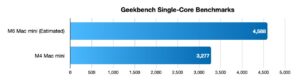
There’s also a compatibility quirk worth noting: the M6 Mac mini uses Thunderbolt 4, which means it cannot participate in RDMA clustering. Only the M5 Pro Mini ($1,699) and the Mac Studio lines qualify. So the cheap entry point into Apple’s clustering story is actually two M5 Pro minis, not the flashy M5 Ultra Studio.
Real-World Performance: Benchmarks Nobody Has (Yet)
The biggest red flag in this entire saga? The EXO maintainer admitted that full benchmarks aren’t public yet. They’re headed to local.ai “as soon as we can share them.” Apple’s own claim is that a 4-node cluster delivers 3x faster inference than a single unit, which is honestly a suspiciously conservative number for near-linear scaling claims.
There’s a hint of skepticism from the community. Jeff Geerling’s benchmarks from the initial M3-era RDMA launch showed only a 30-35% decode tok/s improvement on 2-node setups. The EXO maintainer says that was “on launch” and that subsequent kernel optimization work (reducing kernel launch overhead) has dramatically improved scaling. But those claims are exactly the kind of thing that needs independent verification.
The skepticism is warranted based on prior experience. The EXO system has a mixed reputation, one M3 Studio cluster owner on the thread said they’d “pretty much given up on exo as a stable cluster platform” until this announcement. The maintainer’s response was refreshingly direct: “We’re not going to hype things up… If you’re hesitant, wait for benchmarks to land on local.ai and then decide.”
Beyond the Hype: What This Actually Unlocks
Strip away the marketing, and there are three genuinely transformative implications worth holding onto:
1. Frontier Models on Your Desk, Legally and Privately
Kimi K3 and GLM-5.3 are the current frontier-class open weights everyone wants to run. Kimi K3 needs over 500GB just for 1-bit quantization. No consumer GPU box can touch that. A 4x cluster of 256GB Mac Studios gives you a 1TB shared pool, enough for these models with room to spare for KV cache. As Apple states, this is for “the largest and most demanding frontier-class open-weight models available today.” Privacy-first teams no longer have to choose between capability and data sovereignty.
2. The Power-Per-Watt Argument Is Unbeatable
This is where the Mac Studio cluster genuinely beats NVIDIA on economics. A 4-node Mac cluster at 480W peak each pulls 1.92kW. An equivalent-bandwidth NVIDIA setup would require multiple RTX 6000 Ada cards at 300W each plus NVSwitch infrastructure. Over 24/7 operation, the power and cooling savings are significant. Apple’s marketing frames this as “a data center on every desk”, for SMBs and research labs without datacenter budgets, that’s not hyperbole, it’s math.
3. Software Maturity Is Finally Arriving
EXO’s architecture supports arbitrary mesh topologies, MLX.distributed natively, and, according to the maintainer, can cluster MacBooks in under a minute. They’re working on speculative decoding and quantization co-optimization. This isn’t a toy, it’s a serious distributed inference engine that happened to land right as Apple formalized RDMA as a first-class macOS feature (introduced in Tahoe 26.2). The new Core AI framework alongside MLX makes this the first credible scale-out path for local AI.
The Verdict: Wait for Benchmarks, But Watch Closely
The honest take? This is the most significant hardware+software combination for local AI since the original M1 Ultra. The RDMA-over-Thunderbolt-5 capability turns Apple’s entire lineup into a modular, scalable AI infrastructure story. But it’s still unproven for production workloads.
For teams considering the jump, wait for independent benchmarks. The cost and accessibility challenges of GPU hardware aren’t going anywhere soon, and the DRAM crisis means Apple’s unified memory pricing won’t improve, but the software will. The EXO maintainer confirmed a release is dropping “tomorrow” (August 26) with bug fixes and performance optimizations. The local AI infrastructure landscape is shifting fast, and this update might be the one that makes the “data center on every desk” vision a reality instead of a slogan.
The M7 Ultra is already rumored for mid-2027, meaning this is just the first iteration. If the benchmarks land where EXO claims, the next 12 months will see serious reconsideration of how we build cost-effective AI infrastructure, and it won’t involve a rack.