Qwen 3.8-27B Is Almost Here, And It’s About to Reset the Local AI Playing Field
Alibaba’s Qwen team confirmed it this week: Qwen 3.8-27B is coming, and the entire 3.8 generation goes open-weight. For the developers who’ve been wrestling with the trade-offs of local inference, this is the release they’ve had circled on their calendars since the Qwen3.6-27B shattered expectations back in June.
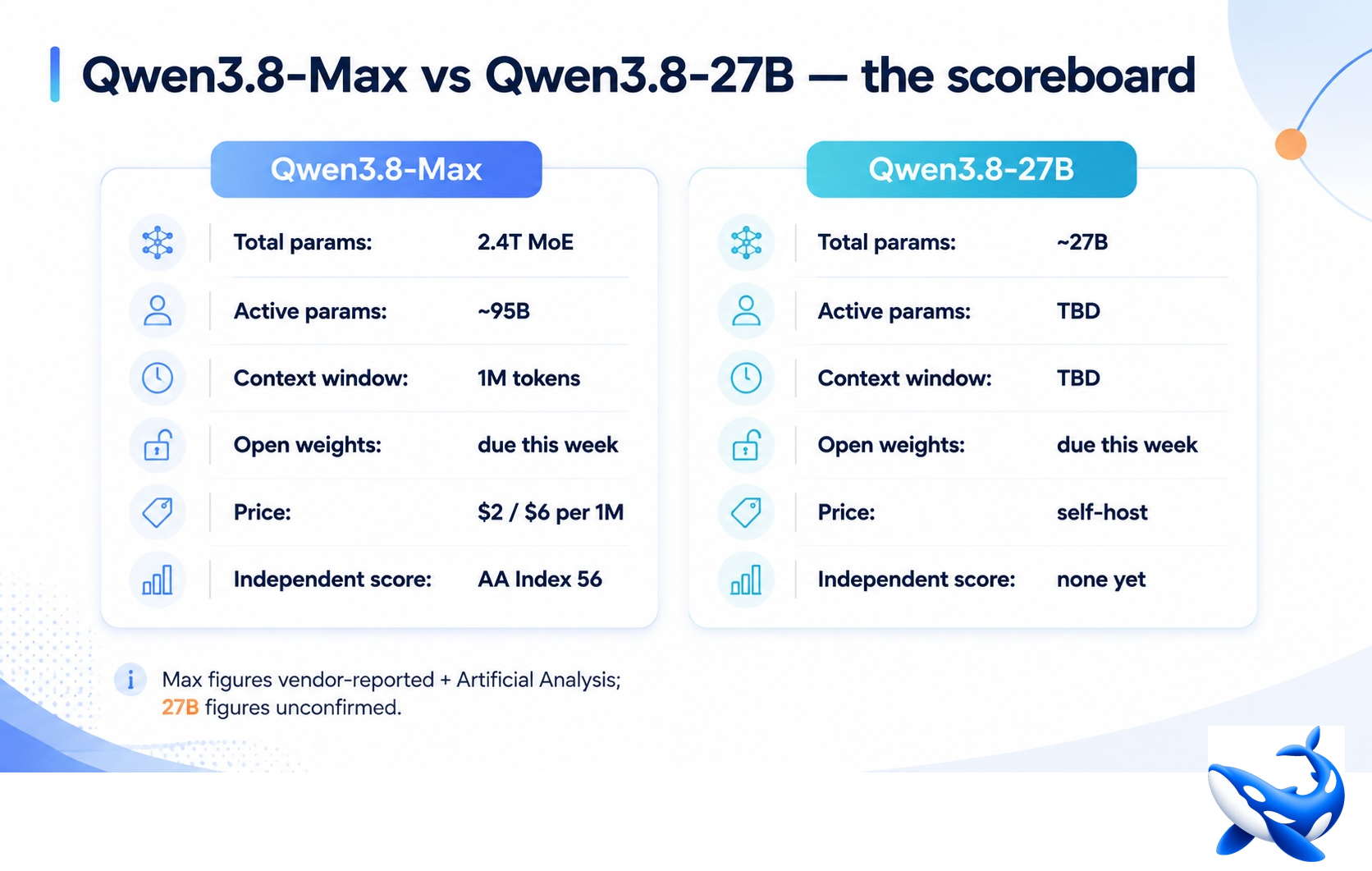
Here’s the thing though: right now, “Qwen3.8-27B” is mostly a name and a parameter count. The official repository hasn’t dropped on Hugging Face yet. No license has been named. The architecture is unconfirmed, the context window is TBD, and there are zero official benchmark scores.
That hasn’t stopped the community from losing their collective minds.
The Max Is the Headline, the 27B Is the Real Story
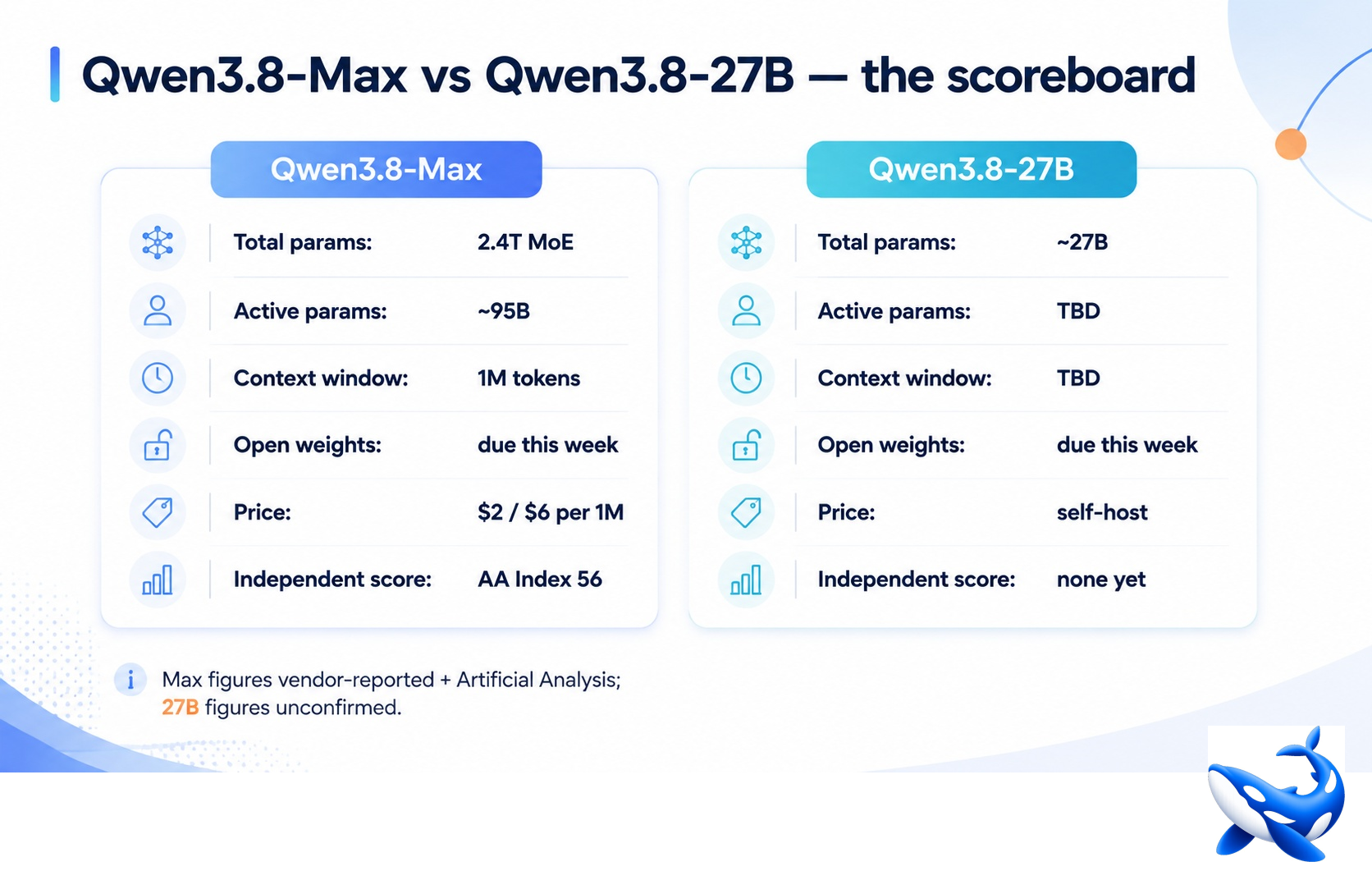
Let’s get the flagship out of the way. Qwen3.8-Max shipped on August 3 with a spec sheet that makes your GPU cry: a 2.4-trillion-parameter mixture-of-experts model with roughly 95 billion active parameters. The Max briefly dethroned Opus 5 on the Agentic Index before the benchmark gods corrected course. It’s available on the Qwen API at $2/$6 per million tokens, aggressive pricing for a frontier model.
But here’s what actually matters for most of us: the Max is the first Max-generation Qwen model to come with an open-weights promise. And alongside it, Alibaba confirmed the 27B would also go open-weight, positioning it as “the realistic path for local and on-premise deployment.”
That’s the news. The 27B, not the 2.4T monster, is the model that lands on hardware you actually own.
The previous generation’s 27B is widely regarded as one of the best local models available, performant enough to rival cloud-based AI on many workloads, while letting you keep your data on your own box. If the 3.8 generation delivers even a fraction of the Max’s improvements at 27B scale, the local AI landscape shifts significantly.
The Spec Sheet Is Suspiciously Empty
Here’s what Alibaba has actually confirmed about the 27B:
- It’s roughly 27 billion parameters
- It’s the open-weight member of the Qwen3.8 generation
- It’s sized for single-GPU and on-premise work
- It will be published on Hugging Face and ModelScope “within the week” (that week is now here, and the repo still hasn’t appeared)
That’s it.
Alibaba hasn’t published whether the 27B is dense or MoE, its context window, which modalities it accepts, or any benchmark scores. Unsloth’s Daniel Han reports it should fit in roughly 17GB of VRAM at release, a single prosumer card, but that’s a projection, not a spec.
The useful reference point is the previous generation: Qwen3.5-27B was an open-weight dense model with a 32K context window. It’s a reasonable lower bound for what 3.8-27B has to beat, and a reminder that Qwen’s 27B-class models have historically been built to run on hardware a developer actually owns.
The Max Sets the Bar for What the 27B Might Inherit
The 27B won’t match the Max’s raw ceiling, but the Max’s numbers set expectations for what the generation’s improvements look like. On Alibaba’s own evaluations (all vendor-reported, none independently confirmed yet):
- GPQA Diamond: 92.6
- Terminal-Bench 2.1: 86.6
- SWE-bench Pro: 67.7
- FrontierSWE: jumped from 40.7 to 73.5 in a single generation
That agentic improvement is the headline. If even part of that flows down to the 27B, it would reset what “good local coding model” means in its class.
The community is already running the math. On Hacker News, one developer noted that their fine-tuned Qwen3.6-27B deployments have been working well, but they “could use a bump in intelligence.” Another reported that the 27B dense model “punches way above its weight in a lot of domains, especially coding”, and that the 35B MoE variant, despite being an excellent speed demon, simply isn’t as coherent for multi-step tasks.
The sentiment is consistent: the 27B dense is the sweet spot, and the community is starving for a successor.
The License Question Nobody Can Answer Yet
Here’s the part that could turn this from a celebration into a legal headache: Apache 2.0 is not a safe assumption.
Alibaba has named no license for the Qwen3.8 weights, and several prior Qwen releases shipped under the Tongyi Qianwen license, which includes a 100-million-monthly-active-users threshold that triggers a commercial conversation.
That clause is precisely the kind of detail that decides whether “open weights” means “safe to build a product on” or “fine for personal use, legally complicated at scale.” Teams planning to build commercial products on Qwen3.8-27B should read the LICENSE file in the actual repository before planning around it.
This matters more than any benchmark score. The single most consequential line of the entire release will be the license file.
Hardware Reality Check
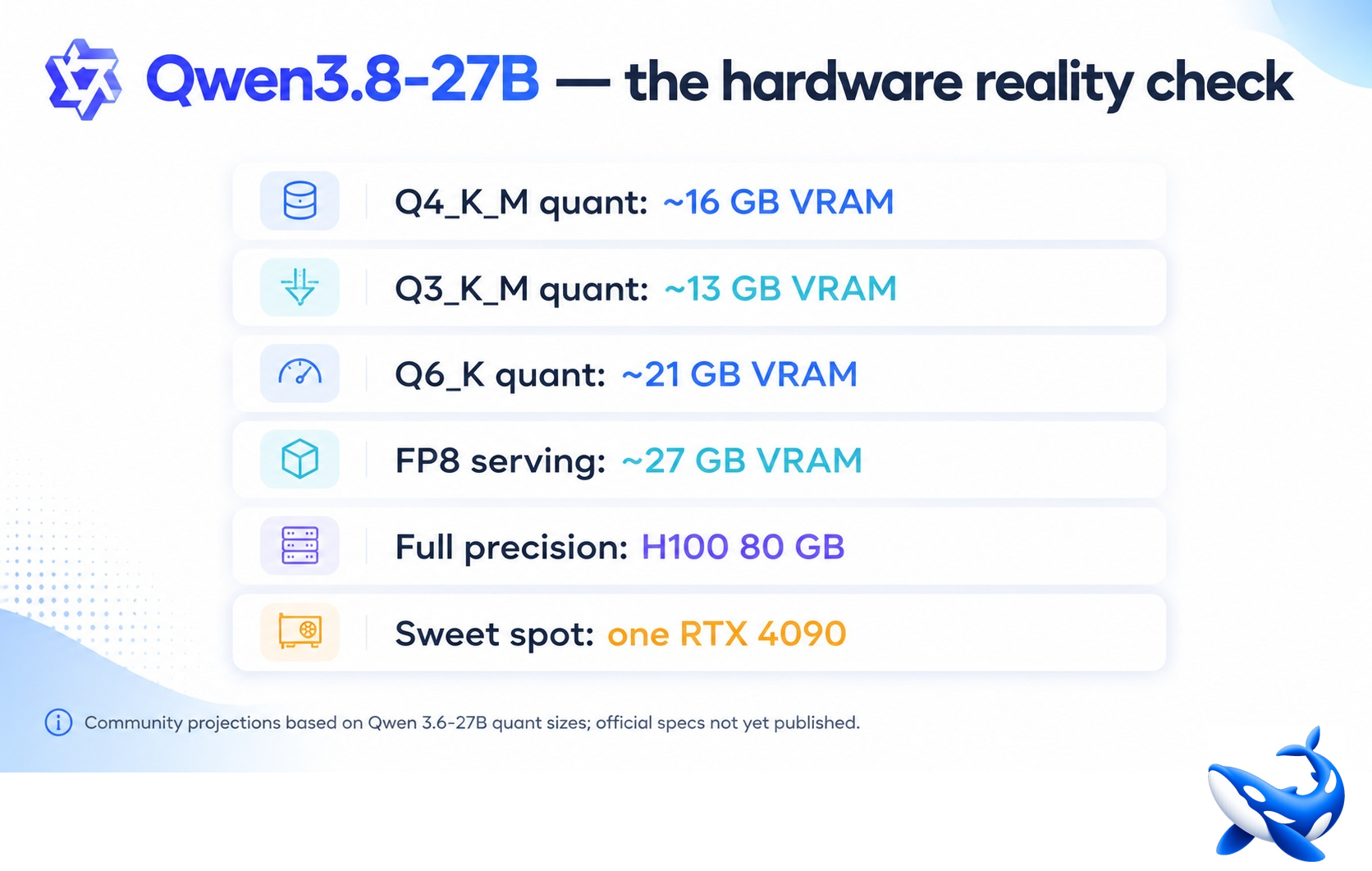
Because Alibaba hasn’t published hardware requirements, the numbers in circulation are community projections based on the Qwen 3.6-27B quant table. Treat them as estimates, not specs:
| Quant | VRAM Required | Target Hardware |
|---|---|---|
| Q4_K_M | ~16GB | RTX 4090 or equivalent |
| Q3_K_M | ~13GB | 12GB cards like RTX 3060 |
| Q6_K | ~21GB | 24GB cards, near-lossless |
| FP8 | ~27GB | Single L40S, production serving |
| Full precision | H100 80GB | Benchmark-quality path |
The Q4 sweet spot is 16GB, a single consumer card. That’s the number that matters for most local developers. And it means the toolchain timing becomes critical: vLLM and SGLang are the most likely to have working support within days of the weight drop, but community GGUF and AWQ quantizations typically lag by one to two weeks. The Ollama-style “pull and run” experience probably won’t be available on release day.
For those who want to see how the 27B performs on 24GB VRAM with optimized backends, the previous generation already proved the path: it’s viable, it’s fast, and it’s only getting better.
What the Community Is Actually Saying
The Reddit thread announcing this release collected 2,163 upvotes in under a day. The top comment was a link to the Qwen3.8-2.4T-A95B model page on ModelScope, with the wry observation that “Modelscope is owned by Alibaba so there’s much weight (pun intended) to be considered.”
One Redditor asked about the 35B-A3B variant, noting they’d “found a few types of tasks that 35BA3B does amazing at with great speed for the HW it’s using.” The response suggested Alibaba is considering releasing other models, and that something that looks like a 35B-A3B has been spotted being tested on OpenRouter.
Hacker News had a similar energy, with one developer summarizing the mood: “Qwen3.6-27B is widely regarded as one of the best local models, especially since nothing else comes close to it, that isn’t benchmaxxed, without being significantly larger. If 3.8 truly improves upon it that would be awesome.”
The skeptics are there too. One HN commenter ran Qwen3.6-27B on 32GB locally and found it “not very useful for code” at lower quants. Another pointed out that “the quants we run locally are sharply reduced in intelligence from the benchmarks for the full models.”
That’s a fair warning. The benchmarks we see from Alibaba are for the full-precision model. Your Q4 quant at home isn’t going to hit those numbers. The gap between benchmark and local reality is a recurring theme in the NVFP4 quantization debate, and it’s not going to disappear with 3.8.
The Strategic Play Nobody’s Talking About
Here’s the part that should make US cloud AI providers nervous: the Chinese labs are releasing open-weight models at a pace that’s forcing price cuts across the industry. OpenAI recently cut prices 20% for GPT-5.6 Terra and 80% for 5.6 Luna specifically to stay competitive.
The Qwen3.8-Max pricing at $2/$6 per million tokens is aggressive for a frontier API, and it matters for the routing math, at those numbers, the 3.8 generation becomes an option for workloads that used to default to more expensive flagships. And that’s before the 27B lands on self-hosted hardware where the marginal cost of inference approaches the cost of electricity.
There’s a deeper cultural shift here too. The HN thread had a telling exchange about local models: one commenter argued that hosting your own model is a “0 investment and 0 commitment” proposition if you have hardware sitting around. Others pushed back, pointing out the hours of setup time and the GPU costs. But the underlying sentiment, that local models are a legitimate alternative to API subscriptions, not a hobbyist curiosity, is gaining ground.
For teams in regulated industries or with strict data residency requirements, the 27B’s appeal isn’t about benchmark scores. It’s about keeping data on-premise. The conversation around compressing models for edge deployment is accelerating, and Qwen is positioned to be the default open-weight choice for that wave.
The Bottom Line
Qwen3.8-27B is confirmed to exist, committed to open weights, and hours-to-days away from an official repository. The architecture, license, context length, and benchmarks are still unwritten. That uncertainty is the whole story right now.
What we know: the 27B class of models is the workhorse of local AI, and Qwen’s previous generation 27B set the standard. The 3.8 generation’s flagship posted dramatic agentic improvements, and if even a fraction of those gains trickle down, this could be the most important local AI release of 2026.
What we don’t know: whether it’s dense or MoE, what the license says, and whether the benchmarks survive contact with real-world quantization.
The smart move is not to pre-order your excitement. Wait for three signals: the repository appearing under the official Qwen organization, the license file, and the first independent benchmark. Those will tell you whether this is a routine open-weight release or a genuine reset of what a 27B can do.
In the meantime, if you’re evaluating the Qwen3.8 generation’s behavior without waiting for the weights, the Max API is live at $2/$6 per million tokens. The community reaction to Qwen’s benchmark claims has taught us to take vendor numbers with a grain of salt, but the trend line is clear.
The local AI era isn’t coming. It’s already here, and Qwen is leading the charge.