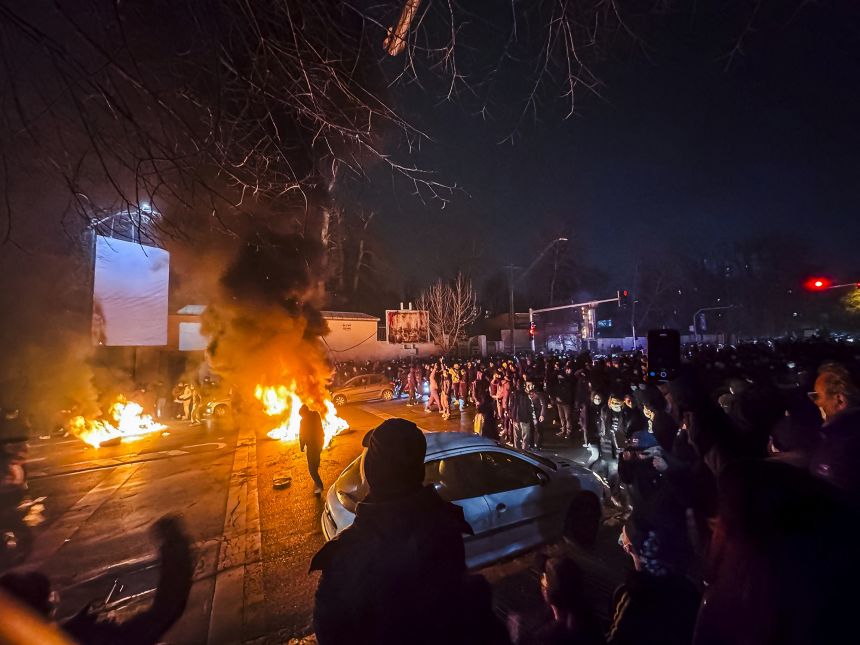
When Iran’s government pulled the plug on the internet for 400 hours during recent protests, they executed one of the most comprehensive digital blackouts in modern history. The move was deliberate: silence the population, halt the flow of information, and conceal human rights violations. What they didn’t anticipate was that a handful of Iranians would keep accessing uncensored information using nothing more than consumer GPUs and open-source software.
This isn’t another story about VPNs or Tor bridges. It’s about how local large language models, running on hardware as modest as 8GB of VRAM, became lifelines for information access when the entire cloud infrastructure became either unreachable or compromised.
The Cloud AI Mirage in a Blackout
During the first days of the blackout, the Iranian government whitelisted exactly three services: Google, ChatGPT, and DeepSeek. Everything else, Gmail, international news, social media, remained blocked. This created a perverse situation where citizens could ask AI models about the outside world, but only through channels that refused to help them circumvent censorship.
One user, struggling to load Reddit through intermittent connections, described the frustration: ChatGPT would read webpage contents but “refuses, and deepseek is worse” when asked about censorship circumvention. Even when explaining the “truly fucked up situation”, the models’ safety guardrails kicked in, rendering them useless for the one task that mattered most, staying informed and connected.
This is the fundamental weakness of cloud AI in authoritarian contexts: your helpful assistant is only helpful until it encounters topics its creators decided are off-limits. When the internet itself is weaponized, centralized control becomes centralized vulnerability.
Local Models as Digital Survival Tools
The solution emerged from an unlikely place: locally hosted, uncensored models running on personal hardware. Using llama.cpp on systems with just 8GB of VRAM, Iranians deployed Gemma3 12B and Qwen3 8B models, compact enough to run on consumer hardware but powerful enough to serve as reasoning encyclopedias.
The technical setup is straightforward but requires foresight. As one guide notes, Ollama requires “downloading the core application and the LLMs it depends on, which can be several gigabytes in size”, the LLaMA series alone can consume up to 15GB. In Iran’s case, users who had preemptively downloaded these models found themselves with a pocket of digital freedom while the rest of the country went dark.
The hardware requirements are surprisingly accessible. While benchmarks show NVIDIA A100 GPUs delivering 40% faster inference than CPU-only systems, the reality is that modern consumer GPUs work remarkably well. An RTX 3060 with 8GB VRAM can comfortably run quantized 8B-12B models, and even CPU-only setups remain functional, if slower. This democratization of AI hardware is crucial, you don’t need a data center, just a gaming PC.
The Censorship Arbitrage Problem
What makes local LLMs uniquely valuable isn’t just their offline capability, it’s their uncensored nature. Cloud providers operate under corporate policies, legal frameworks, and geopolitical pressures that force them to refuse certain requests. A local model running on your hardware has no such constraints.
This creates a censorship arbitrage: the information that centralized AI refuses to provide becomes precisely what decentralized AI excels at delivering. When one user asked about specific music videos, even 4B models proved “basically a compressed knowledge” source. The key insight is that model size doesn’t linearly correlate with utility, common knowledge, technical troubleshooting, and circumvention techniques don’t require 230B parameter behemoths.
The community quickly recognized this. As discussions evolved, developers noted that “having a local LLM and a Meshtastic node are basically a must in today’s society”, one for knowledge, the other for communication when cell towers go down. This combination of local AI and mesh networking represents a fundamental shift in digital resilience strategy.
Technical Implementation Under Fire
The practical reality of deploying local LLMs in a blackout involves more than just downloading a model. Users needed to optimize for constrained resources, limited power, and the constant threat of hardware seizure.
Quantization became essential. Running Qwen’s 230B model in Q2 format or GPT-OSS 120B required aggressive compression to fit within available VRAM. The trade-off between model capability and resource consumption drove users to experiment with different configurations. One user successfully used these massive models to “troubleshoot and configure my home local network, as well as to set up my NAS and other devices, preparing them for connection to a wired internet connection”, demonstrating that even heavily quantized models retain substantial practical utility.
For those building systems from scratch, the low-cost hardware enabling grassroots AI resilience in restricted regions has become a critical enabler. The eBay scavenger hunt for used GPUs isn’t just about saving money, it’s about building infrastructure that authoritarian regimes can’t easily track or disable.
Performance optimization also matters when every watt counts. The debate between CUDA and Vulkan takes on new urgency in resource-constrained environments. Recent benchmarks show Vulkan quietly outpacing CUDA for specific LLMs on consumer GPUs, particularly for quantized models, the exact use case Iranians faced. This isn’t academic, it’s about maximizing tokens per second on hardware that might be running on generator power.
The Knowledge Base Challenge
A common critique of local LLMs during blackouts is the knowledge cutoff date. If you can’t access the internet, how do you get current events? The solution is hybrid: use the brief moments of connectivity to scrape and summarize.
One Iranian user described how they would “ask it to read contents of some pages or get latest news” during intermittent access, then use the local model to process and analyze that information offline. This creates a knowledge base that persists even when connectivity doesn’t. Others suggested downloading Wikipedia dumps, around 100GB for the entire corpus, which provides a foundation of factual knowledge that can be queried locally without any network connection.
This approach fundamentally changes how we think about information access. Instead of real-time queries to centralized servers, you build a personal knowledge base that serves you even when the outside world goes silent. The accuracy and reliability of local LLMs in high-stakes scenarios becomes paramount when you can’t fact-check against external sources.
Beyond Iran: A Blueprint for Digital Resilience
Iran’s experience isn’t unique. Internet blackouts during protests have become standard playbook for authoritarian regimes from Belarus to Myanmar. What makes this case significant is the proof-of-concept it provides for AI-powered censorship resistance.
The technical stack is now battle-tested: llama.cpp for inference, quantized models for memory efficiency, and consumer hardware for accessibility. The community has validated that breaking cloud dependency to maintain functionality during internet outages isn’t just theoretical, it’s life-saving.
This has profound implications for how we develop and deploy AI. The current trend toward ever-larger cloud models creates a single point of failure for digital freedom. When your AI assistant requires a persistent connection to San Francisco or Beijing, you’re vulnerable not just to network outages but to the political pressures those companies face.
The alternative, enabling real-time information access in offline or restricted environments, requires rethinking our entire approach to AI architecture. It’s not about replacing cloud AI entirely, it’s about ensuring that when the cloud evaporates, you still have access to intelligence.
The Limitations and Realities
Local LLMs aren’t a panacea. They hallucinate. They lack the vast context windows of frontier models. They can’t browse the web in real-time. And they require technical expertise to deploy and maintain.
The hardware barrier, while lowering, remains significant. Not everyone has an RTX 3060 or the knowledge to set up llama.cpp. Power consumption becomes critical during extended blackouts, running a GPU continuously isn’t sustainable on battery backup.
Moreover, local models can’t replace the social functions of the internet. They can’t coordinate protests, share videos of human rights abuses, or connect you with family across the city. That’s why the combination with mesh networks like Meshtastic becomes crucial. The LoRA-based communication infrastructure, while susceptible to jamming as one researcher noted, provides a parallel channel for coordination that doesn’t depend on ISP infrastructure.
The Future of Uncensored AI
Iran’s blackout reveals a critical gap in the AI safety conversation. We spend immense effort ensuring AI doesn’t say harmful things, but comparatively little ensuring it can say necessary things when access to information becomes a matter of life and death.
The development of uncensored local models isn’t about enabling misinformation, it’s about preserving cognitive autonomy. When governments control information flow, the ability to run independent AI becomes a fundamental check on state power.
This is driving a quiet revolution in how developers approach AI tooling. The local LLM adoption among developers for privacy-sensitive coding is accelerating not just because of data privacy concerns, but because of resilience concerns. Teams building applications for users in authoritarian regimes are increasingly requiring that core functionality work offline-first, with cloud sync as an enhancement rather than a requirement.
What You Can Do Now
If this scenario concerns you, and it should, preparation is straightforward:
-
Download models before you need them. Use Ollama or llama.cpp to pull several quantized models in the 7B-13B range. They’ll cost you 4-8GB of disk space each, but that storage is cheap insurance.
-
Test your hardware. Run
ollama run gemma3or similar on your current system. If it works, note the performance. If it doesn’t, you’ll know what hardware to target. -
Build a knowledge base. Download Wikipedia dumps or other reference materials. Use your local LLM to create summaries and indexes that make this information searchable offline.
-
Learn the tooling. The command-line interface isn’t optional. Practice pulling models, creating custom Modelfiles, and adjusting parameters like temperature and context length.
-
Consider your power budget. Extended blackouts mean no electricity. Calculate how long you can run your setup on backup power and optimize accordingly.
The goal isn’t paranoia, it’s preparedness. As one Iranian user bluntly put it: “Having a local LLM and a Meshtastic node are basically a must in today’s society.” That sentiment, born from 400 hours of digital darkness, deserves our attention.
The Bottom Line
Iran’s internet blackout didn’t just test local LLMs, it validated them as essential infrastructure for digital freedom. When the cloud becomes a liability, local AI becomes a necessity. The technology works, the hardware is accessible, and the use case is undeniable.
The question isn’t whether local LLMs have a place in our AI future. The question is whether we’ll recognize that place before the next blackout makes the choice for us.
For those interested in the technical foundations discussed here, explore our deep dives on performance optimization of local LLMs on consumer hardware and the broader implications of breaking cloud dependency to maintain functionality during internet outages.