The Rise of DuckDB and Polars in Modern Data Engineering Pipelines
Your Spark cluster is overkill. There, I said it. While you’re provisioning nodes, configuring YARN, and debugging mysterious executor failures, a growing contingent of data engineers has quietly moved on to tools that run in a single process and outperform your distributed behemoth on all but the most massive datasets.
The rise of DuckDB and Polars isn’t just another tech trend, it’s a fundamental recalibration of what modern data engineering actually needs. And the data backs it up: most pipelines process far less data than their architects admit, and the overhead of traditional big data stacks has become a tax on productivity rather than a necessity.
The Spark Hangover: When Big Data Became a Religion
For years, the data engineering orthodoxy has been clear: if you’re serious about data, you use Spark. Need to transform a few gigabytes? Spark. Building a prototype? Spark. Processing a CSV that fits on your laptop? Just containerize Spark and pretend it’s reasonable.
This collective delusion has created a generation of data engineers who reach for a sledgehammer to hang a picture frame. The typical justification follows a predictable pattern: “What if we scale to terabytes?” or “Enterprise standards require it.” Meanwhile, the actual workloads tell a different story.
The reality of data scale in most engineering environments is sobering: a veteran engineer with seven years in BFSI and pharma recently sparked an uncomfortable conversation by admitting they’ve never seen incremental loads larger than 15 GB. Yet their LinkedIn profile probably still lists “Spark Expertise” as a top skill.
DuckDB and Polars: The In-Process Revolution
DuckDB is an in-process analytical database that feels like SQLite got a PhD in columnar storage. Polars is a DataFrame library written in Rust that makes pandas look like it’s running in molasses. Together, they’re rewriting the rules of what’s possible without a cluster.
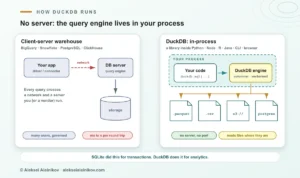
The technical architecture is deceptively simple: DuckDB operates as an embedded database, using the same process as your application. No network overhead, no serialization costs, no distributed coordination. Polars leverages Rust’s zero-cost abstractions and Arrow’s columnar memory format to achieve parallelism without the complexity of Spark’s executor model.
A performance benchmark of DuckDB versus cloud data warehouses tells the story: on a 20GB time-series dataset, DuckDB running on a single server delivered queries 3-10x faster than BigQuery and Athena at essentially zero marginal cost. The “cloud data warehouse” advantage evaporates when you’re not actually operating at cloud scale.
Real-World Implementation: The MyAnimeList Pipeline
Let’s get concrete. A recent project built by a data engineering beginner demonstrates just how sophisticated these “simple” tools have become. The MyAnimeList pipeline processes data from the Jikan API about 7,000 anime titles through a full medallion architecture:
- Bronze layer: Raw JSON ingested into DuckDB using Python
- Silver layer: Polars DataFrames flatten JSON, remove columns, and handle many-to-many relationships
- Gold layer: dbt transforms everything into a star schema
- Consumption: Streamlit dashboard answering “What makes an anime popular?”
- Containerization: Everything in Docker
The entire stack runs on a laptop. No Spark cluster. No cloud data warehouse. Just DuckDB’s single-file database and Polars’ blazing-fast transformations.
The code reveals the elegance: Polars handles the messy JSON flattening with unnest() operations and aggressive type coercion, while DuckDB manages the persistent storage with ACID guarantees. The dbt layer sits on top, providing the same transformation rigor you’d expect in a Fortune 500 data platform.
Performance That Actually Matters
The benchmark data is stark. When testing 847 million e-commerce purchase events (180GB raw), the results defy conventional wisdom:
Daily Revenue Aggregation (847M rows → 180 results):
– ClickHouse: 0.31s ($0.03/query)
– DuckDB: 0.42s ($0.00/query)
– Snowflake: 1.80s ($0.12/query)
– PostgreSQL: 43.00s ($0.02/query)
Yes, ClickHouse is faster by 0.11 seconds. But DuckDB runs on existing infrastructure, while ClickHouse burned 16 CPU cores to achieve that speed. For most organizations, the operational simplicity of DuckDB outweighs marginal performance gains.
The hidden cost becomes obvious when you scale to 100 queries per day: ClickHouse costs $90/month in compute, while DuckDB costs $0 because it’s running on the application server you already have.
The Production Readiness Question
Skeptics will ask: “Is DuckDB really production-ready?” The answer depends on your definition of production. If you need multi-user concurrency and petabyte-scale processing, stick with Snowflake. But if your “production” involves scheduled ETL jobs and analytical queries, DuckDB’s real-world production use and enterprise readiness might surprise you.
Engineering teams are reporting 70% cost reductions while outperforming Spark clusters. The key is understanding that “enterprise workloads” often means “reliable batch processing” more than “massive scale.”
DAGs Without the Drama
Orchestration is where the lightweight stack really shines. Traditional pipelines require Airflow or Dagster to coordinate distributed tasks across a cluster. With DuckDB and Polars, your DAG becomes a simple script:
# Ingest
duckdb.sql("CREATE TABLE raw_readings AS SELECT * FROM read_json('api_endpoint')")

# Transform with Polars
df = pl.read_database("SELECT * FROM raw_readings", conn)
df_clean = df.unnest("items").drop_nulls()

# Load back to DuckDB
duckdb.sql("CREATE TABLE curated AS SELECT * FROM df_clean")

# dbt takes it from here
subprocess.run(["dbt", "run"])

The DAG is still there, it’s just not pretending to be distributed. Do you like DAGs? The lineage visualization looks identical, but the underlying execution is orders of magnitude simpler.
The Scale Delusion
Here’s the uncomfortable truth: Your “terabyte-scale” data pipeline probably processes 15 GB a day. The median data engineering workload fits comfortably on a modern laptop, yet we’ve architected complex distributed systems to handle theoretical scale that never materializes.
The cost isn’t just infrastructure, it’s cognitive overhead. Every hour spent debugging Spark shuffle errors is an hour not spent understanding your data. Every line of boilerplate cluster configuration is a line that could have been business logic.
Escaping Vendor Gravity
The lock-in risks of cloud data warehouses compound the problem. Snowflake’s “Enterprise AI Nervous System” has become a strategic straightjacket for teams who’ve built their entire medallion architecture inside a proprietary platform. When your data, transformations, and compute are all Snowflake-native, migration becomes a rewrite, not a rehosting.
DuckDB and Polars flip this dynamic. Your data stays in open formats (Parquet, CSV). Your transformations are plain SQL and Python. If you outgrow DuckDB, migrating to ClickHouse or Snowflake is a configuration change, not a ground-up rebuild.
The Resource Inefficiency Problem
Traditional ETL tools have their own bloat issues. N8N’s RAM addiction demonstrates how open-source ETL alternatives can eat your server alive, with one CTO struggling to process a few million rows despite 16GB of RAM and an AMD EPYC processor.
Polars avoids this by design. Its lazy evaluation and streaming capabilities mean you can process datasets larger than memory without the memory footprint of tools like N8N or even pandas. The Rust backend ensures predictable performance without GC pauses or memory leaks.
Small Enterprise Reality Check
While data Twitter debates Snowflake vs. Databricks, thousands of small enterprises run production ETL on Windows Task Scheduler and Excel. The DuckDB/Polars stack finally gives these teams a legitimate upgrade path that doesn’t require a team of specialists.
A property insurance company processing claims data with VBA macros and scheduled Excel tasks can migrate to a Python script with DuckDB and Polars in a week, gaining version control, testing, and reliability without the complexity of a “modern data stack.”
Querying Cold Storage Directly
The cold storage debate gets reframed with DuckDB. Your API might be fine querying S3 directly, especially when DuckDB can read Parquet files from S3 with the HTTPFS extension and deliver sub-second query performance.
The traditional “move cold data to S3, front with Athena” pattern assumes Athena’s performance is acceptable. DuckDB makes it unnecessary for many use cases, just query the files directly from your application server.
The Scaling Myth
Distributed systems advocates will argue that “just add more servers” solves everything. But the distributed scheduler’s dilemma shows how this becomes a death spiral. Coordination overhead, network latency, and consistency complexity eventually overwhelm the benefits of horizontal scaling.
DuckDB and Polars embrace vertical scaling first. A modern server with 64 cores and 512GB RAM can handle surprisingly large workloads before distribution becomes necessary. And when you do need to scale, tools like MotherDuck provide serverless DuckDB without the operational complexity of managing clusters.
When to Actually Use Spark
This isn’t a universal condemnation of distributed systems. If you’re processing terabytes daily, have true streaming requirements, or need multi-tenant concurrency, Spark remains the right tool. The sin is reaching for it by default.
The decision matrix is clear:
– < 100GB per day: DuckDB + Polars
– 100GB – 1TB per day: DuckDB + orchestration (Dagster/Airflow)
– > 1TB per day: Spark or cloud data warehouse
– Streaming: Flink or Spark Streaming
– Multi-user analytics: Cloud warehouse
Implementation Strategy
Migrating isn’t about wholesale replacement, it’s about strategic augmentation:
- Start with analytics: Move dashboard queries to DuckDB first
- Replace batch ETL: Convert scheduled Spark jobs to Polars scripts
- Keep the warehouse for BI: Let analysts keep using Snowflake/Redshift
- Use dbt for both: dbt works identically across DuckDB and cloud warehouses
The MyAnimeList pipeline shows the pattern: Python for orchestration, Polars for transformation, DuckDB for storage, dbt for modeling. Each tool does one thing well, and the integration points are simple files and SQL.
The Bottom Line
The rise of DuckDB and Polars isn’t about replacing Spark, it’s about recognizing that most data engineering never needed Spark in the first place. The tools have finally caught up to the reality that scale is the exception, not the rule.
Your laptop is more powerful than you think. Your data pipeline is probably smaller than you claim. And your cloud bill is definitely higher than it should be.
The revolution isn’t coming from a new distributed algorithm or a faster cluster manager. It’s coming from engineers who finally asked: “Do we actually need all this complexity?” The answer, for most of us, is no.
Start with a single Python script. Use Polars for transformation. Store in DuckDB. Orchestrate with Dagster. And stop provisioning clusters until your data proves you need them. Your future self, and your CFO, will thank you.