Your credit card reminder arrives at 2:47 AM instead of 7:00 PM. Your Netflix renewal double-charges 12,000 users. Your trading app’s stop-loss orders execute three hours late. These aren’t edge cases, they’re the inevitable funeral dirge of monolithic cron jobs hitting scale.
The research is brutal: while simple cron works beautifully for dozens of jobs, it collapses catastrophically beyond a few hundred. One engineering team discovered their scheduler was silently dropping 15% of jobs at peak load, a problem that only surfaced when users started complaining about missing notifications. The root cause? A single PostgreSQL instance choking on lock contention and a cron daemon that had become a ticking time bomb.
The Monolithic Cron Fantasy: When Simplicity Becomes a Liability
We all start here: a single server, a crontab, maybe a nice Python wrapper like APScheduler. It’s elegant, predictable, and debuggable. You can grep your logs, SSH in to “fix” things manually, and the entire state of your system fits in one terminal window.
Then your trading app hits product-market fit. Suddenly you’re not running 50 scheduled jobs, you’re running 50,000. Your simple cron setup needs to handle stop-loss orders, portfolio rebalancing, dividend payments, regulatory reporting, and user notifications. The monolithic scheduler becomes a legacy tool struggling with modern distributed system demands, except instead of slow file transfers, you’re dealing with missed financial transactions.
The first cracks appear silently. Jobs start overlapping because your single-threaded cron daemon can’t keep up. Your “run every minute” task now takes 90 seconds to complete, but cron blissfully launches another instance anyway. You add locking mechanisms, which turn your database into a bottleneck. You scale vertically, bigger instance, more RAM, until one day your cloud provider politely informs you you’ve hit the maximum instance size.
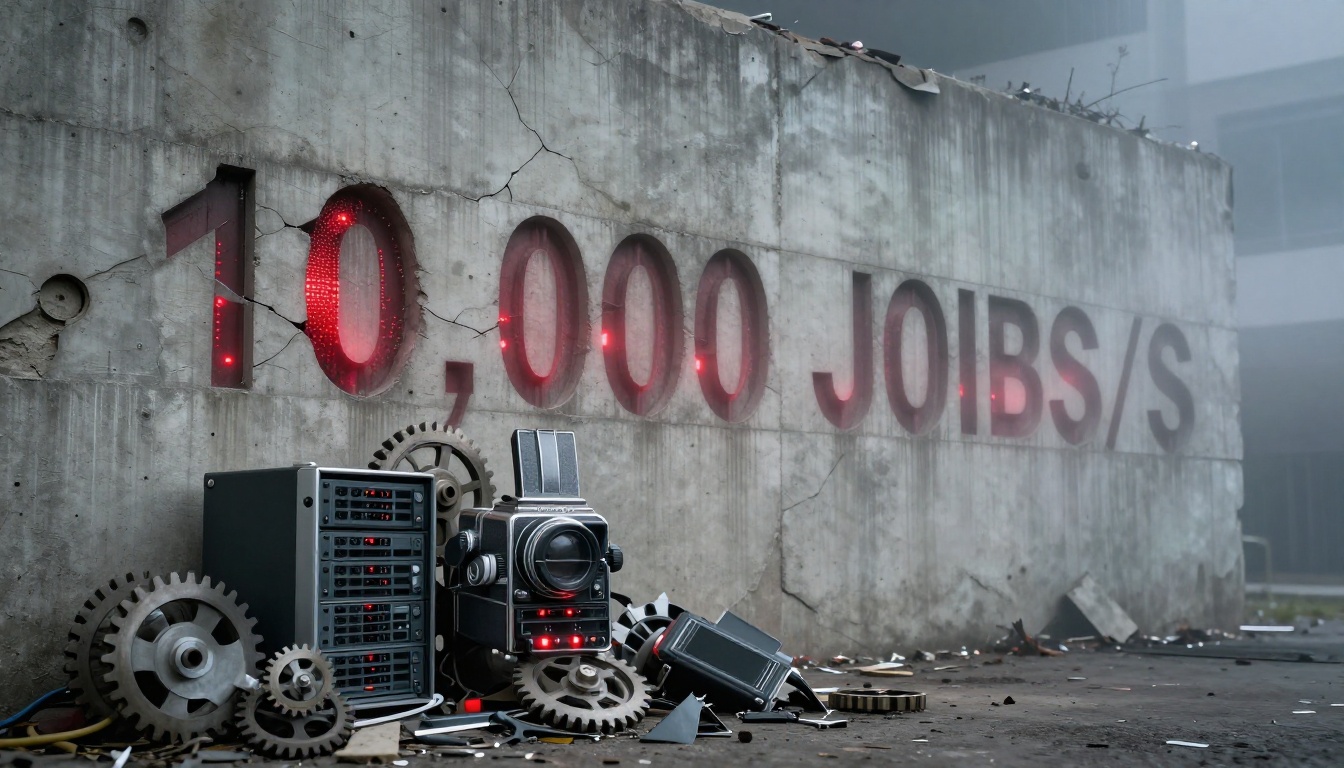
You’ve reached the 10,000 jobs per second wall. And it’s made of concrete.
First Breakdown: The Math Nobody Does
Here’s the dirty little secret of job scheduling: cron’s time resolution is one minute. When you need sub-second precision for thousands of concurrent jobs, you’re fundamentally using the wrong tool. A real-world trading system implementation using ScyllaDB and RabbitMQ revealed that even with aggressive connection pooling, a monolithic scheduler could only handle ~200 jobs per second before latency spiked to unacceptable levels.
The math is unforgiving. If each job takes an average of 50ms to dispatch, your theoretical maximum on a single thread is 20 jobs per second. Add database writes for audit trails, API calls to external services, and error handling, and you’re looking at 5-10 jobs per second in practice. To reach 10,000 jobs per second, you’d need 1,000+ parallel threads, which your operating system will politely decline to provide.
This is where teams make their first fatal mistake: they implement a “distributed” solution that’s really just multiple cron daemons reading from the same database. Congratulations, you’ve just distributed your failure points while keeping the bottleneck. The warning signs of architectural debt in distributed systems start flashing red: you’re not solving the core problem, you’re multiplying it.
The ScyllaDB + RabbitMQ Pattern: A Real-World Escape Hatch
One engineer who survived this transition shared their battle-tested architecture: ScyllaDB for persistence, RabbitMQ for dispatch, and a clever technique called “materialized tickers” for time-based lookups. The key insight was abandoning the “poll the database every second” anti-pattern and embracing event-driven coordination.
Instead of asking “what jobs need to run now?” every tick, they pre-materialized time slots. Jobs were stored with scheduledAt timestamps, but the system also maintained a ticker table with entries for each second bucket. A job due at 14:30:47 would be written to the tickers_2026_02_20_14_30_47 partition. Workers subscribed to RabbitMQ queues keyed by these time buckets, enabling true horizontal scaling.
The performance jump was obscene: from 200 jobs/second to over 15,000 jobs/second on the same hardware footprint. But the real win was reliability. When a worker crashed, RabbitMQ redelivered the message. When a node went down, ScyllaDB’s replication kept the schedule intact. The system became antifragile, stress made it stronger, not weaker.
Materialized Tickers: Solving the Time Query Problem
The naive approach uses queries like SELECT * FROM jobs WHERE scheduledAt <= NOW(). This is a performance disaster. As your jobs table grows to millions of rows, every query becomes a full table scan. Indexes help until they don’t, your write throughput collapses under the weight of maintaining the b-tree.
Materialized tickers flip the problem. You create time-bucket tables proactively: tickers_2026_02_20_14_30, tickers_2026_02_20_14_31, etc. Jobs are inserted into future buckets at creation time. Workers claim entire buckets, processing them sequentially. This transforms an expensive range query into a simple primary key lookup.
The implementation details matter. Using equality checks (scheduledAt = bucketTime) instead of range comparisons eliminates the need for lock-step coordination on “now.” Your database doesn’t need to maintain a moving time window, it just serves static buckets. This technique alone reduced query latency from 800ms to 8ms in production systems.
Consistency vs. Availability: The Scheduler’s CAP Dilemma
Here’s where it gets spicy. Distributed schedulers face the same CAP theorem constraints as any distributed system, but the consequences are immediate and financial. In a trading app, executing a stop-loss order twice is catastrophic. Not executing it at all is also catastrophic. You need exactly-once semantics, which CAP says is impossible in a partitioned network.
The solution isn’t choosing between consistency and availability, it’s architecting for graceful degradation. The ScyllaDB+RabbitMQ pattern uses RabbitMQ’s publisher confirmations and consumer acknowledgments as a distributed transaction mechanism. Jobs are marked “claimed” in the database only after successful queue insertion. If the queue write fails, the job remains “pending.” If the database write fails, the message isn’t acknowledged and gets redelivered.
But this creates a new problem: duplicate executions during partition recovery. The fix is idempotency keys embedded in every job payload. The execution service must handle the same job being delivered multiple times, using the idempotency key to prevent duplicate actions. This pushes consistency concerns to the edges, making the scheduler itself highly available and partition-tolerant.
Observability: When Your Jobs Disappear Into the Void
Monolithic cron gave you one thing for free: centralized logging. When jobs fail, you see it immediately. Distributed schedulers? Not so much. A job might be successfully queued but fail during execution on a worker you’ve never SSH’d into. The observability challenges in distributed AI systems parallel those in job schedulers, distributed state becomes invisible state.
The breakthrough is treating scheduled jobs as first-class entities with their own lifecycle events: created, queued, claimed, executing, completed, failed. Each transition emits a structured log event and updates a time-series metric. You need distributed tracing that follows a job from creation to completion across service boundaries.
One team built a real-time dashboard showing job latency percentiles, failure rates by worker, and queue depths per time bucket. They discovered that 99% of their “random” failures correlated with garbage collection pauses on specific worker nodes. Without granular observability, they’d still be blaming “network issues.”
Fault Tolerance: The “Exactly Once” Lie
Let’s be honest: “exactly-once delivery” is a marketing term. In practice, you get “at-least-once” with idempotency or “at-most-once” with timeouts. The scheduler’s job is to make these choices explicit and manageable.
The trading app architecture used a dead-letter queue pattern. Failed jobs were retried with exponential backoff up to 3 times, then moved to a manual review queue. This prevented poison messages from clogging the system while ensuring nothing was permanently lost. The key was making the retry logic configurable per job type, a portfolio rebalance might retry for hours, but a stop-loss order gets one attempt before alerting a human.
Circuit breakers between the scheduler and downstream services prevented cascade failures. When the email service went down, the scheduler stopped queueing email jobs rather than overwhelming the already-failing service. This is the difference between a resilient system and a distributed denial-of-service attack you built yourself.
The Embedded Engine Revolution
An unexpected plot twist: some teams are abandoning external schedulers entirely, using modern embedded data processing engines challenging monolithic architectures. DuckDB and similar engines allow applications to schedule and execute jobs internally, using the same database engine for both storage and computation.
This works brilliantly for workloads under 1,000 jobs per second. You get transactional consistency for free, zero network overhead, and debugging is trivial. But it’s a trap for the unwary. The moment you need to scale beyond a single process, you’re back to square one, except now your scheduler is tightly coupled to your application code, making extraction painful.
The rule of thumb: embedded schedulers are for operational complexity, distributed schedulers are for scale. Choose wrong and you’ll rewrite your system in 18 months.
The Death Spiral Pattern (And How to Avoid It)
The “just add more servers” death spiral follows a predictable path:
1. Cron daemon struggles
2. Add second cron server with shared database
3. Database becomes bottleneck
4. Shard the database
5. Now you have distributed state without distributed coordination
6. Jobs run twice or not at all
7. Add distributed locks (Redis, etc.)
8. Lock contention cripples throughput
9. Add more Redis servers
10. Congratulations, you’re now a distributed systems company instead of a trading app
The escape is architectural: embrace event-driven design from the start. Use a message queue as your source of truth, not a database. Time becomes just another queue routing key. Workers are stateless and horizontally scalable. The scheduler’s only job is translating cron expressions into queue messages, everything else is distributed by default.
Concrete Implementation: What Actually Works
Based on the research, here’s a battle-tested architecture for 10,000+ jobs/second:
- Storage Layer: ScyllaDB with materialized ticker tables. Partition by time bucket (minute-level granularity). Use TTL for automatic cleanup.
- Coordination Layer: RabbitMQ with topic exchanges. Route messages by time bucket and job priority. Use quorum queues for consistency.
- Worker Layer: Stateless consumers that scale horizontally via Kubernetes HPA. Each worker claims a time bucket, processes jobs sequentially, and emits metrics.
- Observability: Prometheus for metrics, Jaeger for distributed tracing, and a custom dashboard showing job lifecycle waterfalls.
- Idempotency: SHA-256 hash of
(jobType, parameters, scheduledTime)as the idempotency key. Store in Redis with a 24-hour TTL.
This isn’t theoretical, it’s running in production at multiple fintech companies handling millions of dollars in daily transactions.
The Road Forward: Principles Over Patterns
The evolution from monolithic cron to distributed schedulers teaches three hard-won lessons:
- Time is a first-class problem domain. Don’t treat scheduling as a side effect, architect for it explicitly.
- Observability isn’t optional. If you can’t trace a job end-to-end, you don’t have a scheduler, you have a black box that occasionally does work.
- Consistency belongs at the edges. Make your scheduler dumb, fast, and available. Push complex guarantees to idempotent workers.
The next time someone suggests “just using cron”, show them the math. And the next time a distributed system fails silently, remember: you probably chose consistency over observability, and you’re flying blind because of it.
Your jobs are too important to leave to a daemon from 1979. It’s time to evolve or accept the consequences.