title: “DuckDB in Production: The Embedded Database Challenging Enterprise Data Dogma”
description: “Real engineering teams are running DuckDB in production, cutting costs by 70% and outperforming Spark clusters. But is an embedded analytics database really ready for enterprise workloads, or are we just tired of overcomplicated data stacks?”
slug: duckdb-in-production-is-the-embedded-analytics-database-ready-for-enterprise-use
date: 2026-02-06
tags: [“duckdb”, “production”, “data-engineering”, “analytics”, “motherduck”]
categories: [“Data Engineering”, “Enterprise Architecture”]
The question landed on a data engineering forum with the quiet desperation of someone who’d found a tool they loved but couldn’t defend to their infrastructure team: “Is someone using DuckDB in PROD?” The responses weren’t theoretical whitepapers or vendor pitch decks, they were battle reports from engineers who’d already made the leap. One team had been running DuckDB in production for a year, generating queries with Python code on Linux boxes in the cloud. No complex infrastructure. No Spark clusters. Just simple, reliable performance.
This is the heart of the DuckDB production debate: we’ve been conditioned to believe that production analytics requires distributed systems, orchestration platforms, and infrastructure teams, when 95% of companies could run just fine with an embedded database and a cron job. The controversy isn’t about DuckDB’s technical capabilities, it’s about challenging a decade of enterprise data architecture orthodoxy.
The Production Reality Check: What “Enterprise” Actually Means
The Reddit thread reveals a critical insight: most production workloads aren’t training large language models or processing petabytes of clickstream data. They’re running scheduled ETL jobs, serving dashboards, and answering business questions on datasets that fit comfortably on a single server. One engineer put it bluntly: “There is no ‘big data’ in corporate, unless you work in MAG7, major banks or AI labs.”
Teams are using DuckDB in ways that would make traditional data architects nervous:
- Offloading Snowflake queries that were overkill even on the smallest compute instances
- Running inside Django web servers for sub-100ms analytics on the frontend
- Powering dbt transformations with microbatching for robust incremental pipelines
- Processing security logs in AWS Lambda functions at a fraction of cloud warehouse costs
The common thread? These aren’t toy projects. They’re production systems handling real money, real customers, and real business logic. The difference is they rejected the premise that you need a 20-node cluster to process a few gigabytes of data.
The Performance Paradox: When Smaller Means Faster
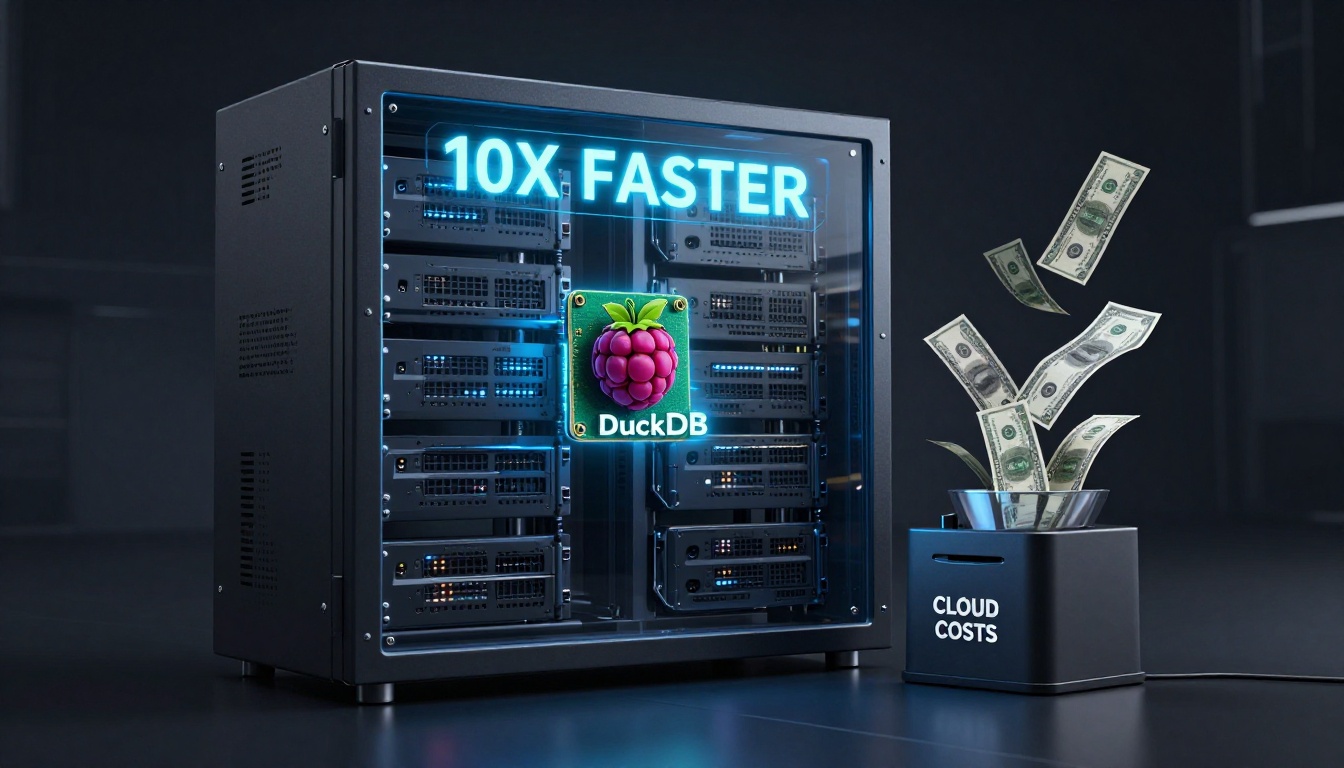
Here’s where the spiciness starts. A team that migrated from PySpark to DuckDB reported 10x faster execution with half the resources on their actual production data. They admitted their Spark code could have been optimized better, but that’s the point, DuckDB’s simplicity means you get good performance by default, not after weeks of tuning.
This challenges the fundamental assumption that distributed equals scalable. DuckDB’s vectorized execution and columnar storage aren’t just buzzwords, they’re architectural choices that make single-node analytics brutally efficient. Modern cloud VMs offer 200+ cores and terabytes of RAM. When your dataset is under a terabyte (which it probably is), why pay the distributed systems tax?
The performance comparison becomes even more stark when you look at the overhead:
– Spark: JVM startup, cluster coordination, serialization overhead, network I/O
– DuckDB: In-process library, zero network latency, direct memory access
One engineer noted that DuckDB actually does a better job parallelizing queries across cores than Spark did in their testing. The embedded nature isn’t a limitation, it’s a feature that eliminates entire classes of performance problems.
The MotherDuck Question: Cloud Extension or Architectural Betrayal?
This is where the debate gets theological. DuckDB was born as a pure embedded database, the “SQLite for Analytics.” MotherDuck extends it to the cloud with serverless compute, shared data catalogs, and organization-wide sharing. But is this necessary sophistication or a betrayal of DuckDB’s simplicity?
The answer depends on your production requirements:
Pure DuckDB works when:
– Your team can manage their own infrastructure (even if it’s just Linux boxes)
– You don’t need concurrent writes from multiple users
– Your data fits on a single machine
– You’re comfortable with file-based collaboration
MotherDuck adds value when:
– You need zero-copy database cloning for dev/test environments
– Multiple analysts require concurrent read access
– You want hybrid execution (local + cloud) for complex queries
– Your organization needs centralized governance and access controls
The pricing model reveals the philosophy difference: MotherDuck charges per second of actual compute with zero idle costs, while Snowflake has 60-second minimums and BigQuery charges for data scanned. This isn’t just cheaper, it’s a fundamentally different approach to cloud analytics that aligns costs with value delivered.
Incremental Strategies: The Real Production Challenge
Production isn’t about benchmark performance, it’s about recoverability, backfilling, and operational simplicity. This is where dbt’s microbatching strategy for DuckDB becomes critical.
Traditional cloud warehouses use physical partitions, separate files for each date range. DuckDB uses row groups (~122,000 rows each) with zone maps for filtering. This means microbatching behaves differently:
- Partition pruning isn’t automatic, you need physically partitioned sources like Parquet files in S3 or DuckLake
- Row group alignment matters, daily batches don’t map to storage boundaries
- Temp table collisions require batch-specific identifiers in multi-threaded execution
The implementation uses delete+insert scoped to time windows, which trades some overhead for the ability to reprocess specific date ranges without rebuilding everything. For a table that grew from 10GB to 4TB, this means fixing a bug in three-month-old data doesn’t require a full refresh.
Configuration is straightforward but requires attention to detail:
models:
  - name: events_enriched
    config:
      materialized: incremental
      incremental_strategy: microbatch
      event_time: created_at
      begin: '2024-01-01'
      batch_size: day
The key insight: production readiness isn’t about feature count, it’s about having robust patterns for the messy reality of data pipelines. Microbatching gives you that.
Cost and Complexity Arbitrage: The 70% Reduction Reality
Let’s talk numbers, because CFOs don’t care about architectural purity. Definite reported a >70% cost reduction migrating from Snowflake to self-hosted DuckDB. Gardyn achieved 10x lower costs with 24x performance improvement. Okta slashed Snowflake expenses from $2,000/day to a fraction using DuckDB in Lambda.
These aren’t edge cases, they’re the logical outcome of a simple equation:
Cloud Warehouse Costs = Idle compute + Data transfer + Over-provisioned clusters + Complex pricing models
DuckDB Costs = Zero (local) or Per-second query time (MotherDuck) + Storage
The hidden cost multiplier is engineering time. One team noted that getting rid of Spark meant eliminating the entire JVM infrastructure and its security vulnerabilities. Another pointed out that local development is faster because there’s no network latency or cloud provisioning delay.
This creates a fascinating arbitrage opportunity: you can afford to hire better engineers if you’re not paying for managed infrastructure you don’t need. The talent cost savings often dwarf the infrastructure savings.
The Concurrency Myth: Multi-User vs. Multi-Node
The most common objection to DuckDB in production is concurrency. “But what if 100 analysts query it simultaneously?” The answer reveals a misunderstanding of actual workload patterns.
DuckDB’s multi-threading excels at parallelizing a single query across cores. MotherDuck solves multi-user concurrency by giving each connection an isolated Duckling instance. This isn’t traditional database connection pooling, it’s a fundamentally different model where compute resources scale per-user rather than per-query.
For most organizations, this works better than expected because:
– Peak concurrency is lower than assumed (how many analysts are actually running heavy queries at 2 PM on Tuesday?)
– Query patterns are bursty (dashboard refreshes, not constant load)
– Read scaling handles the common case of many readers, few writers
The limitation is write concurrency. DuckDB isn’t designed for hundreds of simultaneous transactions. But analytical workloads are predominantly read-heavy with scheduled batch updates, a pattern DuckDB handles beautifully.
When It Breaks: Real Limitations and Failure Modes
Let’s be honest about where DuckDB production deployments struggle:
Dataset Size: When you genuinely exceed single-machine capacity (petabytes, not terabytes), DuckDB’s single-node architecture becomes a real constraint. MotherDuck’s read scaling helps, but it’s not a distributed query engine.
Write-Heavy Workloads: High-frequency streaming ingestion or many-to-many relationship updates create write amplification. The delta store pattern helps, but it’s not magic.
Ecosystem Maturity: While growing rapidly, DuckDB doesn’t have Snowflake’s marketplace or dbt’s decade of tooling. Some specialized features are still developing.
Operational Visibility: Embedded databases lack the monitoring infrastructure of managed services. You need to build your own observability for query performance, storage growth, and error tracking.
The teams succeeding with production DuckDB acknowledge these limits and design around them. They don’t try to force it into use cases it’s not built for, they match the tool to the problem.
The Enterprise Architecture Implication: What This Means for Your Data Strategy
The DuckDB production debate forces a reckoning with how we evaluate data tools. Traditional enterprise architecture emphasizes:
– Vendor support contracts
– Feature checklists
– “Enterprise-grade” certifications
– Scalability to theoretical maximums
DuckDB’s production success suggests a different framework:
– Actual performance on real workloads (not benchmarks)
– Total cost of ownership (including engineering time)
– Operational simplicity (fewer moving parts, less expertise required)
– Architectural fit (right-sized for the problem)
This isn’t about declaring DuckDB the winner for all use cases. It’s about recognizing that the “enterprise” label has become a proxy for complexity that often delivers negative value. A tool that runs reliably on a single server with zero idle costs and predictable performance might be more production-ready than a distributed system requiring constant tuning.
The internal links throughout this post tell a broader story. From lightweight vs. distributed processing to building cost-effective open-source stacks, the industry is rediscovering that simplicity scales better than complexity for most problems.
Conclusion: The Verdict on Production Readiness
Is DuckDB ready for enterprise production? The answer is frustratingly simple: yes, for the workloads that matter to most enterprises, and no, for the workloads that don’t.
The controversy isn’t about technical capability, it’s about challenging the assumption that enterprise data architecture must be complex, distributed, and expensive. Teams using DuckDB in production aren’t cutting corners, they’re making rational choices based on their actual requirements rather than industry dogma.
The real question isn’t whether DuckDB is production-ready. It’s whether your definition of “production” is based on real needs or vendor marketing. For the 95% of companies processing less than a terabyte of analytics data, DuckDB isn’t just ready, it’s overqualified.
The next time someone asks if you can use DuckDB in production, the correct answer is: “What’s your actual data size, concurrency pattern, and recovery requirement?” Because chances are, the tool you already have is the one you need.
Ready to explore DuckDB for your production workloads? Start with local development to validate performance, then evaluate MotherDuck if you need cloud collaboration. The cost of experimentation is near zero, but the potential savings are substantial.
For more context on the broader shift toward lightweight data tools, see our analysis of when dimensional modeling becomes technical debt and the rise of full-stack data generalists leveraging tools like DuckDB to deliver value without infrastructure complexity.