There’s a moment in every AI enthusiast’s life when they realize the frontier model they’ve been paying $20/month for is about to become free, offline, and running on their gaming PC. That moment is coming sooner than you think.
A recent analysis on r/LocalLLaMA sparked a firestorm by projecting that a ~30B parameter “Mythos at home” model, capable of matching Anthropic’s heavily-gated frontier model, could emerge as soon as January 2027. The claim sounds absurd until you look at the trajectory.
The gap between frontier models and what runs on consumer hardware isn’t just shrinking. It’s collapsing at an accelerating rate. And the implications for developers, enterprises, and anyone who values data privacy are massive.
The Shrinking Lag: From Years to Months
The core argument rests on a simple question: when did an open model small enough to run on high-end consumer hardware reach roughly the capability of an earlier frontier model?
The answer, based on the analysis, reveals a startling pattern:
| Comparison | Consumer-Ready Equivalent | Time Lag |
|---|---|---|
| GPT-3 → LLaMA-33B | ~2.5 years | Conservative estimate |
| GPT-3.5 → Yi-34B-Chat | ~18 months | Medium-high confidence |
| GPT-4 → Qwen2.5-32B | ~12 months | Clean comparison |
| GPT-4o / Claude 3.5 → Qwen3-32B | ~11 months | Text/reasoning only |
| Claude 4 / GPT-5 → Qwen3.6-27B | ≤9 months | SWE-bench verified |
| Opus 4.5 → Qwen3.8-27B | ~6-8 months | Provisional |
| Fable / Mythos 5 → ~30B model | 7-11 months (projected) | Speculative |
That last row is the projection. The historical lag has gone from roughly 18 months → 12 → 11 → ≤9. If that trend continues, and there’s no physical law preventing it, we’re looking at a 7-11 month lag between the release of a frontier model like Mythos and a consumer-hardware-ready 30B equivalent.
The pattern is so striking that even skeptics acknowledge something fundamental has shifted in how quickly open-source models catch up.
The Numbers Don’t Lie: Qwen3.8-27B vs. Opus 4.5
The most recent data point makes the projection believable. Qwen3.8-27B, a model you can run on a single high-end GPU today, is posting numbers that rival Anthropic’s Opus 4.5, a model that costs $5/$25 per million tokens through the API:
| Benchmark | Qwen3.8-27B | Opus 4.5 | Gap |
|---|---|---|---|
| SWE-bench Pro | 61.7 | 57.1 | +4.6 points |
| NL2Repo | 42.3 | 43.2 | -0.9 points |
| GPQA | 89.2 | 87.0 | +2.2 points |
| LiveCodeBench | 90.3 | 84.8 | +5.5 points |
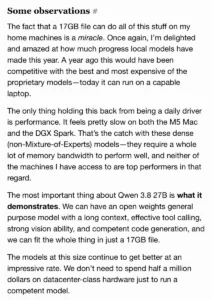
The evaluation setups aren’t perfectly identical, so calling this definitive product parity would be irresponsible. But the direction is unmistakable. A 27B model that fits in ~24GB of VRAM is trading blows with a frontier model that was state-of-the-art just a few months ago.
This isn’t an isolated fluke. The pattern holds across generations:
- Qwen2.5-32B scored 74.5 on Arena-Hard versus 37.9 for GPT-4-0613, comfortably beyond original GPT-4 and close to GPT-4 Turbo.
- Qwen3.6-27B hit 77.2 on SWE-bench Verified and 87.8 on GPQA Diamond, compared to Opus 4’s launch scores of 72.5 and 79.6 respectively.
The implications are profound: a 30B-parameter model already outperforming larger counterparts is no longer a novelty, it’s becoming the norm.
But Wait: The Information Theory Objection
Before you start planning your “Mythos at home” build, let’s address the elephant in the room. The most compelling counterargument comes from information theory: can a 30B model actually replicate a 1-10T parameter frontier model?
The reasoning goes like this: if a model’s world knowledge is encoded in its weights, each irreducible bit of information shapes the probability distribution of every token it produces. A smaller model has less capacity for that knowledge. The ability to reason is informed by exposure to everything, even the feeding habits of African gazelles influence a model’s C++ code generation.
Here’s the thing though: that argument has already been disproven in practice.
- GPT-4 was a ~1T model that’s now “absolutely spanked” by Qwen 27B models on benchmarks.
- GLM 5.3 can beat GPT-5.6 and Fable 5, models many times its size, on key tasks.
- Pathway’s 150M-parameter BDH-CQ model is reportedly close to GPT-5.6 Luna on ARC-AGI-1.
The fact that 27B models can compete with trillion-parameter models from just a few months ago proves we’re nowhere near the physical or information-theoretical limits of model efficiency. If we were, these rapid improvements would be impossible.
The Knowledge vs. Reasoning Distinction
The most insightful pushback in the thread reframes the entire debate: we don’t need a knowledgeable model. We need a reasoning-capable model.
The argument goes like this:
- I don’t expect my model to have cpython implementation memorized.
- I do expect it to be able to look it up.
- The model’s intelligence is not directly tied to its size.
- Params don’t mean as much as the statistical representation of data trained into the model.
This is where agentic capabilities change everything. A 30B model with excellent tool-calling, web search, and MCP support can punch far above its weight class. It doesn’t need to store facts, it needs to know how to retrieve them.
The developer sentiment in the community supports this shift: “We don’t want the model to know a million different libraries, we want it smart enough to know when to look them up.”
The “Benchmaxxing” Skepticism: A Necessary Caveat
Of course, not everyone is convinced. The most persistent criticism is that benchmarks don’t tell the whole story. Some models are “benchmaxxed”, optimized to score well on standardized tests while failing at real-world tasks.
The counterargument from practitioners who actually use these models:
- Local models went from “something to play with” to “something you can actually trust with complex projects” in the span of one generation (Qwen 3.6-27B).
- Real-world testing shows Qwen models handling significant coding projects, not just benchmark trivia.
- Closed benchmarks that can’t be gamed show the same improvement patterns.
But the skepticism has a point. Some users report that Qwen models “spew explanations that sound good but make zero sense” on complex security tasks. The model might score well on SWE-bench while struggling with nuanced, context-heavy work.
The honest takeaway: benchmarks provide a directional signal, not a complete picture. The gap between local and frontier is closing, but it hasn’t closed completely for all workloads.
The Architecture Revolution: Why Small Is Getting Smarter
The information theory objection assumes parameter count is destiny. But emerging architectures are challenging that assumption:
Engram and Lngram
(token-based and multimodal memory systems): These provide ways to store knowledge in SSD and basic RAM instead of VRAM, as a separate table that’s still part of the model. This frees up parameters for reasoning rather than memorization.
MoE with streaming weights
Most tasks can be accomplished with a few billion active parameters. Having accessible parameters streamed into VRAM as needed effectively increases knowledge to frontier levels without requiring half a million dollars in hardware.
Versor-based geometric reasoning
A paper on arxiv shows up to 200x performance improvements in specific task categories.
The fundamental insight: we’re still extremely far from optimal architectures. The rapid improvements in small model capability suggest massive inefficiency remains in current trillion-parameter models. As new architectural approaches improving local model efficiency mature, the parameter count needed to match frontier capability will continue to drop.
What “Mythos at Home” Actually Means
Let’s be precise about what we’re projecting. A “30B Mythos at home” model wouldn’t be an exact replica of Anthropic’s gated frontier model. It would be:
- A ~30B parameter model that matches Mythos Preview’s capability on text, reasoning, and coding tasks
- Running on consumer hardware, probably a 24GB VRAM GPU, not a server rack
- Released as open weights, likely from a Chinese lab (Qwen, DeepSeek) given the pattern
- Available by January 2027, if the current trajectory holds
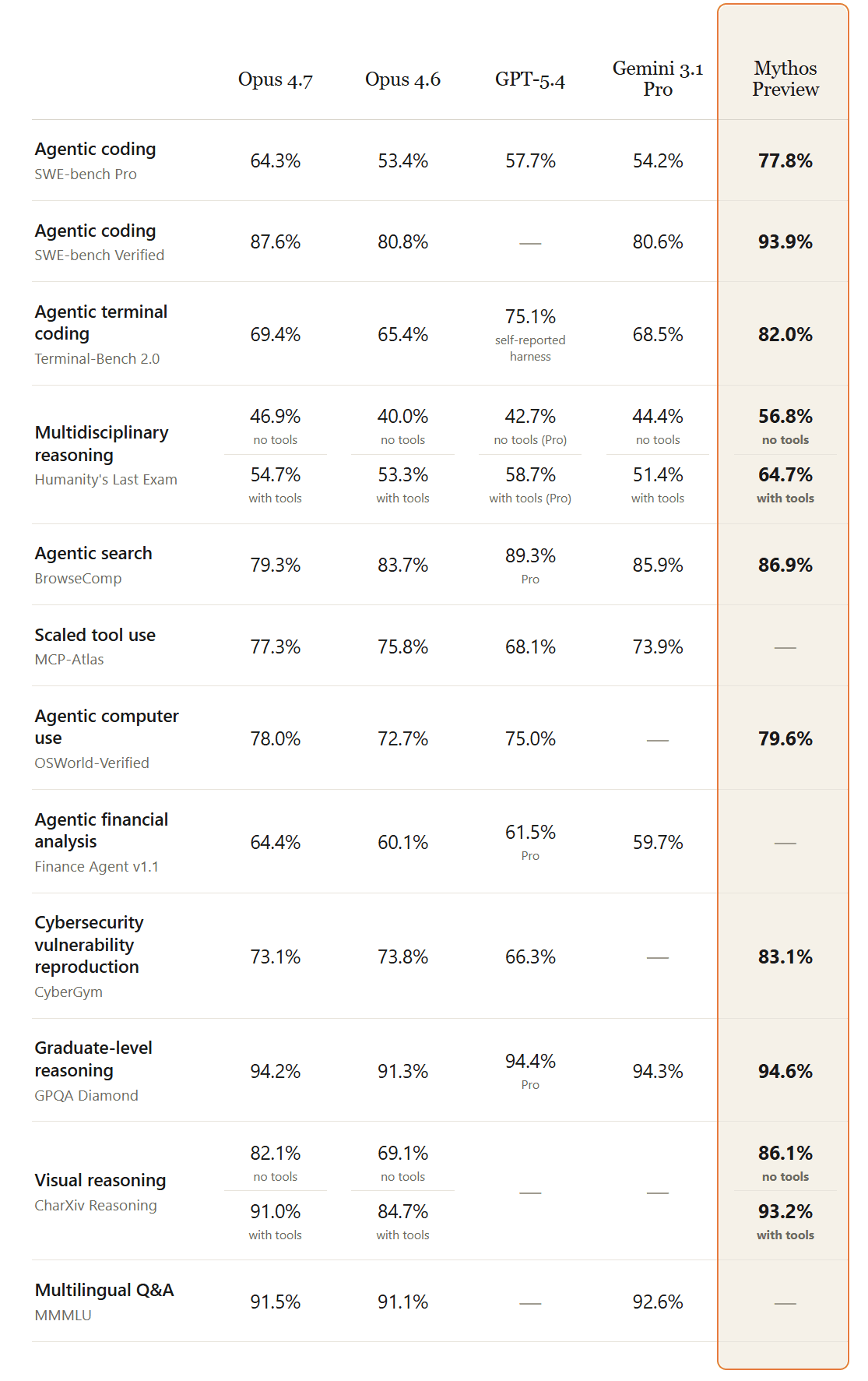
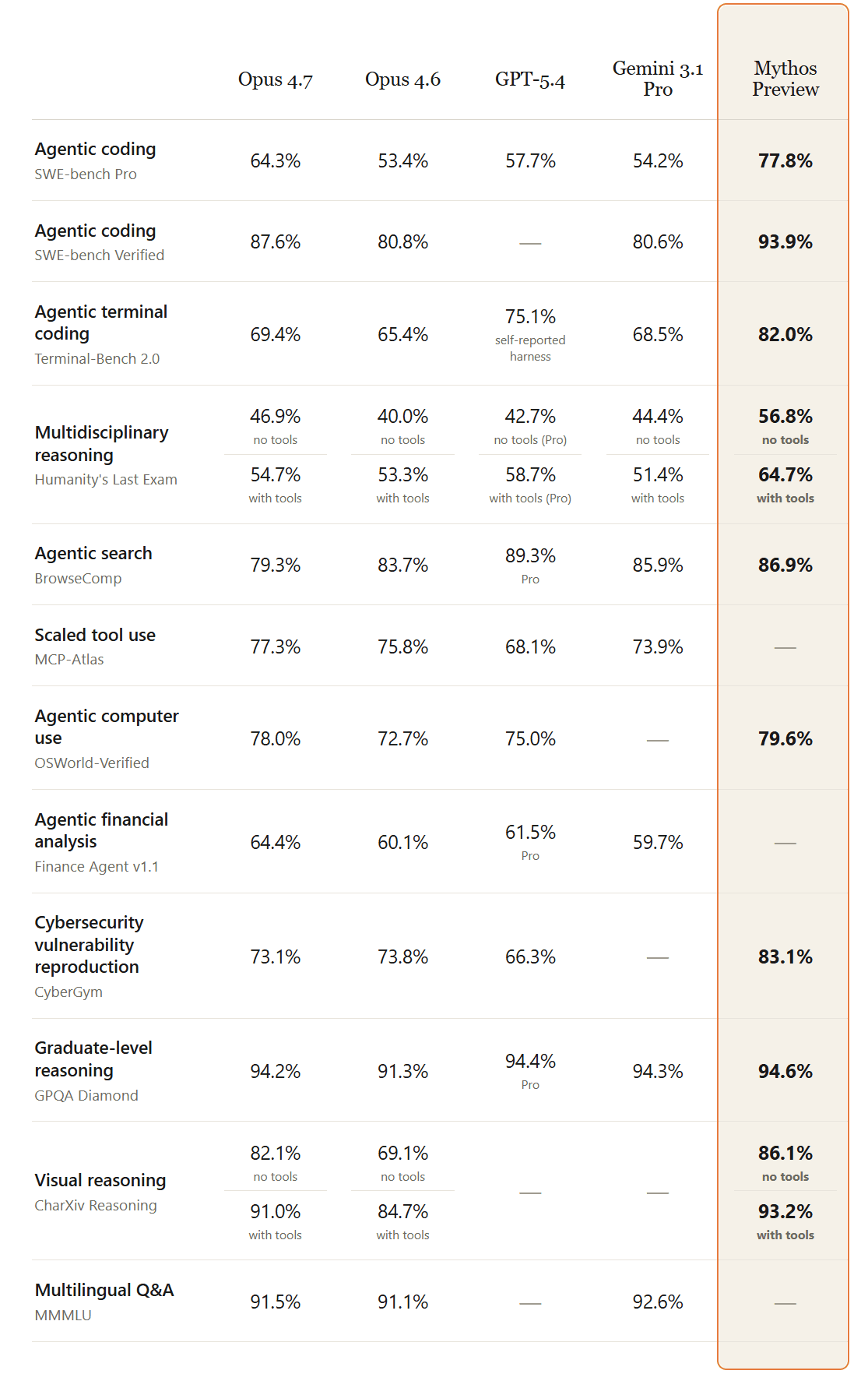
Notably, it wouldn’t necessarily include Mythos’s dangerous cybersecurity capabilities. That’s probably a feature, not a bug. The UK AISI evaluation showed Mythos is the first model to fully solve their 32-step corporate network attack simulation, something we probably don’t want running on every gaming PC.
The Hardware Angle: We’re Already There
One of the most interesting developments in the local AI space is how quickly consumer GPU performance enabling powerful local AI inference has improved. An 8x Radeon 7900 XTX rig running GLM-4.5 at 131K context for under $7K has enterprise engineers questioning their infrastructure budgets.
For a single 30B model, you don’t need that much. A single RTX 4090 or 5090 with 24GB VRAM can run a quantized 30B model comfortably. The hardware for “Mythos at home” already exists in thousands of gaming PCs worldwide.
The Timeline Reality Check
The projection of January 2027 is a median estimate, not a guarantee. Here’s the honest range:
- Optimistic case (late 2026): AI-assisted research accelerates open-model development. Qwen 4 or similar arrives with 30B models matching Fable 5/Mythos Preview capability.
- Base case (early 2027): The 7-11 month lag holds. A Mythos-equivalent model emerges in the 30B class.
- Pessimistic case (2028+): The trend stalls. Either frontier models pull ahead again, or the open-source community hits a wall on efficiency gains.
The advancements in local inference speed via Multi-Token Prediction and related techniques suggest the pessimistic case is unlikely, but it’s not impossible.
What This Means for You
If you’re a developer or enterprise evaluating AI infrastructure, the implications are significant:
- Don’t over-invest in cloud AI contracts for workloads that could run locally within 6-12 months.
- Start building with local-first architecture now. The models available today are already useful for many tasks.
- Watch the Chinese open-source labs closely. Qwen, DeepSeek, and GLM are the ones driving this trend.
- Prepare for the security implications. When a Mythos-class model runs on consumer hardware, the cyber defense landscape changes dramatically.
The smaller models outperforming larger ones in practical tasks trend isn’t slowing down. The evidence is mounting that we’re approaching a inflection point where consumer hardware can run frontier-class intelligence.
The Bottom Line
The prediction that a ~30B “Mythos at home” model will emerge by January 2027 isn’t wishful thinking, it’s a reasonable extrapolation of a trend that’s been accelerating for years. The lag between frontier release and consumer-hardware accessibility has gone from years to months, and there’s no sign of it slowing.
The real question isn’t whether this happens. It’s whether you’re prepared for when it does.
Your gaming PC is about to get a lot smarter. And the $20/month API bill for frontier intelligence is about to become optional.
The future of local AI isn’t coming. It’s already here, it’s just compressed into 30 billion parameters and waiting for the right model to unlock it.
What are you building for the local-first AI future? The comments are open.