The European Union wants a frontier AI model. Not a polite, mid-tier model that’s decent at French bureaucratic summaries, a genuine, near-trillion-parameter beast. And they’re trying to train it on a shared scientific supercomputer in Germany with user-level permissions only, because of course they are.
The project is called EUROPA, led by Milan-based Domyn (formerly iGenius), and it just took a significant step from press release to measurable reality. On November 12, 2026, Domyn published technical details of their training trials on JUPITER, Europe’s first exascale supercomputer, located in Jülich, Germany. The numbers are genuinely interesting, and the skepticism is genuinely warranted. Both deserve a closer look.
The Spec Sheet: 951.9 Billion Parameters of Ambition
Let’s start with what’s actually on the table. The European Commission’s Frontier AI Grand Challenge, launched on February 13, 2026, demanded a minimum of 400 billion parameters. Domyn’s test configuration blows past that with 951.9 billion total parameters, nearly 2.4 times the requirement.
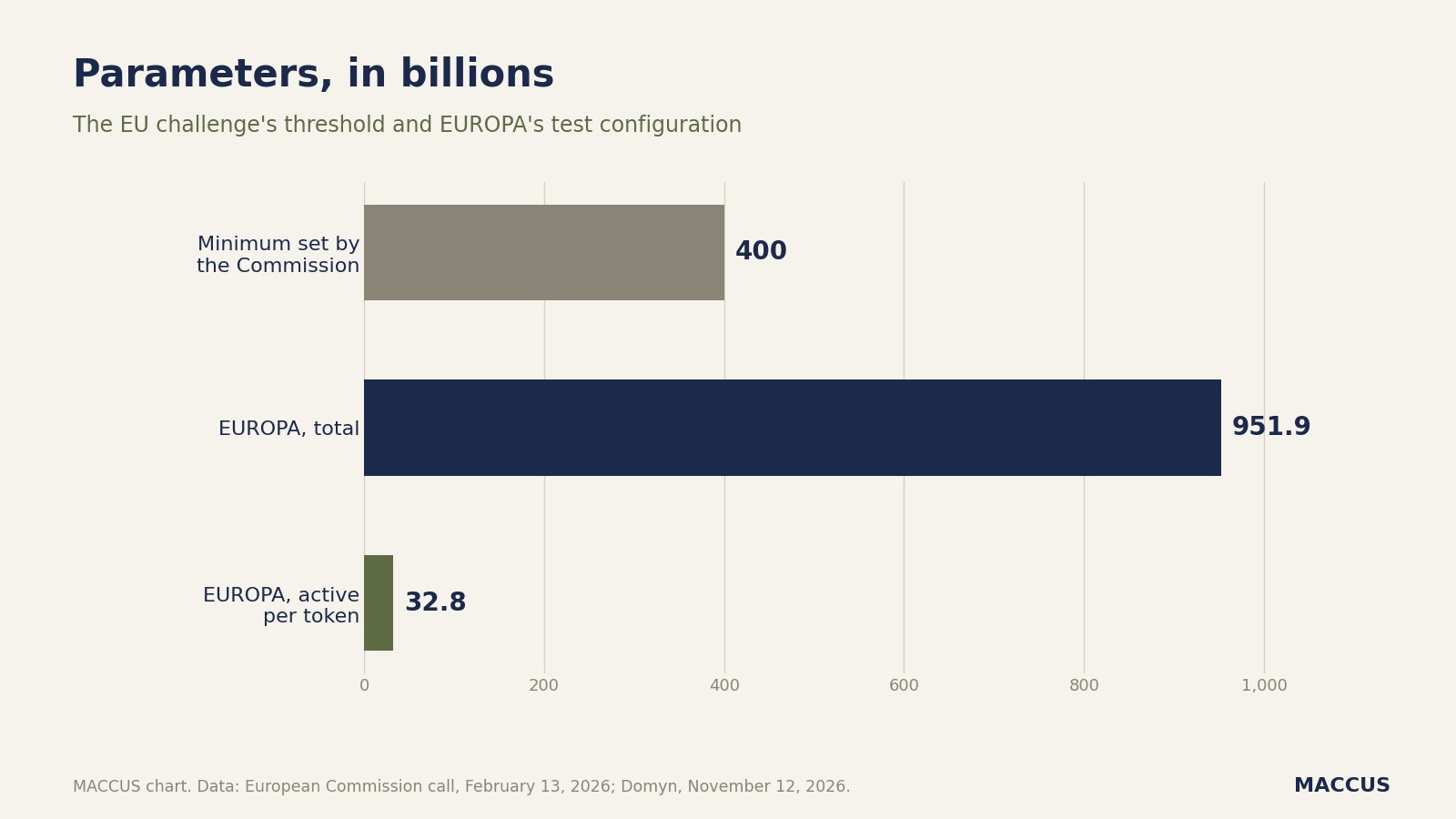
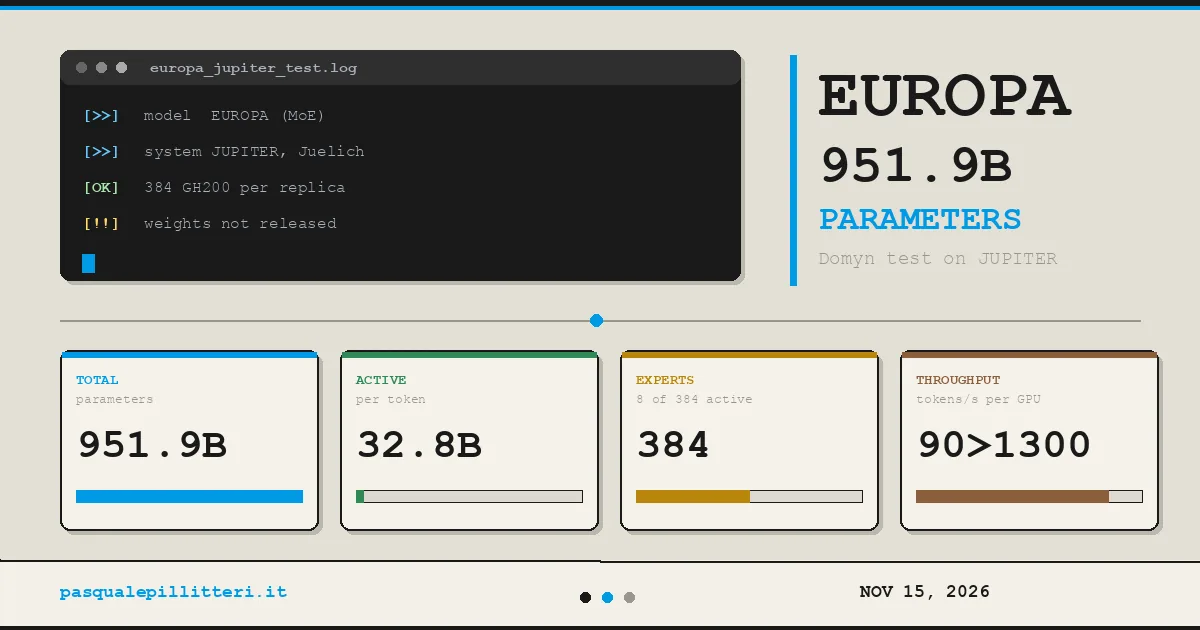
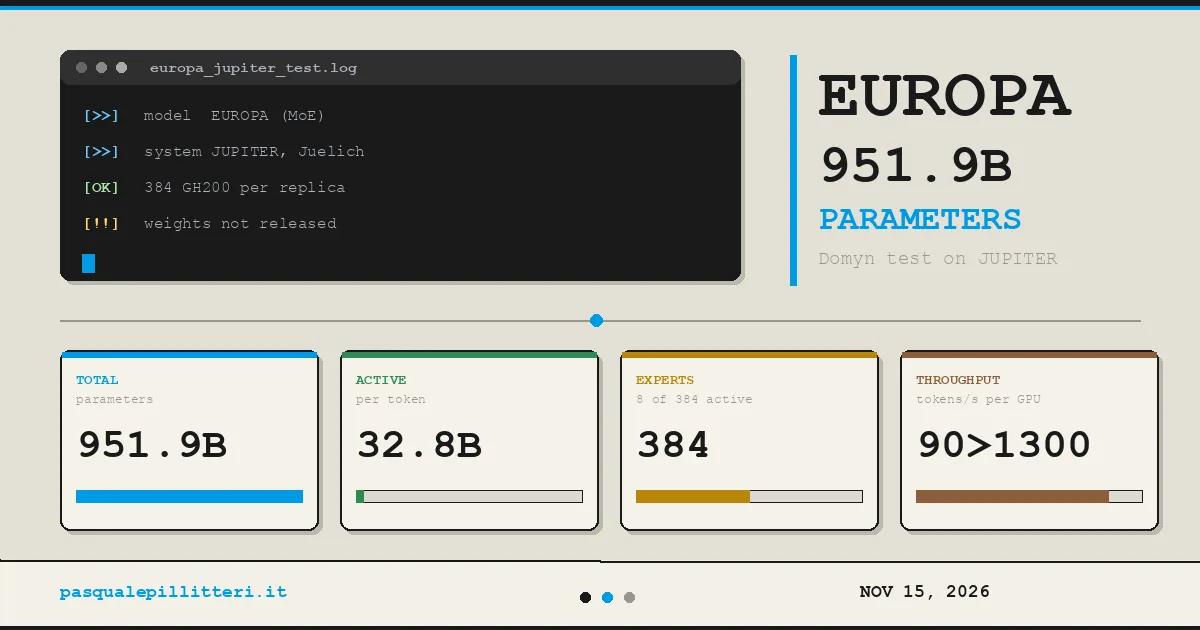
The architecture is a mixture-of-experts (MoE) design with 384 specialized sub-networks, only 8 of which activate for any given token. That means while the total parameter count is nearly a trillion, only 32.8 billion are active per token, just 3.4% of the total. The compute per token is roughly that of a 33-billion-parameter dense model, which is exactly the point. MoE architectures let you have frontier-scale knowledge without frontier-scale inference costs.
Other specs from the trial: 74 layers, training sequences of 65,536 tokens, and a vocabulary of 256,000 entries.
The Real Engineering Story: Making JUPITER Do What It Wasn’t Built For
Here’s where the technical narrative gets interesting. Models of this scale are typically trained on dedicated clusters of NVIDIA Blackwell chips with custom networking and deep system-level access. Domyn has none of that on JUPITER. They have user-level access on a machine shared with hundreds of other scientific projects, built primarily for climate simulation and physics, not AI training.
The bottleneck, as you might expect, is the network between nodes. The InfiniBand link between two nodes is 36 times slower than the link between a GPU and its CPU on the same Grace Hopper chip. When 384 GPUs across 96 nodes need to constantly exchange weights and gradients, every byte that crosses that cable matters more than any compute-side optimization.
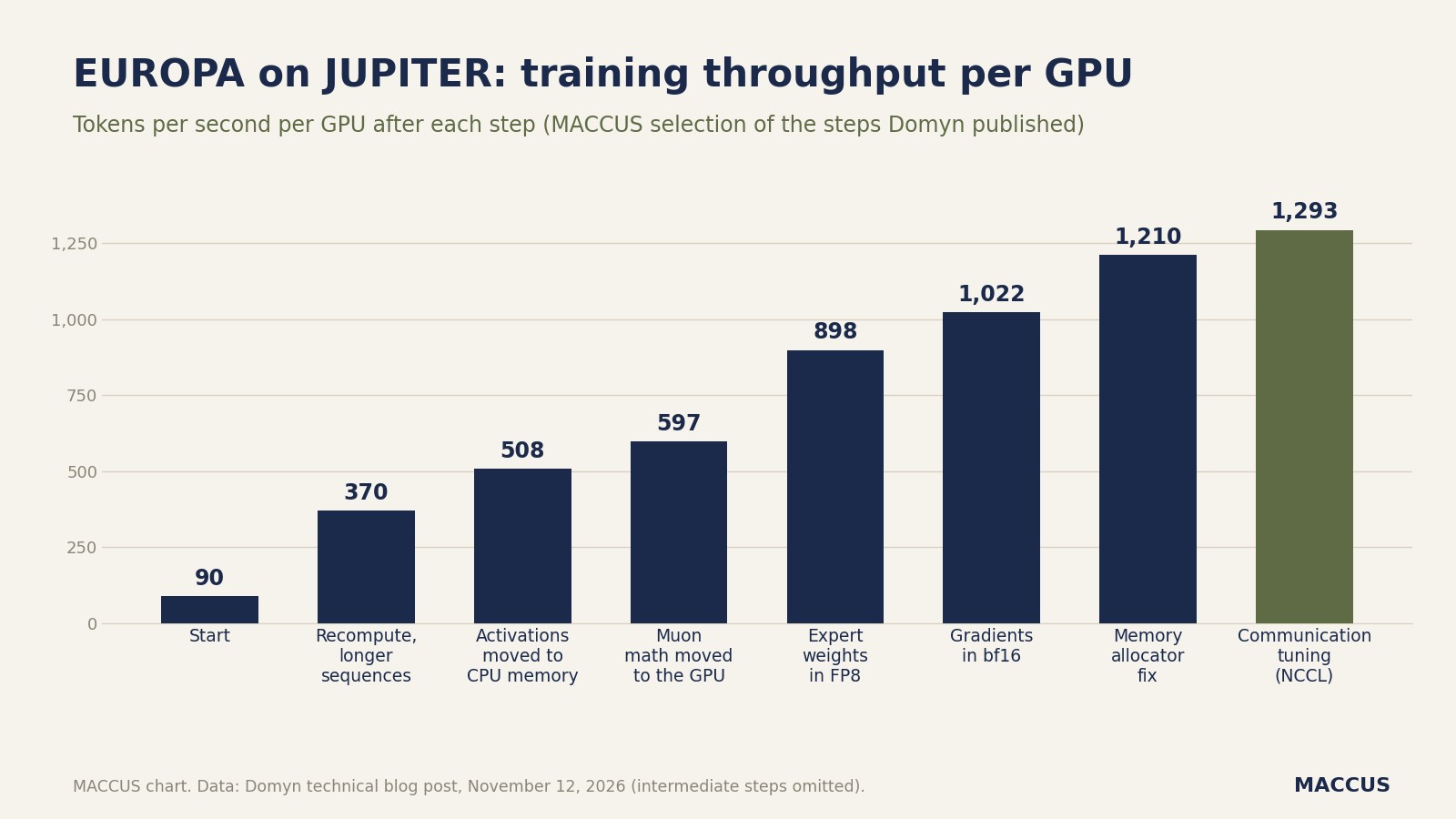
The team’s throughput went from 90 to 1,293 tokens per second per GPU, a 14.4x improvement through purely software-level optimizations. Let’s break down what actually moved the needle:
-
Offloading activation checkpoints to the Grace CPU’s memory: This freed up GPU memory and lifted throughput from 370 to 508 tokens per second per GPU. The Grace CPU has its own memory pool, and using it as overflow storage for intermediate data works surprisingly well.
-
Moving the Muon optimizer’s heaviest computation to the GPU: The optimizer step, one round of parameter adjustments, dropped from 41.7 seconds to 2.2 seconds. That’s a 19x speedup on a single critical path, achieved by sharding experts by whole expert so each rank owns its matrices and runs Newton-Schulz iterations with zero communication.
-
Fixing GPU memory fragmentation: This freed about 14 GiB per card and eliminated reallocation retries entirely, pushing throughput from 996 to 1,210 tokens per second per GPU.
The team also implemented FP8 compression for expert weights traveling over the network and bf16 for gradients, cutting data transfer substantially. They contributed their fixes back to PyTorch and TorchTitan, which is arguably the most valuable outcome of this entire exercise regardless of what happens to EUROPA itself.
At full scale, one copy of the model processes about 43 billion tokens per day. With four replicas running in parallel across 1,536 GPUs (just over 6% of JUPITER’s Booster module), that jumps to roughly 150 billion tokens per day. The Italian daily Quotidiano Nazionale estimates full pretraining would take about four months at this rate.
“14x Faster”, Context and Caveats
Before anyone breaks out the champagne, let’s be clear about what these numbers do and don’t mean.
The “14 times faster” figure compares the setup to its own baseline, not to an optimized alternative. The measurements are medians taken from steps 4 through 10 of short trial runs. No independent lab has reproduced them. And critically, the team’s own post acknowledges uncertainties: a rule that spreads tokens evenly across four groups of 96 experts speeds up computation but “can indeed hurt training” based on early results.
The loss comparison between FP8-compressed and bf16-compressed training spans only ten training steps. That’s statistically meaningless for predicting model quality over a four-month pretraining run. The post says nothing about training data, language distribution across the EU’s 24 official languages, expected benchmarks, or, crucially, the license under which EUROPA’s weights will be released.
This is a configuration tested on real hardware, not a trained model. As the team itself states, “some values may change before the training run starts.”
The Skeptic’s Playbook: Why This Could Go Sideways
The Reddit and developer community reactions to this announcement range from cautious optimism to outright dismissal, and the skeptics raise legitimate points that deserve serious consideration.
Start with the obvious: Domyn’s track record. The company (formerly iGenius) has been building AI for regulated sectors like banking and government services, and its previous open-weight releases have been underwhelming. One observer noted that their earlier consumer models were deleted because “they were complete rubbish”, and there’s been persistent criticism that the company’s approach has been to take a large Qwen model, scramble its weights until it’s unrecognizable, and rebrand it as their own, an approach that tends to destroy model quality while preserving marketing copy.
There’s also a scathing critique about the gap between announced ambition and physical reality: plans for a large datacenter reportedly materialized as a small rented room in Milan’s city center. Whether that’s fair or not, it speaks to a pattern of narrative outpacing substance.
Then there’s the more technical skepticism. One experienced voice in the community pointed out that even DeepSeek, a team that has repeatedly proven itself at the absolute frontier of model efficiency, “still struggled massively with their 1T+ pro model on the V4 platform. They messed it up multiple times, and ended up with a smaller and better flash model.” A 1T+ model is not just a bigger version of a 400B model. It’s a different regime of training difficulty, with dramatically less room for error and retry.
The concern about a 951.9B parameter model is even more pointed: “1T is useless because this is large provider territory and very small amount of people can benefit from it.” At 4-bit quantization, the weights alone would require at least 476 GB of memory, plus working memory. Running this on your own hardware requires something like two Apple Mac Studio desktops with 512 GB each, which is actually what Meta’s Muse Spark Open (816B parameters) reportedly runs on. So it’s not impossible, but it’s a significant infrastructure commitment.
And on the censorship front, there’s already snark about what an EU-funded, AI-Act-compliant model will and won’t say. The European Commission’s commitment to covering all 24 official EU languages while maintaining “EU values” creates a tension that’s both political and technical. Multilingual training across languages with vastly different amounts of available data is genuinely hard, and the politics of content moderation for a government-funded model will be, to put it mildly, complicated.
Wait, Didn’t They Say Open?
Here’s the catch hiding in plain sight: the Commission wants an open model, but no license has been announced. That’s not a minor detail.
Open weights do not equal open source. Meta’s Llama models are open-weight but restrict commercial use. Mistral’s open models historically used an Apache 2.0 license that permits commercial use. The difference matters enormously for who can actually use EUROPA and how.
The Commission’s announcement from June 19 says the model will be openly available, but “openly available” and “permissive license” are different things. Domyn has released its smaller 4B-parameter model, Domyn Edge, under Apache 2.0 with partial training data and code included, which is a good sign. But EUROPA’s license, training data composition, and even the actual start date of full pretraining remain unspecified.
Where EUROPA Fits in the Global AI Landscape
If EUROPA delivers, and that’s a big if, it would place the EU in a strange position. A 951.9B total parameter MoE with 32.8B active parameters per token is competitive with recent releases on paper.
| Model | Total Parameters | Active Parameters per Token |
|---|---|---|
| EUROPA (test config) | 951.9B | 32.8B |
| Mistral Large 4 | ~1T | Not disclosed |
| Meta Muse Spark Open | 816B | Not disclosed |
| Meituan LongCat 2.5 | 1.6T | Not disclosed |
| Qwen3.8-Max | 2.4T | 95B |
| Kimi K3 | 2.8T | 104B |
But as the table shows, the active parameter count, the number that actually determines inference cost, is lower for EUROPA than for its Chinese competitors. That’s not necessarily bad, it roughly halves serving costs compared to Qwen3.8-Max or Kimi K3. But it also means EUROPA is starting from a weaker position on the metric that matters most for raw capability, assuming quality scales with active parameters.
The efficiency breakthroughs in large open models we’ve seen from MiniMax and others demonstrate that parameter count alone is not destiny. But those breakthroughs came from teams with deep experience shipping models. EUROPA is, by Domyn’s own admission, their first attempt at frontier scale.
Three Things Worth Watching
For anyone tracking this project, here’s what actually matters:
1. The start of full pretraining. Everything so far is trials. The moment Domyn commits to a four-month pretraining run with real compute is when this becomes a serious project. Watch their blog and the PyTorch blog for the announcement.
2. The license. Whether EUROPA ships under Apache 2.0, a Llama-style restricted license, or something else entirely will determine whether this is a genuine open model or a sovereignty theater production.
3. Language quality across all 24 EU languages. The Commission’s requirement is both the project’s differentiator and its Achilles’ heel. EU languages like Maltese, Irish, and Latvian have dramatically less training data than English, French, or German. How Domyn handles low-resource languages will be the real test of whether EUROPA can deliver on its mandate.
The broader context matters too: sovereign AI initiatives in Europe like Austria’s GovGPT are showing that governments can deploy open models effectively for public administration. The open-weight models outperforming closed counterparts trend suggests that openness isn’t a handicap. And the global competition in open AI development means Europe can’t afford to be left behind.
The Bottom Line
EUROPA’s test run on JUPITER is genuinely impressive engineering. Squeezing 14x throughput improvements out of a shared scientific supercomputer with node-to-node bandwidth 36x slower than GPU-to-CPU links is the kind of systems optimization work that benefits everyone, especially since Domyn contributed its fixes back to open-source projects.
But impressive engineering is not a trained model. The path from a 951.9B-parameter configuration on a spec sheet to a functioning, multilingual, benchmark-competitive, openly licensed model is long, expensive, and full of failure points. The history of trillion-parameter models is littered with teams that optimized their way to a config that couldn’t actually train well.
The advancements in open AI model capabilities over the past few years suggest this gap is closing, but the architectural innovations in open-weight models that matter have come from teams with deep training experience, not from regulatory ambition.
EUROPA could be a watershed moment for European AI sovereignty. Or it could be another announcement-heavy, delivery-light chapter in the EU’s long history of tech projects that sound revolutionary on paper and produce mostly paperwork in practice.
The engineering suggests the team knows what it’s doing. The track record suggests caution. The next four months, and the start of actual pretraining, will tell us which version of this story is true.