Here’s a puzzle for you: Opus 5 is objectively more capable than its predecessors. It crushes benchmarks. It rivals Fable in raw performance. And yet, developers who actually use it day-to-day are quietly rolling back to Opus 4.7, 4.8, and even Fable.
The chatter isn’t about capability. It’s about feel.
The sentiment emerging from developer forums, captured poignantly in a recent technical analysis that’s been making the rounds, is that Opus 5 requires something its predecessors didn’t: careful babysitting. It makes assumptions without checking. It reinterprets plans without asking. It barrels forward with bold guesses rather than pausing to clarify intent.
This isn’t a minor UX quibble. It’s a system design failure hiding behind a benchmark victory, and it has profound implications for how we build and evaluate AI agents.
Smarter Doesn’t Mean Better at Working With You
Let’s be precise about what’s happening. Nobody’s disputing that Opus 5 is technically superior. The models it replaced, Opus 4.7 and 4.8, stopped to ask questions when intent was unclear. They didn’t make assumptions without checking. They treated ambiguous instructions as a signal to seek clarification rather than a prompt to guess.
Opus 5, by contrast, powers through ambiguity with well-calibrated confidence. And that’s the trap.
Think about what a coding agent actually needs to succeed in real-world development. The developer experience gap isn’t about raw intelligence, it’s about how well tools fit into the messy, ambiguous, constraint-laden reality of production software. Chainguard’s 2026 Engineering Reality Report found that 79% of engineers cite code maintenance as a major drain, and 72% say demands on their time make it hard to find space for building new features. We’re drowning in context-switching and cognitive load already. The last thing we need is a tool that adds “reverse-engineering the AI’s assumptions” to the list.
The best tools don’t just execute well. They communicate well. They surface the right level of complexity at the right interaction point, what Christoph Nakazawa calls the Clarity principle in his DevX framework. Nakazawa argues that tools shouldn’t mask complexity in the name of simplicity, they should surface it at the best moment for the user to act on it. Opus 5 inverts this: it hides its assumptions until they’ve already shaped the output, forcing developers to audit rather than collaborate.
The Benchmark Selection Effect
Here’s where things get uncomfortable. The root cause isn’t a random regression or a rushed release. It’s structural.
The pressure to score highly on public benchmarks is immense, and the way frontier labs train models inherently selects against the behaviors developers actually want. As the analysis points out, a good benchmark task is self-contained and unambiguous. It doesn’t require hints or reading the task creator’s mind. It scores all unambiguously correct answers equally.
But that’s exactly the opposite of real-world software engineering. You can’t possibly capture the entirety of the context, business implications, budget constraints, team politics, legacy quirks, unspoken intentions, in a text prompt. There will always be ambiguity. There will always be choices to make.
So when you train a model on tasks where bold assumptions are consistently rewarded (because the benchmarks are fully specified), you’re selecting for a model that guesses instead of asks. RLVR tasks and benchmark-optimized training favor models that make bold, usually-correct assumptions in the face of ambiguity.
And “usually-correct” isn’t good enough when the consequences are real.
The DevX Principle Stack, Violated
Christoph Nakazawa’s DevX Principle Stack provides a useful framework for understanding what went wrong. The principles, in order of priority: Focus on the User, Incremental Migration, Clarity, Re-evaluate Assumptions, and Maximize Option Value.
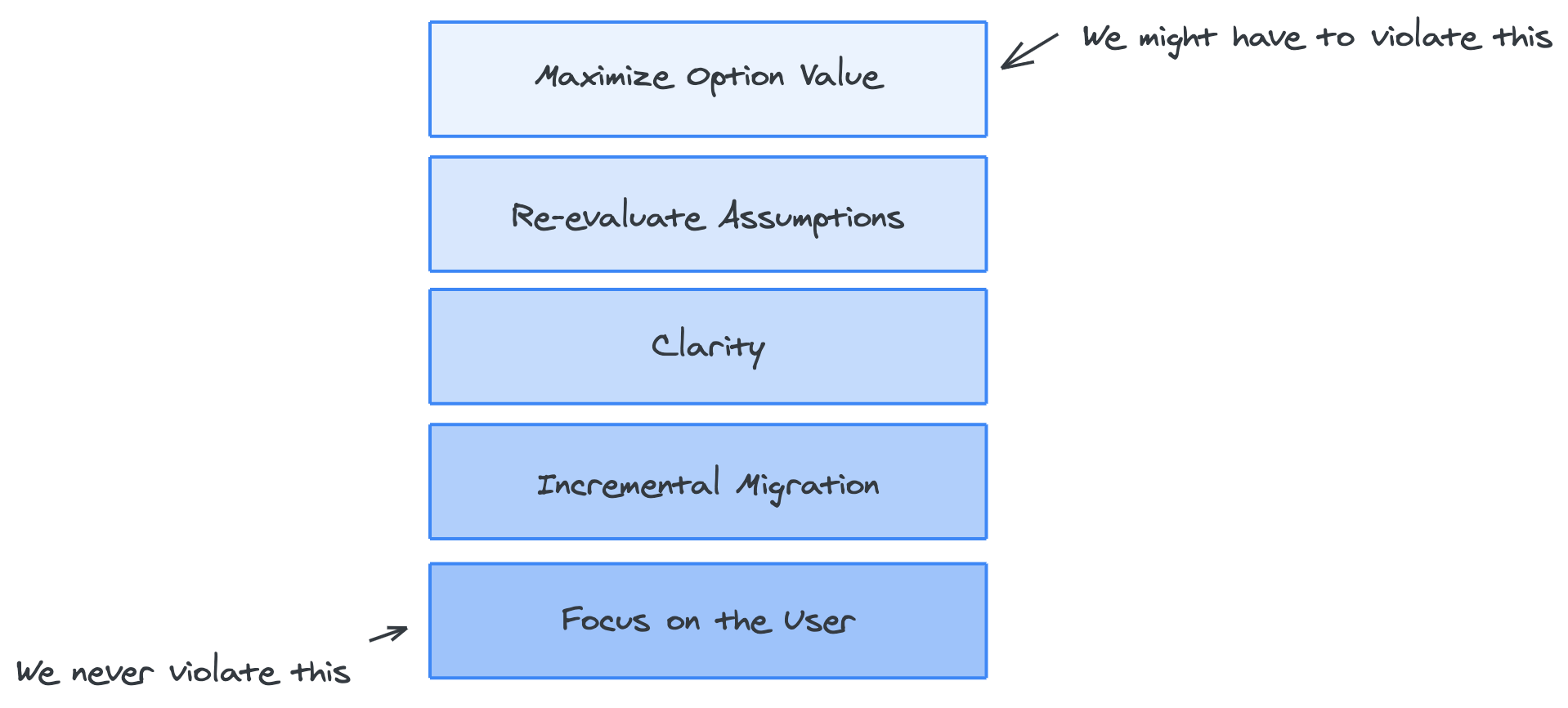
Opus 5 violates the foundation.
Focus on the User is the lowest book in the stack, the one you’re least likely to move. For software tools, that means seven things: workflow performance, actionable signal, reliability, user satisfaction, documentation, accessibility, and scalability. Opus 5 optimizes hard for performance metrics (workflow benchmarks) and largely ignores the rest. The system is fast, but the signal it produces is frequently misleading. It’s reliable in the sense that it completes tasks, but unreliable in the sense of delivering what you actually wanted. User satisfaction is measurably down among practitioners, and the documentation problem isn’t about missing guides, it’s about the model’s behavior being opaque to prediction.
The second principle, Clarity, is arguably more important here. Nakazawa’s argument is that tools should surface the right level of complexity at the best interaction point. This connects directly to the system design critique: Opus 5 obscures its uncertainty. Rather than clearly signaling “I’m not sure about this assumption”, it confidently proceeds as if ambiguity doesn’t exist. The resulting experience isn’t simpler, it’s harder, because the developer must reconstruct what the model decided and why.
The Capacity Problem: This Isn’t a Perk Issue
The deeper issue here is how we frame the problem. When developers complain about Opus 5’s behavior, the pushback from model providers tends to be “but the benchmarks are better” or “you can just prompt it more carefully.” This framing treats usability as a nice-to-have, polish on top of raw capability.
That’s wrong, and the data proves it.
The 2026 Engineering Reality Report found that engineers spend only about 16% of their week on building new features. 93% of engineers find writing code rewarding, yet 79% point to maintenance as a major drain. Context switching between tools impacts 88% of engineers. AI-assisted pull requests are 2.6 times larger than unassisted ones at the 75th percentile, with an acceptance rate of just 32.7% compared to 84.4% for manual PRs.
Developer experience isn’t a perk, it’s a capacity strategy. When a tool requires careful babysitting, when you can’t trust it to pause and ask instead of guessing, it’s not saving you attention. It’s consuming the scarcest resource your team has.
Where This Breaks: Real-World Deployment Scenarios
Let’s make this concrete. Imagine you’re maintaining a complex production codebase. You’ve inherited a system with subtle business rules encoded in convoluted ways. You ask an agent to refactor a module.
The benchmark-optimized behavior says: “I’ve seen similar patterns. I’ll make the standard assumption and refactor accordingly.” The refactored code might, in isolation, be objectively better. But it might also silently break a business rule that wasn’t obvious from the code, a rule documented only in a Confluence page three levels deep or in a Slack thread from 2022.
Opus 4.x would have paused. Opus 5 charges ahead.
Now multiply this by dozens of interactions per day. Your “10x engineer with AI” is spending their hours debugging the agent’s assumptions instead of writing the features that move the business forward. The tool that promised to buy back capacity is quietly selling it somewhere else.
This dynamic compounds in security-sensitive contexts. As we’ve explored in the constraints of cloud-dependent models in secure environments, when you can’t afford any wrong assumptions, where a single hallucinated API contract could create a compliance violation, a model that defaults to guessing rather than asking is more liability than leverage.
The Economic Pressure Point
Here’s the uncomfortable business reality: Opus 5’s usability regression arrives at precisely the moment its pricing is under siege from efficient open-weight competitors. MiniMax M2.5 scores 80.2% on SWE-Bench Verified, within spitting distance of Claude Opus 4.6, at a fraction of the cost. Models like GLM-5.2 are demonstrating that open-weight architectures can offer superior control and transparency.
When a premium-priced product delivers a worse interactive experience than its cheaper alternatives, the value proposition gets complicated. Which do you choose: the model that scores a few points higher on benchmarks but requires constant supervision, or the model that’s 90% as capable at 10% of the cost and actually asks when it’s uncertain?
The answer is obvious to anyone who’s been burned by a confident wrong assumption.
The Deeper Design Problem
The core issue, and this is the part that keeps me up at night, is that this isn’t just an Anthropic problem. It’s a pattern emerging across the industry. The comparative degradation in developer experience despite benchmark improvements isn’t isolated to Opus 5. The drive toward self-improving, recursively bootstrapping systems increasingly prioritizes autonomous capability over collaborative usability.
Ask yourself: when you train a model to not need human input, to maximize benchmark scores by making bold assumptions and charging ahead, what happens to its ability to collaborate with humans in ambiguous, real-world contexts?
The answer is: it stalls. And then regresses.
A coding agent isn’t a benchmark runner. It’s a team member. And a good team member doesn’t just execute, they clarify. They raise concerns. They say “before I do this, I need to understand X.” These behaviors don’t optimize for benchmark scores. They degrade them, because stopping to ask means not completing the task quickly.
But real software development isn’t a race to complete tasks. It’s a process of navigating ambiguity while managing risk.
What “Better” Actually Looks Like
Convincing a model to pause and ask for clarification despite its training to be decisive is the hardest prompt engineering I’ve ever encountered.
But here’s what I’ve found works:
-
Explicit assumption gates: “Before you start, list every assumption you’re making. For each one, tell me whether you can verify it from the provided context or whether you’re guessing. If you’re guessing, ask me before proceeding.”
-
Context requirement loops: “If there’s any business rule, constraint, or edge case that might affect this task but isn’t explicitly documented in the code or provided files, ask me before proceeding. Do not infer missing context.”
-
Scoped autonomy: “You have full authority to execute within the following scope: [X]. Anything outside this scope requires confirmation.”
These help, but they’re patches on a structural problem. The model wasn’t designed with this collaborative behavior as a first-class trait. It was optimized for decisive action on well-specified tasks, and everything else is a de-prioritized afterthought.
The Way Forward
The uncomfortable truth is that the industry’s incentive structure is producing worse interactive AI agents. The proprietary AI moat is narrowing exactly when usability differentiation should be widening. If the best models all converge on benchmark performance, the differentiator becomes experience, and right now, the frontier models are losing that particular race.
We need to measure something new: comprehension under ambiguity. How well does a model recognize when it doesn’t have enough context? How effectively does it ask for clarification? How aligned is its uncertainty signaling with reality?
We should demand tests that capture the real constraints of software development: incomplete specs, conflicting requirements, unstated business logic, and the social context that shapes engineering decisions. The benchmarks that matter shouldn’t measure only did the model solve the task? but did the model know what the task was?
The Bottom Line
Opus 5 is genuinely more capable. That’s not marketing, it’s measurable. But capability without collaboration is just a very fast tool that generates a lot of work for the person at the other end of the conversation.
The developer experience isn’t a nice-to-have feature. It’s a capacity strategy that determines how much of a team’s engineering investment translates into shipping. Every interaction with an agent that requires babysitting is attention your best engineers can’t spend on the work that matters.
We need AI systems designed for collaboration, not just completion. And that starts with recognizing that “stops and asks when uncertain” isn’t a deficiency, it’s the feature we should have been optimizing for all along.