The “revolutionary” policy mostly revolutionized paperwork. But this time, the revolution is real, and it’s forcing a reckoning most engineering teams aren’t prepared for.
The Year Everything Changed
In 2025, the debate was about whether AI could ever generate “good” code. Skepticism was the default position, and for good reason. Early AI-generated code was slop.
Then Opus 4.5 landed in November 2025, and the ground shifted. As Charity Majors documented, “AI has been able to generate code that is approximately as good as that of the median software engineer, at least for common patterns, and much faster and more cheaply.”
But that’s only half the story. The real change wasn’t just the model, it was the agentic harness wrapping it. Tool use, function calling, MCPs, all of this wave built over 2025 and crested into general-purpose usability by year’s end.
The enthusiasts were right about the timeline. They just got the implications backward.
Why Faster Code Generation Makes Bad Architecture Catastrophic
When code was expensive to produce, architecture mistakes were painful but survivable. You could patch around bad decisions slowly. Now that code generation is effectively free and instant, the risk profile flips entirely.
Modern architecture demands beyond traditional frameworks align with the need for disciplined system design under AI. Here’s why: when an AI can generate 10,000 lines of code in a single prompt, a bad architectural decision doesn’t just create a mess, it creates a landfill.
Chad Fowler, the engineer who coined “immutable infrastructure” in 2013, has been writing about this shift. His concept of the Deletion Test is deceptively simple: imagine deleting the entire implementation of any system you work on.
“Most engineers experience deletion as existential. Code feels like the thing. When people say ‘We can’t just throw the code away,’ what they usually mean is: we don’t know what behavior is required, which failures are unacceptable, what invariants must hold, or how to tell if a new version is correct. Those are not code problems. They are evaluation problems.”
AI-generated code makes this dynamic worse. If you don’t understand what your system is supposed to do, having an AI write it faster doesn’t help, it accelerates the accumulation of incomprehensible, untestable garbage.
The Phoenix Architecture: Code as Cache
The most useful mental model for the AI era comes from Fowler’s Phoenix Architecture. The core insight is borrowed directly from infrastructure engineering:
“Immutable infrastructure. Containers. Blue-green deployments. These ideas all share a common premise: never fix a running thing. Replace it. AI pushes this premise beyond infrastructure and into application code itself. When rewriting is cheap, editing in place becomes risky. Mutation accumulates entropy. Replacement resets it.”
This is the paradigm shift most teams haven’t internalized yet. Code stops being an asset and starts acting as a cache, a materialized view of understanding that’s useful while current, disposable when stale.
The Real Problem: Your Specs Are Trash
Here’s the uncomfortable truth AI exposes: most engineering teams don’t have good specifications. They have code that was treated as “the source of truth” because writing anything else was too expensive.
The argument that AI engineering requires foundational data discipline supports the need for rigorous architecture. Without clear requirements, acceptance criteria, and behavioral specifications, AI-generated code is just plausible-looking garbage.
The tools to fix this already exist, they just haven’t been treated as priorities. Behavioral tests, characterization tests, capture/replay, traffic splitters. Observability (the good kind). These aren’t new ideas. They’re the engineering practices we’ve neglected because we were too busy hand-crafting code.
Three Disciplines That Become Mandatory
1. Architectural Governance
When anyone on the team can generate thousands of lines of code with a prompt, architectural boundaries aren’t optional, they’re the only thing preventing chaos.
Engineers need deep system understanding to fix AI performance bottlenecks, reinforcing discipline. This means:
- Explicit architecture decision records (ADRs) that document constraints and tradeoffs
- Clear module boundaries enforced by tooling, not just convention
- Dependency rules that prevent accidental coupling
- Automated architectural fitness functions that run in CI/CD
Without these, AI assistants will happily create circular dependencies, duplicate logic across services, and build technical debt at AI speed.
2. Test Suites That Actually Verify Behavior
The single most dangerous pattern in AI-assisted development is using the same model to generate both code and tests. When you do this, both artifacts can share the same misunderstanding of what the system should do.
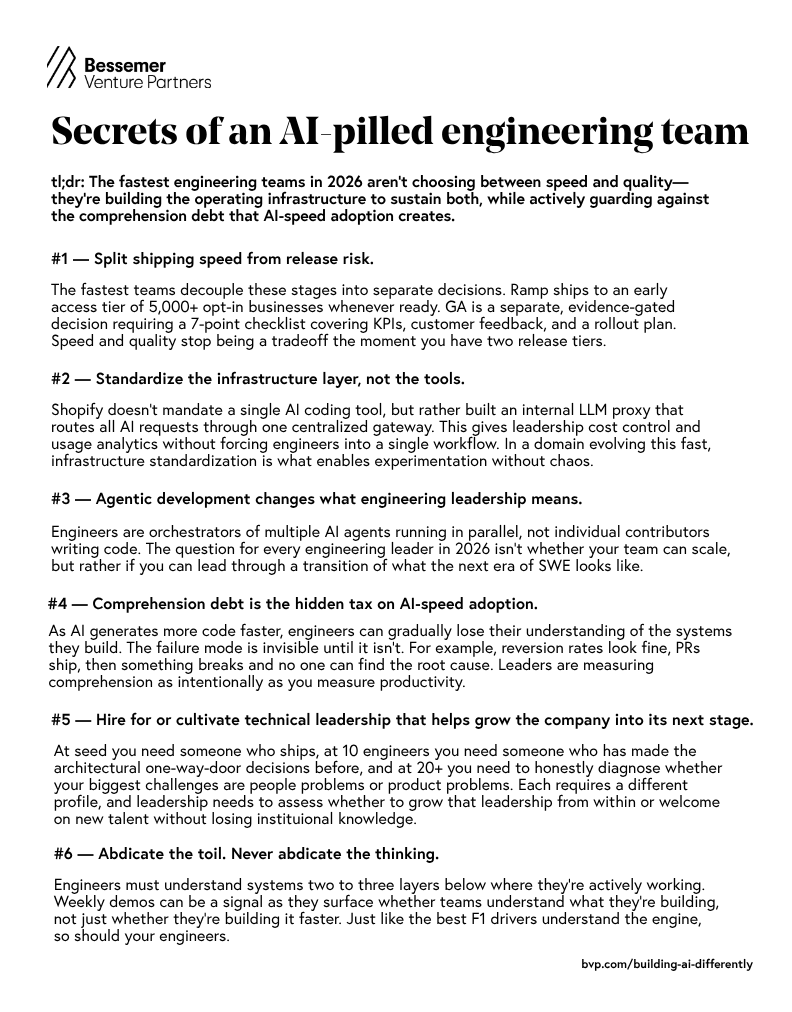
Shopify’s approach is instructive. As documented by Bessemer Venture Partners, Farhan Thawar’s guardrail is specific: “engineers must understand systems two to three layers below where they’re actively working.”
The practical implication: test suites must be grounded in domain acceptance criteria, not in code coverage percentages. AI-generated tests must undergo the same review process as AI-generated code. And regression tests become the single most important artifact in your codebase.
3. Verification Before Production
The shift in engineering skill demands parallels how AI assistants change what discipline means. The most important skills are shifting from code production to verification:
- Can you tell if an AI-generated solution is correct?
- Can you identify which test cases would reveal bugs?
- Can you articulate why a particular implementation is wrong?
Human brains are bad at validation. We’re distractible, we habituate to repetition, and we’re terrible at spotting small details. But we’re the only ones who can ask “is this actually solving the right problem?”
The Shopify Model: Infrastructure Over Standardization
Shopify’s AI adoption strategy reveals something important about how discipline scales. Rather than mandate a single AI tool, they standardized the infrastructure layer underneath.
Farhan’s team built an internal LLM proxy, a centralized gateway routing all AI requests from Claude Code, Copilot, Cursor, or any other tool through a single platform. This gives them cost control, usage analytics, and the ability to switch models without forcing engineers into a single workflow.
The principle: standardize the guardrails, not the tools. Engineers need freedom to experiment, but that freedom must operate within architectural constraints that preserve system integrity.
The Hidden Cost: Comprehension Debt
Productivity metrics are lying to you. Lines of code generated, acceptance rates, pull request velocity, none of these measure whether your team actually understands what they’re building.
Comprehension debt is the silent killer in AI-accelerated development. Engineers who can ship code but can’t diagnose why something breaks are accumulating it. Weekly reverts won’t surface it. But when production goes down at 3 AM, the team that understands their system two layers deep will recover in minutes, while the code-pasters will still be reading logs.
Farhan’s framing is perfect: “You shouldn’t abdicate the thinking. You should abdicate the toil.”
What This Means for Engineering Leaders
The semantic layer as a necessary engineering discipline for AI-ready data architecture isn’t optional, it’s the minimum viable investment.
If you’re leading an engineering team, here’s your new priority list:
- Kill the “ship fast and fix later” mentality. AI accelerates shipping, which means “later” comes faster and harder.
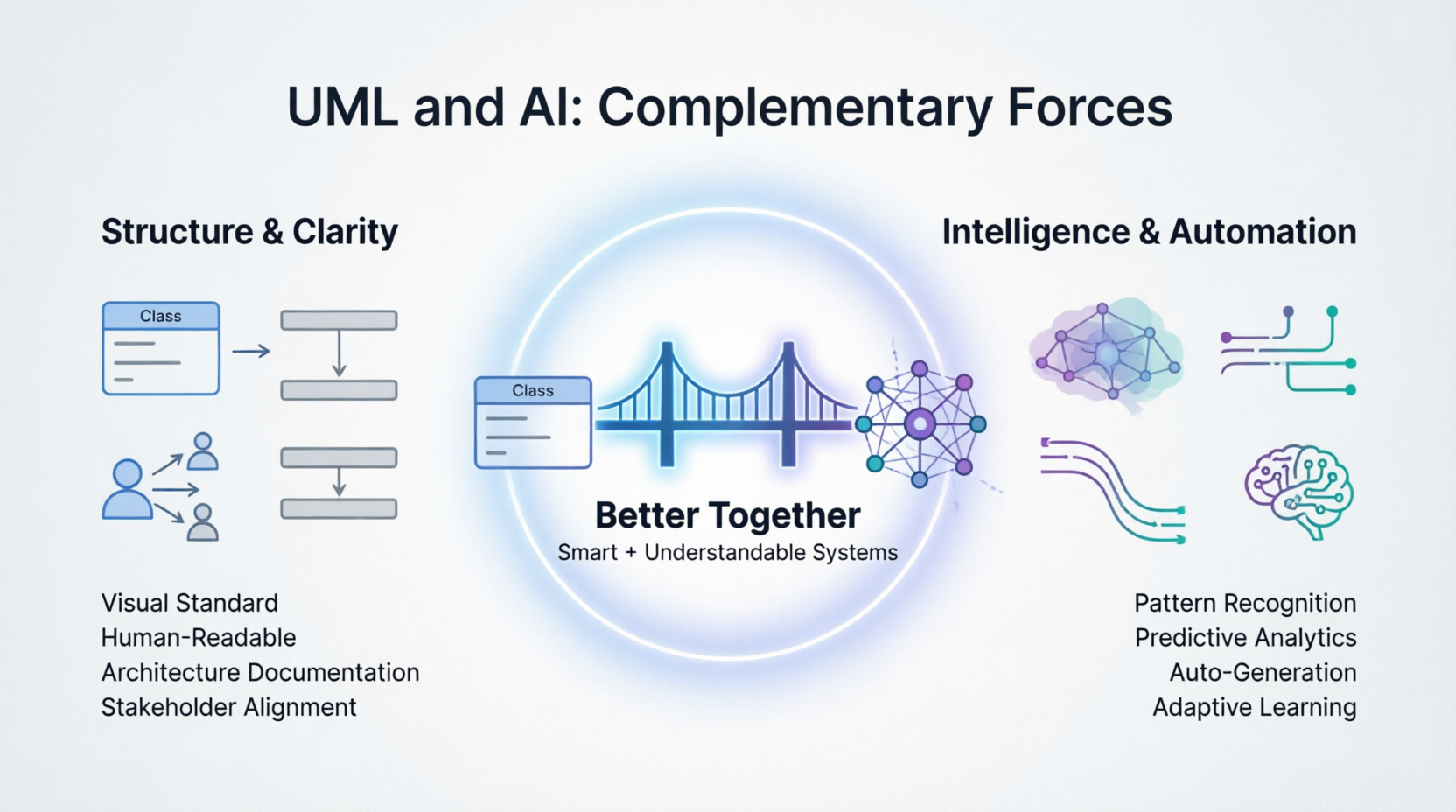
- Invest in architecture artifacts. Your code is no longer the source of truth. Architecture diagrams, decision records, and behavioral specs are.
- Make comprehension measurable. Weekly demos aren’t about show-and-tell. They’re about verifying that teams understand what they built.
- Accept that AI integration is a continuous process. As one academic framework puts it, this isn’t a one-time transformation. It’s a continuous learning and improvement process where model capabilities, tools, security requirements, and regulatory constraints must be regularly assessed.
Network topology as a hidden discipline in AI inference architecture is one example of a systems-thinking approach that’s becoming mandatory. The pressure of constant upskilling highlights the need for foundational engineering discipline that transcends any particular tool or model.
The most dangerous myth in software development right now is that AI lets you skip the hard parts. It doesn’t. It makes the hard parts unforgiving.
Determinism isn’t going anywhere. Users don’t want to log in every day and find the buttons moved around. Financial transactions need to complete. Systems need to be maintainable, testable, and comprehensible.
AI is not magic. This is still engineering. And the teams that treat AI as a reason to increase discipline, not relax it, will be the ones building systems that last.
Want to go deeper on the architectural implications? Check out why TOGAF won’t save you from the agent apocalypse and the real skills modern architects need.