
The AI community collectively raised an eyebrow this week when Mistral dropped the weights for its 1-trillion-parameter flagship, Mistral Large 4, affectionately nicknamed “Le Chonk.” The name might sound like a lazy Sunday afternoon, but the implications are anything but. This isn’t just another model release, it’s a geopolitical statement wrapped in a Mixture-of-Experts architecture, and it’s landing at a moment when the open-weight race has become uncomfortably synonymous with Chinese labs.

The “Chonk” That Challenged the Narrative
Here’s the uncomfortable truth the AI world has been grappling with: if you wanted a frontier-class open-weight model over the past year, you were essentially shopping Chinese. DeepSeek, Z.ai’s GLM series, Moonshot’s Kimi, these labs have been setting the pace while Western giants either kept their models proprietary or released weights that felt more like appetizers than main courses.
Mistral just said non to that narrative. Hard.
The release of Mistral Large 4’s open weights on Hugging Face represents the most significant Western counter-punch in the open-weight arena since Meta’s Llama series first captured developer hearts. But Le Chonk isn’t just competing, it’s claiming specific territory where it believes it can win outright: agentic coding and defensive cybersecurity.
The developer community’s reaction has been decidedly enthusiastic, with many expressing relief that the open-weight ecosystem isn’t a de facto Chinese monopoly. The underlying concern isn’t xenophobia, it’s dependency. As one prominent voice on Hacker News put it, “We NEED a non-chinese player in this mix.” The reasoning is pragmatic: China just slapped an export license restriction on certain model weights, and the last Kimi release was already visibly neutered regarding cyber capabilities to obtain that license. When geopolitical winds shift, your AI infrastructure shouldn’t become collateral damage.
1 Trillion Parameters, 52 Billion Active: The Architecture of Efficiency
Let’s get the specs out of the way, because they matter. Le Chonk is a hybrid instruct-and-reasoning Mixture-of-Experts model with approximately 1 trillion total parameters, activating just 52 billion per task. That’s the MoE magic, you get the knowledge capacity of a trillion-parameter model with the inference economics of something far smaller.
This efficiency story is central to Mistral’s pitch. The model is natively multimodal (text and image input, text and code output), supports 160+ languages, and was trained entirely on European infrastructure, 3,800 Nvidia Grace Blackwell GPUs over two months, drawing roughly 10 megawatts of power during the reinforcement learning phase in France.
To put that in perspective: OpenAI reportedly trained GPT-6 Astra on roughly 100,000 GPUs. Mistral CEO Arthur Mensch frames the disparity bluntly: “Other labs have raised hundreds of billions to develop equivalent capabilities, in three years, Mistral raised roughly $6 billion.”
That’s not just efficiency, that’s a fundamental challenge to the “compute is destiny” doctrine that has dominated frontier AI development.
The Coding Credentials: Where Le Chonk Actually Bites
Mistral’s claims around coding aren’t vague vibes, they’re specific benchmark scores with real methodology behind them. After three weeks of additional reinforcement learning since the preview release, the gains are measurable:
| Benchmark | Preview Score | Open-Weight Release | Key Rival |
|---|---|---|---|
| Terminal-Bench 4.0 | 28% | 41% | GLM-5.3 at 40% |
| Cognition FrontierCode 2.0 | , | 19.7% | GLM-5.3 at 17.3% |
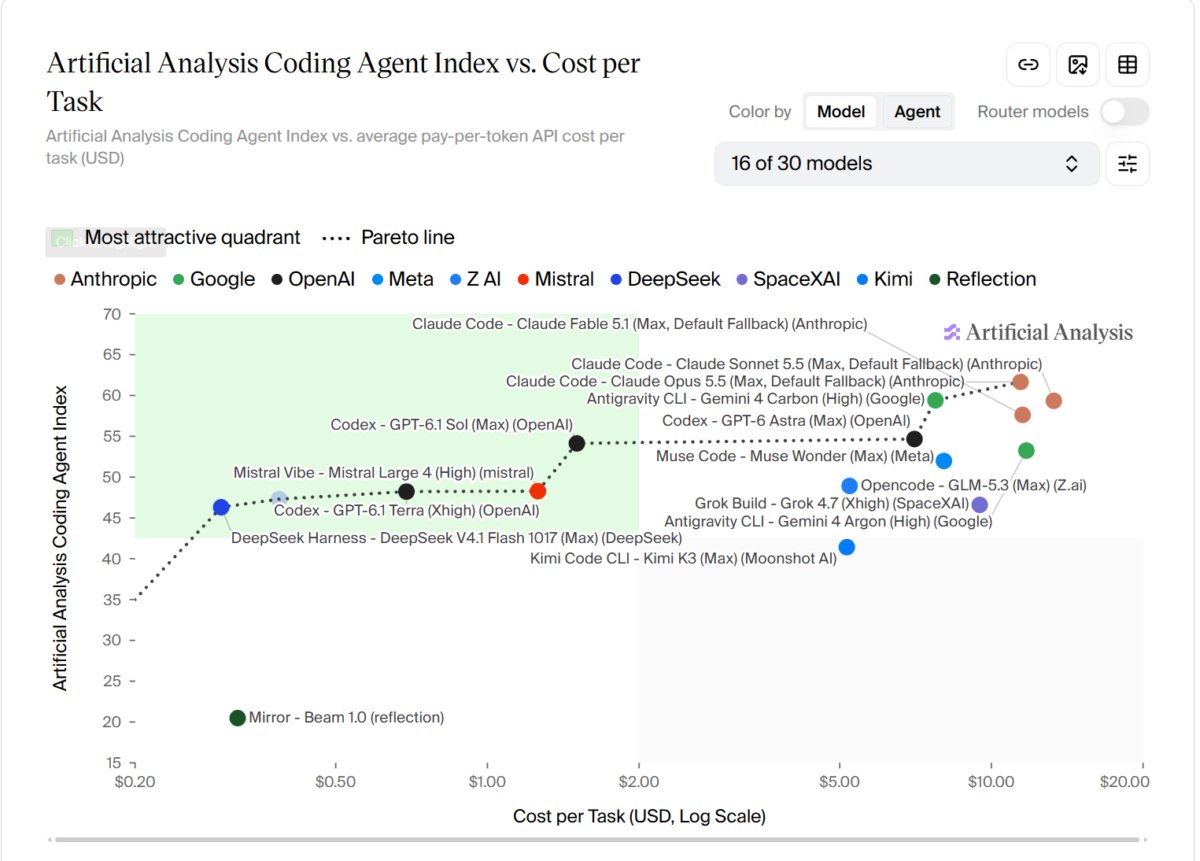
| Artificial Analysis Coding Agent Index | , | 48% | GLM-5.3 at 48-49% |
| Surge Code (blind preference) | , | 64% win rate vs. GLM-5.3 | Claude Opus 5.5 wins 78% |

The Terminal-Bench 4.0 jump from 28% to 41% in three weeks is the kind of training acceleration that makes researchers sit up. But the more important number might be the token efficiency: Mistral claims Le Chonk matches GLM-5.3 on the Coding Agent Index while using 47% fewer tokens per task on average. For teams running coding agents for hours, that’s not a rounding error, that’s a compute budget revelation.
The FrontierCode 2.0 result deserves particular attention. This private benchmark from Cognition assesses whether a repository maintainer would actually merge the agent’s changes, real-world code quality, not just syntactically correct output. At 19.7%, Le Chonk leads all open-weight models, though the gap to Claude Opus 5.5’s 46% illustrates the proprietary frontier still has altitude.
Built for the Defenders: The Cybersecurity Play
Here’s where Mistral is carving genuinely new territory rather than just catching up. The company has positioned Le Chonk as a defensive cybersecurity weapon, with scores to back it up:
- 51% on the Artificial Analysis Cyber Index, which tests finding, reproducing, validating, and patching vulnerabilities without breaking existing functionality
- 79% on CyberGym-E2E, matching MiMo-V2.6-Pro and beating DeepSeek V4.1 Flash’s 76% on real memory-safety bugs in C/C++ projects
- 96.6% average refusal rate on malicious cyber requests, the highest among open models, tested against JailbreakBench, StrongREJECT, and AgentHarm

The security posture isn’t just about benchmarks, it’s about deployment philosophy. Cloudflare’s Chief Strategy Officer Stephanie Cohen captured the argument: “When threats move at machine speed, human defense cannot keep pace. Worse, a defense you don’t control isn’t defense, it’s exposure.”
This is the sovereign AI pitch distilled: open weights mean you can audit the architecture, deploy on your own infrastructure, and maintain full control of your defense stack. For governments and regulated industries, that’s not a nice-to-have, it’s becoming a compliance requirement.
The company is also being unusually candid about the double-edged nature of these capabilities. Mistral acknowledges that during live-traffic monitoring, it observed “a potential for uplift to conduct real attacks” and is modifying guardrails accordingly. The specialized cybersecurity variant being tested with partners like Orange Cyberdefense comes with rigorous vetting and contractual safeguards, restricted to owned or explicitly authorized systems.
The Three Faces of Reasoning: Cost Control Meets Capability
One of the more practical additions is the three-tier reasoning system. Rather than forcing developers to choose between a “quick answer” mode and “deep thinking” mode, Le Chonk now supports:
| Mode | Recommended Use | Token Profile |
|---|---|---|
| Low | Simple tasks, replaces the old ‘None’ reasoning mode | Minimal |
| Medium | Everyday tasks | Balanced |
| High (default) | Hardest use cases requiring precision and thorough reasoning | Maximum |
This granularity matters for enterprise deployment. Not every agent task requires exhaustive reasoning, and the ability to match reasoning depth to task complexity without prompt engineering is a significant operational advantage. Teams can now build pipelines where routine queries route to Low mode while complex architectural decisions get the High mode treatment, all without managing multiple models.
The efficiency gains extend beyond reasoning modes. The model generates 161 tokens per second (up from 111 at preview), and the average cost per index task dropped from $5.54 to $2.06. API pricing is aggressive at $0.70/M input tokens and $2.10/M output tokens, with cached input at just $0.07/M.
The LLM License That Isn’t Quite What It Seems
Before the celebration gets too loud, let’s talk about the “open” in open-weight. The Mistral Ecosystem Open-Weight license is a modified MIT license with one significant catch: businesses operating a Model-as-a-Service offering must obtain a separate commercial license from Mistral.
This has drawn sharp criticism from the open-source community. As one Hacker News commenter pointed out, this isn’t really “open source” in the OSI sense, it’s “weight-available” or “source-available” territory. The same critique applies to Qwen, GLM, Kimi, and others, the industry has been stretching the term “open” to cover increasingly restrictive licensing.
For most developers and enterprises, the license is genuinely permissive: free to use, modify, fine-tune, and commercialize internally. The restriction only kicks in if you’re building a hosting service around the model. That’s a reasonable business protection, Mistral needs to monetize somehow, and API hosting is their obvious revenue stream.
But the semantic debate matters. The distinction between “open weights” and “open source” has significant implications for what enterprises can build on top. This is the architectural and systemic implications of open-weight AI models conversation that keeps the community divided.
The European Sovereign AI Gambit
Mistral isn’t just selling a model, it’s selling a geopolitical alternative. The “sovereign AI” framing is central to their identity, and Le Chonk is the strongest evidence yet that the pitch has substance.
Trained from scratch on European infrastructure with clear lineage from inception to release, Le Chonk gives organizations a verifiable foundation. This matters for European banks, government agencies, and critical infrastructure operators who face increasing scrutiny about where their AI capabilities come from and who controls them.
The enterprise endorsements read like a who’s who of European institutional trust: La Banque Postale, ABN AMRO, Crédit Agricole, ASML, ESA, and Belfius are all on record supporting the sovereign AI vision. At a moment when Mistral’s CEO is proposing European AI taxation schemes to level the playing field, Le Chonk provides tangible evidence that European AI can compete at the frontier.
Mistral VP of Science Pierre Stock frames the core argument with an electricity metaphor: AI is going to be like electricity, and no company should depend on someone who can cut off its access “from one day to another.” Once weights are public, access cannot be withdrawn.
Blockchain of the AI World: The Reality Check
Now, the skeptical take. Because there are legitimate concerns beyond the licensing issue.
The Intelligence Index gap. On Artificial Analysis’s updated Intelligence Index, Le Chonk scores 26 points. That’s better than the open-model median of 23, but well behind DeepSeek V4.1 Flash and GLM-5.3 at 32, and nowhere near Gemini 4 Carbon’s 59 or Claude Opus 5.5’s 58. If you’re a generalist AI consumer, Le Chonk isn’t the smartest model in the room.
The cybersecurity claims need context. Mistral’s own chart shows two models ahead of it on the Cyber Index, DeepSeek V4.1 Flash at 57% and MiMo-V2.6-Pro at 56%. The 51% score puts Le Chonk third among open models, not first. The company’s “leading open model for cyber defense” framing is… let’s call it “aggressive marketing.”
The looming Kimi threat. Moonshot’s Kimi K3.1 Pro tops Terminal-Bench 4.0 at 67% and is set to release its weights by November 4. If that happens, Le Chonk’s coding crown could have a very short shelf life.
The benchmark skepticism. There’s a growing community sentiment that Artificial Analysis’s methodology has become unreliable. The accusations range from benchmark manipulation to editorial bias, with some going so far as to recommend ignoring the index entirely. The v5.0 index changes reportedly downgraded open models 3-4x more than closed ones, which statistically strains credibility.
The Hardware Reality: You’ll Need a Deep Pocket
Let’s address the elephant in the server room: running Le Chonk requires serious infrastructure. According to SGLang documentation, the standard version runs on eight Nvidia B300 GPUs, with a more heavily compressed variant running on four GB300 GPUs. That’s not exactly laptop territory.
Mistral promises smaller, distilled versions in the coming months, including one that runs on a laptop, but they won’t commit to dates. For now, this is a model for organizations with serious GPU budgets or managed cloud deployments.
The deployment options are extensive: Hugging Face weights, vLLM or SGLang self-hosting, NVIDIA NIM containers, Microsoft Foundry, OpenRouter, and the Mistral API. For teams that want the control without the infrastructure overhead, the managed routes are viable.
What This Means for the AI Landscape
Let’s zoom out and consider the strategic implications, because Le Chonk isn’t just a model, it’s a marker in the sand.
The open-weight race is no longer China’s to lose. Mistral has demonstrated that Western labs can produce frontier-competitive open models without trillion-dollar valuations. The previous open-weight releases from Mistral established a pattern, but Le Chonk is a different caliber entirely.
The proprietary frontier is being flanked. While OpenAI, Anthropic, and Google battle over the absolute best model, open-weight alternatives are achieving “good enough” at a fraction of the cost. For the vast majority of enterprise use cases, Le Chonk’s capabilities are sufficient, and the control advantages are compelling.
Sovereign AI has its first real champion. European institutions finally have a credible frontier model they can own, customize, and audit. The broader strategic ambitions of Mistral suggest this is just the opening move.
The cost-performance frontier is shifting. The scatter plot tells the story: models are increasingly clustered in the “good enough and cheap” quadrant, with only a few chasing the “absolute best and expensive” corner.
The Verdict: Download It, But Read the Fine Print
Le Chonk is a genuine achievement. Three weeks of additional training produced measurable gains across every major benchmark, and the token efficiency improvements are the kind of thing that saves engineering teams real money.
If you’re building coding agents, Le Chonk is absolutely worth evaluating. The Terminal-Bench 4.0 score, the FrontierCode 2.0 result, and the token efficiency combine to make a compelling case. The cybersecurity capabilities are a bonus that could justify deployment in security-conscious organizations.
But understand what you’re getting: an open-weight model with a commercial licensing caveat, strong but not frontier-general intelligence, and hardware requirements that preclude casual experimentation. The “open” in open-weight carries asterisks, and the challenges Mistral has faced with previous open model releases suggest the community will scrutinize every claim.
The deeper question, the one that makes this release genuinely important, is whether Le Chonk signals a sustainable Western counter-offensive in open AI, or a one-time triumph built on favorable conditions. For that answer, we’ll need to see what Mistral ships next and whether they can maintain “the cadence of the frontier”, as Pierre Stock put it.
For now, Le Chonk has done something no Western model has managed in over a year: it made the open-weight race genuinely competitive again. And it did it with a name that makes it impossible to take too seriously, which might be the most European move of all.
Ready to dig into running open-weight models? Check out our analysis of the architectural implications of the open-weights paradox, or explore how licensing choices are shaping the open-source AI landscape.