“JEV”, a three-letter acronym that’s been popping up everywhere, leaving half the community scratching their heads and the other half accusing the first half of living under a rock.
“I am seeing this JEV everywhere since yesterday in Localllama and it is passing past my head on what it is?” asked one confused soul. The post racked up 318 upvotes in under 14 hours, with 59 comments ranging from genuinely helpful explanations to accusations of astroturfing.
So what is Jev? Is it a new LLM? An elaborate meme? A marketing stunt? The answer, as it turns out, is both simpler and more interesting than any of those options.
It’s Not an LLM. It’s Not Even Trying to Be One.
Here’s the short version: Jev is TypeSafe AI’s first System One model, a new class of AI model that doesn’t generate text at all. Instead of autoregressively predicting tokens until it produces a paragraph, Jev takes in unstructured state plus structured questions and returns typed, probabilistic decisions.
Think of it less as a chatbot and more as a “frontier-intelligence function call”, as the TypeSafe announcement puts it. Unstructured state goes in, typed probabilistic decisions come out.
If that sounds like a glorified classifier, you’re not wrong. It as “a decision model. It takes in unstructured input or structured Json, and a request for a decision. It outputs Json with either a yes or no, a list of choices ranked by probably of being the right choice with a confidence number, or, it rates your choices.”
The community quickly noted the irony: this thing isn’t local, and it isn’t an LLM. But that doesn’t stop it from being genuinely interesting.
The Technical Breakthrough: Parallel Sampling
Here’s where Jev actually gets interesting. Traditional LLMs generate output sequentially, one token at a time, each conditioned on the previous one. That’s why asking GPT-5.6 Terra to classify something takes 3-329 seconds. Every token requires a full forward pass.
Jev doesn’t work that way. It uses what TypeSafe calls a parallel sampler, all outputs are generated in a single query. Instead of generating JSON token by token, Jev produces all probabilities in one parallel pass. The end-to-end response time is 70-500ms, regardless of how many questions you pack into a single request.
The practical implication is staggering. A LangChain blog post demonstrates a support-ticket triage system where Jev evaluates urgency with a simple request:
{
  "model": "jev-latest",
  "state": "Hi, I've been trying to connect my Stripe account for 3 days and it keeps failing. I'm losing sales. Please help ASAP.",
  "questions": {
    "is_urgent": {
      "type": "noul",
      "instructions": "The message conveys urgency or time-sensitivity"
    }
  }
}
The response comes back in milliseconds:
{
  "is_urgent": {
    "type": "noul",
    "noul": 0.999
  }
}
That’s a 99.9% probability the message is urgent, returned faster than you can blink, at a fraction of the cost of a frontier LLM call.
The Price Tag That Breaks the Economics
Speaking of cost, this is where Jev’s numbers get genuinely absurd. TypeSafe prices input tokens at $0.042 per million ($42 per billion). Output tokens are free, literally described as “too cheap to meter.”
Compare that to the frontier LLM landscape:
| Property | Frontier LLM (GPT-5.6, Opus 5) | Jev (System One Model) |
|---|---|---|
| Output | Generated strings, need parsing | Typed values, schema-guaranteed |
| Sampling | Sequential, one token at a time | Parallel, single query |
| Input price / 1M tokens | $0.20-$10 | $0.042 |
| Output price | ~5x input | Free |
| Latency | 3-329s | 70-500ms |
| Hallucination / type errors | Possible | Impossible by construction |
| Confidence | Overconfident, inconsistent | Calibrated per output |
On TypeSafe’s own workflow benchmarks, Jev hits 67.8% accuracy on complex multi-step workflows, essentially tied with GPT-5.6 Terra (67.9%) while costing 1/76th as much per case and running 25x faster. The accuracy leaders, GPT-5.6 Sol at 74.1% and Claude Opus 5 at 73.1%, maintain a real edge, but you’re paying 200-400x more for those few points.
“Can’t Hallucinate” Is a Marketing Dodge (But Also Kind of True)
TypeSafe makes a bold claim: Jev cannot hallucinate. The community, predictably, pushed back. As one technical observer noted, Jev can absolutely still pick the wrong choice, it just can’t invent a choice that wasn’t in your list.
That’s arguably a semantic dodge. If I give you a multiple-choice question and you pick the wrong option, you’ve still made an error, even if you didn’t invent a new answer. But there’s a deeper point worth acknowledging: the failure mode is different. When an LLM hallucinates a tool call, it breaks your pipeline. When Jev picks the wrong predefined option, your software still works, it just routes the ticket to the wrong department.
For automation, that distinction matters enormously. A 5% error rate where the error is always a valid structured value is far more manageable than a 5% error rate where the model sometimes outputs gibberish JSON.
The Open Source Elephant in the Room
The community has been quick to point out that Jev isn’t exactly breaking new ground. The most interesting pushback came from developers who noted you can replicate much of Jev’s functionality with existing open-weights models by exploiting a simple trick: aggressively prefill a regular LLM and constrain it to generate just one token.
As one developer demonstrated, you can get a 2-3x speedup with Qwen2.5-1.5B-Instruct using this approach versus standard structured output. Extend that with inference batching, and you can approximate Jev’s parallel magic with hardware you already own.
There’s also Laya, an open-source project that claims to deliver similar capability. The author published a paper on arXiv in March 2025, months before Jev’s announcement. TypeSafe’s “revolutionary” approach is really just good engineering on top of known techniques.
Then there’s OpenJev on Hugging Face, which uses last-token pooling on a repurposed generative backbone. The difference, according to technical commentary, is that Jev was “trained ground-up with RLCD for calibrated output probabilities, whereas openjev extracts uncalibrated logits from a repurposed generative backbone.”
That distinction, calibrated probabilities, might be the real moat, even if the raw architecture isn’t revolutionary.
Why the Doom Demo Matters More Than You Think
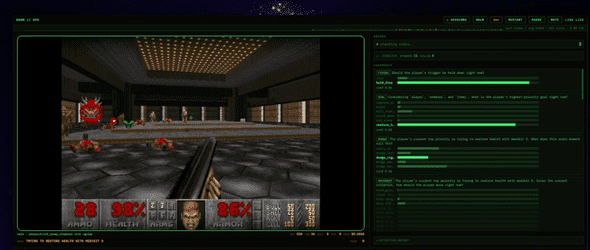
TypeSafe’s most compelling demo has Jev playing Doom in real-time, not by generating text, but by making structured decisions about game state roughly 10 times per second. An engineer worried about making 10 queries per second, which would cost about $7/hour of inference.
For context: that’s completely impractical with a frontier LLM, where you’d be looking at 3-329 seconds per decision. You literally couldn’t play the game, the model would be reacting to a state that existed minutes ago.
As Sean Goedecke’s analysis points out, this is the real insight: “fast software doesn’t just mean we can do the same tasks faster, it means we can do entirely new kinds of tasks.” Nelson Elhage said it first, and it applies here perfectly. Jev isn’t just a cheaper classifier, it’s a computational primitive that enables categories of applications that simply weren’t possible before.
A game AI that thinks 10 times per second. A trading system that evaluates risk in 100ms. An email triage system that processes a million transcripts for $500. These aren’t marginal improvements, they’re qualitatively different capabilities.
The Legitimate Skepticism
For all the hype, there are real questions that deserve answers:
Is the accuracy claim real? TypeSafe’s benchmarks are internally generated, with workflows written by their own team. The numbers are refreshingly upfront about potential bias, but until an independent evaluation reproduces the 67.8% accuracy figure, treat it as vendor-reported.
Is the pricing sustainable? TypeSafe admits it can’t prove the pricing isn’t subsidized. At $0.042 per million input tokens, they’re dramatically undercutting every major provider. Either they’ve found a genuinely more efficient architecture, or they’re burning cash to buy market share.
Is RLCD actually a breakthrough? TypeSafe’s “Reinforcement Learning for Calibrated Decisions” sounds impressive, but it could be a rebrand of existing techniques. The company hasn’t published details about the training methodology, the architecture, parameter counts, or anything that would let an independent researcher verify the claims.
Is this a Jevons paradox? The model is named after William Stanley Jevons, the economist who observed that steam engines becoming more efficient led to increased coal consumption, not decreased. TypeSafe’s bet is that cheap intelligence will unlock exponentially more use cases, which, if true, means we’ll collectively spend more on AI inference, not less. That’s a bold philosophical stance embedded in the product’s name.
What the Community Gets Right
The LocalLLaMA skepticism is healthy, even when it veers into cynicism. This is the community that gave us Kimi K2.5’s massive 1T parameter model and its practical limitations deep dive and continues to push future of powerful local LLMs like 30B ‘Mythos at home’ models. They’ve seen too many “revolutionary breakthroughs” that turned out to be clever marketing.
The accusations of astroturfing are pointed but not baseless. When a new model name appears simultaneously across Twitter (X), Reddit, and tech blogs with suspicious uniformity, it’s reasonable to wonder. However, the substance of the discussion, technical comparisons, use case exploration, and genuine attempts to understand the architecture, suggests real interest, not just orchestrated hype.
The Verdict
Jev isn’t a meme, and it isn’t the second coming of AGI. It’s a genuinely different approach to a narrow but important problem: making fast, reliable, structured decisions inside software.
The real story isn’t Jev itself, it’s the architectural shift it represents. For years, we’ve built AI systems as chatbots with extra steps. TypeSafe’s bet is that software doesn’t need paragraphs, it needs decisions. That’s a bet on a future where AI is composed of specialized primitives rather than one almighty model doing everything.
Whether Jev succeeds or fades into obscurity, the question it raises will persist: why are we paying for 3,000 tokens of prose when we only need a yes/no answer? Why are we waiting 30 seconds for a routing decision when 100 milliseconds is technically possible?
The challenges of running advanced LLMs locally due to hardware costs that dominate r/LocalLLaMA discussions might find an answer not in bigger hardware, but in smarter model design, models that don’t try to do everything, but do one thing blindingly fast.
Jev isn’t the answer. But it’s asking the right question. And that’s worth paying attention to, even if, especially if, you’re skeptical of the hype.
The surrounding code constrains their freedom, making them easier to compose into reliable systems. And that might be the most important idea in AI this year.