The machine learning community has a type. Every few months, something comes along claiming to upend the status quo, and we collectively roll our eyes until the benchmarks drop. Jev, TypeSafe AI’s new “system one” decision model, hit that cultural moment two weeks ago with the force of a freight train. Now the benchmarks are here, and they’re not just impressive, they’re genuinely awkward for anyone who’s spent the last decade building TF-IDF pipelines.
A recent Reddit benchmark comparing Jev against ML/sklearn pipelines showed something that should make every ML engineer pause: Jev beats embedding + logistic regression on zero-shot tasks across most benchmarks, without any fine-tuning, without any labeled data, and with the kind of reasoning capability that traditional pipelines simply don’t have.
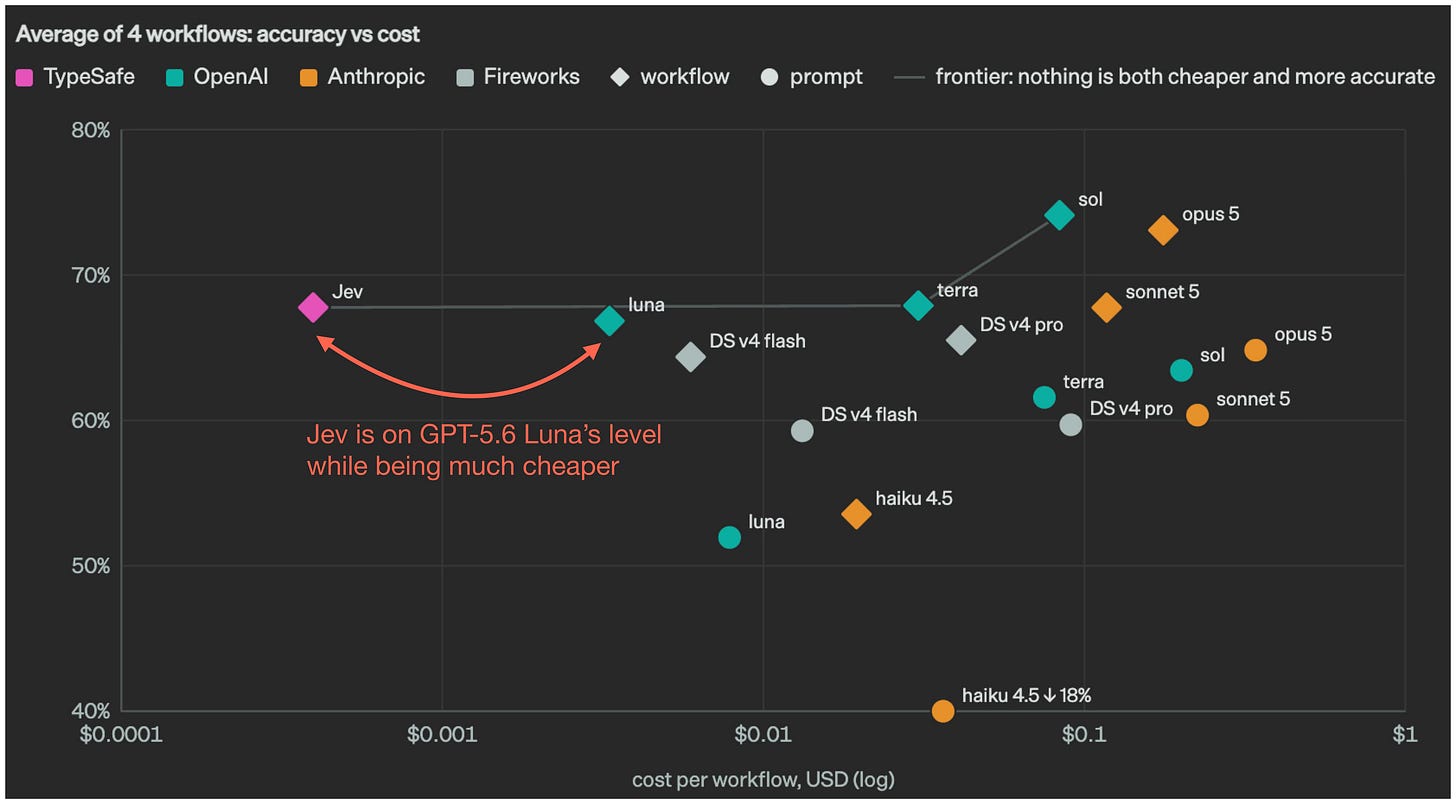
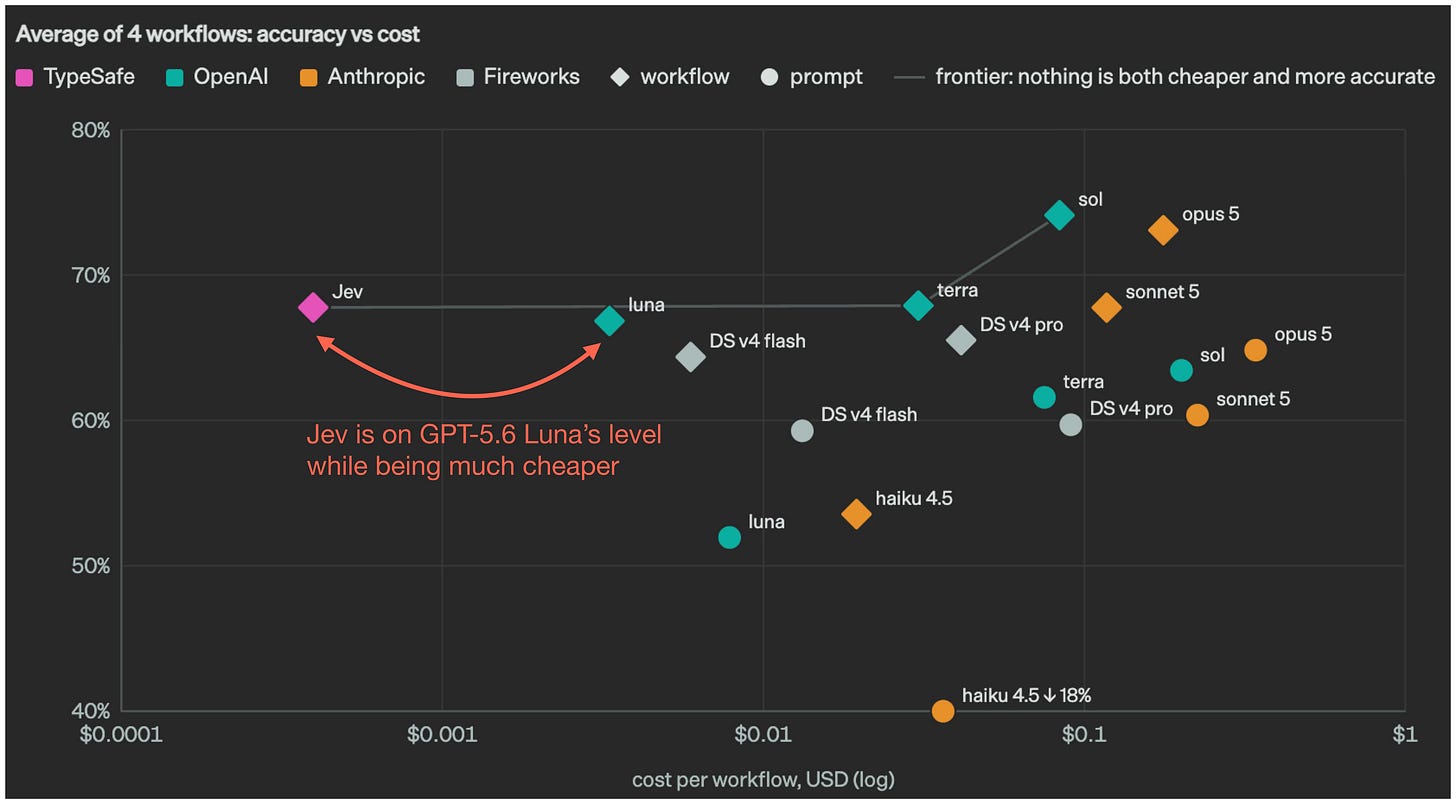
The “revolutionary” part isn’t that Jev is a classifier, we’ve had those for decades. It’s that it’s a classifier you don’t have to train, that costs fractions of a cent per decision, and that handles tasks from sentiment analysis to playing Tetris in real-time. That’s not an incremental improvement. That’s a different category of tool.
What Exactly Is Jev?
Before we get into the benchmark wars, let’s establish what we’re actually talking about. Jev is a proprietary model from TypeSafe AI that describes itself as a “decision model.” You feed it text (or even screenshots), define your classification criteria in plain English via JSON, and it returns typed responses, choices, yes/no probabilities, or ordinal scores, with calibrated confidence values.
The API is brutally simple. Here’s the Choice API for multi-class classification:
curl -sS https://api.typesafe.ai/v1/systemone \
  -H "Authorization: Bearer $TYPESAFE_API_KEY" \
  -H "Content-Type: application/json" \
  -d '{
    "model": "jev-1.13.0",
    "state": "The acting was excellent and the story kept me engaged throughout.",
    "questions": {
      "sentiment": {
        "type": "choice",
        "instructions": "What is the overall sentiment of this movie review?",
        "criteria": {
          "negative": "An overall unfavorable opinion of the movie",
          "positive": "An overall favorable opinion of the movie"
        }
      }
    }
  }'
You don’t train anything. You don’t build a vocabulary. You don’t run cross-validation. You just describe the problem and get back a structured answer with probabilities:
{
  "answers": {
    "sentiment": {
      "type": "choice",
      "choice": "positive",
      "confidence": 1.0,
      "probabilities": {"negative": 0.0, "positive": 1.0}
    }
  }
}
It’s the ChatGPT moment for classification, a general-purpose tool that handles arbitrary decision tasks without per-task fine-tuning. Except instead of generating tokens, it makes decisions in a single forward pass, which makes it orders of magnitude faster and cheaper than throwing a GPT-style LLM at the problem.
The Benchmark Smackdown: Jev vs. The Old Guard
The comparisons that matter aren’t against GPT-5.6 Luna or Claude Opus, of course a massive frontier model can classify text. The comparisons that sting are against the workhorse approaches that power most production ML systems today.
Sebastian Raschka ran Jev against the IMDb movie review dataset, and the numbers are worth sitting down for:
| Approach | Accuracy | Training Time | Inference Cost |
|---|---|---|---|
| Bag-of-words + Logistic Regression | 89.9% | Minutes | ~Zero |
| LSTM RNN (trained from scratch) | 85.66% | Hours | ~Zero |
| CNN (text) | 90.07% | Hours | ~Zero |
| ModernBERT (fine-tuned) | ~95% | 23 minutes | Hardware dependent |
| Jev (zero-shot, no training) | 96.47% | None | $0.65 for 25,000 reviews |
Let that sink in. Jev, with zero training, zero labeled data, and zero fine-tuning, beats every traditional approach on the same benchmark. It even edges out a fine-tuned ModernBERT. The entire 25,000-review test set ran in 22 minutes and cost less than a dollar.
The typical ML engineer’s response at this point is some variation of “sure, but my data is different.” And that’s fair, you should absolutely benchmark on your own data. But the pattern across diverse tasks is consistent enough that dismissing it entirely feels like denial.
Where It Actually Beats sklearn (And Where It Doesn’t)
The strongest case for Jev isn’t replacing your well-maintained, production-tuned classifier on a narrow task. Any specialized model trained on thousands of examples of one specific problem will likely beat a general-purpose zero-shot model at that exact problem. That’s not the point.
The point is what happens at the cold start. Consider these scenarios:
New classification problem with no labeled data
Previously, you’d spend days hand-labeling data, then more days building and tuning a pipeline. With Jev, you write a JSON prompt and have production-quality results in minutes.
Messy, multi-faceted problem
Traditional ML requires you to decompose problems into separate classifiers, routing tickets, detecting urgency, extracting intents. Jev handles multiple typed questions in a single API call with a single forward pass per question.
Need calibrated probabilities
One of Jev’s selling points is that confidence estimates are actually meaningful. In the Reddit benchmark discussion, this was highlighted as a critical advantage, the ability to know when the model doesn’t know, and route those cases to human review.
The community consensus, as captured in the benchmark comments, is that Jev’s strongest use is weak-label generation, proposing themes on small samples, surfacing likely mislabels, labeling large batches for human review, not replacing a well-maintained production classifier outright.
Think about customer feedback analysis. A zero-shot Jev model can propose themes on a sample, identify likely mislabeled examples, and pre-label a batch for human review. Compare that to your TF-IDF/logistic-regression baseline, and you might find Jev saves labeling time but introduces uneven errors on certain languages or regions. The traditional model might still win in production, but the exploration phase just got radically cheaper.
The Real Cost Comparison Nobody’s Talking About
The benchmark numbers that get attention are accuracy figures. The numbers that should concern you are the cost figures.
Running the full IMDb test set (25,000 reviews) through Jev cost approximately $0.65. Not $650. Not $65. Sixty-five cents. And it took 22 minutes with zero GPU infrastructure on your end.
For a support-ticket routing operation processing 10,000 emails per month, benchmark data from AkitaOnRails puts Jev at roughly $0.19 per 10,000 decisions, about $2.28 per year for 10,000 monthly classifications. Meanwhile, the cost of maintaining your own classifier infrastructure (GPU hours, MLOps pipelines, data labeling, model retraining cycles) is measured in thousands of dollars and dozens of engineer-hours.
The claims of breakthrough efficiency in compact models we’ve seen before have been messy. This one is starting to hold up under scrutiny.
The Open-Source Counteroffensive Is Already Here
Within days of Jev’s release, open-source clones started flooding Hugging Face. Most are quick fine-tunes of ModernBERT or Qwen models wrapped in a Jev-like API. Most don’t achieve the same performance. The open-source models outperforming expectations and disrupting benchmark norms trend suggests we’re due for something real, though.
OpenJev, an independent 27B-parameter decision model built on Qwen3.5, has achieved something remarkable: within 1.4 points of the hosted Jev API on 10,000 text questions from 34 public sources, and within 1.2 points on fresh additions the model had never seen (OpenJev: 84.0% vs. Jev: 85.4% on the full set).
And it’s open weights, runnable on your own hardware:
| Model | Accuracy on 10K Questions |
|---|---|
| Jev (hosted API) | 85.4% |
| OpenJev | 84.0% |
| Base model before tuning | 80.4% |
| Nimble 9B (open) | 75.7% |
The gap matters less than the trend. OpenJev achieves this on a single H100 with about 210ms per web decision and 80ms for a short text decision. That’s competitive with the hosted service’s latency profile, with open weights and no vendor lock-in.
The privacy angle is the real driver here. The cost isn’t the issue, Jev is cheap. The issue is that your customers’ support tickets, legal documents, and internal data pass through someone else’s API. For companies with data sovereignty requirements (GDPR, HIPAA, internal compliance), an open alternative with 1-2 points lower accuracy is a trade they’ll happily make. The performance differences between optimized and abstracted runtimes follow a similar pattern, the abstraction overhead of hosted services is increasingly hard to justify.
But Wait, There’s a Catch (Or Three)
Jev’s own CEO confirmed that “100% of our data is synthetic.” That’s either brilliant or terrifying depending on your perspective. The model was trained on curated synthetic data designed to teach general decision-making, not “crap spit out from an LLM”, as he put it, but carefully designed synthetic examples.
The concern is obvious: what happens when the model encounters something outside its synthetic training distribution? The benchmark data shows it struggles with legal reviews in non-English languages, for example. Multilingual performance is a weak spot that can be partially mitigated by chaining a translation model, but that adds latency and complexity.
There’s also the non-determinism issue. Running Jev twice on the same input produces slightly different results, Raschka observed a 96.47% vs. 96.20% accuracy variation between runs of the Choice and Noul APIs on identical data. This is likely due to GPU kernel execution ordering and is common across LLM serving stacks, but it’s uncomfortable when you’re trying to build reproducible decision systems.
The Strategic Question: What Does This Mean for Your ML Stack?
Let’s be blunt: if you’re building a high-volume, narrow classification pipeline for a specific, well-understood problem with abundant labeled data, you probably don’t need Jev. Your fine-tuned ModernBERT or even your bag-of-words + logistic regression baseline might still be the right production choice because you control everything, you understand the error modes, and you can optimize the hell out of it.
But the bar for justifying that fine-tuning work just got much higher.
Consider the decision framework:
- High volume, narrow task, labeled data available: Fine-tune your specialist model. This is still the right call for maximizing accuracy and speed.
- Low volume, diverse tasks, no labels: Jev or a Jev-like model is now the obvious default. The alternative, spending days labeling data and building pipelines, is no longer economically rational.
- Privacy-sensitive workloads: OpenJev and similar open-weight alternatives are close enough in accuracy to make self-hosting viable.
- Agent harnesses and decision routing: Jev-like models as pre-screeners, judges, and routers will become standard components. The idea of using a 400-billion-parameter model to decide whether a prompt is toxic is wasteful, Jev does it in milliseconds for fractions of a cent.
The foundation models redefining tabular data workflows hint at where this is heading: the era of task-specific classifiers for every problem is ending. Instead, we’ll have general-purpose decision models that handle arbitrary classification tasks with zero training. Specialist fine-tuning will remain for cases where it’s economically justified, but those cases will become exceptions rather than the rule.
The Verdict
Jev isn’t a magic bullet, and it isn’t “just a classifier with a nice API.” It’s the first practical instance of what happens when you take the reasoning capability of an LLM and strip away everything except the ability to make calibrated, typed decisions.
The sklearn comparison might feel unfair, sklearn is a library, not a hosted service with millions of dollars of engineering behind it. But that’s precisely the point. The workflow that made sklearn so powerful, load data, engineer features, train a model, deploy, is being disrupted by a model you just prompt. No training data, no feature engineering, no MLOps pipeline, no retraining cycles.
The pragmatic takeaway: benchmark Jev or a Jev-like model on your own data, today. Not because it will definitely beat your current pipeline, but because the cost of finding out is now so low that not trying is the expensive decision.
Microsoft already launched a Jev-like Decision API. OpenAI announced its own at DevDay. The space is moving from “is this real?” to “which vendor do I bet on?” The window for being early is closing.
And remember, the disconnect between high benchmark scores and real-world usability is a real phenomenon. The benchmarks look great. The real test is your data, your users, and your error tolerance. Run the pilot, measure the calibration, check the error rates on edge cases. Then decide.
The horse-drawn carriage isn’t obsolete yet. But the automobile just pulled into the driveway.