
Tabular data is the unsung workhorse of enterprise machine learning. Customer churn, fraud detection, credit scoring, inventory forecasting, the vast majority of business-critical ML runs on rows and columns. And for years, the workflow has been painfully consistent: load a CSV, spend hours engineering features, run a hyperparameter sweep on XGBoost, cross-validate, deploy, repeat.
Google Research just dropped a grenade in that pipeline. TabFM is a zero-shot foundation model for tabular data that takes a table it has never seen and returns predictions in a single forward pass. No training. No hyperparameter search. No feature engineering. It’s the tabular equivalent of what LLMs did to NLP, and the implications for data science workflows are enormous.

The Bottleneck That Refuses to Die
Tree-based models, XGBoost, CatBoost, random forests, have dominated tabular ML for years because they handle mixed data types, missing values, and nonlinear interactions well. But the deployment cost is quietly astronomical. Fitting an XGBoost model to a new dataset is rarely a single .fit() call. Data scientists burn hours on hyperparameter optimization, feature engineering, and cross-validation loops. Every new table repeats the cycle.
The community has been watching this space closely. As one researcher noted on a developer forum, “Our experiments have shown our own TFM trained over massive multicountry, real datasets outperform publicly available TFMs over unseen data.” The implication is clear: the bar for a zero-shot model is high, and practitioners are skeptical.
TabFM doesn’t just lower the bar, it removes the entire training step. The model reframes tabular prediction as an in-context learning (ICL) problem, the same technique that lets LLMs learn new tasks from examples in the prompt without updating weights.
How TabFM Actually Works
Traditional supervised ML updates parameters to match each dataset’s distribution. TabFM does not. At inference time, it receives the entire dataset, training rows with labels and test rows without, as a single unified context. The model learns column relationships and row patterns from that context in one forward pass.
But tables aren’t text. You can’t naively tokenize a CSV like a sentence. Swapping two rows or two columns doesn’t change the underlying meaning, but a sequential language model would treat it as entirely different input. TabFM’s architecture solves this with a hybrid design that synthesizes ideas from TabPFN and TabICL.
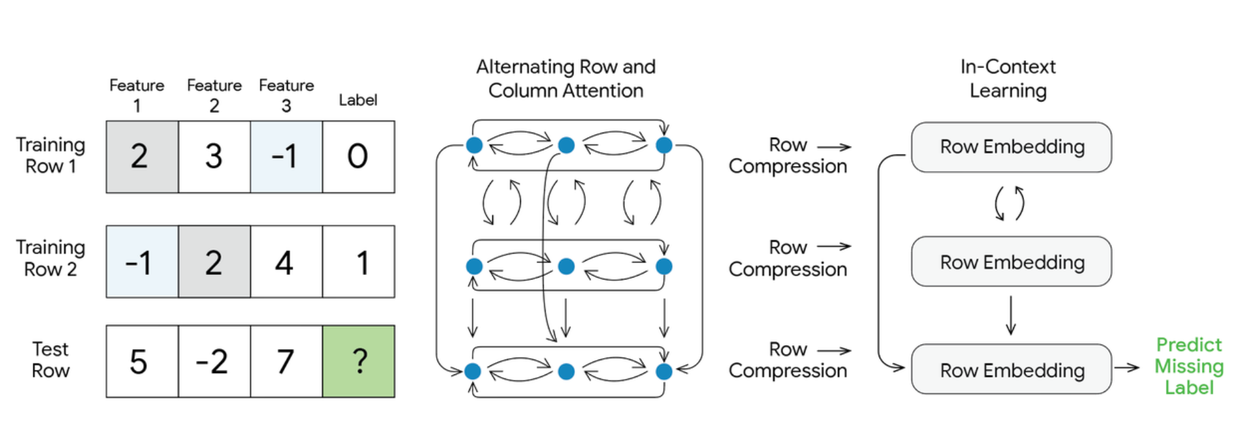
The architecture relies on three mechanisms:
Alternating row and column attention: The raw table passes through a multilayer attention module that alternates across columns (features) and rows (examples). This captures feature interactions and dependencies without hand-built crosses, the work data scientists usually do manually.
Row compression: Each row’s cross-attended information compresses into a single dense vector, reducing the 2D grid to a 1D sequence of row embeddings.
In-context learning on compressed rows: A 24-block causal Transformer attends over these compressed row vectors, treating training rows as context and outputting predictions for test rows. This keeps compute manageable on larger tables.
The key hyperparameters tell the story of a serious model:
| Parameter | Value |
|---|---|
| Embedding dim | 256 |
| Column attention blocks | 3 (4 heads, 256 induced points) |
| Row attention blocks | 3 (8 heads, 8 CLS tokens) |
| ICL transformer blocks | 24 (8 heads) |
| Feed-forward factor | 4 |
| Max classes | 10 |
| Activation | SwiGLU |
| Fourier features | 32 frequencies |
The Synthetic Data Gambit
Foundation models need vast, diverse training data. But high-quality tabular datasets are critically scarce in the open-source space. Industrial tables carry proprietary schemas and sensitive information, making them inaccessible for broad pre-training.
Google’s solution is blunt: train entirely on hundreds of millions of synthetic datasets generated dynamically using structural causal models (SCMs). The justification is pragmatic, synthetic tables can be generated to be arbitrarily large, making them effectively the only viable option for pre-training a foundation model at this scale.
This approach has drawn both interest and skepticism. One practitioner working on privacy-sensitive corporate data noted, “The post itself says that using synthetic data is their only way to train these models, given the sensitive nature of industrial data.” Their lab’s experiments showed that models trained on real, multi-country datasets outperformed publicly available TFMs on unseen data. The synthetic data question remains open.
Benchmarking: The TabArena Results
Google evaluated TabFM on TabArena, a living benchmark that calculates Elo scores from head-to-head win rates. The evaluation spans 38 classification datasets and 13 regression datasets, with sample sizes ranging from 700 to 150,000 rows.
Two configurations were tested:
- TabFM: Out-of-the-box, single forward pass, no tuning or cross-validation
- TabFM-Ensemble: Adds cross features and SVD features, computes optimal weights for a 32-way ensemble using a non-negative least squares solver, plus Platt scaling for classification calibration
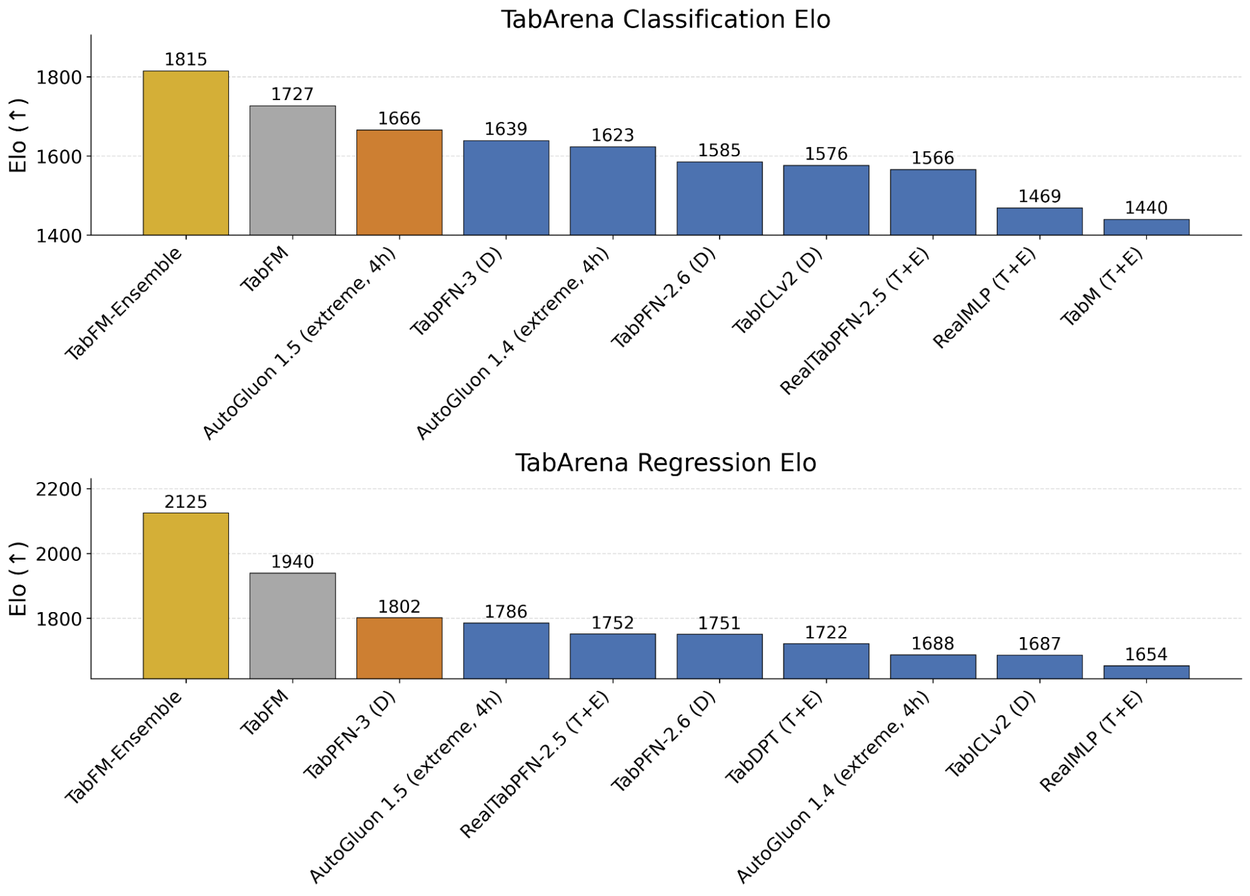
The results show TabFM sitting at or above heavily tuned industry baselines on both classification and regression tasks. The comparison table tells the story:
| Aspect | Traditional GBDT (XGBoost) | TabFM | TabFM-Ensemble |
|---|---|---|---|
| Per-dataset training | Required | None (in-context learning) | None |
| Hyperparameter tuning | Extensive, manual | None | Ensemble weights via NNLS |
| Feature engineering | Manual, domain-specific | Learned by attention | Adds cross + SVD features |
| Prediction | After full training | Single forward pass | 32-way ensemble |
| Calibration | Manual (optional) | , | Platt scaling (classification) |
But the honest caveats matter. The evaluation doesn’t provide per-dataset head-to-head numbers against XGBoost, CatBoost, or earlier tabular foundation models. It doesn’t test on messy enterprise tables with drift, rare categorical values, or leakage. As one commenter put it, “I am skeptical about models trained on real data. If they have been trained on data similar to my validation or test sets, I get unrealistic performance estimates.”
Getting Your Hands Dirty: Code and Usage
TabFM v1.0.0 is available on Hugging Face and GitHub with a scikit-learn-compatible API. Installation is straightforward:
pip install tabfm[pytorch]Classification is a few lines:
from tabfm import TabFMClassifier, tabfm_v1_0_0_pytorch as tabfm_v1_0_0

model = tabfm_v1_0_0.load(model_type="classification")
clf = TabFMClassifier(model=model)
clf.fit(X_train, y_train)
probs = clf.predict_proba(X_test)
Regression follows the same pattern:
from tabfm import TabFMRegressor, tabfm_v1_0_0_pytorch as tabfm_v1_0_0

model = tabfm_v1_0_0.load(model_type="regression")
reg = TabFMRegressor(model=model)
reg.fit(X_train, y_train)
preds = reg.predict(X_test)
The fit() method prepares ordinal encoders and numerical scalers, it does not train model weights on your data. The actual prediction happens through in-context learning in a single forward pass.
The BigQuery Integration: SQL-Native ML
Google plans to expose TabFM through BigQuery in the coming weeks. Users will be able to run regression and classification using a simple AI.PREDICT SQL command, no ML expertise required. This mirrors the path Google took with TimesFM for time-series forecasting.
The implications for enterprise analytics are significant. Analysts who never touch Jupyter notebooks could prototype churn or fraud models the same way they run aggregations today. The developer experience shifts from spinning up an AutoML pipeline to writing a SQL query.
The Honest Limitations
TabFM is impressive, but it’s not magic. The limitations are worth understanding:
Max 10 classes for classification. This is a hard architectural limit. If your problem has 11+ classes, TabFM won’t work out of the box.
Memory scales with training rows. All training rows are passed as context. For datasets with hundreds of thousands of rows, this becomes expensive. As one practitioner noted, “It has serious drawbacks since it requires inputting the entire training set for each prediction. But for small datasets, without real-time processing requirements, it looks like a new option worth considering.”
Optimized for tables up to 500 features. Behavior on very wide tables may degrade.
Synthetic training data risk. Real tables with extreme domain shift may still need fallbacks. Google reports strong TabArena generalization, but your mileage on proprietary schemas may vary.
Non-commercial license. The model weights are released under the TabFM Non-Commercial License v1.0. The source code is Apache 2.0, but the weights themselves have restrictions.
The BigQuery Integration: SQL-Native ML
The most interesting move isn’t the model itself, it’s the deployment path. Google is integrating TabFM directly into BigQuery. In the coming weeks, users will be able to perform advanced regression and classification using a simple AI.PREDICT SQL command.
This is a fundamentally different developer experience from spinning up an AutoML pipeline. It puts tabular foundation model inference next to SQL dashboards without a separate training pipeline. For teams already on Google Cloud, the friction reduction is substantial.
What This Means for Practitioners
The honest assessment from the community is mixed but leaning optimistic. One practitioner summarized it well: “If TabFM holds up on real business tables the way it does on TabArena, the day-to-day of building a churn or fraud classifier changes shape: fewer AutoML sweeps, more SQL.”
The two things to watch closely: whether independent teams can reproduce the Elo results on their own messy data, and how the BigQuery AI.PREDICT rollout is priced and rate-limited once it lands.
For data scientists tired of HPO loops, TabFM is a credible zero-shot first pass before investing in XGBoost tuning. For ML platform teams, the sklearn API plus Hugging Face weights plus impending BigQuery SQL lowers integration friction significantly.
The interesting move in tabular ML this year isn’t a new gradient boosted tree. It’s the idea that you shouldn’t have to train a model at all. TabFM is a serious step in that direction, and the conversation it’s sparking is exactly what the field needs.