Here’s the thing about the semiconductor industry: for the past two decades, the architectural conversation has been a two-party system. x86 for the heavy lifting, ARM for the efficiency play. Everyone else fights for scraps. Then Fujitsu drops MONAKA, and suddenly the political science of chip design gets a whole lot more interesting.
When Fujitsu announced global sales of its in-house FUJITSU-MONAKA CPU starting November 2026, the press release was heavy on the usual vendor language, “world-class”, “sovereign AI infrastructure”, “next-generation.” But strip away the marketing gloss and you’re left with something genuinely unusual in 2026: a major player betting that vertical integration from silicon to software isn’t just viable, it’s the only sane response to a geopolitical landscape where computing infrastructure is now a national security asset.
This isn’t your grandfather’s mainframe play. Let’s dig into why MONAKA matters beyond the spec sheet, and what it signals for system architects who’ve spent their careers assuming the ISA layer is someone else’s problem.
The Two-Nanometer Gambit Nobody’s Talking About
Let’s start with the actual silicon, because the engineering choices here reveal more than any marketing slide ever could. MONAKA is built on a 3D-stacked architecture that pairs a 2nm process for the core with a 5nm process for cache and I/O sections.
Stop and think about what that means for a second. Most chipmakers pick one process node and design the entire die around it. Fujitsu instead split the difference: the compute cores get the bleeding-edge 2nm treatment (courtesy of their NEDO-subsidized research, a project funded by Japan’s New Energy and Industrial Technology Development Organization), while the less performance-critical cache and I/O blocks stay on the more mature, cheaper 5nm node.
That’s not just clever engineering, it’s a cost optimization strategy that quietly undermines one of the industry’s most expensive dogmas: the assumption that you need every transistor on the most advanced node money can buy. By stacking a 2nm compute die face-to-face with a 5nm SRAM die holding the entire last-level cache, plus a third I/O die, Fujitsu gets performance where it matters and cost efficiency where it doesn’t.
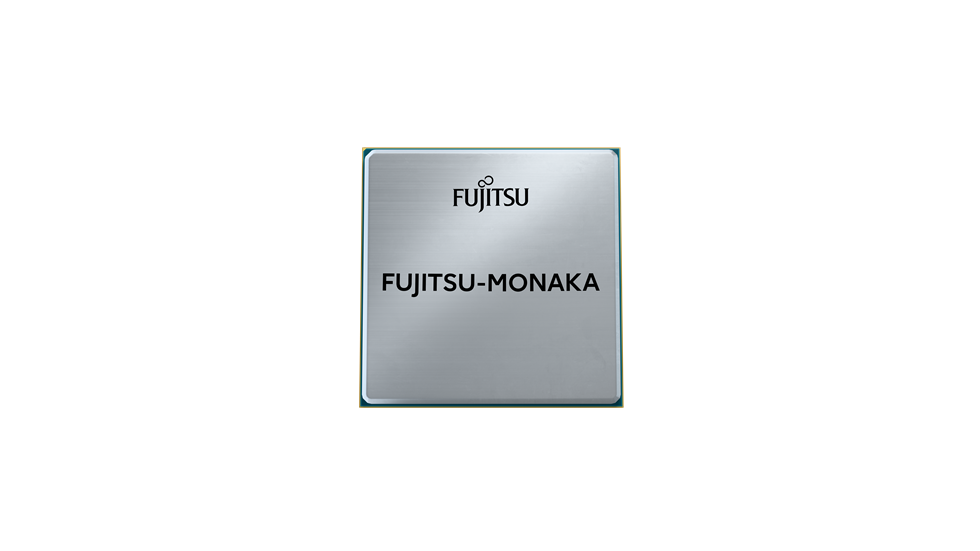
The headline numbers are equally attention-grabbing: up to 144 cores, 3.8GHz maximum frequency, and 8800MT/s DDR5 memory support. Fujitsu claims twice the AI inference throughput compared to competing CPUs, powered by dedicated matrix operation instructions plus SVE2 vector extensions, with hardware-accelerated confidential computing via ARM CCA to protect workloads even from hypervisors.
Here’s the spicy part: Fujitsu says this delivers practical AI inference performance from the CPU alone, no GPU required. In an era where every dollar of AI infrastructure spend seems to funnel toward NVIDIA, that’s the semiconductor equivalent of telling the incumbent party you’re running as an independent.
The “Sovereign AI” Wedge
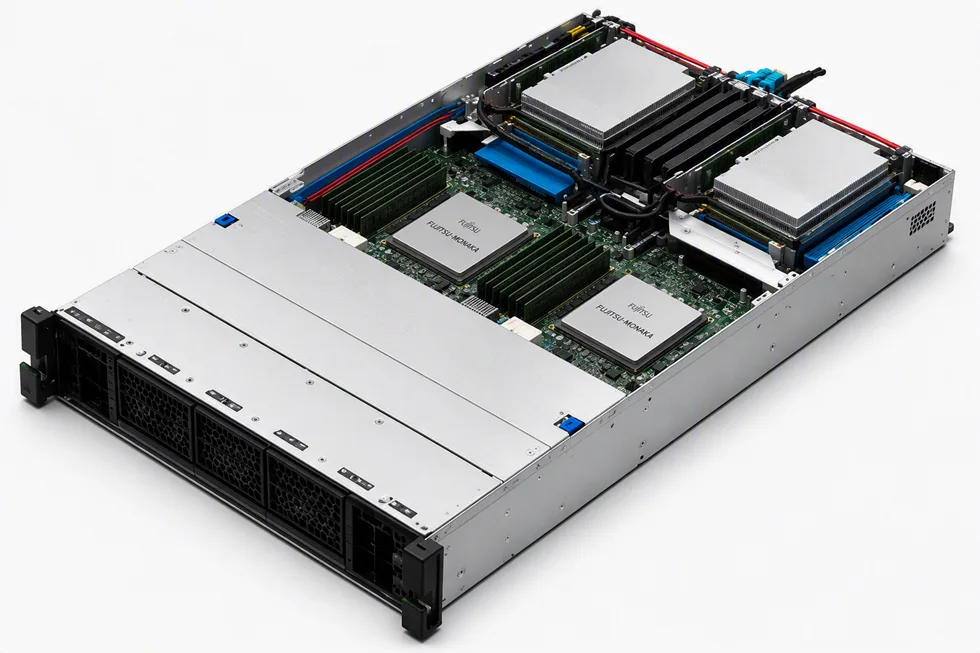
The architecture is impressive, but the real disruption is in the positioning. Fujitsu is explicitly marketing MONAKA, and its accompanying MONAKA Server, manufactured at the Kasashima Plant in Japan, as a sovereign AI infrastructure solution. That term has started popping up with increasing frequency across Europe’s data platform conversations, where the struggle for technological self-sufficiency has shifted from philosophical debating point to regulatory imperative.
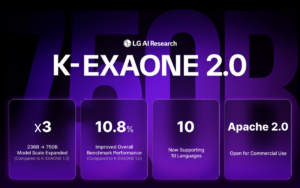
South Korea’s K-EXAONE sovereign AI initiative took a software-first approach, releasing a 750B-parameter model under Apache 2.0 and hoping the open-source ecosystem does the rest. Fujitsu’s MONAKA gambit is more radical: control the hardware, the server design, the manufacturing, and the entire software stack, including their proprietary capabilities like the Fujitsu Kozuchi AI platform and Takane enterprise generative AI. That’s not just vertical integration, it’s national infrastructure policy wearing a server rack’s clothing.
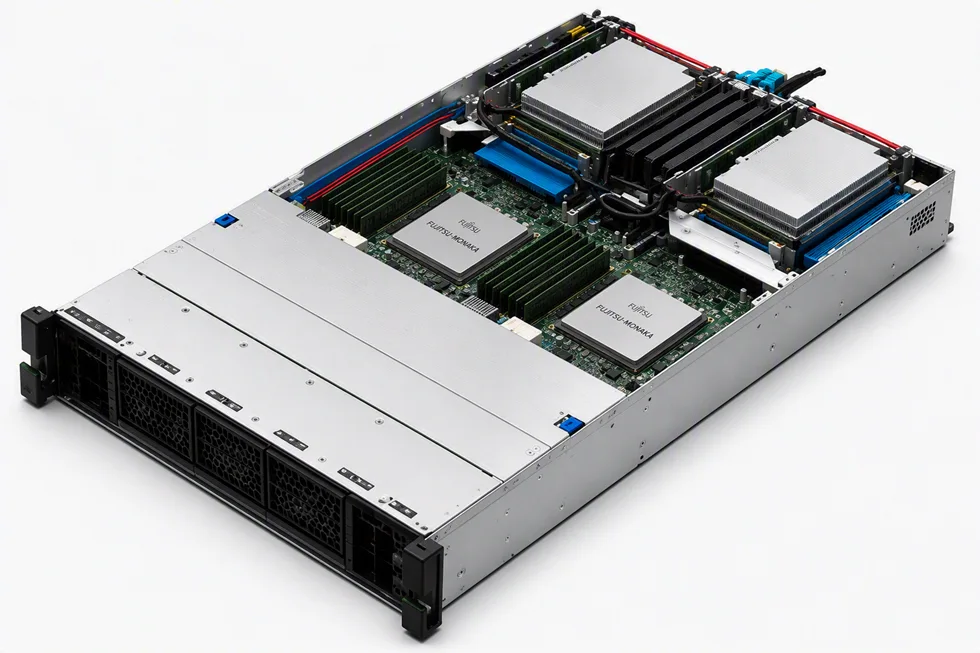
The pitch for domestic manufacturing goes beyond feel-good patriotism. Fujitsu is betting that traceability and supply chain transparency are now existential requirements for certain workloads, particularly in defense, government, and critical infrastructure sectors. A CPU manufactured in Japan, by a Japanese company, with a documented component lineage, offers something neither Intel nor AMD can fully replicate: the absence of geopolitical ambiguity.
Is the AI Inference Actually Real?
Now for the claims the pushback will target. Fujitsu asserts that the CPU delivers “twice the AI inference throughput and superior power efficiency compared to other CPUs,” effectively halving the number of servers needed for equivalent processing loads. Skeptics should default to healthy suspicion, every vendor says their chip cures cancer and solves world hunger, but the underlying architecture does carry genuine merit.
The 1U server runs with air cooling at ambient temperatures up to 40°C, and water cooling up to 45°C, potentially slashing server cooling power consumption by up to 80%. That’s not trivial. Power constraints are becoming the primary limiting factor in data center expansion, the ability to deploy AI inference in facilities that NVIDIA’s H100 and its liquid-cooled successors simply can’t reach changes the deployment calculus for edge and mid-tier AI workloads.
The design choice to use stacked cache plus DDR5 instead of HBM (High Bandwidth Memory) is another strategic move that keeps the platform cost-effective at scale. HBM delivers bandwidth but at premium pricing and with supply-chain constraints that have plagued the industry. DDR5-8800, the fastest validated speed in the spec, won’t match HBM bandwidth, but it’s sufficient for many inference workloads, especially when combined with aggressive on-die cache hierarchy. The “good enough plus much cheaper” play is precisely how you open new deployment scenarios that nobody else can serve cost-effectively.
The Software Stack Question
Here’s where MONAKA’s fate will actually be decided, and where the architectural independence narrative gets genuinely interesting.
Fujitsu is deploying a vertically integrated sovereign AI model, combining the CPU, the server, and their proprietary AI platforms into a single offering. That’s coherent, but it raises the question architects have been wrestling with since the mainframe era: how much integration is too much?
Contrast this with the approach exemplified by Cohere’s Command A+, a 218B-parameter MoE model engineered to run on just two GPUs. The philosophy there is optimizing for existing hardware constraints, making the software conform to what’s already deployed. Fujitsu’s approach inverts that logic: design the hardware around the AI workloads you anticipate serving, including matrix multiplication accelerators using dedicated instructions, and let the software stack grow into the architecture.
Neither approach is objectively wrong. But the divergence reveals a systemic tension in large-scale design: whether to optimize for the hardware you have or build the hardware you want, then design around it. Historically, the latter has been the domain of Apple, who made this exact bet with in-house ARM silicon and, ironically, strategic GPU partnerships. Fujitsu is effectively proposing that national governments and large enterprises should do the same: stop renting compute from foreign vendors and own the stack end-to-end.
The Defense and Security Elephant
Let’s address the most uncomfortable dimension of MONAKA’s rollout: the explicit orientation toward defense sector customers and the language around contributing to national security. Fujitsu states it plainly, MONAKA Server will be available to “the defense sector” in Japan and Europe starting November 2026.
What makes a CPU defense-grade? In the MONAKA context, it’s a combination of confidential computing (protecting workloads even from administrators via ARM CCA), the traceability of domestic manufacturing, and the elimination of dependency on external chipmakers whose supply chains might be disrupted by geopolitical events. For procurement officers in defense and intelligence agencies, the appeal is less about raw performance and more about reducing attack surface and dependency risk simultaneously.
That said, this positioning isn’t without controversy. Sovereign infrastructure arguments cut both ways, they can be inward-looking and protectionist, raising costs and reducing interoperability. The European experience with homegrown cloud and data platform alternatives has been notably rocky, and the gap between political ambition and engineering reality tends to be larger than expected. If Europe’s struggle with Databricks alternatives is any guide, the path from “sovereign silicon” to “sovereign working system” involves ecosystem maturity that doesn’t materialize overnight.
What MONAKA Tells Us About the Post-x86 Era
If we zoom out from the chip itself, MONAKA’s real significance is as a marker of how the compute landscape is fragmenting.
The ARM server ecosystem has been a slow-burn for a decade. Ampere pushed hard, AWS’s Graviton has succeeded within AWS, but the broader server market remains deeply dominated by x86 in Western enterprises. MONAKA adopts ARM’s instruction set architecture, specifically, the scalability of SVE2, while building proprietary extensions for matrix operations, including dedicated AI inference instructions. That’s a middle path between x86 dependency and fully custom ISA development.
For enterprise architects, this signals something important: the choice architecture of compute is expanding in ways that have architectural, not just procurement, implications. Choosing MONAKA (or Graviton, or Ampere) means choosing an ecosystem. It means accepting that the software you deploy might need to be specifically optimized for the CPU’s instruction set, and that the traditional “forward-compatible binary” assumption that Xeons became the standard on, write once, deploy anywhere, is weakening.
Part of that is strategic. Also in the broader market, the AI-optimized CPU positioning, “CPU alone can build an AI inference platform”, challenges the assumption that GPU training and inference infrastructure require the additional fixed capital for a rack of accelerator cards. The CDI/CXL technology in the 1U server, supporting Composable Disaggregated Infrastructure, allows memory and accelerators to be pooled across physical boundaries, mitigating memory shortages common in inference workloads. That’s a deliberate attempt to position this as an enterprise-grade alternative to the GPU-addicted AI infrastructure stack.
The Bottom Line: Independence Has a Price
Fujitsu MONAKA is genuinely significant, not because it dethrones NVIDIA or Intel, it won’t, but because it demonstrates a viable alternative path for institutions that crave architectural independence. It’s a bet that sovereignty, traceability, and supply chain security can offset the performance and ecosystem deficiencies that come from betting against the industry’s dominant players.
Whether that bet pays off will be determined by the same forces that determined the development of the systems that came before it: does the software ecosystem mature enough to make the hardware practically usable? Does the performance advantage in power efficiency and AI inference hold up in real deployments with real data, or does it evaporate when exposed to the messy workloads of production environments? And most importantly, will institutional buyers, banks, telecoms, government agencies, actually pay a premium for the ability to say their AI infrastructure is “made in Japan”?
Fujitsu’s timeline suggests a high level of confidence: select enterprise customers in financial, telecommunications, and manufacturing sectors start testing the servers in late fiscal 2026, with broader shipments beginning April 2027. High-density AI data center servers and rack-scale autonomous-operation servers are already planned.
The 30+ years of lessons from system design suggest that successful infrastructure decisions balance long-term vision with immediate practical results. MONAKA may ultimately deliver on its sovereign AI promise, or it may fall victim to the political and practical inertia that’s plagued homegrown alternatives worldwide. The architecture is genuinely clever, and the manufacturing strategy is smart. But chips don’t deploy themselves. The software stack, the ecosystem, and the operational confidence of the institutions that bet on them will determine whether MONAKA represents a revolution in computing independence or another expensive proof that dominant architectures have gravity for a reason.
The processors will ship in November. Whether the rest of the ecosystem measures up to the silicon is a much longer story, and it’s just starting to be written.