LG AI Research just dropped a bomb on the open-source AI community, and depending on who you ask, it’s either a masterstroke of national AI strategy or a 750B-parameter flex that punches below its weight class.
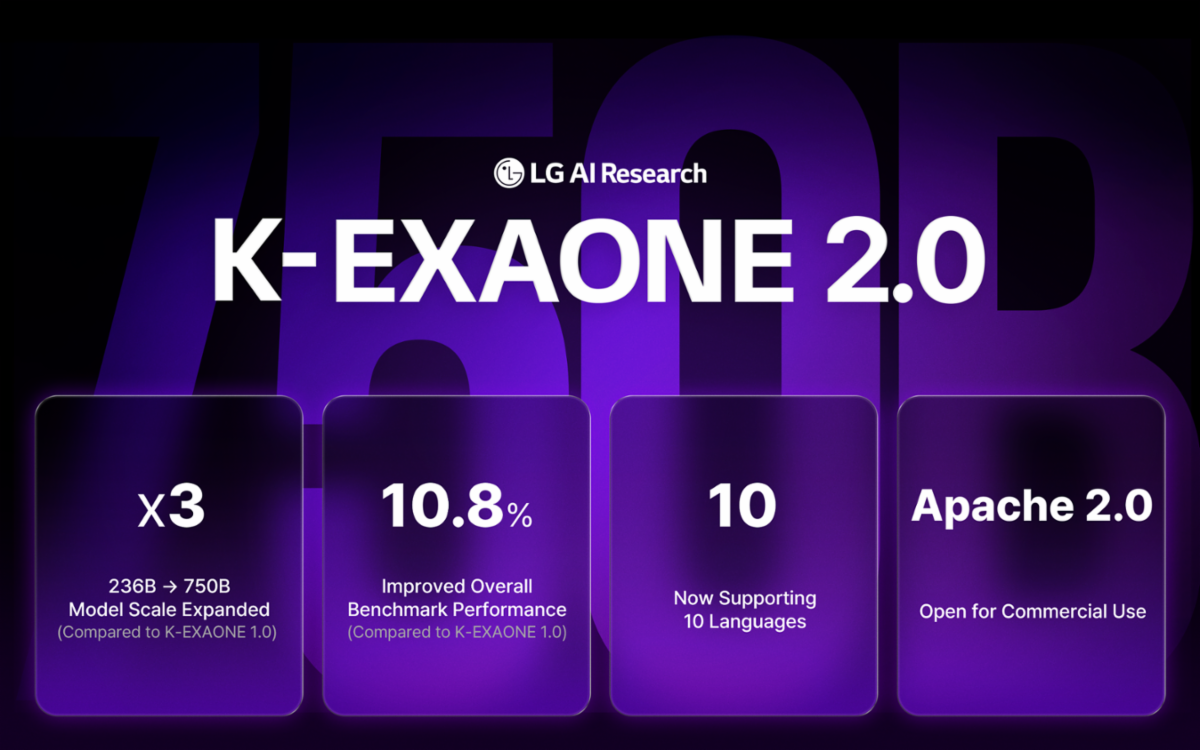
The K-EXAONE 2.0 model, released today under the fully permissive Apache 2.0 license, represents Phase 2 of South Korea’s Sovereign AI Foundation Model Project. With 750 billion total parameters (37B active) in a Mixture-of-Experts architecture, it’s the largest domestically-built AI model in Korean history, triple the size of the 236B-parameter v1 model from December 2025.
But here’s where things get interesting, and controversial.
The Good, The Bad, and The Benchmark
Let’s start with what K-EXAONE 2.0 actually does well, because the model has some genuinely impressive niches.
Long-context retrieval is its superpower.
On the OpenAI-MRCR benchmark, it scored 94.4, absolutely demolishing China’s GLM-5.1 (71.5) and even edging out Qwen3.5 (93.0) and DeepSeek V4 Pro Max (92.9). On the Korean long-context benchmark Ko-LongBench, it hit 89.6, again comfortably ahead of GLM-5.1’s 83.6. This isn’t an accident: the model supports a 262,144-token context window, putting it in rare company for production-ready open-weight models.
Agentic tool use is another bright spot.
On τ3-Bench Banking, K-EXAONE 2.0 scored 14.2, beating Qwen3.5 (13.4) and GLM-5.1 (11.5). For anyone building AI agents that need to interact with financial systems or enterprise tools, this matters.
Safety and alignment are genuinely impressive.
The model averaged 94.6 across ROK-Fortress and KGC-Safety benchmarks, far outpacing DeepSeek V4 Pro Max (65.2) and GLM-5.1 (71.6). For a government-backed sovereign AI project, this was likely a non-negotiable requirement, and they delivered.
Now for the uncomfortable part.
The Parameter Economy Problem
The most damning criticism came straight from the Reddit trenches. As one developer pointed out: “In their technical paper, they chose to benchmark against Qwen3.5-27B. That’s all you need to know. It sucks. And it’s massive.”
That user was responding to a real oddity: K-EXAONE 2.0 has 37B active parameters, while Qwen3.5 (the model they’re comparing against) uses only 17B active parameters, less than half. And on several key benchmarks, the smaller model wins.
Let’s look at the numbers from their own technical report:
| Benchmark | K-EXAONE 2.0 (750B/37B active) | Qwen3.5 (397B/17B active) | GLM-5.1 (754B/40B active) |
|---|---|---|---|
| MMLU-Pro | 83.5 | 89.8 | 86.0 |
| GPQA-Diamond | 82.2 | 88.4 | 86.2 |
| Humanity’s Last Exam | 18.3 | 28.7 | 31.0 |
| AIME 2026 | 92.3 | 91.3 | 95.3 |
| SWE-Bench Verified | 68.2 | 76.4 | 73.6 |
| Terminal-Bench 2.1 | 43.8 | 51.3 | 61.8 |
The pattern is stark. Despite having more than double the active parameters of Qwen3.5, K-EXAONE 2.0 trails on nearly every knowledge, reasoning, and coding benchmark. It’s competitive on math (AIME 2026) and leads on safety and long context, but the overall picture isn’t flattering.
One developer’s reaction was brutal but fair: “With this parameter count I see no reason why anyone would want to use this over GLM-5.2.”
The Architecture Inside the Beast
Let’s dig into what makes K-EXAONE 2.0 tick, because the design choices reveal a lot about LG AI’s priorities.
- 78 layers (2 heading Dense + 76 Sparse) plus 1 MTP layer
- 256 total experts, 8 activated per token
- 1 shared expert for always-available knowledge
- Hidden dimension: 6,144 with intermediate size 18,432
- 64 Q-heads / 8 KV-heads with head dimension 128
- Vocab size: 153,600, supporting 10 languages
The attention mechanism is notably complex: 1× Global (NoPE), 1× 4096 SWA, then 19× blocks of [3× 128 SWA + 1× Global]. This hybrid sliding-window-plus-global-attention design helps explain the strong long-context performance but also hints at the training complexity.
The model was built through upcycling, expanding both depth and width of the previous K-EXAONE model, followed by continual pretraining, difficulty-focused mid-training, and post-training. LG AI notes they found that “clamping after two SwiGLU branches effectively mitigates the exploding activations in deeper layers”, a detail that suggests the training process wasn’t exactly smooth sailing.
For production deployment, they support two speculative decoding methods: MTP (Multi-Token Prediction) and DSpark, both claiming 3-5× speedup. They’ve published dedicated forks for SGLang and vLLM to make serving feasible across 2 nodes of 8× NVIDIA H200 GPUs.
Sovereign AI Context
K-EXAONE 2.0 doesn’t exist in a vacuum. It’s part of South Korea’s broader push for AI independence, a movement that’s gained urgency as geopolitical tensions have affected access to foreign AI models.
South Korea’s Ministry of Science and ICT is currently recruiting 200 citizen evaluators to directly test domestically developed AI models from four teams: LG AI Research, Upstage, SK Telecom, and Motif Technologies. The “agentic AI” capabilities have emerged as key criteria in this round, with the second-phase evaluation scheduled to narrow the field from four teams to three, and a final two selected by year-end.
This isn’t just academic. The model is already being deployed in practical applications: it’s being used as the AI search model for Korea’s portal ZUM, and its use is expanding into telecommunications, public safety, and police investigative support.
The broader sovereign AI story is about control over critical infrastructure. As one analysis noted: “South Korea is treating general AI access like broadband, education, or digital identity.” The domestic-model requirement makes control of models, data, language, and culture part of national capability.
Competitor Landscape
K-EXAONE 2.0 enters a brutally competitive field. Let’s compare it to the peers it’s actually running against:
DeepSeek V4 Pro Max (1.6T total/49B active): Nearly double the active parameters. Dominates on coding and math. K-EXAONE 2.0 only beats it on safety and long-context retrieval.
GLM-5.1 (754B/40B): Similar total size, slightly more active params. K-EXAONE 2.0 beats it on long context and safety, but trails on knowledge and coding.
Qwen3.5 (397B/17B): This is the embarrassing comparison. Half the active parameters, but better on most intelligence benchmarks. K-EXAONE 2.0 wins on long context and agentic banking tasks.
Solar Open 2 (250B/15B): Upstage’s competitor in the Korean sovereign AI race. At less than half the total parameters and 15B active, Solar Open 2 scores 85.4 average on Korean benchmarks versus K-EXAONE 2.0’s estimated lower performance, though direct comparisons are limited by different benchmark suites.
Motif-3 (314B/13B): The dark horse from Motif Technologies. Scored AAII 44, third among open-source models globally. Built in about five months on government-supplied GPUs.
The Apache 2.0 Gambit
One genuinely unambiguously good decision: Apache 2.0 licensing.
The original K-EXAONE models used a proprietary license. The switch to Apache 2.0 for v2.0 is a strategic move that signals LG AI Research’s commitment to open-source AI development. This matters because:
- Enterprise adoption becomes frictionless. No legal review, no compliance headaches.
- Community contributions become possible. Developers can actually build on this.
- Transparency builds trust. For a government-backed sovereign AI project, this is crucial.
The model’s expansion to 10 languages (adding French, Italian, Portuguese, Polish to the existing Korean, English, Spanish, German, Japanese, Vietnamese) also signals that LG AI Research isn’t just building for Korea, they want global relevance.
Implementation Reality Check
If you’re actually considering using K-EXAONE 2.0, here’s what you need to know:
Hardware requirements are brutal. You need at least 2 nodes of 8× NVIDIA H200 GPUs (16 GPUs total) just to serve the model. For a 750B parameter MoE model, this isn’t surprising, but it does mean the “open source” nature is theoretical for most teams.
The forked inference engines are a double-edged sword. You need to install from LG’s custom forks of SGLang or vLLM. This means you’re pinned to their updates and bug fixes. The note about NVIDIA B200 GPU issues is particularly troubling: “If you are using NVIDIA B200 GPUs, please set EXAONE_ENABLE_SWA_KV=0 and add the --disable-prefill-cuda-graph option to prevent issues with model generation collapse.”
Performance is sensitive to configuration. The recommendation is temperature=1.0 and top_p=0.95 for most cases. The model uses enable_thinking=True by default for reasoning mode, and the preserve_thinking option is recommended for agentic use. This isn’t a plug-and-play model, you need to understand the interaction patterns.
Here’s the basic serving setup with SGLang:
sglang serve \
    --model-path LGAI-EXAONE/K-EXAONE-2.0-750B-A37B \
    --served-model-name K-EXAONE-2.0-750B-A37B \
    --tp 16 \
    --dist-init-addr $HEAD_ADDR \
    --nnodes 2 \
    --node-rank $NODE_RANK \
    --reasoning-parser qwen3 \
    --tool-call-parser qwen3_coder \
    --host 0.0.0.0 \
    --port 8000 \
    --speculative-algo EAGLE \
    --speculative-num-steps 4 \
    --speculative-eagle-topk 1 \
    --speculative-num-draft-tokens 5
And just loading it for basic inference:
from transformers import AutoTokenizer, AutoModelForCausalLM

tokenizer = AutoTokenizer.from_pretrained("LGAI-EXAONE/K-EXAONE-2.0-750B-A37B")
model = AutoModelForCausalLM.from_pretrained(
    "LGAI-EXAONE/K-EXAONE-2.0-750B-A37B",
    device_map="auto"
)
The Verdict
K-EXAONE 2.0 is a paradoxical release. It’s simultaneously impressive and underwhelming, strategic and wasteful.
Where it wins:
- Long-context retrieval is genuinely frontier-class
- Agentic tool use, particularly in banking, is competitive
- Safety and alignment far exceed comparable models
- Apache 2.0 licensing is a net positive for the ecosystem
- Multilingual support (10 languages) with strong Korean performance
Where it loses:
- Parameter efficiency is terrible, 37B active params underperform against 17B active competitors
- Knowledge and reasoning benchmarks trail significantly
- Coding performance is a weak spot (68.2 SWE-Bench vs 76.4 for Qwen3.5)
- Hardware requirements are prohibitive for most teams
- Forked inference engines create maintenance burden
The open-sourcing of large AI models and their strategic implications raises a legitimate question: is a model this expensive to run actually useful if most of the community can’t deploy it?
LG AI Research’s own leadership seems aware of these limitations. As co-head Bae Woo-hyung stated: “The current performance is not a completed result, but a starting point to fully unleash the potential of global frontier-scale models.” They’re committing to further work on data quality, subsequent learning, reinforcement learning, and reasoning technology.
For the broader AI community, K-EXAONE 2.0 represents a crucial data point in the sovereign AI movement. It proves that non-US, non-China actors can build competitive frontier-scale models. But it also demonstrates that parameter count alone doesn’t guarantee performance.
The real question is whether South Korea’s investment in this model, and the sovereign AI project more broadly, will pay off in practical terms, or whether the compute budget could have been better spent on a smaller, more efficient architecture with better data and training.
For now, K-EXAONE 2.0 joins the growing list of “interesting but not quite there yet” open-weight models. It has specific strengths that make it worth evaluating for long-context retrieval and safety-critical Korean-language applications. But as a general-purpose model, it’s hard to recommend when smaller, cheaper alternatives outperform it on most metrics.
The race for AI sovereignty is real. The question is whether we’re measuring success by parameter count or by actual capability.