The AI arms race just got a new contender that’s simultaneously impressive, confusing, and, depending on your perspective, either a genuine gift to the open-source community or a brilliant piece of narrative management.
Elon Musk confirmed that xAI will open-source its current 0.5 trillion parameter Grok model “towards the end of this year.” This is the V8-small model currently serving all Grok production traffic, and Musk claims it “should still be quite useful” even after the significantly more capable V9-Medium (1.5T) launches in 2-3 weeks.
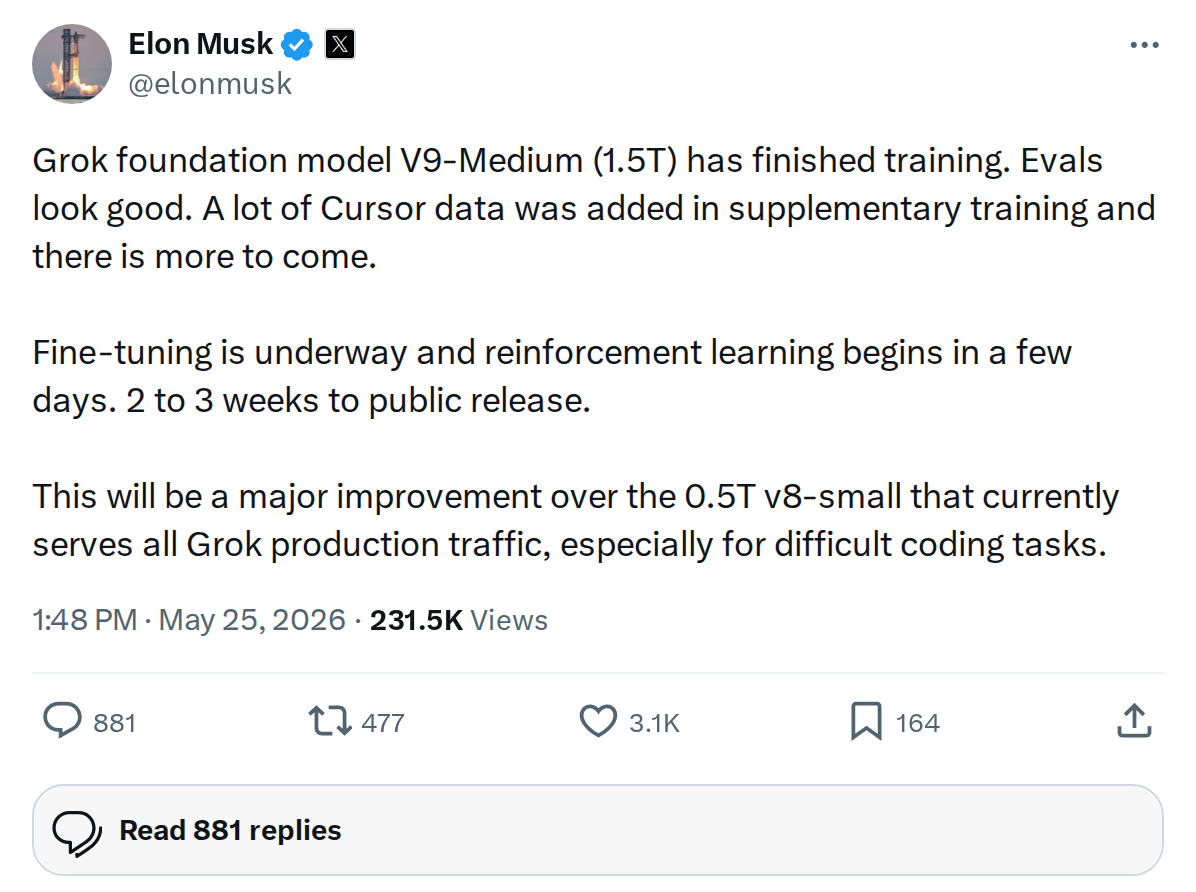
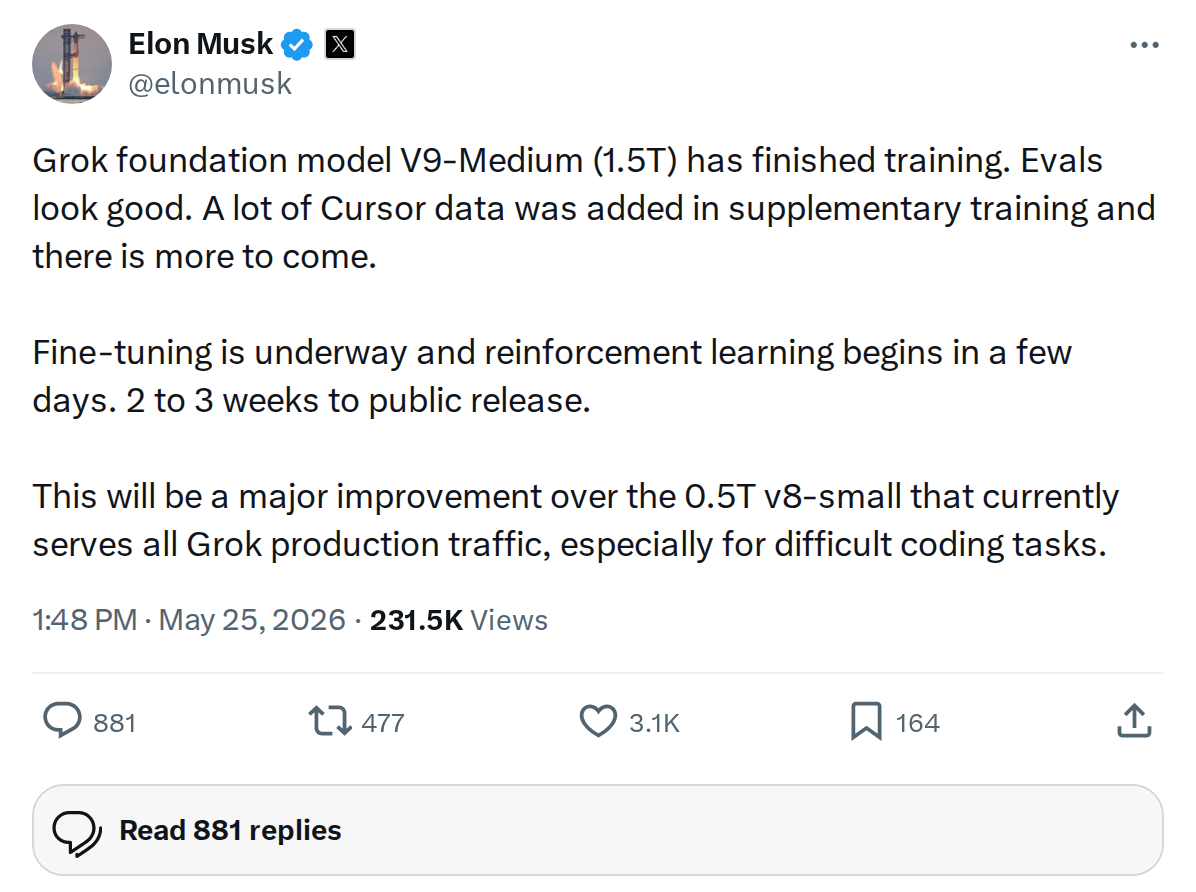
The announcement landed alongside news that V9-Medium has finished training, evaluations look good, and that a substantial volume of Cursor data was incorporated during supplementary training. Supervised fine-tuning is already underway, with reinforcement learning set to begin within days.
But here’s what makes this story genuinely interesting: the 0.5T model being open-sourced is the old model. The model that’s about to get three generations behind. The model that xAI will have zero competitive reason to keep proprietary.
The Timing Tells a Different Story
Right now, xAI is pushing hard on two fronts simultaneously. The V9-Medium (1.5T) model represents a 3x parameter jump from V8, and based on the trajectory of model scaling, that typically translates to substantially stronger reasoning, better instruction-following, and improved performance on complex tasks.
The timing of the open-source promise is revealing. Musk made it in direct response to a user asking whether xAI would open-source the 0.5T model. The answer was yes, but only after the 1.5T model is fully deployed and the “next next” generation (reportedly targeting “multiple trillions of parameters”) is on the horizon.
One AI researcher on X noted that “end of year we gonna have open source models that are better than ANY frontier model rn including opus 4.7 and gpt 5.5.” That’s a bold claim, and one that depends heavily on when “end of year” actually means and how fast the frontier moves in the interim.
The Financial Reality Behind the Headlines
Here’s where the story gets uncomfortable for anyone buying the narrative that this is pure altruism. SpaceX’s IPO filing, revealed just days ago, shows xAI burned $6.4 billion last year on just $3.2 billion in revenue. That’s a -200% operating margin, and it’s getting worse, Q1 2026 annualized implies a -302% margin.
xAI Financial Snapshot (FY2025)
| Metric | Value |
|---|---|
| Revenue | $3.2B |
| Operating Loss | $6.4B |
| Operating Margin | -200% |
| Capex | $12.7B |
| Grok MAUs | 117M (out of 550M total X MAUs) |
The per-user economics are brutal: approximately $27 in revenue per Grok MAU versus ~$191 in fully-loaded cost. That’s a $164 gap per user per year. The math doesn’t work without the Anthropic compute lease ($1.25B/month) propping up the revenue side.
Open-sourcing the 0.5T model costs xAI nothing in competitive advantage (it’s being replaced) and generates enormous goodwill. It’s the cheapest PR spend in the entire xAI budget.
What “Open Source” Actually Means Here
There’s a meaningful debate about what “open source” means in the context of a 0.5T model. A model of that size requires significant compute infrastructure just to run inference, let alone fine-tune. Most developers and researchers don’t have access to the hardware needed to do anything useful with it.
Some in the community have already pointed this out. One commenter noted that “some 30b models right now are better already” than what xAI is offering. Another pushed back hard, saying “Grok 4.3, assuming that’s what he’s talking about, is absolutely amazing.”
The truth likely sits somewhere in the middle. The 0.5T model will be useful for organizations with significant compute budgets, for researchers studying model scaling, and for the community to analyze and learn from. But for the average developer running models on consumer hardware, it’s not going to change their workflow.
This contrasts sharply with models like Molmo 2 that challenge the ‘bigger is better’ orthodoxy with efficiency, proving that smaller, well-trained models can punch far above their weight class.
The Cursor Data Angle: xAI’s Real Play
One detail in Musk’s announcement that deserves more attention: “A lot of Cursor data was added in supplementary training and there is more to come.”
Cursor is the AI-powered coding assistant that’s been making waves in developer tools. xAI’s decision to heavily incorporate Cursor data suggests they’re doubling down on developer and coding use cases for this generation of Grok.
This makes strategic sense. The coding assistant market is massive and growing. OpenAI has Codex/ChatGPT, Anthropic has Claude’s coding capabilities, and Google has Gemini Code Assist. xAI needs a credible developer story, and training on high-quality coding interaction data is how you get there.
The timing also aligns with xAI’s broader infrastructure play. The V9-Medium model is being trained on the Colossus 2 cluster, which was deployed in just 91 days and houses an estimated 555,000 GB200-class GPUs. That’s the kind of compute that enables serious coding model training.
The “Multiple Trillions” Horizon
The SpaceX IPO filing explicitly states that xAI plans to scale Grok toward “multiple trillions of parameters,” described as enabling “a step change in reasoning in depth and overall intelligence.”
This is company-authored marketing language from the filing itself, not an independent technical assessment, but it signals where xAI’s capex is heading. The Colossus 1 + Colossus 2 combined infrastructure, plus a third Memphis building targeting ~2GW total capacity, suggests xAI is building for a future where model parameters are measured in trillions, not billions.
For perspective, a “multiple trillions” model would be 5-10x larger than what’s currently considered frontier. GPT-4 is estimated at around 1.7T parameters (though OpenAI has never confirmed this). Grok’s own V9-Medium is 1.5T. Moving to “multiple trillions” means models in the 5-10T range.
This is the scale that requires the kind of infrastructure spending we’re seeing. It’s also the scale where the hardware arms race powering these models, like OpenAI’s $10B Cerebras deal starts to make sense.
The Open-Source Paradox
xAI’s open-source promise creates an interesting tension with their stated ambitions. If you believe that “multiple trillions of parameters” models will constitute a “step change in reasoning”, then open-sourcing a 0.5T model is relatively low risk, it’s like open-sourcing a 2022-era flagship in 2026.
But it also creates expectations. The open-source AI community has been increasingly critical of companies that promise openness but deliver restrictions. xAI’s commitment to release the 0.5T model “towards the end of this year” will be watched closely.
If the model arrives with meaningful restrictions (non-commercial license, usage caps, or missing weights), the goodwill generated by the announcement will evaporate quickly. If it’s genuinely open, Apache 2.0 or similar, it could be one of the most significant open-source AI releases in history.
The comparison to smaller open-source reasoning models like GLM-4.7-Flash that reveal their thinking process is instructive. The community doesn’t just want parameter counts, they want transparency, reproducibility, and genuine usability.
What This Means for the AI Arms Race
The Grok open-source announcement lands in a market that’s increasingly polarized between massive proprietary models and efficient open-source alternatives. International competitors like Korea’s Solar-Open-100B challenging US model hegemony are proving that you don’t need trillion-parameter models to compete.
Key implications:
- For developers: A 0.5T open-source model could be useful for specialized fine-tuning and research, but expect most practical work to remain on smaller, more efficient models
- For competitors: xAI is signaling that they’re willing to open-source significant assets, which could pressure others to follow suit or face community backlash
- For the open-source ecosystem: A genuine 0.5T release would be the largest openly available model by a significant margin, enabling research that’s currently impossible
- For xAI investors: The open-source move costs nothing but generates massive goodwill, it’s smart narrative management for a company burning $6.4B/year
The Bottom Line
Elon Musk’s promise to open-source Grok’s 0.5T model is genuinely good news for the AI community. But it’s also a calculated move from a company that’s burning cash at a staggering rate, needs developer goodwill, and is about to release a model that makes the 0.5T version look like yesterday’s news.
The real test will be execution. Will the model arrive on time? Will it be genuinely open? Will it actually be useful?
And perhaps most importantly, will the open-source release include the kind of documentation, tooling, and community support that makes a model actually usable? Because a 0.5T parameter model without proper infrastructure is just a very expensive doorstop.
The AI arms race continues, and for once, the open-source community might actually be winning something. Whether that victory is substantial or symbolic remains to be seen.
What do you think? Is open-sourcing a soon-to-be-deprecated 0.5T model a genuine contribution or clever marketing? Drop your thoughts in the comments.