Korea’s AI Moonshot: How Solar-Open-100B Declares War on U.S. Model Hegemony
South Korea’s Upstage just dropped a 102-billion-parameter model with a commercial license, trained on government GPUs, and aimed squarely at breaking America’s AI stranglehold.
While Silicon Valley debates the ethics of AI safety and OpenAI ponders whether to release yet another slightly better version of GPT-4, a South Korean startup just pulled the rug out from under the entire conversation. Upstage’s Solar-Open-100B isn’t just another entry in the parameter-count arms race, it’s a geopolitical statement wrapped in a Mixture-of-Experts architecture.
The model dropped on Hugging Face with minimal fanfare but maximum implications: 102.6 billion parameters, 19.7 trillion training tokens, and a license that actually lets you use the damn thing commercially. No gatekeeping. No “contact us for enterprise pricing.” No mysterious usage restrictions buried in Terms of Service that change every quarter.
The Specs That Actually Matter
Let’s cut through the marketing fluff. Solar-Open-100B is a MoE model with 102.6B total parameters but only 12B active per token. That means you’re getting the knowledge capacity of a massive model with the inference cost of something you can actually afford to run. The context window stretches to 128k tokens, enough to swallow most codebases or legal documents whole.
The training data? 19.7 trillion tokens. For perspective, that’s roughly 15 times the entire English Wikipedia, repeated thousands of times over. The hardware? NVIDIA B200 GPUs, courtesy of South Korea’s government-funded AI initiative. This isn’t a hobby project trained in someone’s garage, it’s a state-sponsored moonshot aimed at creating technological sovereignty.
# Loading the model is refreshingly straightforward
import torch
from transformers import AutoModelForCausalLM, AutoTokenizer

MODEL_ID = "upstage/Solar-Open-100B"

tokenizer = AutoTokenizer.from_pretrained(MODEL_ID)
model = AutoModelForCausalLM.from_pretrained(
    pretrained_model_name_or_path=MODEL_ID,
    torch_dtype=torch.bfloat16,
    device_map="auto",
    trust_remote_code=True,
)
The generation parameters tell their own story: temperature 0.8, top_p 0.95, top_k 50. This isn’t a model designed to be safe and boring, it’s built to be useful.
The License Heard ‘Round the World
Here’s where things get spicy. The model uses a “Solar-Apache License 2.0”, which is exactly what it sounds like: Apache 2.0 with extra Korean flavor. Unlike Meta’s Llama models with their “open but not really” restrictions, or OpenAI’s “here’s an API, don’t look under the hood” approach, Solar-Open-100B gives you actual freedom.
Developer forums lit up immediately. One commenter noted the license has “rather mild requirements” compared to typical corporate offerings. Another pointed out the irony: a $45 million-funded company accidentally violating Apache’s trademark by modifying the license text itself. The legal naivety would be charming if it weren’t so telling, this is a startup moving fast and breaking things, Silicon Valley style, but with Seoul sensibilities.
The licensing controversy cuts both ways. While the open-source community celebrates genuine commercial freedom, intellectual property lawyers are having conniptions. The model’s license may have technical violations, but the intent is clear: Upstage wants this model used, not just studied.
The Korean Gambit: Cultural AI as National Strategy
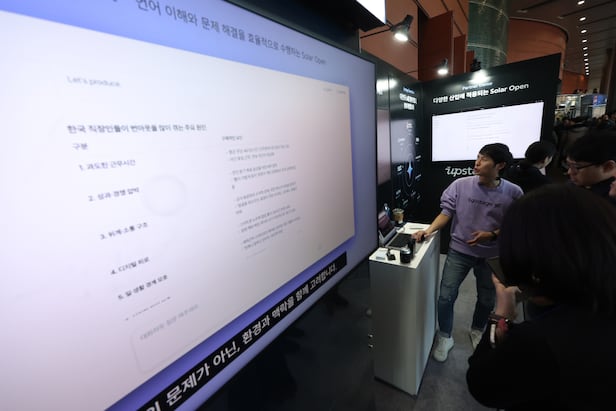
What makes Solar-Open-100B truly different isn’t the architecture, it’s the agenda. Upstage CEO Kim Sung-hoon didn’t mince words at the COEX presentation: “Unlike large corporations, Upstage has spent the past five years focused solely on a single goal: building AI that helps everyone.”
The model was trained specifically on Korean language nuance, including the critical distinction between honorific and informal speech, something Western models consistently butcher. The consortium approach is uniquely Korean: Flitto provided culturally-aware training data, Lablup built the auto-failover infrastructure, and companies like Law&Company, MakinaRocks, and VUNO tested it in actual Korean work environments.
This isn’t about beating GPT-4 on English benchmarks. It’s about creating an AI that understands Korean business culture, legal frameworks, and social context. The government didn’t fund this to win Twitter debates about MMLU scores, they’re building technological independence.
The model’s training on 19.7 trillion tokens represents a massive data moat, one built with Korean government support and domestic partnerships. This is industrial policy meeting AI development, and it’s working.
The Elephant in the Room: Where Are the Benchmarks?
Here’s where the Reddit hivemind sharpened its knives. Multiple commenters flagged the conspicuous absence of performance metrics. The Hugging Face page simply states “TBA” under performance. In an era where every model release is accompanied by a leaderboard victory lap, this silence is deafening.
Critics smell a rat. “No release of benchmarks? Smells like BS”, wrote one developer. Another pointed to the upcoming Korean government evaluation on January 15th, where five elite teams will be narrowed to four, with subsidies on the line. The timing is suspicious, announce first, benchmark later, hope the hype carries you through evaluation.
The counterargument is compelling: benchmarks are increasingly gamed anyway. Upstage is betting that real-world validation from Korean enterprises matters more than synthetic test scores. They’re not playing the meta, they’re trying to win the actual game.
The MoE Revolution Goes Global
The Mixture-of-Experts architecture choice is strategic. With 129 experts (128 routed + 1 shared) and only 8 active per token, Solar-Open-100B achieves something U.S. companies are still struggling with: efficient scale. The model requires minimum 4x A100 80GB GPUs, substantial but not impossible for serious startups.
This democratizes access to frontier-level AI capabilities. You don’t need a billion-dollar data center, you need a modest GPU cluster and the technical chops to implement the provided vLLM optimizations. The Docker deployment is ready to go:
docker run --gpus all \
    --ipc=host \
    -p 8000:8000 \
    upstage/vllm-solar-open:latest \
    upstage/Solar-Open-100B \
    --trust-remote-code \
    --tensor-parallel-size 8
The Real Controversy: Synthetic Data and Training Ethics
One Reddit thread cut to the heart of modern AI’s existential question: training data provenance. “Arent these models are just trained on synthetic data?” asked one commenter. The answer is nuanced: they’re trained on natural data plus synthetic augmentation, but the source of that natural data remains murky.
This is the unspoken truth of the AI race. While OpenAI faces lawsuits for training on copyrighted material, Korean companies are building their own data pipelines from scratch. Flitto’s end-to-end data curation is a competitive advantage that can’t be replicated by scraping the internet. It’s slower, more expensive, and legally cleaner.
What This Means for the Global AI Landscape
Solar-Open-100B isn’t going to dethrone GPT-4 tomorrow. But it doesn’t need to. It represents a fundamental shift: AI development is no longer a U.S.-only game. The model’s roadmap is aggressive, 200B parameters in 2026, 300B by 2027, with Korean, English, and Japanese support.
- For developers: A truly open model with commercial freedom, optimized for specific cultural contexts
- For enterprises: An alternative to U.S. AI dependency, crucial for companies in regions wary of American tech dominance
- For governments: Proof that strategic AI investment can create viable alternatives to Silicon Valley
- For the AI community: A reminder that open source means actual freedom, not just “free as in beer”
The Korean government will evaluate the five elite teams in January, with one elimination per six-month review cycle until only two remain in 2027. Upstage, the only startup among giants like SK Telecom and Naver, is betting that agility beats scale.
The Bottom Line
Solar-Open-100B is simultaneously impressive and infuriating. The technical achievement is real: a massive MoE model trained from scratch, with genuine commercial openness, optimized for Korean language and culture. The lack of benchmarks is either refreshing honesty or strategic obfuscation.
What matters is the signal it sends. While American AI companies debate safety and chase artificial general intelligence, South Korea is building practical AI for real applications, with government backing and a clear national strategy. The model’s Apache-style license, training efficiency, and cultural specificity represent a different vision for AI’s future, one where openness, sovereignty, and utility matter more than scale for scale’s sake.
The AI race just got a new lane, and it’s not running through Palo Alto.