When NVIDIA CEO Jensen Huang personally delivered the first DGX Spark units last year, the AI community held its breath. A 1 PFLOPS AI supercomputer you could fit in a laptop bag. Local inference without the cloud tax. The democratization of AI compute.
Fast forward to May 2026, and the market tells a different story. Dell, HP, Lenovo, MSI, GIGABYTE, Acer, and ASUS have all released devices that look suspiciously identical, same 150mm footprint, same half-kilo weight class, same NVIDIA GB10 chip inside. The “revolution” didn’t produce a thousand flowers blooming. It produced eight clones that vary by millimeters and grams.
This isn’t a failure of innovation. It’s the signal that AI hardware has crossed a threshold most industries never reach: standardization.
The Spreadsheet That Reveals Everything
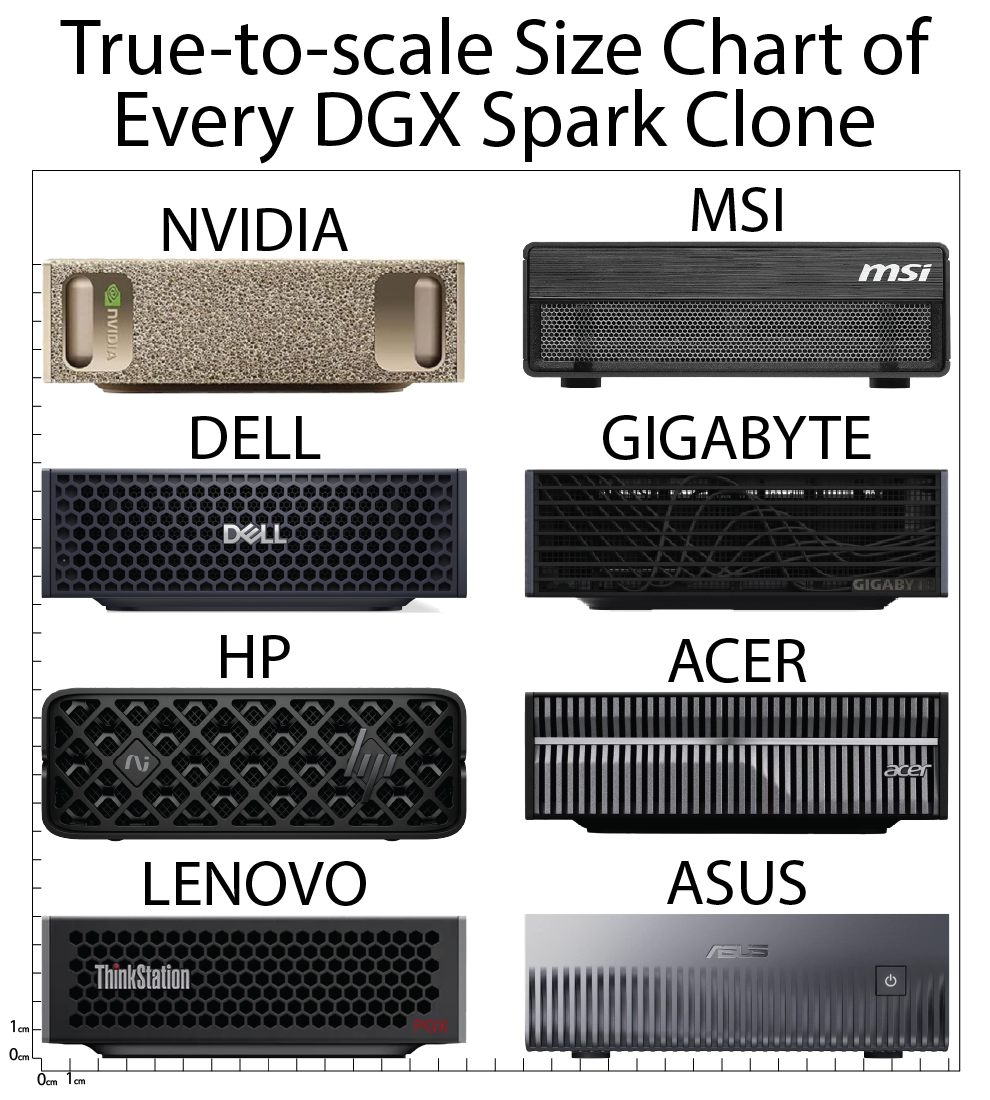
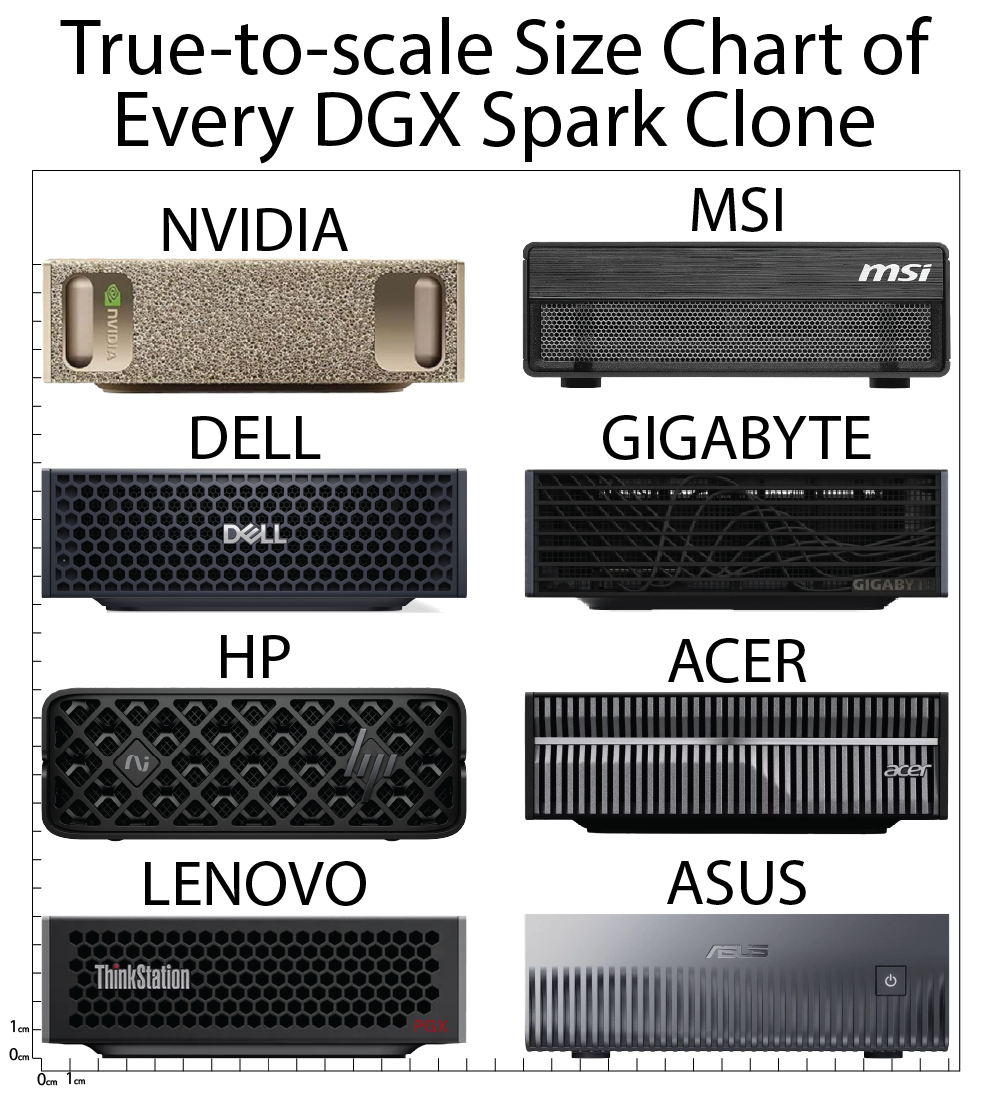
A Reddit user named rexyuan compiled a true-to-scale size chart of every DGX Spark clone, and the data is almost comically uniform:
| Model | Width (mm) | Height (mm) | Length (mm) | Weight (kg) |
|---|---|---|---|---|
| NVIDIA DGX Spark | 150 | 50.5 | 150 | 1.2 |
| Dell Pro Max | 150 | 51* | 150 | 1.31* |
| HP ZGX Nano G1n | 150 | 54.5* | 150 | 1.25* |
| Lenovo ThinkStation PGX | 150 | 50.5 | 150 | 1.2 |
| MSI EdgeXpert | 151* | 52* | 151* | 1.2 |
| GIGABYTE AI TOP ATOM | 150 | 50.5 | 150 | 1.2 |
| Acer Veriton GN100 AI Mini Workstation | 150 | 50.5 | 150 | 1.2 |
| ASUS Ascent GX10 | 150 | 51* | 150 | 1.48* |
Every single device occupies a 150x150mm footprint. Height varies by 4mm total. Weight differences amount to less than 300 grams across the entire lineup. The MSI unit is literally 1mm wider and longer, whether that’s a manufacturing tolerance or an act of corporate rebellion remains unclear.
This isn’t competition. It’s a form-factor standard being born in real time.
What These “Clones” Actually Are
The Reddit thread had predictable pushback. One user, BobbyL2k, scored 101 upvotes arguing: “We’re calling these clones? These are products from other system integrators. They have the same real chip from NVIDIA. These are the same concept as GPUs from ASUS, Gigabyte, MSI, etc.”
And they’re right. Sort of.
The distinction matters: these aren’t counterfeit products or shady knockoffs. Every vendor ships an NVIDIA GB10 Grace Blackwell chip. The SoC die is identical. What varies is the thermal solution, the chassis materials, and the software stack. The name “DGX Spark and Clones” originally came from a Discord server for GB10 machine owners, and it stuck because the visual uniformity is genuinely striking.
But calling them “clones” misses the real story. When every major OEM releases a product with the same chip, the same form factor, and near-identical dimensions, it signals something bigger: the industry is coalescing around a reference design. NVIDIA didn’t just release a product, it released a platform.
The ASUS Factor: What “Premium” Means When Everything’s The Same
One Reddit user, melikeytacos, shared hands-on experience with two Dells and the ASUS unit:”One thing I noticed with the ASUS is from looking at the photos I assumed the front was plastic. In reality it’s a solid hunk of aluminum, and the whole thing is very solid and weighty feeling.”
The ASUS Ascent GX10 is also the heaviest unit at 1.48kg, 23% heavier than the baseline DGX Spark. That weight delta comes from materials and likely a beefier heatsink. Crucially, melikeytacos noted the ASUS unit lacks a front vent like the others, yet “in use it’s stayed within a degree or two of the Dell.”
When you’re building a cluster of these devices for local inference, a few degrees matter. A millimeter of clearance matters. The GIGABYTE AI TOP ATOM was noted as “well received for its cooling” despite being the same weight as the Spark. These subtle thermal engineering choices will determine which OEM wins enterprise deployment contracts.
The Naming Nightmare
Reddit user Mickenfox delivered the most brutal and accurate take: “This is a good case study in how bad all these companies are at naming things.”
The critique lands hard. “Dell Pro Max” appears on half their product lines. “ThinkStation” would be a killer name but Lenovo already uses it for their desktop PCs. “HP ZGX Nano G1n” reads like a warehouse inventory code. “MSI EdgeXpert” sounds like a third-party GPU utility.
The recommended naming convention from that thread is deceptively smart: “[Brand] [AI workstation] [Mini] [2026]”. The “Mini” and “2026” parts are critical because vendors will release successor models next year, and customers need to know what’s current at a glance. This is the kind of detail that separates consumer chaos from enterprise-grade product lines.
The Deeper Implication: NVIDIA’s Platform Play
This wave of clones reveals NVIDIA’s strategic brilliance. The DGX Spark isn’t a product, it’s a wedge. By offering the GB10 chip to every major OEM, NVIDIA ensures that any organization building an AI workflow around the Spark can also buy from Dell, HP, or Lenovo with identical performance characteristics. Vendor lock-in becomes vendor optionality.
Compare this to the PC market. Every Windows laptop runs x86, but form factors vary wildly. The DGX Spark clones show NVIDIA doing something closer to Apple’s approach, define the reference, control the chip, let partners compete on thermals and build quality.
Our initial analysis of the DGX Spark’s role in AI research flagged exactly this trajectory. The device was always too expensive for consumers and too weak for datacenters. But as a building block for standardized inference clusters? That’s where the math works.
What Competition Is Coming
NVIDIA isn’t the only player in town. A look at AMD’s competing AI dev box, which fits into the same form factor reveals that AMD is trying the same playbook with Lenovo as their OEM partner. The Acer Veriton RA110 AI Mini Workstation, announced just yesterday, runs the AMD Ryzen AI Max+ 395 processor with Radeon 8060S graphics, and it’s physically larger at 160x160x47mm.
The Acer unit also has a different spec: up to 128GB of LPDDR5X memory, Wi-Fi 7, and a claimed 126 TOPS with support for models up to 200 billion parameters. It’s a direct competitor, but it’s not a clone. The form factor divergence means you can’t rack AMD and NVIDIA units interchangeably. That’s a problem for standardization.
Thunderobot, a Chinese OEM, has shown a roadmap for AMD-based Medusa Point and Medusa Halo AI mini workstations. The market is splitting into two camps: the NVIDIA reference and the AMD wild west.
The Benchmark Reality
A direct performance comparison between the DGX Spark and AMD’s Strix Halo reveals that the Spark’s actual performance sometimes falls short of its marketing. And a detailed comparison of memory bandwidth across AI hardware including the DGX Spark confirms that memory bandwidth, not teraflops, is the bottleneck for local LLM inference.
The Spark’s LPDDR5X memory delivers roughly 273 GB/s of bandwidth. That’s enough for 7B and 13B parameter models, but 70B models will crawl. An analysis of memory bandwidth limitations on the competing AMD Strix Halo platform shows that even AMD’s 192GB configuration is bandwidth-limited. The clones inherit these constraints because they share the same chip.
This means the standardization we’re seeing isn’t about peak performance. It’s about enough performance in a predictable, deployable package.
What Standardization Unlocks
When every device shares the same footprint, three things become possible that weren’t before:
1. Rack standardization. A 150x150x50mm form factor fits neatly into a 1U or 2U chassis with custom mounting trays. Datacenters can deploy 8-16 units in a single rack slot, creating a dense inference cluster without specialized cooling.
2. Infrastructure tooling. If every Spark clone uses the same power connector profile, the same mounting holes, the same airflow direction, then power distribution, cooling, and networking can be designed once and deployed everywhere. This is exactly how server blade standards emerged.
3. Software consistency. The GB10 chip runs the same CUDA stack regardless of who stamped the chassis. Engineers developing inference pipelines on a Dell Pro Max can deploy to an HP ZGX Nano without firmware surprises.
Practical tips for cooling and powering DGX Spark systems in a cluster become dramatically simpler when every unit behaves similarly.
The Pricing Question Nobody Answered
The Reddit thread’s top-voted reply was brutally simple: “Now, do pricing.”
We don’t have complete pricing data yet. The DGX Spark launched at $3,999. Dell’s Pro Max with GB10 is expected around $3,800. The ASUS Ascent GX10 may command a premium for its aluminum chassis. But here’s the uncomfortable truth: if every unit costs roughly the same and delivers roughly the same performance, then the OEMs are competing on exactly two things: build quality and support contracts.
That’s a mature market dynamic, not a startup frenzy. It’s the same pattern that drove PC standardization in the 1990s and server virtualization in the 2000s. The boring phase is where the real adoption happens.
The race to standardize AI mini workstations isn’t about which vendor builds the fastest device. It’s about which ecosystem, NVIDIA’s reference or AMD’s open field, becomes the default building block for local inference.
The clones aren’t a sign that innovation stalled. They’re proof that the market has found a working formula and is now optimizing for deployment volume. When eight major OEMs release near-identical products simultaneously, the industry is signaling that AI compute is moving from experimental hardware to standardized infrastructure.
Don’t mistake uniformity for stagnation. The boring boxes on your desk are the foundation of something much bigger.