The AI Burnout Crisis: Developers Struggle with Constant Upskilling in a Rapidly Shifting Landscape
The breakneck cadence of AI releases has created a brutal paradox for developers: tooling has never been more powerful, yet career stability has rarely felt so fragile. New models and frameworks arrive weekly, burying teams under untracked cognitive labor and triggering a relentless pressure to upskill or become obsolete. Drawing on recent surveys of engineering leaders, clinical behavioral markers, and widespread industry sentiment, this post examines how the jagged frontier of AI advancement is fueling a novel form of burnout. We look at the hard data behind collapsing productivity expectations, the erosion of deep craft satisfaction, and what it actually takes to build a sustainable practice when the ground beneath you shifts faster than your CI pipeline.
The Stack Treadmill Moves at Human Expense
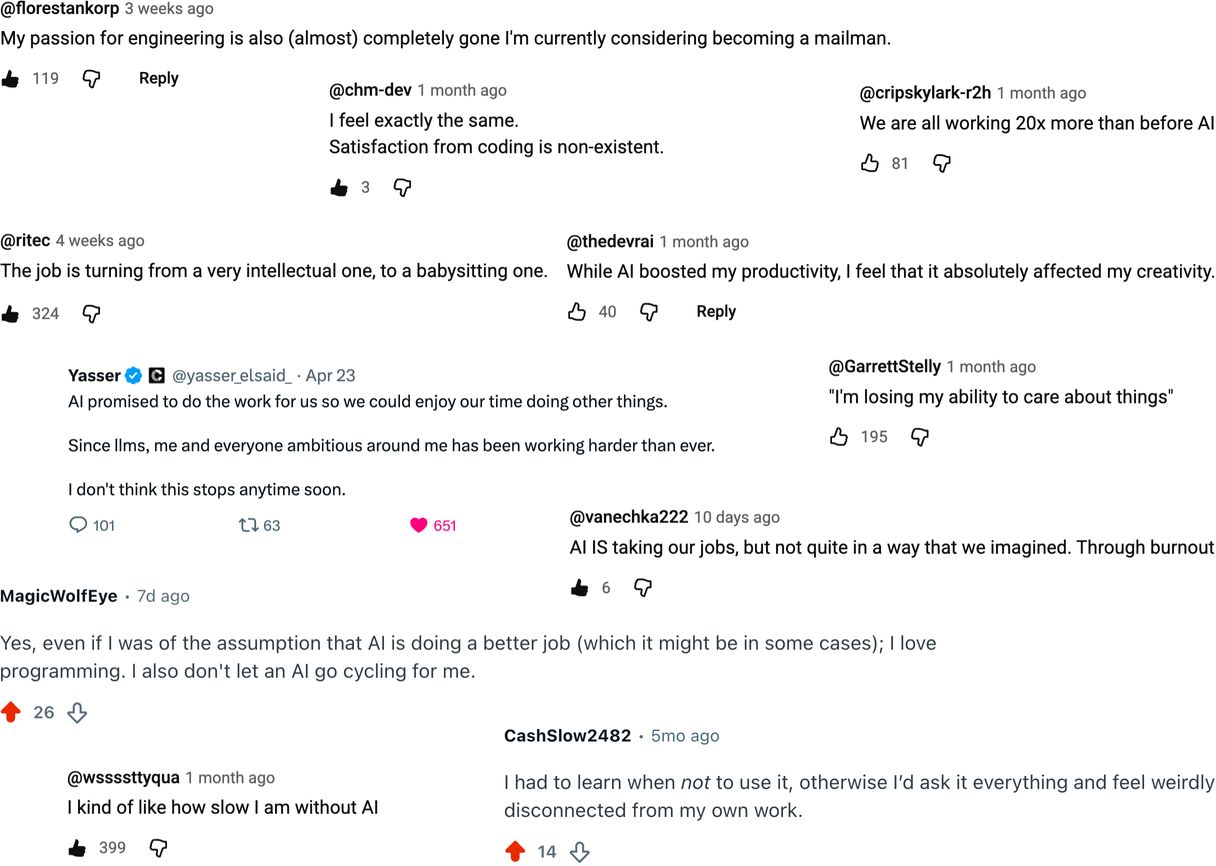
Last week it was Qwen 3.6, this week it’s a rumored 122B parameter variant. Developers with 16GB of VRAM are already calculating whether they need to upgrade again, while others wonder if dense models will be abandoned entirely for sparse MoE architectures that spill across unified memory. Across community forums, a common sentiment is taking hold: life genuinely felt simpler before AI exploded everywhere. There was a domain, a role, a stack, and while things changed, it did not feel like the ground moved every seven days. Now, choosing a specialty risks becoming a losing bet. Invest months in a new framework and the market may pivot before you ship. Opt out, and you face unilateral disarmament against peers who treat LLM assistance as table stakes. This is the career trap of constant upskilling in AI, and the only safe position seems to be endless motion.
Startups are reacting by prioritizing infrastructure they can understand, adapt, and govern rather than accumulating brittle integrations. Individual developers, however, rarely have the luxury of pausing the entire ecosystem to catch their breath. When your stack risks obsolescence before you have finished the tutorial, the psychological overhead becomes a second job.
The Productivity Paradox, By the Numbers
Evil Martians laid out the math with painful clarity. Ben codes manually for four hours and stops. Alice delegates to an AI agent, compressing her timeline to two hours, but the cognitive load shifts rather than shrinks. She spends those hours in high-intensity review, steering, and debugging. Because the task “came easy”, she does not feel done. She pulls another ticket. In the same four-hour window, Ben completes one steady task and eats lunch, Alice completes two draining ones and wonders why she feels hollow.
This is not a niche complaint. A Harness survey of 700 developers and engineering leaders found that while 89% saw improvements in the productivity metrics their organizations track after adopting AI tools, 81% reported increased time spent reviewing code. Just under a third of their day disappears into AI-related tasks that existing metrics completely ignore. Worse, 94% said technical debt, validation time, and developer burnout are not being tracked by current systems at all.
So while dashboards glow green, the human cost is pushed off the books. Specific untracked burdens include time spent reviewing AI code for accuracy (53%), fixing subtle bugs from AI code (52%), and explaining AI code to teammates (48%). Only 38% of organizations bother measuring time spent reviewing AI-generated code. It is the productivity trap and AI’s role in burnout playing out in real time: every efficiency gain on paper creates a shadow workload no one invoices.
From Flow State to Behavioral Addiction
The warning signs are clinical. Escalating tolerance: the first feature shipped in 20 minutes was electric, now you need three before the dopamine hits. Inability to stop despite wanting to: developers report staying up until 2 AM not because of a deadline, but because the agent made it easy to forget to stop. Sleep disruption: polyphasic schedules to supervise agents around the clock. Rationalization: “This is different because I am building something real.” Neglect of biological needs: meals replaced by the next prompt, laptops carried into bathrooms so agents do not idle.
These are not quirks. They are clinical markers for process addiction mapped perfectly onto AI-assisted workflows. The difference between flow and compulsion lives in the body. Flow expands, compulsion grips. When your jaw locks, your breathing shallows, and your peripheral awareness collapses to the width of a terminal, you are not in flow. You are being piloted by the tool. This is the speed trap and AI-driven brain fry in its purest form.
The result is what one observer calls the open loop problem. Before agents, implementation friction acted as a natural governor: you could only open as many loops as you could build. That bottleneck is gone. Now five agents generate five features while opening three new architectural questions each. Cognitive debt compounds silently, then all at once. Your working memory floods, your priority sense degrades, and the background hum of unfinished threads becomes a constant low-grade threat signal.
AI Malaise and the Jagged Frontier
The Atlantic’s Charlie Warzel argues that too much is happening too fast, and that disorientation is a feature, not a bug, for those selling the technology. The discourse whipsaws from “prompting is dead” to “this prompt seminar changes everything” within days. The frontier is jagged: agents can be eerily brilliant at one task and catastrophically wrong at another, pressing people deeper into polarization.
The fallout is measurable. A Gallup poll found only 18% of Gen Z reported feeling hopeful about AI, a nine-point drop in a single year. An NBC survey placed AI’s overall favorability at 26%. In the physical world, 20 data-center projects were canceled in Q1 due to local opposition, and college students booed commencement speakers who framed AI as the next Industrial Revolution.
For developers, this manifests as a low-grade hum of difficult-to-place anxiety. It is the feeling that your current stack is already obsolete while you are still learning it. It is the fatigue of watching burnout as a feature of AI startup culture rather than a bug you can file and fix.

Cognitive Atrophy and the Death of Passive Thinking
AI-assisted coding does not just change velocity, it alters cognition. When you delegate writing and understanding to an agent, the architecture stops living in your head. Edge cases, past reasoning, subtle shortcuts, they all migrate outside your skull. Supervising something you no longer truly know is exhausting, and over time you become a curator of a system you cannot intuitively navigate. This is cognitive atrophy from over-reliance on AI, and it compounds weekly.
Worse, the model fills the silence before your own thinking connects dots. Traditional problem-solving relies heavily on unconscious background processing, those shower moments where the solution clicks. Agentic workflows collapse planning into a few minutes of prompt tennis, replacing actual thinking with agreeing or disagreeing with proposals. The result is seemingly fine but objectively non-optimal decisions stacked into brittle towers, a pattern mirrored in observations of how AI writing destroys critical thinking over time.
Add review bottlenecks to the mix. Agentic coding speeds up typing, which was never the slow part. It removes the bottleneck on introduced errors and poor decisions, flooding senior engineers with thousands of lines of code nobody else has read. Meanwhile, fewer than half of corporations have any AI policy at all, leaving employees to navigate AI brain fry without guardrails or training. It is no surprise that AI slop hindering productivity and learning has become a universal complaint.
Reclaiming Sovereignty Over Your Stack
This is not a call to smash the machines. The tools are extraordinary. But sustainability requires rewriting the contract between human and agent.
First, acknowledge the wins. Keep a log. AI may generate the code, but you are doing the work, often harder work than before. You have the right to feel ownership.
Second, rethink the workflow. Plan extensively before generating, review less by getting the plan right. If an agent is not yielding results in three to four iterations, stop and restart rather than ramming your head against stochastic noise. Never run two AI-heavy tasks back to back, alternate with low-cognitive-load work to let your brain recover. Decompose tasks even when the agent can swallow large prompts, the mental load does not vanish, it just shifts to a later, more panicked stage.
Third, protect craft hours. Select tasks where you code without agents, not because AI cannot handle them, but because you enjoy them. Passion projects should remain human-paced. Use “Ask” mode for navigation and advice rather than full generation. Reconnect with the part of the profession that attracted you in the first place.
Fourth, observe your body. Scan your jaw, shoulders, breath. If you are gripping, you are not guiding the machine, it is guiding you.
Finally, every leader should note: you cannot performance-manage your way out of this. Organizations need explicit AI policies, training on specific tools rather than generic “AI literacy”, and metrics that capture the shadow work of validation and explanation. Stop token-maxxing. Start measuring what ships, what breaks, and how people feel.
Build for the Long Merge
The industry will figure itself out eventually. Most of the apps and labs will collapse or consolidate, leaving behind utilities we treat like electricity. Until then, the question is not whether to use AI. It is whether you will survive its current pace with your judgment, curiosity, and health intact. The race belongs to those who know when to stop running.